

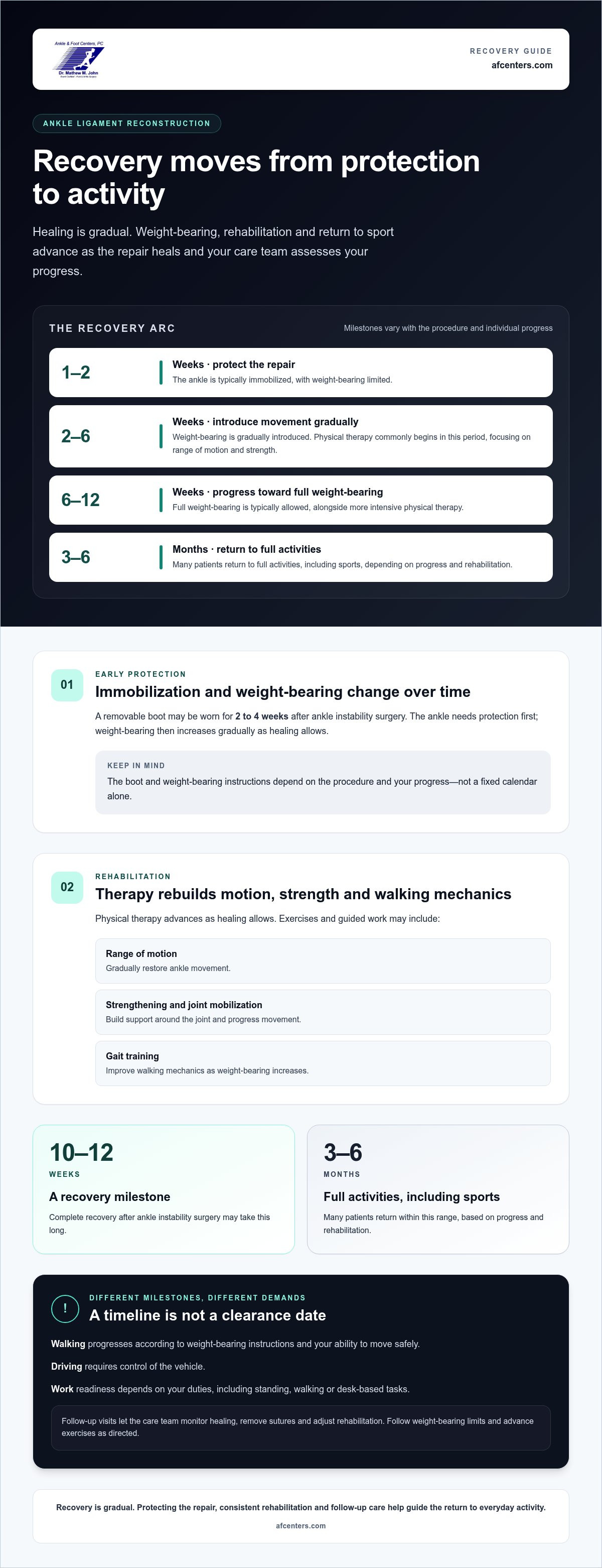
Recovery is a gradual return to stability, not a single milestone. In ankle reconstruction recovery in Marietta, the ankle is typically immobilized and weight-bearing is limited for the first 1-2 weeks, then weight-bearing is gradually introduced during weeks 2-6. Returning to full activities, including sports, may take 3-6 months as healing and rehabilitation progress.
It’s understandable to want a clear sense of what lies ahead, especially when pain and limited mobility affect everyday routines. Ankle ligament reconstruction repairs or rebuilds support around the joint when instability persists, and recovery depends on protecting the repair while restoring movement and strength. This guide explains what the procedure involves, how immobilization and weight-bearing usually change over time, and how physical therapy and arthroscopy fit into treatment. You’ll also learn how follow-up care supports healing and helps guide a safe return to function.
Key Takeaways
- Learn how ligament repair or reconstruction can address ongoing ankle instability after nonsurgical care hasn’t provided enough relief.
- Understand why protecting the repair comes first, with weight-bearing introduced gradually as healing progresses.
- See how physical therapy can help rebuild strength, restore range of motion, and improve walking mechanics.
- Explore how arthroscopy may be used as part of ankle surgery and why the procedure depends on the injury.
- Recognize the role of follow-up care in monitoring healing and guiding a gradual return to everyday activities.
What is Ankle Ligament Reconstruction?
Ankle reconstruction surgery repairs damaged ligaments or uses tissue to replace a ligament that cannot adequately support the joint. The surgeon may tighten and stitch stretched or partially torn ligaments, or use tendon tissue to reconstruct a weakened ligament. The approach depends on the injury and the ankle’s stability.
Ankle ligaments connect bones and help stabilize the joint when you walk, turn, or change direction. A sudden twist can stretch a ligament beyond its limit, causing a partial or complete tear. After a sprain, the ankle may feel unreliable when you pivot or walk on uneven ground. Poor healing or incomplete rehabilitation can leave instability that continues to affect daily activities.
Symptoms may include pain, swelling, bruising, stiffness, and difficulty walking. Some sprains also cause tenderness or numbness in the toes. Persistent discomfort or trouble bearing weight calls for medical evaluation, since fractures can cause similar symptoms. A medical history and physical examination help assess the injury; an X-ray may also be ordered.
Surgery is not commonly recommended for an ankle sprain. Initial care may include rest, ice, compression, limited weight-bearing, bracing, and physical therapy. Reconstruction may be considered if substantial instability remains despite nonsurgical care and rehabilitation. The aim is to improve joint support, not to operate on every painful sprain.
In many cases of ankle instability, anatomic repair is preferred. This approach restores the ligament’s original position and tension. For stretched or partially torn ligaments, a Broström procedure tightens and repairs the ligament with stitches or sutures. If the ligament is too weakened for direct repair, a tendon section from the foot and ankle may be used to reconstruct it. The U.S. Environmental Protection Agency describes Hemi-Castaing ligamentoplasty as using the peroneus brevis tendon as a dynamic ankle stabilizer.
What does ankle reconstruction surgery involve? The surgeon repairs or rebuilds ligament support to improve joint stability, using stitches or tendon tissue depending on the damage. The specific technique depends on the ligament’s condition and the degree of instability.
Does insurance cover ankle reconstruction surgery in Georgia? Coverage depends on your health plan and its criteria for medically necessary care. Plan rules may also address authorization and network participation, so coverage decisions are specific to each policy.
Knowing what the repair involves can help set recovery expectations. Reconstructed tissue needs protection before the ankle can safely rebuild strength and movement. The repair, joint stability, and condition of surrounding tissue shape the next steps. An evaluation can help distinguish ligament instability from other sources of ankle pain and inform a discussion of treatment.
Physical therapy and recurrence prevention
Rehabilitation rebuilds ankle motion and strength after surgery while protecting healing tissue. Its pace depends on the procedure and your progress, not a fixed calendar alone.
Physical Therapy After Surgery
Physical therapy uses guided movement and strengthening to restore ankle function after surgery. After ankle instability surgery, a removable boot may be worn for 2 to 4 weeks. Therapy commonly begins during weeks 2-6, focusing on range of motion and strength. The boot supports the ankle during this transition, while the therapy plan advances as healing allows.
A physical examination and MRI can help assess ligament damage and whether conservative treatment remains appropriate. The findings also inform rehabilitation after a sprain or reconstruction. Follow-up visits allow the care team to monitor healing, remove sutures, and adjust the rehabilitation program. Progress may include gradually moving the ankle more freely.
Returning to Activity
Therapy prepares you to return to daily movement by improving strength, joint motion, and walking mechanics. Exercises may include strengthening, joint mobilization, and gait training. Full weight-bearing is typically allowed 6-12 weeks after reconstruction, alongside more intensive physical therapy. That milestone supports a gradual increase in walking, but it doesn’t automatically mean every activity is ready to resume.
There is no single date for walking, driving, or returning to work. Walking progresses according to weight-bearing instructions and your ability to move safely. Driving requires control of the vehicle, while work readiness depends on your duties, such as prolonged standing, walking, or desk-based tasks. Discuss these demands at follow-up so your rehabilitation plan reflects your routine rather than a set date.
Recovery and Recurrence Prevention
Complete recovery after ankle instability surgery may take 10 to 12 weeks. Most patients return to full activities, including sports, within 3-6 months, depending on progress and adherence to rehabilitation protocols. These timelines describe different milestones: completing recovery and regaining readiness for more demanding activities. The procedure and your progress shape how quickly each step can advance.
Consistent rehabilitation helps address weakness and limited motion that can affect ankle control. Gait training focuses on walking mechanics, while strengthening exercises build support around the joint. Returning to activity too quickly can get ahead of this progress. Follow weight-bearing limits and advance exercises as directed; follow-up visits help track healing and adjust the plan.
For guidance on foot and ankle care, consider how an evaluation can clarify the injury and next steps.
Physical therapy after ankle instability surgery is used to strengthen the joint and improve range of motion, and it is commonly prescribed during ankle surgery recovery. For ankle ligament injury rehabilitation, exercises can include strengthening, mobilization, and gait training to support joint control as activity increases.
Depending on healing and weight-bearing needs, a fracture boot, splint, cast, crutches, scooter, or wheelchair may help keep weight off the affected leg. A physical examination and imaging, such as an MRI, can help guide care after an ankle sprain.
Postoperative immobilization and weight-bearing
The usual timeline moves from immobilization to gradual loading, then fuller weight-bearing. During weeks 1-2, the ankle is immobilized and weight-bearing is limited; during weeks 2-6, weight-bearing is gradually introduced with a boot or brace.
Mobility Aids and Weight-Bearing
Mobility aids help you move while limiting pressure on the operated ankle. A cast or splint may protect the joint, while crutches, a scooter, or a wheelchair can help keep weight off the leg. The right aid depends on your surgical restrictions and how safely you can move while following them.
In the first few weeks, avoid putting weight on the reconstructed ankle if your instructions require it. Crutches can support short transfers, while a wheelchair or scooter may help cover longer distances without loading the joint. During weeks 2-6, a walking boot or brace may remain part of the plan as weight-bearing increases gradually.
Full weight-bearing is typically allowed 6-12 weeks after reconstruction, alongside more intensive physical therapy. This is a general recovery phase, not permission to skip the steps before it. Follow the specific progression given for your surgery, since the repair needs protection as activity increases.
Restrictions and Wound Care
Weight-bearing limits and wound care help protect the repair while the incision heals. Follow your podiatrist’s directions on when to put weight on the ankle, how to care for the wound, and when to attend follow-up visits. Increased activity should align with healing and your prescribed rehabilitation plan.
Keep the sequence clear: use the recommended cast, splint, boot, or brace; rely on the assigned mobility aid; and increase weight only as directed. For example, if your plan limits weight during the initial 1-2 weeks, don’t treat reduced pain as a signal to walk without support. The restriction protects the reconstructed tissue while early healing progresses.
Follow-up visits after reconstruction let the care team monitor healing, remove sutures, and adjust rehabilitation as needed. Bring questions about wound care or changes in permitted activity to these visits. New instructions may affect how you use a boot or mobility aid, so follow the current plan rather than relying on an earlier milestone.
Conservative treatment is generally considered before surgery for ankle ligament problems. If instability persists and surgery is chosen, immobilization and controlled weight-bearing help protect the repair. Keeping activity limits and wound-care instructions in mind can clarify why mobility returns in stages.
Ankle reconstruction and arthroscopy
Ankle reconstruction and arthroscopy are different surgical terms that may relate to ankle sprains and ongoing instability. Reconstruction repairs or rebuilds ligament support. Arthroscopy describes a surgical approach that may be used to treat the ankle. The procedure depends on the injury, ligament condition, and degree of instability.
During ankle ligament reconstruction, stretched or torn ligaments may be shortened and stitched to restore support. The procedure may be performed arthroscopically under general anesthesia. Whether this approach is appropriate depends on the damaged tissue and the repair needed. The goal is to address ligament-related instability, not to operate on every sprain.
Ankle instability surgery may be considered when instability persists and nonsurgical treatment has not helped enough. Assessment includes your injury history and a physical examination; an X-ray may also be ordered. These steps help distinguish ligament damage from other problems, including a fracture. The cause and extent of symptoms guide whether surgery is appropriate.
Arthroscopy and reconstruction do not mean the same thing. Arthroscopy is an approach a surgeon may use to work on the ligaments, while reconstruction means repairing or replacing ligament support. Stretched ligament tissue may be tightened and stitched; a weakened ligament may need tendon tissue to help rebuild stability.
Swelling and pain can follow an ankle injury, but they do not show that reconstruction is needed. Depending on its location and displacement, a fracture may require surgery to realign the bone. That differs from ligament reconstruction, which addresses joint support. Identifying whether the problem involves ligament tissue, bone, or both helps guide the treatment plan.
Recovery depends partly on the procedure performed. Ankle surgery may require at least 6-8 weeks of healing, depending on the operation. More complex foot and ankle surgeries may involve several weeks of healing and rehabilitation. Those periods describe healing needs, not an automatic return to every activity; rehabilitation progresses according to the operation and recovery.
Every surgical approach carries risks. Reported complications of ankle ligament reconstruction include infection, nerve damage, joint stiffness, and recurrent instability. These risks are part of weighing surgery against continued nonsurgical care. Discussing the injury, planned repair, and rehabilitation needs helps clarify what the procedure is intended to address.
After surgery, follow-up visits help monitor healing and adjust rehabilitation. The repair method affects how the ankle is protected and moved during recovery, so instructions should match the operation. Ligament repair and bone realignment address different injuries and may require different plans. Understanding the distinction can help you connect the surgical goal with the next steps in healing.
Pain relief and restoration of function
Pain relief after ankle ligament reconstruction develops alongside healing and restored joint control. Surgery aims to address instability that interferes with walking, turning, or bearing weight. Early recovery focuses on protecting the repair and managing swelling; later progress focuses on moving the ankle and resuming daily activities. Less pain alone does not mean the ligament is ready for every demand.
During early recovery, keeping the leg elevated and applying ice may help reduce swelling. For ligament injuries, RICE means rest, ice, compression, and elevation. These measures support rest and help manage pain and swelling. Follow postoperative instructions for wound care and activity, since recovery also requires protecting the repair.
Medication may also be part of pain management. Nonsteroidal anti-inflammatory drugs may be recommended for pain and inflammation from ankle ligament injuries. Use medication as directed for your care, and do not let symptom relief prompt you to increase activity or bear weight sooner than your postoperative plan allows.
Track progress through practical tasks: walking on a level surface, standing for routine activities, and turning without the ankle giving way. Physical therapy can help rebuild strength and movement, while gait training addresses foot placement and weight shifting. These activities connect pain management with the control needed for everyday mobility.
Severe or persistent symptoms need to be considered in context. Pain, swelling, bruising, stiffness, and difficulty walking can follow ligament injuries, but similar symptoms may occur with a fracture. Assessment considers your injury history and examination, with imaging such as an X-ray when appropriate. Identifying the cause matters because ligament instability and bone injury involve different treatment decisions.
Returning to activity is a gradual progression, not a test of how much discomfort you can tolerate. Follow weight-bearing limits, then build movement and activity according to your rehabilitation plan. Walking comfortably, for example, does not automatically mean the ankle is ready for a sudden pivot or sports movement. Gradual loading helps strength and control develop together.
During ankle reconstruction recovery in Marietta, notice how symptoms change as daily activity increases. Record whether discomfort occurs while walking, after standing, or with a particular movement. These details help relate symptoms to daily function and guide discussion of the next rehabilitation step. A recovery plan should keep practical activity goals in view.
If ankle pain or instability continues to limit walking, explore reconstructive foot and ankle care as part of a discussion about treatment options.
Ankle & Foot Centers, PC: Reconstructive Foot and Ankle Surgery
Ankle & Foot Centers, PC offers Reconstructive Foot and Ankle Surgery for foot and ankle conditions that may need surgical care. If ankle instability continues to interfere with walking after nonsurgical treatment, an evaluation can help clarify the cause and discuss appropriate options. Dr. Mathew John is a Board Certified Foot Surgeon by the American College of Foot and Ankle Surgery.
Bring details about previous sprains, symptoms during daily activities, and any imaging or treatment you have received. This information helps guide discussion of ankle stability, possible procedures, and recovery expectations. Surgery is not the first step for every sprain, but persistent instability deserves careful assessment.
Contact Ankle & Foot Centers, PC to discuss your ankle concerns and possible next steps.
Take the Next Step Toward Steadier Movement
Healing is about more than waiting for discomfort to fade. It also means understanding what your ankle needs and working toward the activities that matter to you. If ongoing instability or pain affects your confidence with everyday movement, an individual assessment can clarify the issue and guide a discussion of care.
Ankle & Foot Centers, PC provides Reconstructive Foot and Ankle Surgery, as well as care for bunions and hammertoes. If you are considering ankle reconstruction recovery in Marietta, bring questions about the procedure, healing, and returning to your routine. A clear discussion can help you understand your options and next steps.
Contact Ankle & Foot Centers, PC to discuss your foot or ankle concerns. Move forward at a pace that supports lasting function and confidence.
Ankle & Foot Centers, PC and Ankle Reconstruction Recovery in Marietta
Ankle & Foot Centers, PC offers Reconstructive Foot and Ankle Surgery for people considering ankle reconstruction or seeking guidance about recovery. An evaluation can help you discuss your foot and ankle concerns and relevant care options.
Ankle & Foot Centers, PC also treats sports injuries, flat feet, and heel pain, and offers custom orthotics.
Frequently Asked Questions
How long does physical therapy take after ankle reconstruction?
Physical therapy is part of recovery, and its duration depends on healing, mobility, strength, and progress toward daily activities. Rehabilitation may move from basic ankle control to more demanding tasks, such as walking on uneven ground or sports movements. Tell your therapist which activities you hope to resume so the program can address those goals as recovery advances.
What complications and risks can occur after ankle reconstruction?
Possible complications include infection, nerve damage, ankle joint stiffness, and recurrent instability. Stiffness may limit motion, while recurrent instability can leave the ankle feeling unreliable. Discuss your health history and concerns before surgery, and attend follow-up visits so healing and function can be assessed. Contact your care team about symptoms or changes that concern you.
Which orthopedic surgeons in Marietta perform ankle reconstruction?
Ankle & Foot Centers, PC provides reconstructive foot and ankle surgery in Marietta through Dr. Mathew John, a Board Certified Foot Surgeon by the American College of Foot and Ankle Surgery. The practice serves patients in the surrounding area, including Roswell, Woodstock, Kennesaw, Atlanta, and Sandy Springs. Ask about an evaluation if persistent ankle instability is limiting your activities.


