
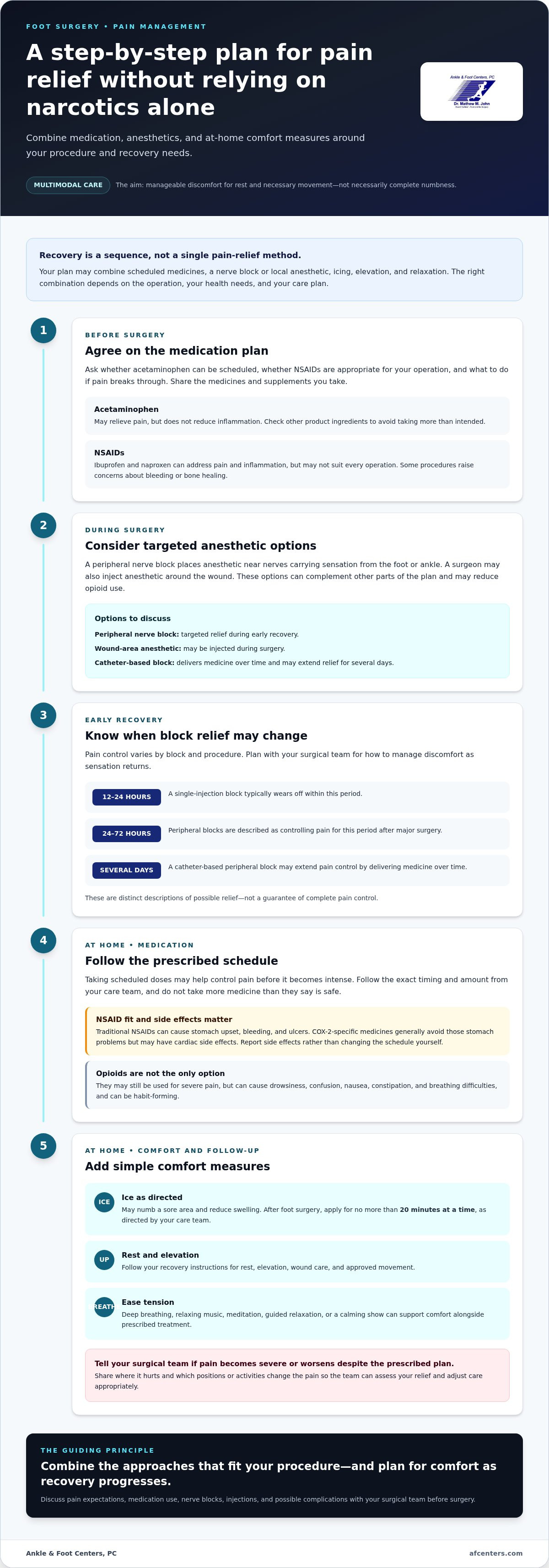
Pain relief after foot surgery doesn’t have to rely on narcotics alone. Managing pain after foot surgery without narcotics often involves multimodal pain management, combining options such as medication, nerve blocks, local anesthetics, icing, elevation, and relaxation. The goal is to keep discomfort manageable enough for rest and gentle movement, not to eliminate every sensation.
It’s understandable to want a clear recovery plan, especially when weighing pain relief against medication side effects. Non-narcotic approaches can work together, with the right combination shaped by your procedure, health needs, and care plan.
Here, you’ll learn how scheduled medications, nerve blocks, and anesthetics may help, and how icing, elevation, and calming techniques can complement them. Discussing pain expectations and medication use with your surgical team before the procedure can also help you prepare for recovery.
Key Takeaways
- Multimodal pain care combines different approaches, so you can discuss a plan that fits your procedure and recovery needs.
- A single-injection nerve block typically wears off within 12 to 24 hours, while a catheter-based block can extend relief for several days.
- Acetaminophen and NSAIDs may be scheduled to help keep pain manageable, but NSAIDs aren’t suitable after every surgery.
- Use ice and elevation as your care team advises, and try breathing exercises or calming distractions to support comfort.
- Learn how local and regional anesthetics can complement other pain-relief methods after foot surgery.
Are nerve blocks better than opioids for post-surgical pain?
No single method suits every foot surgery or recovery. Nerve blocks can target pain signals and reduce discomfort without relying solely on opioids. Opioids may still be used for severe pain, but they can cause drowsiness, confusion, nausea, constipation, and breathing difficulties. They can also be habit-forming. The goal is manageable discomfort that allows rest and necessary movement, not necessarily complete numbness.
In the United States, costs vary according to the treatment, where it’s provided, and your insurance benefits. Coverage depends on your health plan, and deductibles and copays can affect your share. The specific approach, such as medication alone or a procedure involving anesthesia, also affects overall cost.
Common non-opioid medicines include acetaminophen and nonsteroidal anti-inflammatory drugs (NSAIDs), such as ibuprofen and naproxen sodium. Acetaminophen may help with pain, while inflammation may require a different approach. NSAIDs can address pain and inflammation, but aren’t appropriate after every operation. A surgeon may also include a local anesthetic or gabapentinoid in a multimodal plan. Follow your prescribed schedule, and don’t take more medicine than your care team says is safe.
Peripheral nerve blocks deliver anesthetic near nerves that carry sensation from the foot or ankle. They can provide targeted pain relief during the early recovery period. After major surgery, peripheral blocks are described as controlling pain for 24 to 72 hours. A single-injection block typically wears off within 12 to 24 hours, so ask how pain control will continue as sensation returns. A block can ease the transition from the operating room, but it doesn’t guarantee complete relief or replace every other part of the plan.
For longer-lasting relief, a catheter-based peripheral nerve block can deliver medicine over time and may extend pain control for several days. A surgeon may also inject anesthetic around the wound during surgery. These approaches can reduce opioid use, but the right choice depends on the operation, expected pain, and your health. Discuss blocks, injections, and possible complications before surgery so you know what to expect as the anesthetic wears off.
At home, follow the recovery instructions for rest, icing, elevation, wound care, and approved movement. Ice can numb a sore area and reduce swelling; after foot surgery, apply it for no more than 20 minutes at a time, as directed by your care team. Deep breathing, relaxing music, or a calming show can help you manage tension alongside medication. Tell your surgical team if pain becomes severe or worsens despite the prescribed plan. Share where it hurts and which positions or activities change the pain, so the team can assess your pain relief and adjust care appropriately.
Scheduled acetaminophen and NSAIDs for postsurgical pain
A scheduled medication plan uses doses at set times to help control pain before it becomes intense. Before surgery, ask which medicines suit your procedure, whether NSAIDs are appropriate, and what to do if pain breaks through.
NSAIDs for Inflammation-Related Pain
Nonsteroidal anti-inflammatory drugs, or NSAIDs, reduce inflammation as well as pain. That can matter after foot surgery, where inflammation contributes to soreness and discomfort during recovery. Ibuprofen and naproxen are common examples, and a surgeon may include an NSAID with acetaminophen in a multimodal plan. The combination addresses pain through different pathways, but each medication still needs to fit your surgical and health needs.
NSAID Restrictions After Surgery
NSAID restrictions limit their use when a procedure raises concerns such as bleeding or bone healing. Some foot and ankle surgeries may require avoiding NSAIDs or taking them only as specifically directed. Because the operation can change which pain-control options make sense, ask whether your procedure has an NSAID restriction, when it applies, and which alternative medicine is recommended if NSAIDs aren’t suitable.
NSAID Risks and Side Effects
Traditional NSAIDs, including ibuprofen and naproxen, can cause stomach upset, bleeding, and ulcers. They block both COX-1 and COX-2 enzymes, which helps explain why stomach effects can occur. COX-2-specific medicines generally avoid those stomach problems, but may have cardiac side effects. Your medication history and procedure help shape the plan. Report side effects to your care team rather than changing the schedule yourself.
Acetaminophen relieves pain but doesn’t reduce inflammation, so it serves a different role from an NSAID. A surgeon may recommend taking it on a schedule as part of a combination plan, rather than waiting until discomfort becomes severe. Follow the exact instructions for timing and amount, and check the ingredients before adding over-the-counter products. Some contain acetaminophen alongside other medicines, which can lead to taking more than intended.
Make your preoperative questions specific: “Should I take acetaminophen on a schedule?” “Are NSAIDs safe for this operation, given bone-healing or bleeding concerns?” “What side effects should I report, and what should I do if scheduled medicine doesn’t control pain?” Also mention all medicines and supplements you take. Clear answers help you understand how medication fits with a nerve block and the rest of your recovery plan.
Connect medication planning with the procedure itself by reviewing the foot and ankle care options relevant to your surgical needs.
Distraction and relaxation techniques
After foot surgery, pain can make it harder to rest. Deep breathing, guided relaxation, meditation, music, or a comforting show can give your mind another focus. These approaches don’t replace prescribed treatments, but can support the pain-control plan your surgical team recommends.
Try a simple breathing exercise while resting in a supported position. Breathe in gently, then let your exhale become slow and easy. Repeat at a comfortable pace, focusing on each breath rather than the surgical area. Deep breathing can reduce tension and change how strongly pain feels. Stop if the exercise makes you uncomfortable, and return to normal breathing.
Guided relaxation gives your attention a clear path to follow. For example, listen to a recording that prompts you to relax one area of your body at a time. Keep your operated foot still and follow instructions for your upper body, shoulders, or hands. Meditation can use a similar focus: notice a thought, then gently bring your attention back to your breathing.
Choose a distraction that holds your attention without requiring you to move around. Relaxing music, a familiar movie, or a favorite television show can make rest easier. Before settling down, put the remote, headphones, water, and other essentials within reach. A little preparation helps you stay comfortable without repeatedly getting up or disrupting your recovery routine.
These methods work best as part of a broader plan, not as substitutes for medication or a nerve block. Follow your prescription instructions, including scheduled doses, and use relaxation while resting or waiting for treatment to take effect. Don’t change medication timing because music or breathing seems to help. Discuss persistent or worsening discomfort with your surgical team.
Match your approach to the moment. If worry increases before a dressing change, try slow breathing and calming music. If discomfort distracts you during rest, choose a familiar show and settle into a position allowed by your postoperative instructions. Your surgical team can discuss which treatments fit your procedure and how relaxation can complement blocks and prescribed pain control.
You can also describe pain clearly during follow-up conversations. Rate it from 0 to 10, where 0 means no pain and 10 means the worst pain you can imagine. Add where it hurts and whether breathing, rest, or a position changes it. These details help the care team understand your experience and consider the next step in your recovery.
Elevation and icing after surgery
After foot or ankle surgery, swelling can add pressure and soreness around the operative area. Rest, ice, compression, and elevation can work together to help control swelling and inflammation. Their role depends on your procedure and recovery instructions. Follow your doctor’s directions for positioning, cold therapy, and compression rather than adding a method on your own.
Elevation raises the surgical foot to help limit inflammation. Use the position your care team recommends, and protect the dressing and incision. If your doctor gives specific positioning instructions, follow them during rest rather than improvising with pillows that press against the wound. Elevation can support comfort, but it doesn’t replace prescribed medication or wound care.
Ice can numb a sore area and reduce swelling after surgery. Place it only as directed, and use a barrier or application method approved by your care team. Apply cold for no more than 20 minutes at a time during early recovery. Don’t put ice directly against skin or an incision unless your team specifically instructs you to do so.
Cold therapy needs clear limits. Use heat or cold only as your care team advises, including their instructions for safe application. If the foot is covered with a dressing or you have reduced sensation, ask how to apply ice without disturbing the surgical site. A schedule that works after one foot procedure may not suit another.
Rest supports healing, but follow instructions about approved movement and exercises. Gentle movement can improve circulation and reduce stiffness when allowed. Don’t use movement as a substitute for elevation or change weight-bearing instructions to test whether pain has improved. If activity is part of your plan, your doctor can explain how to coordinate it with rest and medication.
Set up your recovery space before settling down. Keep water, your phone, and prescribed medicines within reach to avoid unnecessary trips. Take pain medication before movement or exercises only if that fits your prescribed schedule. Manageable pain can make it easier to rest and breathe deeply, but worsening discomfort needs your care team’s attention.
Tylenol is a familiar brand of acetaminophen, which can relieve pain but doesn’t reduce inflammation. Use it only as directed in your medication plan, and don’t assume it replaces icing or elevation. These methods address different aspects of postoperative discomfort. Following instructions for ice, rest, and positioning can support recovery while your incision heals.
Local and regional anesthetics
Local and regional anesthesia can reduce pain signals during and after foot surgery. A local anesthetic may be given around the time of surgery to limit discomfort during early recovery. Regional anesthesia numbs a broader area, such as the lower body or a leg. These methods differ in where the medicine is delivered and how much of the body is affected.
For foot procedures, local anesthetics may be injected near the surgical site or incision, placing the medicine close to the tissue where soreness is expected. Anesthetics address pain but don’t reduce inflammatory swelling in the same way as anti-inflammatory medicine. Your pain plan may combine local anesthesia with other approaches, each addressing a different part of postoperative comfort.
Regional anesthesia can be given in the lower body as spinal or epidural anesthesia. A femoral or sciatic block places anesthetic near nerves in the leg. These techniques can limit pain signals traveling from the operated area. The procedure site and expected pain help shape the approach. Your surgical team can explain which areas may become numb and how that could affect early recovery.
An epidural catheter can deliver medication after surgery. It may remain in place for several days to help control postsurgical pain; another approach leaves a catheter in the epidural space for 1 or 2 days after surgery. The medication continues through the catheter rather than relying on a single injection. Ask how the catheter will be managed and what the plan is when it’s removed.
Before surgery, discuss anesthesia alongside other prescribed pain treatments. Ask what area will be numbed, how pain relief will continue as sensation returns, and whom to contact about unexpected changes. Tell your care team about your health conditions, current medicines, and supplements. These details help the team consider the anesthetic approach and factors that may affect your plan.
Local and regional anesthetics are pain-control tools, not a promise of complete numbness or a replacement for incision care. Follow instructions for protecting the operated foot, especially while sensation is reduced. Don’t use heat or cold near a numb area unless your care team directs you to, because altered sensation can make it harder to judge temperature. Report new or worsening concerns to your surgical team.
Include anesthesia in your broader conversation about foot and ankle surgery. A clear plan can connect the anesthetic technique with medication and recovery instructions, so you know what to expect before surgery and as the anesthetic wears off.
Ankle & Foot Centers, PC: Reconstructive Foot and Ankle Surgery
Ankle & Foot Centers, PC provides Reconstructive Foot and Ankle Surgery for people considering surgery for a foot or ankle condition. Discuss expected recovery and pain-control options with your surgeon before the procedure, including how medication and anesthesia may fit your plan. Dr. Mathew John is a Board Certified Foot Surgeon by the American College of Foot and Ankle Surgery. This conversation can help you understand the procedure and prepare questions about pain relief without narcotics.
If foot or ankle symptoms have you considering surgery, contact Ankle & Foot Centers, PC to discuss your care.
Prepare for a more confident recovery
A thoughtful approach to managing pain after foot surgery without narcotics starts with a conversation before your procedure. Bring questions about your operation, concerns about medication, and any previous experiences that may shape your preferences. Clear communication helps you understand your options and feel better prepared to take an active role in recovery.
If bunion or hammertoe pain has you considering surgery, Ankle & Foot Centers, PC can discuss your concerns and surgical care options. You can also talk through what to expect before and after a procedure, making your next steps clearer and more personal.
Contact Ankle & Foot Centers, PC to start a conversation about your foot and ankle care. Each informed step can help you move toward recovery with greater confidence.
Ankle & Foot Centers, PC: Support for Foot and Ankle Care
Ankle & Foot Centers, PC provides reconstructive foot and ankle surgery and care for conditions such as bunions, hammertoes, heel pain, plantar fasciitis, and sports injuries. If you are planning foot surgery or have questions about managing pain afterward without narcotics, contact the practice to discuss your foot and ankle care.
The practice also offers custom orthotics, MLS Laser Therapy, and Extracorporeal Shockwave Therapy (ESWT), along with care for diabetic foot problems, neuromas, warts, fungal toenails, and ingrown toenails. Contact Ankle & Foot Centers, PC in Marietta to discuss care for a foot or ankle condition and your treatment options.
Frequently Asked Questions
What Is Multimodal Pain Management?
Multimodal pain management coordinates different parts of care throughout recovery rather than relying on one method in every situation. For managing pain after foot surgery without narcotics, clarify how the plan changes between the immediate postoperative period, rest, and permitted activity. Ask whom to contact if the plan isn’t working and how to describe your pain clearly. Keeping the instructions together can make them easier to follow.
Why Reduce Opioid Use After Surgery?
Reducing opioid exposure can also help lower practical risks at home. If an opioid is prescribed, avoid alcohol while taking it, store the medicine securely, and follow directions for unused doses. A pharmacy take-back program is an appropriate disposal option when available. These steps matter even when medicine is prescribed for short-term postsurgical pain, because others in the household could access medicine left unsecured.
How can I control pain at home?
Use your discharge instructions to guide routine decisions, including dressing care and which exercises are allowed. Don’t remove or adjust a dressing to inspect the incision unless instructed. Keep a written record of medicine times and questions, so you can discuss them at follow-up. If someone is helping you at home, share the instructions so you both follow the same plan.
How long does TENS therapy take to work after surgery?
TENS may provide relief soon after its electrode pads are applied. That describes when some people may notice an effect, not how long relief lasts or whether TENS suits every recovery. Ask your care team to demonstrate safe pad placement and explain how to use the device around your surgical dressing. Don’t place pads over an open incision or near a pacemaker.
What is the best pain medication for after surgery?
No single medicine is best for every person or procedure. Before surgery, provide a complete list of medicines, herbs, and supplements you’ve taken during the month beforehand. These can affect medication planning or interact with pain medicines. Ask which prescribed products contain the same active ingredient, and what to do if you miss a scheduled dose. That discussion can help prevent accidental duplication at home.
When should I see my healthcare provider?
Contact your surgical team about new concerns such as incision drainage, increasing warmth or redness, or calf pain and swelling. Also report a fever over 101°F that doesn’t improve after fever-reducing medicine, or new numbness or tingling. These details help the team assess what’s happening after surgery. Keep the postoperative contact instructions where you can find them, rather than waiting for a routine appointment.
Which non-opioid option should you choose?
The best fit depends on your procedure, health history, and when pain occurs during recovery. Discuss how the options match your priorities, such as avoiding particular side effects or following instructions while resting. Mention any personal or biological family history of substance use disorder. For managing pain after foot surgery without narcotics, discussing the plan before the operation helps you understand the intended role of each option.
Are NSAIDs such as ibuprofen or naproxen safe after foot surgery, and do they affect bone healing?
NSAID use after foot surgery depends partly on the procedure and its healing considerations. Ask whether your operation has a restriction, how long it applies, and what to use instead if ibuprofen or naproxen isn’t part of your plan. Clarify whether medicines you already take affect the recommendation. Don’t restart an NSAID based only on instructions from an earlier procedure.


