

Did you know that up to 40% of people who suffer an ankle sprain still experience persistent symptoms like pain or swelling a full year after their injury? If you feel like your ankle sprain not healing is holding you back from your favorite sports or even a simple walk, you aren't alone. It is exhausting to deal with that nagging fear of your ankle "giving way" every time you try to be active, especially when you've diligently followed the standard advice of rest and ice without seeing real results.
You deserve a recovery plan that moves as fast as you do. You'll discover exactly why your injury has stalled and how advanced, non-surgical treatments can finally return you to a pain-free lifestyle. We'll explore the common underlying issues that simple rest can't fix and how Dr. Mathew John, a Board Certified Foot Surgeon by the American College of Foot and Ankle Surgery, uses high-level tools like 3-D impressions and MLS Laser Therapy to restore your vitality. Our team at 2790 Sandy Plains Road on the corner of Post Oak Tritt and Sandy Plains is ready to be your partner in this journey toward long-term health.
Key Takeaways
- Identify when an ankle sprain not healing past the six-week mark signals a deeper issue like Chronic Ankle Instability or scar tissue buildup.
- Gain clarity on how specialized physical stress tests and advanced imaging uncover the soft tissue damage that standard rest and ice often miss.
- Discover how non-surgical treatments like MLS Laser Therapy and ESWT can restart your recovery by reducing inflammation and stimulating blood flow.
- Learn why the expertise of Dr. Mathew John, a Board Certified Foot Surgeon by the American College of Foot and Ankle Surgery, is essential for a safe return to sports.
- Find out how to access world-class podiatric care right in your community at our office on the corner of Post Oak Tritt and Sandy Plains.
Why Won’t My Ankle Sprain Heal? Understanding the Normal Timeline
Most people expect a minor twist to resolve within a few days of rest. If you have been patient for a month and still feel a sharp ache or instability, you are likely dealing with an ankle sprain not healing as it should. A standard recovery follows a predictable path of inflammation, repair, and remodeling. When your progress stalls, it is usually a sign that the body's natural repair process has encountered a significant roadblock that simple home care cannot overcome.
Ligaments are quite different from muscles or bones. They consist of dense connective tissue with a very limited blood supply. While a broken bone has a robust network of vessels to deliver healing nutrients, ligaments have poor vascularity. This biological reality makes them naturally slow to mend. If the initial injury was severe, the lack of blood flow can prevent the tissue from regaining its original strength, leaving you with a recalcitrant injury that feels permanently tender.
The 4-Week Milestone: When "Rest" Isn’t Enough
The RICE method (Rest, Ice, Compression, Elevation) is an excellent tool for the first 48 to 72 hours. It manages initial swelling and protects the joint from further insult. However, if you are still icing your foot every evening after four weeks, you aren't truly treating the injury anymore; you are simply masking the symptoms. Chronic tissue dysfunction occurs when the acute inflammation subsides but the ligament remains stretched or develops restrictive scar tissue. Persistent swelling after a simple walk is a clear signal to visit us at 2790 Sandy Plains Road on the corner of Post Oak Tritt and Sandy Plains for a professional evaluation.
Grading Your Injury: From Mild Stretch to Full Tear
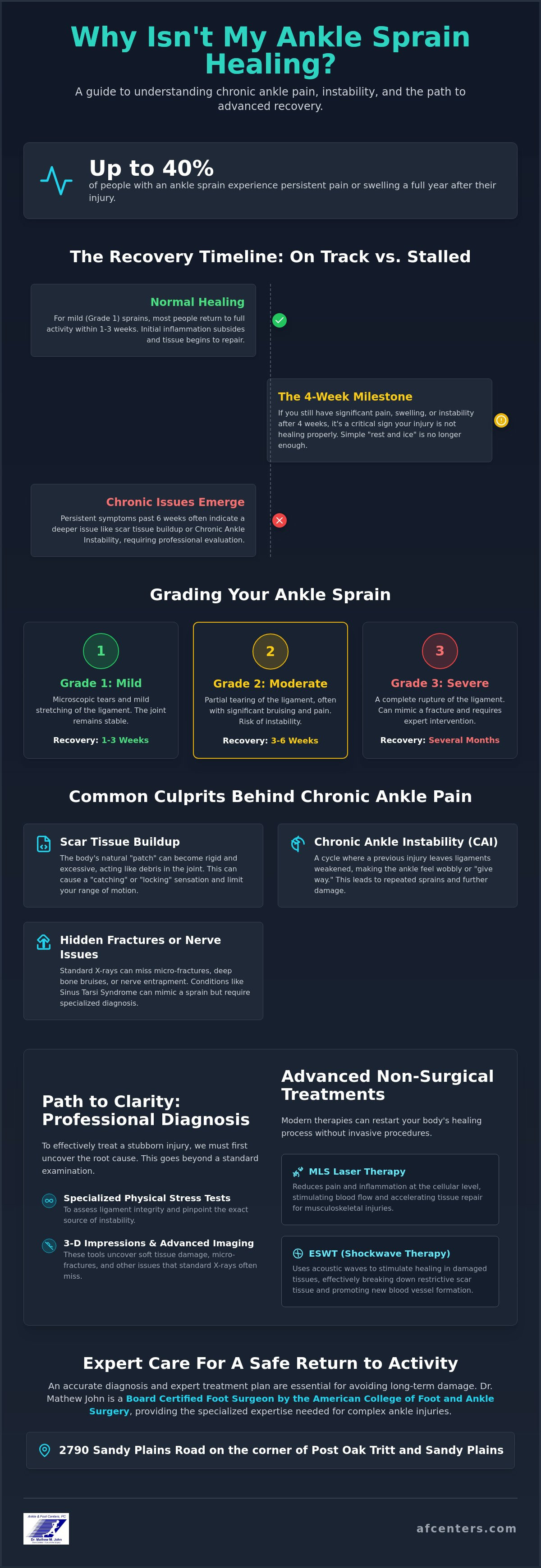
Understanding the severity of your original injury helps set realistic expectations for your journey back to health. We categorize these injuries into three distinct levels:
- Grade 1: These involve microscopic tears and mild stretching. You'll feel some soreness, but the joint remains stable. Most people return to full activity within one to three weeks.
- Grade 2: These are partial tears that often cause significant bruising. These require a focused approach to prevent Chronic Ankle Instability (CAI), a condition where the ankle feels wobbly or "gives way" during normal activity.
- Grade 3: This is a complete rupture of the ligament. These serious injuries often mimic the pain of a fracture and require expert intervention from a specialist like Dr. Mathew John, a Board Certified Foot Surgeon by the American College of Foot and Ankle Surgery.
Watch out for red flags such as a clicking sensation, a feeling that the joint is "locking," or a total inability to put weight on the foot without sharp pain. These symptoms suggest your ankle sprain not healing might actually be a hidden fracture or a cartilage tear that requires our specialized podiatric services to diagnose and treat effectively. Identifying these issues early is the key to avoiding long-term damage and ensuring you can return to your favorite activities with confidence.
Common Culprits Behind Chronic Ankle Pain and Instability
When an ankle sprain not healing persists beyond the expected window, it is rarely just a matter of bad luck. Often, the body has attempted to repair itself but created new obstacles in the process. One of the most frequent barriers is the development of dense scar tissue. While your body uses this tissue as a temporary patch, it can become rigid and excessive. This buildup acts like physical debris inside the joint, causing a "catching" or "locking" sensation and significantly limiting your natural range of motion. If you are frustrated by an ankle sprain not healing, it is time to look deeper into the structural health of your foot.
Other hidden factors might be contributing to your daily discomfort. Standard X-rays are excellent for spotting major breaks, but they often miss micro-fractures or deep bone bruises. These hidden injuries can cause significant, throbbing pain for months. Similarly, nerve entrapment or Sinus Tarsi Syndrome, which is inflammation in the small tunnel between your ankle and heel bone, can create a deep, localized ache. These conditions feel like a standard sprain but require a more sophisticated clinical approach to resolve.
The Cycle of Chronic Ankle Instability
Repeatedly "rolling" your ankle is a hallmark of Chronic Ankle Instability (CAI). This condition occurs when a previous injury has not adequately healed, leaving the ligaments loose and the surrounding muscles weak. Your recovery depends heavily on proprioception, which is your brain's ability to sense where your foot is in space. Without this internal GPS, you are prone to micro-twists that restart the inflammatory cycle. Powering through this pain does not build toughness; it simply erodes the joint surface over time and leads to long-term damage.
Hidden Secondary Injuries
Sometimes the pain isn't coming from the ligament at all. Osteochondral lesions, which are small areas of damage to the talus bone's cartilage, can cause persistent swelling and deep-seated pain that feels impossible to pin down. Additionally, the peroneal tendons running along the outside of your ankle may have sustained small tears or chronic inflammation during the initial twist. Research suggests that approximately 20% of acute sprains develop into chronic instability if they are not managed by an expert like Dr. Mathew John, a Board Certified Foot Surgeon by the American College of Foot and Ankle Surgery.
If you are tired of feeling like your ankle is a weak link in your active lifestyle, exploring our specialized treatment options at 2790 Sandy Plains Road on the corner of Post Oak Tritt and Sandy Plains can provide the clarity you need to move forward with confidence.
Professional Evaluation: How We Diagnose Stubborn Ankle Injuries
If you are struggling with an ankle sprain not healing, the first step toward recovery is moving beyond guesswork. A visual exam can only tell us so much about the internal health of your joint. When you visit us at 2790 Sandy Plains Road on the corner of Post Oak Tritt and Sandy Plains, our goal is to identify the precise mechanical or structural failure holding you back. Dr. Mathew John, a Board Certified Foot Surgeon by the American College of Foot and Ankle Surgery, performs specialized physical stress tests to evaluate ligament laxity. By manually checking the "end-point" of your ligaments, he can determine if the tissue is simply inflamed or if it has lost the tension required to keep you steady on your feet.
We also take a close look at your gait and overall foot structure. Often, an ankle sprain not healing is the result of an underlying biomechanical issue, such as flat feet or high arches, which puts undue stress on the outside of the ankle. By watching how you walk, we can see if your body is overcompensating for the injury. This comprehensive approach ensures we aren't just treating the pain, but also the reason the injury happened in the first place.
Beyond the Standard X-Ray
X-rays are excellent for identifying broken bones, but they are essentially "bone pictures." They don't reveal the frayed tendons, cartilage damage, or fluid buildup that often accompany chronic sprains. If your pain persists, Dr. John may recommend an MRI to get a clear view of the soft tissue landscape. We might also use diagnostic injections to pinpoint the exact source of your discomfort. If a targeted injection provides immediate relief, we've found the culprit. This clarity allows us to move away from general "rest" and toward a treatment plan that actually works.
3-D Impressions for Long-Term Stability
Stability starts from the ground up. To provide your joint with the support it needs, we utilize 3-D impressions to create a highly accurate model of your foot. These 3-D impressions allow us to craft custom-molded orthotics tailored specifically to your anatomy. Unlike generic store-bought inserts, these medical-grade devices correct the specific biomechanical flaws that lead to repeated twists. By stabilizing the subtalar joint and supporting your arch, custom orthotics provide the foundation you need to return to your favorite activities without the constant fear of your ankle giving way. This professional guidance ensures you don't have to navigate your recovery journey alone.
Advanced Non-Surgical Treatments for Faster Healing
Many patients feel trapped in a frustrating middle ground between basic home care and invasive surgery. If you are struggling with an ankle sprain not healing, it's time to explore sophisticated medical technologies that target the root cause of your pain. We don't believe in just "waiting it out." Instead, we use advanced tools to jumpstart your body's natural repair mechanisms, and you can explore Terapia komórkami macierzystymi (Lipogems) to see how regenerative medicine offers a potent alternative to surgery. These treatments focus on restoring function at a cellular level, providing a path forward when traditional methods have failed.
MLS Laser Therapy for Ankle Inflammation
MLS Laser Therapy is a primary tool for managing musculoskeletal pain and inflammation. This system uses specific, synchronized wavelengths of light to penetrate deep into the injured tissue. By stimulating cellular activity, it accelerates the repair process and reduces swelling without the use of medication. The treatment is completely non-invasive and requires no downtime. You can visit us at 2790 Sandy Plains Road on the corner of Post Oak Tritt and Sandy Plains for a session and return to your daily routine immediately after. It's an ideal choice for difficult-to-heal injuries that have resisted traditional rest and elevation.
Shockwave Therapy (ESWT) for Ligament Repair
Extracorporeal Shockwave Therapy (ESWT) is another breakthrough for chronic injuries. This technology uses high-energy acoustic waves to trigger a biological healing response in "stuck" or poorly vascularized ligaments. By increasing blood flow and stimulating metabolic activity, ESWT helps the body finally repair tissue that has remained in a state of chronic dysfunction. Many of our patients find this to be the "game-changer" that ends the cycle of an ankle sprain not healing. You can learn more about our advanced services to see how these technologies work together to restore your vitality.
To ensure long-term success, we pair these treatments with custom-molded orthotics and targeted physical therapy. Using the 3-D impressions we take in the office, we create devices that provide the exact mechanical support your joint requires. This combination of high-tech healing and structural support allows Dr. Mathew John, a Board Certified Foot Surgeon by the American College of Foot and Ankle Surgery, to guide you toward a full, pain-free recovery. Don't let a slow injury dictate your lifestyle; contact us today to start your personalized healing journey with a team that cares about your progress.
Just as finding a specialized podiatrist is key to your mobility, finding a dedicated primary care physician is essential for your broader health needs; for residents in New York City requiring specialized services such as immigration physicals, John Abroon M.D. provides expert, board-certified medical evaluations to help you move forward with your goals.
Expert Ankle Care in Marietta: Meet Dr. Mathew M. John
Finding the right expert is often the turning point for an ankle sprain not healing. Dr. Mathew John brings a unique blend of surgical precision and conservative care to every patient he treats. As a Board Certified Foot Surgeon by the American College of Foot and Ankle Surgery, he has spent years refining his approach to complex sports injuries. Our team at Ankle & Foot Centers, PC, believes that no one should have to accept a "new normal" of pain or instability. We are dedicated to providing the Marietta community with a sophisticated resource where advanced technology meets compassionate, personal guidance. Our philosophy centers on returning you to an active, pain-free lifestyle through a partnership that values your long-term health over short-term fixes.
We understand the frustration that comes with a stalled recovery. When you visit us, you aren't just another appointment on the calendar; you are a neighbor seeking to regain your vitality. Dr. John takes the time to listen to your history and perform the detailed evaluations that other providers might overlook. This thoroughness is why so many patients seek us out for a second opinion when they feel their ankle sprain not healing has been dismissed as "just a slow recovery." By focusing exclusively on podiatric excellence, we provide the clarity you need to stop worrying about your next step and start looking forward to your next adventure.
A Local Hub for Advanced Podiatry
Our facility is conveniently situated at 2790 Sandy Plains Road on the corner of Post Oak Tritt and Sandy Plains. This location serves as a localized hub for residents throughout East Cobb and the greater Atlanta Metro area. By choosing a specialist who focuses exclusively on the intricate structures of the foot and ankle, you ensure that even the most subtle issues are addressed with high-level expertise. Whether you are dealing with a lingering sprain or looking for heel pain relief in Marietta, we provide the expert oversight necessary to get you back on your feet safely and effectively.
Your Path Back to Activity
Chronic pain doesn't have to be a permanent part of your life. Your journey toward recovery starts with a clear diagnosis and moves through a structured plan involving 3-D impressions and advanced therapies like MLS Laser. We focus on results that last, emphasizing progress and functional strength as you regain your mobility. If you are frustrated by an injury that won't quit, we invite you to schedule a consultation today. Our environment is welcoming and non-judgmental, designed to make your path to health as smooth as possible. Take the first step toward a pain-free lifestyle by visiting our services page to book your appointment and join our community of healthy, active individuals.
Take the Next Step Toward Lasting Relief
Living with an ankle sprain not healing can feel like you're constantly waiting for a recovery that never arrives. We've explored how undiagnosed issues like scar tissue or chronic instability can stall your progress and why standard rest isn't always the answer. You now know that advanced diagnostics, such as 3-D impressions, and innovative treatments like MLS Laser Therapy and ESWT offer a clear path back to the activities you love.
You don't have to navigate this journey alone. Dr. Mathew John is a Board Certified Foot Surgeon by the American College of Foot and Ankle Surgery, and he's ready to help you regain your confidence. Our clinic is conveniently located at 2790 Sandy Plains Road on the corner of Post Oak Tritt and Sandy Plains, providing the East Cobb community with expert podiatric care. Schedule your consultation with Dr. Mathew John in Marietta today to start your personalized healing plan. We're excited to help you return to a vibrant, pain-free life.
Frequently Asked Questions
Why does my ankle still hurt 3 months after a sprain?
An ankle still hurting after three months suggests the injury has transitioned into a chronic phase, often due to an ankle sprain not healing properly at the structural level. This delay is frequently caused by excessive scar tissue buildup or undiagnosed ligament laxity that prevents the joint from stabilizing. Without professional intervention to restart the healing process, you may find yourself stuck in a cycle of persistent inflammation and discomfort.
Can an old ankle sprain cause problems years later?
Yes, an old injury that didn't mend correctly can lead to Chronic Ankle Instability (CAI) and even early-onset osteoarthritis years down the road. When ligaments remain loose, the joint experiences abnormal wear and tear every time you walk. Addressing these lingering issues now with a specialist like Dr. Mathew John, a Board Certified Foot Surgeon by the American College of Foot and Ankle Surgery, can help preserve your joint health and keep you active for decades to come.
What is the best way to strengthen a weak ankle after a sprain?
The most effective approach involves a combination of strength training and proprioception, which is your brain's ability to sense your ankle's position. Exercises like single-leg balances and resistance band work help retrain the muscles to support the joint. We often pair these exercises with custom orthotics made from 3-D impressions to provide a stable foundation while you rebuild your natural strength at our office on the corner of Post Oak Tritt and Sandy Plains.
Is surgery always necessary for a non-healing ankle sprain?
Surgery is rarely the first option for a stalled recovery, as many patients find success with advanced non-surgical treatments. Options like MLS Laser Therapy or Extracorporeal Shockwave Therapy (ESWT) are designed to reduce inflammation and trigger the body's natural repair mechanisms. Surgery is typically reserved for severe ruptures or cases where conservative methods haven't provided the necessary stability to return to your daily activities.
How does MLS Laser Therapy help with ankle pain?
MLS Laser Therapy uses specific wavelengths of light to penetrate deep into the musculoskeletal tissues to reduce pain and inflammation at the source. This non-invasive treatment works at a cellular level to increase blood flow and accelerate tissue repair. It's an excellent option for those frustrated by an ankle sprain not healing, as it provides rapid relief without the need for medication or recovery downtime.
What is the difference between an ankle sprain and a fracture?
A sprain is an injury to the ligaments that connect bones, while a fracture is a break in the bone itself. While both cause pain and swelling, a fracture often involves intense, localized tenderness directly on the bone and an immediate inability to bear weight. Because the symptoms can overlap, we use advanced diagnostic tools at 2790 Sandy Plains Road to provide a clear and accurate diagnosis.
When should I see a podiatrist for a twisted ankle?
You should schedule an evaluation if you experience severe swelling, bruising, or an inability to walk immediately after the injury. It is also vital to see a specialist if your pain hasn't significantly improved after two weeks of home care. Early intervention by a Board Certified Foot Surgeon ensures your ligaments heal correctly and prevents the development of long-term instability that can limit your future mobility.
Does insurance cover custom orthotics for ankle instability?
Coverage for custom orthotics varies significantly depending on your specific insurance provider and your individual plan details. Many plans do provide benefits for these devices when they are medically necessary to treat chronic instability or biomechanical issues. Our team can help you navigate your benefits after we take 3-D impressions of your feet to ensure you receive the highest quality of specialized support.


