

You are mid-stride on a morning run through East Cobb when your ankle suddenly rolls, followed by a sharp pain and the immediate worry that you've done real damage. In that moment, it's hard to tell if you've suffered a minor twist or a serious tear that might lead to permanent instability. It's a stressful experience that leaves you wondering how long you'll be sidelined from work or the sports you love.
We understand that you want more than just an ice pack; you want professional confirmation and a clear path to healing. Finding effective ankle sprain treatment Marietta residents can trust is the first step toward reclaiming your mobility. You deserve a recovery plan that prioritizes both speed and long-term strength so you don't have to worry about re-injury down the road.
In this article, you'll discover how Dr. Mathew John, a Board Certified Foot Surgeon by the American College of Foot and Ankle Surgery, provides advanced care at our office located at 2790 Sandy Plains Road on the corner of Post Oak Tritt and Sandy Plains. We'll look at how we use MLS Laser Therapy to reduce inflammation and 3-D impressions to create custom orthotics, ensuring you have a steady hand guiding you back to peak performance.
Key Takeaways
- Identify the grade of your injury to understand if you are dealing with microscopic ligament stretching or a more complex tear.
- Follow a structured RICE protocol during the first 72 hours to ensure your ankle sprain treatment Marietta starts with controlled inflammation.
- Accelerate your recovery with MLS Laser Therapy, a non-invasive technology that targets musculoskeletal pain and promotes faster tissue healing.
- Prevent long-term joint weakness and chronic instability through custom-molded orthotics designed from precise 3-D impressions.
- Benefit from a clear recovery roadmap provided by Dr. Mathew John, a Board Certified Foot Surgeon by the American College of Foot and Ankle Surgery.
Understanding Your Ankle Sprain: Grades and Severity
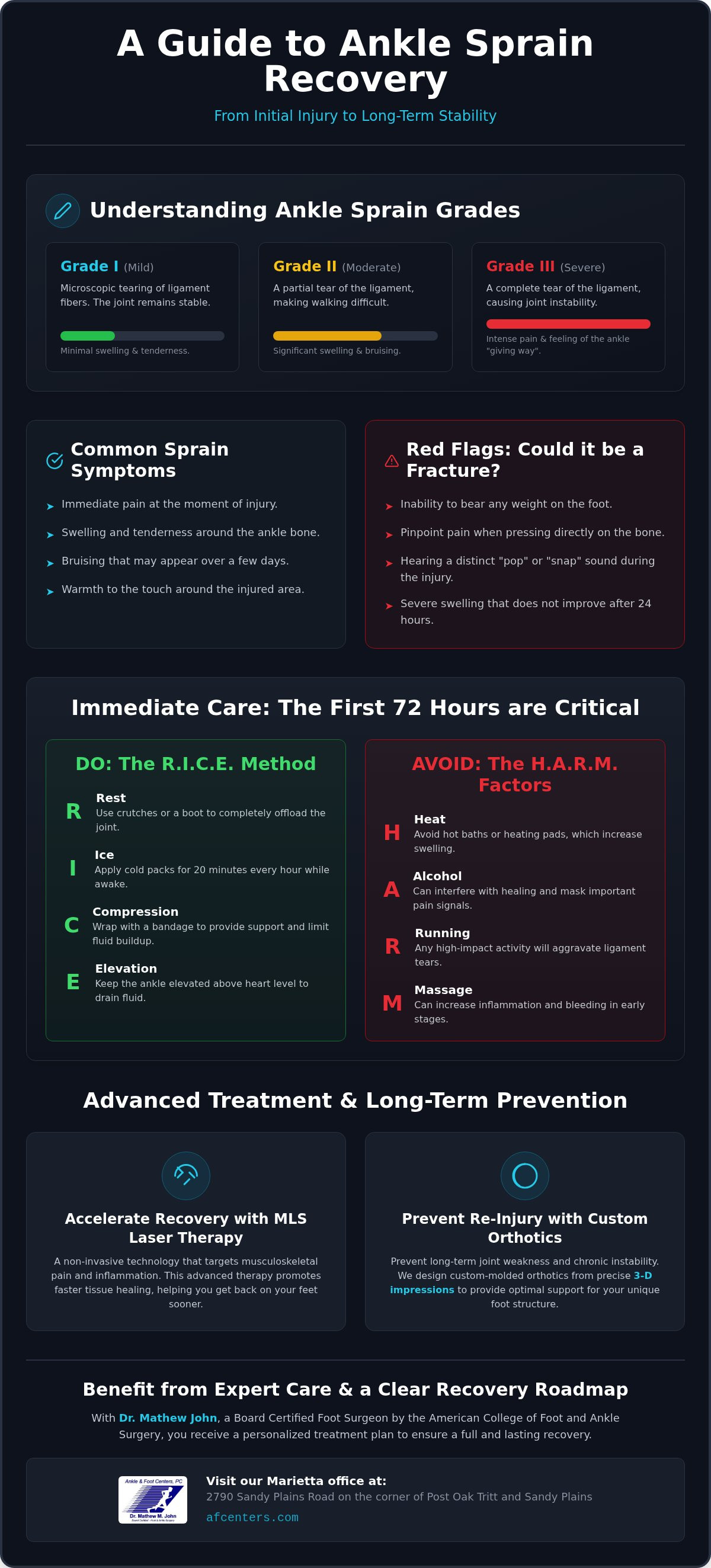
An ankle sprain happens when the ligaments that support your joint are stretched beyond their natural limits. These tough bands of tissue are designed to keep your bones in place, but a sudden roll or twist can cause them to fray or tear. Dr. Mathew John, a Board Certified Foot Surgeon by the American College of Foot and Ankle Surgery, emphasizes that knowing the extent of this damage is the first step toward a successful recovery. To help you understand your injury, medical professionals categorize sprains into three distinct grades.
- Grade I (Mild): This involves microscopic tearing of the ligament fibers. You'll likely experience minimal swelling and tenderness, but the joint remains stable.
- Grade II (Moderate): This is a partial tear of the ligament. You'll notice more significant swelling, bruising, and a moderate level of pain that makes walking difficult.
- Grade III (Severe): This is a complete tear of the ligament. It often results in intense pain, severe swelling, and a feeling that the ankle is "giving way" or unstable.
Identifying the grade of your injury early is vital for effective ankle sprain treatment Marietta residents can rely on. Without a proper assessment, you might return to activity too soon, which increases the risk of long term joint issues.
Common Symptoms of a Sprained Ankle
You'll usually feel immediate pain the moment the injury occurs. This is often followed by swelling and tenderness around the malleolus, which is the bony bump on the side of your ankle. Bruising is also common; it may not appear right away and can often spread down toward your foot or toes over the next few days. If the area is tender to the touch or feels warm, your body is already starting the inflammatory response to begin healing.
Sprain vs. Fracture: How to Tell the Difference
One of the most common questions we hear is whether the bone is actually broken. While a severe sprain can feel just as painful as a break, there are a few clues to watch for. An inability to bear any weight on the foot often signals a fracture rather than a simple sprain. You should also look for pinpoint bone pain; if it hurts specifically when you press on the bone itself, it's a red flag. Soft tissue soreness from a sprain tends to be more generalized around the joint.
Because the symptoms overlap so much, professional imaging at our clinic is essential for an accurate diagnosis. We provide comprehensive ankle sprain treatment Marietta at 2790 Sandy Plains Road on the corner of Post Oak Tritt and Sandy Plains. Don't leave your mobility to chance; getting a clear picture of your injury ensures you receive the right care from the start.
Immediate Ankle Sprain Treatment in Marietta
The moment you injure your ankle, a biological countdown begins. The first 48 to 72 hours are the most critical window for managing inflammation and preventing secondary tissue damage. While your body's natural response is to rush blood to the site, excessive swelling can actually slow down the healing process. Starting effective ankle sprain treatment Marietta at home immediately can make a significant difference in your total recovery time.
While you focus on recovery, you must also avoid "HARM" factors during these first few days. Heat, such as hot baths or heating pads, can increase blood flow and worsen swelling. Alcohol can interfere with your body's ability to heal and may mask pain, leading you to overexert yourself. Running or any high impact activity will likely aggravate the tear. Finally, avoid deep tissue massage in the early stages, as it can increase internal bleeding and inflammation.
The RICE Method Done Right
Most people have heard of RICE, but many don't apply it strictly enough to see the benefits. Rest means you shouldn't try to "walk it off." Use crutches or a walking boot to completely offload the joint. For icing, apply cold packs for 20 minutes every hour while you're awake to constrict blood vessels and numb pain. Compression is equally vital; wrap the area with an ACE bandage or a compression sleeve to provide external support and limit fluid buildup. Finally, keep your ankle elevated above the level of your heart to let gravity drain excess fluid away from the injury.
When Home Care Is Not Enough
Sometimes, a bag of frozen peas and a bandage aren't enough to solve the problem. If you heard a distinct "pop" or "snap" when the injury happened, it's a sign that a ligament may have completely ruptured. Severe swelling that shows no improvement after 24 hours of RICE is another red flag. In these cases, you need a specialist to ensure there isn't a hidden fracture or a Grade III tear that requires more intensive intervention.
Getting a professional exam early is the best way to avoid chronic instability. Dr. Mathew John, a Board Certified Foot Surgeon by the American College of Foot and Ankle Surgery, can provide a comprehensive evaluation and a tailored plan. You can find our office at 2790 Sandy Plains Road on the corner of Post Oak Tritt and Sandy Plains. For a full list of our specialized podiatric services, feel free to explore how we support your journey back to health and help you find the right ankle sprain treatment Marietta for your specific needs.
Advanced Medical Options: MLS Laser Therapy for Healing
While the RICE method provides a solid foundation for early recovery, modern clinical technology can significantly shorten your time on the sidelines. Dr. Mathew John, a Board Certified Foot Surgeon by the American College of Foot and Ankle Surgery, incorporates MLS Laser Therapy into the comprehensive ankle sprain treatment Marietta patients receive at our office. This non-invasive treatment uses specific wavelengths of light to reach deep into the joint, targeting the source of your discomfort without the need for needles or surgery.
The laser works by stimulating cellular activity at a fundamental level. When ligaments are torn, the surrounding cells often become sluggish or damaged. The light energy helps these cells produce more energy, which speeds up the natural healing process. Most of our patients report a noticeable reduction in pain and swelling after just a few sessions; this makes it an ideal choice for those who need to return to work or sports quickly.
How MLS Laser Therapy Speeds Recovery
Traditional recovery often relies on time alone, but MLS Laser Therapy takes an active role in tissue repair. It increases blood flow directly to the injured ligaments, which ensures that oxygen and essential nutrients reach the damaged area faster. This boost in circulation is vital for repairing the microscopic tears found in Grade I and II sprains.
Another major benefit is the reduction of scar tissue formation. Excessive scar tissue can lead to chronic stiffness and a limited range of motion, which often results in future injuries. By promoting healthy fiber alignment during the healing phase, the laser helps maintain your ankle's natural flexibility. This approach provides a completely drug-free alternative for pain management, allowing you to avoid the potential side effects of long term medications.
What to Expect During a Session
Many patients are surprised by how simple and relaxing the process is. MLS Laser Therapy is a dual-action light therapy that addresses both pain and edema simultaneously. The treatment is entirely painless; you might feel a slight, soothing warmth, but there is no discomfort involved. Each session typically lasts about 10 to 15 minutes, making it easy to fit into a busy schedule.
Because the therapy is non-invasive, there is no downtime required after you leave our clinic at 2790 Sandy Plains Road on the corner of Post Oak Tritt and Sandy Plains. You can continue your daily routine immediately after your appointment. This efficiency, combined with the expertise of a Board Certified Foot Surgeon, ensures your ankle sprain treatment Marietta is as effective and convenient as possible.
Preventing Chronic Instability with 3-D Impressions
A single sprain is painful, but repeated injuries can lead to a frustrating condition known as chronic ankle instability. When your ligaments don't heal with the proper tension, the joint remains loose. This leaves you feeling like your ankle could "give way" during simple tasks or on uneven ground. Over time, this constant micro-trauma causes the cartilage to wear down prematurely, which often results in early-onset arthritis. Preventing this cycle is a core part of the ankle sprain treatment Marietta residents receive at our facility.
Dr. Mathew John, a Board Certified Foot Surgeon by the American College of Foot and Ankle Surgery, focuses on stabilizing the joint's foundation to prevent future issues. This often involves using custom-molded orthotics or specialized braces that provide the exact structural support your ligaments need to stay protected. Proper footwear combined with medical-grade support creates the foundation for long-term ankle health.
The Precision of 3-D Impressions
To create these custom devices, we utilize high-precision 3-D impressions. This technology is far superior to traditional foam boxes because it captures the unique contours and alignment of your foot in a specific, non-weight-bearing position. By getting a perfect map of your foot structure, we can design orthotics that realign the foot and prevent the outward roll that causes most sprains. These devices act as an internal "seatbelt" for your joint, providing essential stability during high-impact activities like running or jumping.
Strengthening and Rehabilitation
Support from the outside is only half the battle; you also need to rebuild the internal "wiring" of your joint. We focus heavily on proprioception exercises. These are specific movements designed to help your brain re-connect with your ankle. This improves your balance and reaction time, allowing your body to self-correct before a roll happens. It's about training your nervous system to protect the joint instinctively.
We also target the peroneal muscles on the outside of your leg. These muscles are your first line of defense against an inversion sprain. Strengthening them creates a natural brace made of muscle and tendon. Dr. Mathew John will work with you to develop a personalized return-to-play plan that ensures you don't rush back to activity too soon. If you're ready to secure your long-term mobility, we invite you to learn more about our advanced ankle sprain treatment Marietta at 2790 Sandy Plains Road on the corner of Post Oak Tritt and Sandy Plains.
Expert Care with Dr. Mathew John in Marietta
Choosing the right professional for your recovery makes all the difference in how quickly you return to your favorite activities. Dr. Mathew John is a Board Certified Foot Surgeon by the American College of Foot and Ankle Surgery; he brings a high level of expertise to every patient he treats. Our practice is built on the belief that you shouldn't have to settle for a "good enough" recovery. We focus on providing a steady hand to guide you toward an active, pain-free lifestyle where you feel confident in every step you take.
We provide a full spectrum of care tailored to the severity of your injury. For some, this means conservative bracing and physical therapy to protect the joint while it heals. For others with Grade III tears or chronic instability, Dr. Mathew John offers reconstructive surgery to restore the structural integrity of the ankle. This comprehensive approach ensures that whether your injury is mild or complex, you have access to the most effective ankle sprain treatment Marietta has to offer.
A Specialized Approach to Foot and Ankle Health
Our clinic is equipped with advanced diagnostic tools available on-site, allowing us to provide immediate results and start your treatment plan without delay. We specialize in complex sports injuries and chronic pain conditions that require more than just standard care. By combining sophisticated technology with a warm, community-focused atmosphere, we help you navigate the path to wellness with confidence and clarity.
Our commitment to advanced technology extends beyond ankle sprain treatment Marietta. For patients struggling with other foot conditions, we offer Swift Treatment for stubborn or recalcitrant plantar warts. This innovative solution utilizes microwave ablation technology to target the source of the wart. The process typically involves four sessions spaced one month apart, and one of the biggest benefits is that there's absolutely no downtime for patients following the procedure. It's just one example of how we use modern medical resources to provide better outcomes for our community.
Visit Our Marietta Office
You can find our office at 2790 Sandy Plains Road on the corner of Post Oak Tritt and Sandy Plains. We're proud to serve as a localized hub for residents in Marietta, Roswell, and Woodstock who are looking for premium podiatric care. Our environment is designed to be welcoming and non-judgmental, ensuring that every person who walks through our doors feels supported in their health journey.
Don't let a lingering injury turn into a permanent problem. Scheduling a consultation today is the best way to ensure your ankle heals correctly and stays strong for years to come. Explore our full range of podiatric services and let us help you reach your personal health goals with the professional guidance you deserve.
Take the Next Step Toward Full Mobility
Recovering from a ligament injury is about more than just managing temporary pain; it's about restoring your confidence and protecting your future strength. By understanding the specific grade of your injury and utilizing advanced tools like MLS Laser Therapy, you can significantly accelerate your body's natural healing process. We prioritize a holistic approach that combines immediate relief with long term prevention through precision 3-D impressions for custom orthotic support.
Finding the right ankle sprain treatment Marietta offers ensures you're supported by the expertise of Dr. Mathew John, a Board Certified Foot Surgeon by the American College of Foot and Ankle Surgery. Our office at 2790 Sandy Plains Road on the corner of Post Oak Tritt and Sandy Plains is ready to help you return to the activities you love. Schedule Your Ankle Evaluation with Dr. Mathew John today to start your personalized recovery journey. We're here to provide the steady hand and professional guidance you need for a strong, lasting recovery.
Frequently Asked Questions
How long does it take for a sprained ankle to heal?
Healing time varies based on the severity of the ligament damage. A mild Grade I sprain might heal in one to three weeks; however, a moderate Grade II injury typically takes three to six weeks of dedicated care. Severe Grade III tears can take several months to fully stabilize. Consistency with your rehabilitation plan is the best way to ensure you return to activity safely without risking a setback.
Can I walk on a sprained ankle if it doesn’t hurt too much?
It's best to avoid bearing weight on the joint during the initial inflammatory phase. Even if you feel you can walk, doing so too early can stretch already weakened ligaments, leading to a higher risk of chronic instability. Seeking professional ankle sprain treatment Marietta ensures you receive a clear timeline for returning to activity. We often recommend using a walking boot or crutches to protect the joint while it begins to mend.
Is MLS Laser Therapy safe for treating an ankle sprain?
Yes, MLS Laser Therapy is a safe and non-invasive option for managing musculoskeletal pain and inflammation. It uses specific wavelengths of light to stimulate cellular repair without any discomfort or side effects. This technology is particularly effective at reducing the swelling associated with ligament tears. Because there is no downtime involved, it's an excellent addition to your recovery plan to help you get back on your feet faster.
Do I need an X-ray for a twisted ankle?
An X-ray is often necessary if you experience pinpoint bone pain or find it impossible to take more than a few steps. Dr. Mathew John, a Board Certified Foot Surgeon by the American College of Foot and Ankle Surgery, uses diagnostic imaging to rule out fractures that mimic sprain symptoms. Getting an accurate diagnosis at our office located at 2790 Sandy Plains Road on the corner of Post Oak Tritt and Sandy Plains ensures you aren't treating a broken bone with simple soft tissue protocols.
What happens if a Grade III ankle sprain is left untreated?
Leaving a Grade III sprain untreated significantly increases your risk for chronic ankle instability and early-onset arthritis. When a ligament is completely torn, it may heal with too much slack, leaving the joint loose and prone to recurring injuries. Professional intervention ensures the ligament heals with the correct tension. This prevents the cycle of micro-trauma that eventually wears down the protective cartilage in your ankle joint.
How do 3-D impressions help with recurring ankle injuries?
We use 3-D impressions to create a perfect map of your foot's unique structure and alignment. Unlike generic inserts, these custom-molded devices provide the specific support needed to prevent the outward roll that causes most sprains. By realigning your foot, orthotics reduce the strain on your ligaments during high-impact activities. This specialized part of ankle sprain treatment Marietta is essential for patients who struggle with weak ankles or frequent rolls.
What is the Swift Treatment for warts mentioned during my visit?
Swift Treatment is an advanced medical solution for stubborn or recalcitrant plantar warts using microwave ablation technology. If we find warts during your visit, this treatment offers a highly effective alternative to traditional freezing or acids. The process typically involves four sessions spaced exactly one month apart. Patients appreciate that there is no downtime after the procedure, allowing you to maintain your active lifestyle while we address the underlying infection.
Will I need surgery for a severe ankle sprain?
Most sprains respond well to conservative care, but surgery is an option for severe cases that don't stabilize. If ligaments are completely ruptured or if you experience persistent instability after months of therapy, reconstructive surgery may be required. Dr. Mathew John, a Board Certified Foot Surgeon by the American College of Foot and Ankle Surgery, will evaluate your joint's mechanical integrity. We always prioritize the least invasive path that leads to a full, pain-free recovery.


