
What if the right bunion surgeon isn’t the one promising the fastest fix, but the one who takes time to understand how your foot affects daily life? If pain, shoe discomfort, or changes in your walking have you wondering whether to seek care, it’s reasonable to want clear answers before considering surgery. Choosing the best bunion surgeon Marietta GA means looking beyond promotional claims and comparing relevant qualifications, the quality of the evaluation, and whether the recommendations fit your needs.
You don’t need to know in advance whether surgery is right for you. A bunion-focused visit can help clarify what may be contributing to your symptoms and whether nonsurgical care or a surgical discussion makes sense. Dr. Mathew John is a Board Certified Foot Surgeon by the American College of Foot and Ankle Surgery, and Ankle & Foot Centers, PC provides bunion care and reconstructive foot and ankle surgery in Marietta.
This guide offers a practical checklist for comparing qualifications, preparing for an evaluation, and asking informed questions about treatment choices and follow-up. Use it to make a considered next step based on your symptoms and goals.
Key Takeaways
- Compare relevant qualifications, the thoroughness of the evaluation, communication, and the treatment plan, not just promotional claims.
- A bunion-focused evaluation can help clarify your symptoms and options. Imaging may be considered when appropriate.
- A bunion doesn’t automatically mean surgery is necessary. Ask why continued nonsurgical care or a surgical discussion is recommended for your situation.
- Use the consultation checklist to ask about credentials, findings, alternatives, and follow-up planning.
- When comparing options for the best bunion surgeon Marietta GA, consider Dr. Mathew John, a Board Certified Foot Surgeon by the American College of Foot and Ankle Surgery.
What to look for in the best bunion surgeon in Marietta, GA
Wondering whether a bunion means surgery is ahead? A practical way to compare care is to look for a surgeon with relevant qualifications who evaluates your foot and symptoms, explains options clearly, and makes recommendations that reflect your goals. The best bunion surgeon Marietta GA for you is not necessarily the one making the boldest promises. It’s the one who helps you understand your choices and make an informed decision.
A bunion, commonly called hallux valgus, is a deformity in which the big toe angles toward the smaller toes and the joint at its base may become prominent. In brief: Hallux valgus is a change in the alignment of the big toe and the joint at its base. A visible bump may be part of the picture, but bunion care involves more than treating general foot pain. You can read an overview of what a bunion is, then discuss how your symptoms and priorities relate to your care with a clinician.
Why bunion-specific evaluation matters
A visible bump or discomfort in certain shoes can prompt you to seek an assessment, but appearance alone doesn’t establish whether surgery is appropriate. The clinician should consider how your foot feels and functions, including whether symptoms affect footwear, walking, or everyday activities. Your goals matter too. Be ready to explain what you want to address, such as difficulty finding comfortable shoes or discomfort during your usual activities. If symptoms are affecting your routine, an evaluation can help you understand the options rather than trying to judge the need for surgery by appearance alone.
What “best” should mean when comparing Marietta surgeons
Look for relevant credentials and a thorough, bunion-focused assessment. You should leave with an explanation of the findings and recommendations you can understand, not pressure or promises of a particular result. Ask whether the clinician treats bunions and performs reconstructive foot and ankle surgery. If you want to verify credentials, ask which organization granted them and check through appropriate professional sources.
Dr. Mathew John of Ankle & Foot Centers, PC is a Board Certified Foot Surgeon by the American College of Foot and Ankle Surgery. The Marietta practice treats bunions and provides reconstructive foot and ankle surgery. You can explore its foot and ankle services as one step in learning about local care.
Practical access matters as well. Consider whether the practice’s location works for you and whether you can comfortably attend appointments and follow-up visits. No single surgeon is the right fit for everyone. A good match combines relevant expertise with communication that helps you understand your choices and take part in decisions about your foot health.
How a Marietta bunion surgeon evaluates your foot and treatment options
A bunion consultation is a chance to understand what may be contributing to your symptoms and discuss possible next steps. It isn’t a commitment to have surgery. The clinician gathers information, examines your foot, and considers how the problem affects your movement and routines before discussing care options.
What may happen during a bunion consultation
Before your visit, note when the discomfort began, what tends to aggravate it, and how it affects walking or activities you value. Mention footwear challenges, care you’ve already tried, and relevant health history. These details help the clinician understand your experience rather than focusing on the visible bump alone.
The clinician will examine your foot and discuss your priorities. Depending on the assessment, they may consider imaging to learn more about the foot’s structure. Imaging isn’t automatically required for everyone; the clinician determines whether it would add useful information. Ask what the examination or any proposed imaging is intended to clarify.
How treatment recommendations should be explained
The recommended plan depends on clinical evaluation, your symptoms, and your individual goals. A consultation helps establish whether continued nonsurgical care or a discussion of surgery is appropriate, but an evaluation by itself doesn’t mean you need to proceed with an operation. Ask the clinician to explain the findings and how they connect to the recommendation.
A clear conversation should make room for alternatives, questions, and your preferences. If surgery is discussed, ask why it may be considered in your case, what other approaches could be appropriate, and what information is still needed before making a decision. Don’t assume a particular procedure, recovery timeline, or outcome applies to you. Those details depend on your evaluation and the plan recommended for your circumstances.
The Mayo Clinic overview of how a clinician evaluates your foot and treatment options describes a range of nonsurgical and surgical approaches. Use it as background for your appointment, not as a substitute for individualized medical advice.
As you compare options for the best bunion surgeon Marietta GA, notice whether the clinician listens, answers questions in language you understand, and gives you time to consider the plan. Ankle & Foot Centers, PC provides bunion care and reconstructive foot and ankle surgery in Marietta. You can review the practice’s foot and ankle services as you prepare to discuss your concerns.
Does every bunion need surgery? Compare a surgeon’s advice carefully
No. Having a bunion doesn’t automatically mean you need an operation. The decision depends on more than how the joint looks. A clinician considers your symptoms, examination findings, how the condition affects daily activities, and what you hope to do. Two people with bunions may have different concerns and receive different recommendations.
Depending on your evaluation, the discussion may involve continuing nonsurgical management or considering surgery. Neither option should be treated as the automatic choice. Ask the clinician to explain why an approach fits your situation and what factors could lead to revisiting the plan. A comparison chart can help organize your questions, but it can’t replace advice based on your individual examination.
Signs that it may be time to ask about specialist care
Consider discussing your symptoms with a qualified clinician if discomfort keeps returning, affects activities, or makes it hard to find comfortable footwear. These concerns don’t prove that surgery is needed. They are useful details to share so the clinician can assess your foot and talk through possible options. Describe what you’ve noticed and how it changes your routine, rather than trying to decide on your own whether the bunion is severe enough.
Questions that help you assess a recommendation
A clear recommendation should come with an explanation you can understand. You might ask:
- What findings from my evaluation support this recommendation?
- What alternatives did you consider, including continued nonsurgical care?
- If surgery is being discussed, why might it fit my symptoms and goals?
- What follow-up and recovery expectations apply to my individual case?
- What questions should I resolve before deciding on a next step?
Answers should relate to your circumstances, not a promised result or a one-size-fits-all timeline. For general background before your visit, the Cleveland Clinic’s guide to bunion surgery discusses the procedure, risks, and recovery. Use it to prepare questions, then ask your clinician how the information applies to you.
If you’re uncertain or have unanswered questions, it’s reasonable to seek another qualified opinion before making a decision. As you compare options for the best bunion surgeon Marietta GA, notice whether the surgeon welcomes questions and explains the reasoning behind the plan. Ankle & Foot Centers, PC provides bunion care in Marietta. You can review its foot and ankle services as you consider a consultation.
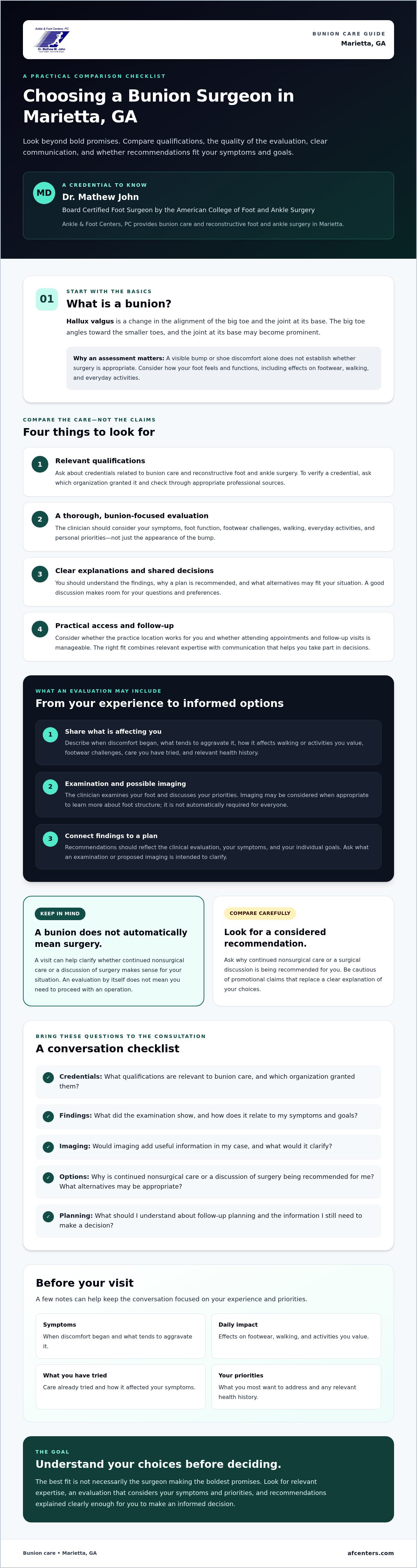
Questions to ask when choosing a bunion surgeon in Marietta
A consultation is more useful when you leave with a clearer understanding of your foot and the choices available. Bring a short list of questions, a medication list, relevant records, and notes about your symptoms if you have them. You don’t need to know which treatment you want before the appointment. Focus on understanding the recommendation and feeling comfortable asking for clarification.
Credentials and experience questions
Start with questions that help you understand the surgeon’s qualifications and approach. Ask the surgeon to explain their credentials in plain language. For example, Dr. Mathew John is a Board Certified Foot Surgeon by the American College of Foot and Ankle Surgery. You can ask what board certification a surgeon holds and which organization granted it, then verify any credential details you want to confirm.
Communication and follow-up questions
Use the rest of your list to understand how the clinician reached a recommendation and what support to expect as you consider next steps. These questions can help:
- How do you evaluate a bunion, and what findings from my assessment matter most?
- Why are you recommending this approach for my symptoms and goals?
- What alternatives should I consider, including continued nonsurgical care?
- If surgery is discussed, what would the proposed plan involve, and what recovery expectations apply to my case?
- What follow-up would be planned, and how can I ask questions before and after a procedure?
The way your questions are answered matters. Look for explanations that are clear, specific to your situation, and unhurried. A surgeon should be able to describe the reasoning behind a proposed plan and discuss appropriate alternatives without making you feel pressured to decide immediately. If something remains unclear, ask for it to be explained another way.
Ankle & Foot Centers, PC provides bunion care and reconstructive foot and ankle surgery in Marietta. To explore the practice’s relevant services as you prepare for a consultation, visit the foot and ankle services page. A thoughtful question list can help you compare options for the best bunion surgeon Marietta GA and make your next conversation more productive.
Meet a bunion surgeon in Marietta and take your next step
If you’re ready to talk through a bunion concern, Ankle & Foot Centers, PC is a Marietta podiatry practice that treats bunions and other foot conditions and provides reconstructive foot and ankle surgery. A consultation gives you space to describe what you’re experiencing, ask how your foot may be evaluated, and learn which options could be appropriate. Scheduling an evaluation doesn’t mean you’ve decided to have surgery.
Why patients may consider Dr. Mathew John
Dr. Mathew John is a Board Certified Foot Surgeon by the American College of Foot and Ankle Surgery. His practice in reconstructive foot and ankle surgery is relevant if you’re seeking a bunion-focused evaluation and want to understand whether surgical care should be part of the discussion. A credential is one useful point to consider alongside the quality of the assessment, how clearly options are explained, and whether the proposed next step reflects your needs.
There isn’t one surgeon who is the right fit for every person. As you consider the best bunion surgeon Marietta GA, focus on whether you feel heard and understand the reasoning behind any recommendation. You can ask for clarification, take time to consider your options, and discuss concerns before deciding what to do.
Make a confident, informed appointment decision
Before an appointment, jot down when symptoms occur and how they affect activities such as walking, work, or choosing shoes. Bring your questions, medication list, and relevant records if available. These notes can help you explain what matters most and make the conversation more useful.
During the visit, ask what the evaluation involves, what the clinician’s findings mean, and what options may fit your situation. If surgery comes up, ask what the proposed plan would involve and what follow-up expectations apply to your individual case. The aim is to understand your choices, not to rush into one.
If a local discussion would help clarify your concerns, consider contacting Ankle & Foot Centers, PC to ask about a bunion evaluation and the next step. Bring your questions and share your goals. Contact the Marietta practice when you’re ready to start the conversation.
Take Your Next Step With Clearer Answers
Choosing the best bunion surgeon Marietta GA starts with more than comparing claims. Look for relevant qualifications, a careful evaluation, and a conversation that helps you understand the findings and weigh treatment options. A bunion doesn’t automatically mean surgery is necessary. Your symptoms, daily activities, and goals all matter when discussing what comes next.
Ankle & Foot Centers, PC provides bunion care and reconstructive foot and ankle surgery in Marietta. Dr. Mathew John is a Board Certified Foot Surgeon by the American College of Foot and Ankle Surgery. An evaluation is an opportunity to share your concerns, ask questions, and learn about options without assuming you need to proceed with surgery.
If foot discomfort or shoe challenges are affecting your routine, consider taking a practical next step. Schedule a bunion evaluation with Ankle & Foot Centers, PC and bring your questions. A thoughtful conversation can help you move forward with greater confidence, at a pace that feels right for you.
Frequently Asked Questions
Does every bunion need surgery?
No, having a bunion doesn’t automatically mean surgery is needed. A clinician considers your symptoms, examination findings, how the bunion affects everyday activities, and your goals. Depending on your situation, you may discuss continued nonsurgical care or whether surgery is worth considering. Ask why a particular approach is recommended and what alternatives may fit your needs. An individual evaluation is more useful than judging the decision by the bunion’s appearance alone.
How do I choose a bunion surgeon in Marietta, GA?
Compare relevant credentials, the quality of the evaluation, and how clearly the surgeon explains options. Ask what board certification they hold and which organization granted it, and look for recommendations grounded in your symptoms and goals rather than promises. For local readers in Marietta, Roswell, Woodstock, Kennesaw, Atlanta, and Sandy Springs, practical access for appointments and follow-up may also matter. The best fit is a clinician whose approach helps you make an informed decision.
What should I ask a bunion surgeon at my first appointment?
Ask what the evaluation shows, why the clinician recommends a particular approach, and what alternatives you can consider. If surgery comes up, ask what the proposed plan involves and what recovery and follow-up expectations apply to your individual case. You can also ask how to raise questions as you consider your options. Clear, specific answers help you understand the reasoning without feeling pushed to make an immediate decision.
Is a podiatrist qualified to perform bunion surgery?
A podiatrist may provide bunion care and perform foot surgery, but you should confirm the individual clinician’s training, relevant experience, and credentials. Ask directly about board certification and which organization granted it. Dr. Consider this credential alongside the clinician’s evaluation, communication, and ability to explain a plan that reflects your needs.
What happens during a bunion evaluation?
A bunion evaluation typically begins with a discussion of your symptoms, relevant health history, activities, and footwear concerns. The clinician examines your foot and asks about your priorities. They may consider imaging if it could help assess your situation, but testing isn’t automatically required for everyone. The visit helps the clinician explain their findings and discuss whether continued nonsurgical care or a surgical conversation may be appropriate for you.
Can I get a second opinion before bunion surgery?
Yes, you can seek another qualified opinion if you’re uncertain about a recommendation or still have questions. Bring relevant records and describe your symptoms, daily activities, and goals so the clinician can understand your perspective. Ask the second clinician to explain their findings and how their advice compares with the first plan. Take the time you need to understand your choices and feel comfortable with the next step.
How do I prepare for a bunion surgeon appointment?
Prepare a short list of questions and notes about when symptoms occur, what activities are affected, and which shoes feel uncomfortable. Bring a medication list and relevant medical records if available. It can also help to write down any care you’ve already tried and what you hope to understand during the visit. These details give the clinician useful context and help you make the most of your consultation.


