

The shoes you wear every day could be silently putting your health at risk. If you're living with diabetes, that's not an exaggeration; it's a clinical reality that foot specialists see far too often. Finding the right diabetic footwear in Marietta isn't about comfort preferences or personal style. It's a medical decision, and making it without professional guidance can lead to consequences that are genuinely difficult to reverse.
You already know that diabetes changes everything, including the way your feet respond to pressure, friction, and even the seams inside an ordinary shoe. The worry about developing a sore that won't heal, or struggling to find footwear that accommodates swelling and neuropathy, is completely valid. Add the confusion around Medicare and insurance benefits for therapeutic shoes, and the whole process can feel overwhelming before you even take a single step toward getting help.
This guide is here to change that. You'll discover how a Board Certified Foot Surgeon can properly evaluate your feet, fit you with medical-grade therapeutic footwear, and walk you through the insurance process with clarity and confidence. From understanding your clinical needs to finding local expertise you can trust, consider this your straightforward path forward.
Key Takeaways
- Diabetic footwear is a medical necessity, not a comfort upgrade — the right therapeutic shoes can prevent serious complications like non-healing wounds and amputations that affect thousands of people living with diabetes.
- Choosing the right diabetic footwear in Marietta means working with a Board Certified Foot Surgeon like Dr. Mathew John, whose clinical oversight delivers outcomes that off-the-shelf comfort shoes simply cannot match.
- Quality diabetic shoes include specific medical features — such as extra depth and non-binding uppers — that work alongside custom-molded orthotics made from precise 3-D impressions of your unique foot contours.
- Medicare and insurance benefits may cover a significant portion of your therapeutic footwear costs, and understanding the qualification process starts with a proper clinical evaluation of your circulation and sensation.
- Ankle & Foot Centers, PC, located at 2790 Sandy Plains Road on the corner of Post Oak Tritt and Sandy Plains, offers comprehensive diabetic foot care from evaluation to fitting — all under one roof.
The Critical Role of Diabetic Footwear in Preventing Complications
Diabetic footwear isn't simply a more comfortable version of a standard shoe. It's a category of therapeutic medical device, engineered specifically to reduce the risk of skin breakdown, pressure ulcers, and the cascade of complications that follow when a wound on a diabetic foot goes undetected. The distinction matters enormously, because the consequences of wearing the wrong footwear aren't always immediately visible. They develop quietly, beneath the surface, in ways that ordinary shoes simply aren't designed to prevent.
At the center of this risk is a condition called peripheral neuropathy. When diabetes damages the nerves in your feet, you lose the body's most reliable warning system: pain. A blister, a seam pressing against your toe, a pebble caught inside your shoe — none of these trigger the discomfort that would normally prompt you to act. Understanding the full scope of diabetic foot complications makes it clear why therapeutic footwear isn't optional for many patients; it's a frontline defense against outcomes that are genuinely difficult to reverse.
Understanding Neuropathy and Pressure Points
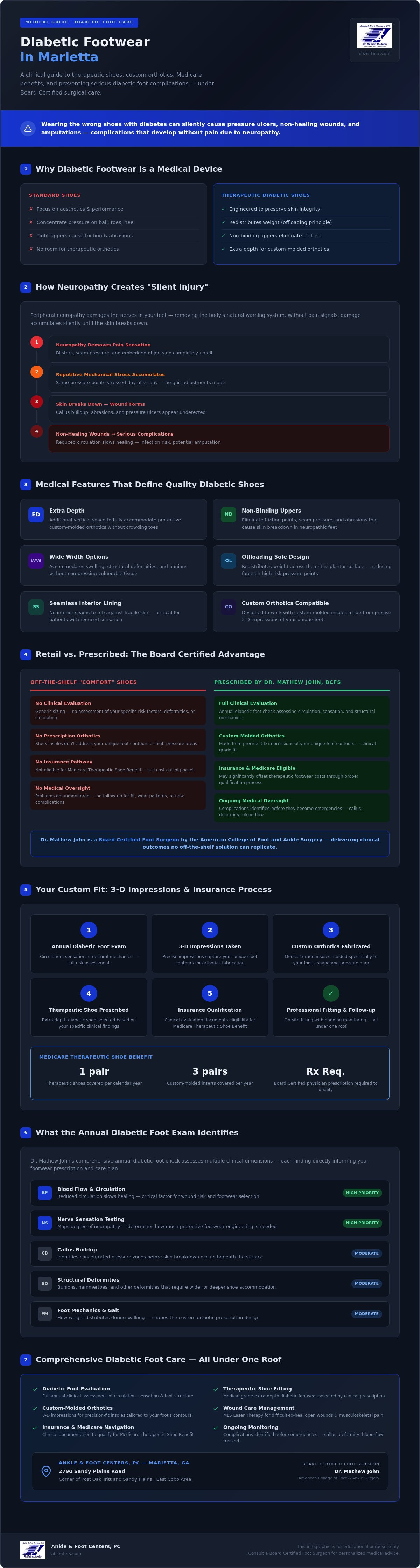
Without sensation, the foot becomes vulnerable to what clinicians call "silent injury." Traditional shoes concentrate pressure on predictable areas — the ball of the foot, the toes, and the heel. In a healthy foot, that pressure triggers micro-adjustments in your gait. In a neuropathic foot, those signals never arrive. The result is repetitive mechanical stress on the same tissue, day after day, until the skin breaks down.
Therapeutic diabetic footwear addresses this through a principle called offloading. Specialized design features redistribute weight more evenly across the entire plantar surface, reducing the concentrated force on high-risk pressure points. Extra depth accommodates protective insoles and custom orthotics. Non-binding uppers eliminate the friction that causes abrasions. These aren't comfort upgrades; they're clinical interventions built into every stitch and sole.
Why Marietta Residents Need a Specialized Foot Exam
Getting the right diabetic footwear in Marietta starts with a proper clinical evaluation, not a trip to a shoe store. At Ankle & Foot Centers, PC, located at 2790 Sandy Plains Road on the corner of Post Oak Tritt and Sandy Plains, Dr. Mathew John, a Board Certified Foot Surgeon by the American College of Foot and Ankle Surgery, conducts thorough annual diabetic foot checks that assess your circulation, sensation, and structural foot mechanics.
That evaluation isn't just a formality. It identifies specific risk factors — areas of callus buildup, structural deformities, reduced blood flow — before they become emergencies. The findings then directly inform your footwear prescription. The shoe that's right for your foot is determined by clinical data, not guesswork, which is precisely why professional oversight produces outcomes that no off-the-shelf solution can replicate. Explore the full range of diabetic foot care services available at the practice to understand how each step connects.
For East Cobb residents managing diabetes, this kind of localized, specialized access isn't a luxury. It's the practical difference between staying ahead of complications and reacting to them after the fact.
Medical Features That Define Quality Diabetic Shoes
When you begin your search for diabetic footwear in Marietta, it's helpful to understand that these shoes are built with a completely different set of engineering priorities than standard retail sneakers. Every stitch and material choice serves a specific clinical purpose. While a typical shoe focuses on aesthetics or general athletic performance, medical-grade footwear focuses on the preservation of skin integrity and the stabilization of the foot's internal structures.
One of the most critical features of a quality diabetic shoe is "extra depth." This additional vertical space is necessary to accommodate protective, custom-molded orthotics. At our clinic, Dr. Mathew John, a Board Certified Foot Surgeon by the American College of Foot and Ankle Surgery, uses 3-D impressions to create these orthotics, ensuring they mirror the exact contours of your feet. Without this extra depth, a custom insert would crowd your foot against the top of the shoe, creating the very pressure and friction we are trying to avoid. Following CDC guidelines on diabetes and foot health, we prioritize these features to prevent the minor irritations that can quickly escalate into serious wounds.
To further protect the foot, these shoes utilize non-binding uppers and seamless interiors. Traditional shoes often have thick internal seams that can rub against the skin, causing blisters that a person with neuropathy might not feel. By eliminating these seams and using a wide toe box, the shoe allows for natural toe movement. This prevents the crowding of toes, which is a common cause of skin breakdown and ingrown toenails in diabetic patients. If you are unsure if your current shoes meet these standards, you can schedule a professional footwear evaluation at our Sandy Plains Road office.
The Importance of the Outsole and Stability
The bottom of the shoe is just as important as the top. Many diabetic shoes feature rocker-bottom soles, which are slightly curved to help the foot roll through a step more naturally. This design reduces the amount of force placed on the ball of the foot and the toe joints. We also prioritize lightweight materials. Heavy shoes can cause muscle fatigue, which alters your gait and increases the risk of tripping. For patients who struggle with balance due to neuropathy, a firm, stable heel counter is essential to prevent falls and maintain a steady path.
Breathable Materials and Moisture Management
The internal environment of the shoe must stay dry and cool. This is why we recommend high-quality leather or advanced synthetic meshes over cheap plastics or vinyl. These breathable materials allow moisture to escape, which is vital because a damp environment encourages the growth of bacteria and fungi. If a fungal infection does take hold, our clinic offers advanced fungal laser therapy to clear the condition quickly. By managing moisture through proper footwear, you're building a primary defense against infections that could complicate your overall foot health.
Retail vs. Prescribed Footwear: The Board Certified Advantage
It's common to see "comfort" shoes marketed in retail stores as suitable for everyone, but for someone managing diabetes, an off-the-shelf purchase can be a risky gamble. Retail clerks and shoe fitters, while well-intentioned, lack the clinical training to identify subtle changes in your foot's vascular health or nerve function. When you seek diabetic footwear in Marietta at a specialized medical practice, you aren't just buying a pair of shoes; you're receiving a prescribed medical intervention designed by a specialist who understands your unique pathology.
One major difference lies in the documentation and clinical justification required for insurance. Most retail stores aren't equipped to handle the rigorous requirements for Medicare coverage for therapeutic diabetic shoes. At Ankle & Foot Centers, PC, we bridge that gap. We ensure your footwear meets specific medical criteria and that your 3-D impressions are translated into orthotics that truly protect your health. This professional oversight ensures that your footwear works in harmony with your overall treatment plan, including the use of MLS Laser Therapy to manage musculoskeletal pain or inflammation that often accompanies diabetic gait changes.
Expert Evaluation by Dr. Mathew John
The quality of your care depends on the expertise behind the prescription. Dr. Mathew John is a Board Certified Foot Surgeon by the American College of Foot and Ankle Surgery. This distinction means he brings a deep understanding of reconstructive surgery and foot biomechanics to every non-surgical recommendation. He doesn't just look at the surface of your foot; he evaluates the underlying bone structure and joint function to determine how a shoe should be constructed to prevent future issues. This comprehensive approach is a hallmark of the care provided at our office located at 2790 Sandy Plains Road on the corner of Post Oak Tritt and Sandy Plains.
Addressing Stubborn Issues: Beyond the Shoe
Diabetic foot wellness often requires addressing secondary skin conditions that can become dangerous if ignored. For instance, plantar warts can be particularly stubborn or recalcitrant in diabetic patients. Our clinic offers Swift Treatment, an advanced solution that uses microwave ablation technology to target the root of the problem. This treatment typically involves four sessions, each spaced exactly one month apart. Because there is absolutely no downtime following the procedure, you can immediately return to your daily activities in your new protective footwear. By treating the underlying foot structure and concurrent skin issues, we provide a level of care that retail outlets simply cannot offer. You can learn more about our full range of specialized foot care services to see how we support your long-term mobility.
Getting Your Custom Fit: 3-D Impressions and Insurance
Understanding what therapeutic shoes need to do is one thing. Getting a pair that actually does it for your specific feet is another. The fitting process for diabetic footwear in Marietta at Ankle & Foot Centers, PC follows a clear, four-step clinical pathway that moves from assessment to final adjustment with precision at every stage.
The process begins with a thorough clinical evaluation of your circulation and sensation. Dr. Mathew John, a Board Certified Foot Surgeon by the American College of Foot and Ankle Surgery, examines vascular flow and nerve function to establish your current risk profile. This isn't a formality; it's the clinical foundation that determines everything that follows. Without it, any footwear recommendation is simply guesswork.
From there, the focus shifts to capturing the exact geometry of your feet.
The Precision of 3-D Impressions
Retail environments often promote foot scanning as a sophisticated service, but a digital scan captures surface geometry without accounting for the dynamic way your foot loads and distributes weight under pressure. At our Sandy Plains Road office, we take precise 3-D impressions that create a physical, three-dimensional map of your foot's unique contours. The goal is total contact: an orthotic surface that meets every curve and hollow of your plantar anatomy, leaving no gap where pressure can concentrate. This level of accuracy is what separates a truly custom-molded orthotic from a mass-produced insert placed inside a slightly wider shoe.
Once your impressions are complete, Dr. John selects the appropriate shoe style based on your medical prescription. Factors like joint deformity, areas of callus buildup identified during your evaluation, and your daily activity level all influence this decision. You're not browsing a catalog; you're receiving a clinical recommendation grounded in your specific pathology.
The final step is the fitting and adjustment appointment. Every contact point inside the shoe is checked. Friction points are eliminated before you ever walk out the door.
Navigating Insurance and Medicare in Georgia
For qualifying patients, the Medicare Therapeutic Shoe Bill provides coverage for diabetic footwear under Part B. Generally, this includes one pair of therapeutic shoes and multiple pairs of custom-molded inserts per calendar year for patients diagnosed with diabetes who have at least one additional foot-related condition, such as neuropathy, poor circulation, or a history of foot ulcers. Your primary care physician must certify the medical necessity, and your podiatrist handles the prescription and fitting.
The documentation requirements can feel daunting, but our staff at 2790 Sandy Plains Road on the corner of Post Oak Tritt and Sandy Plains guides you through every step. We coordinate with your primary care physician, ensure all clinical notes meet Medicare's criteria, and handle the paperwork so your focus stays where it belongs: on your health.
Ready to start the process? Schedule your diabetic footwear evaluation at Ankle & Foot Centers, PC and take the first step toward footwear that's built specifically for you.
Comprehensive Diabetic Foot Care at Ankle & Foot Centers, PC
Everything you need to protect your feet from the ground up is available in one place. Ankle & Foot Centers, PC brings together clinical evaluation, custom-molded orthotics, therapeutic footwear fitting, and advanced treatments under one roof, so you're never left piecing together your care from multiple providers who don't communicate with each other. That kind of coordinated, continuous oversight is exactly what managing diabetes well requires.
The goal here is simple: keep you healthy, mobile, and confident on your feet for the long term. Proactive care today is the most reliable way to avoid reconstructive surgery tomorrow. When the right footwear, properly fitted orthotics, and regular clinical monitoring work together, the conditions that lead to non-healing wounds and structural foot damage rarely get the chance to develop. That's not a promise; it's the documented benefit of catching problems early and treating them with precision.
Our Sandy Plains Road Location
The clinic sits at 2790 Sandy Plains Road on the corner of Post Oak Tritt and Sandy Plains, making it straightforward to find for families throughout East Cobb and the broader Marietta area. Whether you're coming from the Post Oak Tritt corridor or heading north on Sandy Plains, the corner location is a familiar landmark for the community. Inside, you'll find a welcoming, unhurried environment where your questions get real answers and your care gets genuine attention.
This isn't a high-volume clinic where you feel like a number. It's a practice built around the kind of relationship-centered care that makes a real difference when you're managing a chronic condition. Neighbors trust it because the results speak clearly.
Schedule Your Diabetic Foot Evaluation Today
If you've recently been diagnosed with diabetes, or if you've been managing it for years and haven't had a thorough foot evaluation, now is the right time to act. Recurring pain, numbness, changes in skin texture, or difficulty finding footwear that fits without causing irritation are all signals worth taking seriously before they escalate.
Dr. Mathew John, a Board Certified Foot Surgeon by the American College of Foot and Ankle Surgery, brings the clinical depth to evaluate not just your symptoms but the underlying mechanics driving them. When you're looking for diabetic footwear in Marietta that's genuinely built for your feet, that level of expertise makes every difference. You won't be navigating this path alone.
Take the first step toward lasting foot health. Book your diabetic foot evaluation at Ankle & Foot Centers, PC and let a Board Certified team guide you forward with confidence.
Your Next Step Toward Healthier Feet Starts Here
Living with diabetes doesn't mean accepting the risk of preventable foot complications. Throughout this guide, you've seen how the right diabetic footwear Marietta residents need goes far beyond what any retail store can offer. From precise 3-D impressions that create truly custom-molded orthotics to the clinical oversight that makes insurance navigation manageable, every part of the process is designed to protect your long-term mobility.
The difference between proactive care and reactive treatment often comes down to a single appointment. At Ankle & Foot Centers, PC, Dr. Mathew John, a Board Certified Foot Surgeon by the American College of Foot and Ankle Surgery, brings the expertise to evaluate your feet thoroughly and prescribe footwear that genuinely fits your health needs. The clinic is conveniently located at 2790 Sandy Plains Road on the corner of Post Oak Tritt and Sandy Plains, making specialized care easy to access for East Cobb families.
You don't have to figure this out alone. Schedule your diabetic foot exam and fitting at our Marietta office today and take a confident step toward lasting foot health.
Frequently Asked Questions About Diabetic Footwear in Marietta
Does Medicare Cover Diabetic Shoes in Marietta, GA?
Yes, Medicare Part B covers therapeutic diabetic footwear for qualifying patients under the Therapeutic Shoe Bill. To qualify, you must have a diabetes diagnosis and at least one additional foot-related condition, such as neuropathy, poor circulation, a history of foot ulcers, or a pre-ulcerative callus. Your primary care physician must certify medical necessity, and a qualified foot specialist like Dr. Mathew John handles the prescription and fitting.
At Ankle & Foot Centers, PC, our staff coordinates directly with your primary care physician and manages the documentation requirements on your behalf. Coverage typically includes one pair of therapeutic shoes and multiple pairs of custom-molded inserts per calendar year, though you should confirm current benefit details with Medicare directly, as requirements can be updated.
How Often Should I Replace My Diabetic Footwear?
Most therapeutic diabetic shoes need replacement every twelve months, though your individual activity level and foot condition may require more frequent changes. The protective features of diabetic footwear, particularly the cushioning and outsole integrity, degrade with regular wear. Once the shoe no longer maintains its original structure, it loses its ability to offload pressure effectively, which puts your skin at risk.
Your annual diabetic foot evaluation at our Sandy Plains Road clinic is a natural checkpoint to assess whether your current footwear is still performing as intended. Don't wait until you notice visible wear; by that point, the internal protective properties may already be compromised.
What Is the Difference Between a Custom Orthotic and a Regular Shoe Insert?
A regular shoe insert is a mass-produced cushion designed for general comfort. A custom orthotic is a medical device fabricated from precise 3-D impressions of your specific foot contours. The difference in protection is significant. A custom orthotic achieves total contact with your plantar surface, distributing weight evenly across every curve and hollow rather than leaving pressure concentrated on vulnerable areas.
For diabetic patients, that distinction is clinically meaningful. A generic insert placed inside a wider shoe doesn't address your unique structural mechanics. A custom-molded orthotic, prescribed by Dr. Mathew John, a Board Certified Foot Surgeon by the American College of Foot and Ankle Surgery, is built around your actual pathology, not an average foot shape.
Can I Wear Normal Socks With My Diabetic Shoes?
Standard socks with thick seams, tight elastic bands, or synthetic materials that trap moisture are not recommended for diabetic patients. These features can create pressure points and retain heat, both of which elevate your risk of skin breakdown. Diabetic-specific socks are designed with seamless construction, non-binding tops, and moisture-wicking fibers that keep the foot dry and free from friction.
Your therapeutic footwear works as a system. The shoe, the custom orthotic, and the sock all contribute to the protective environment your feet need. Wearing the wrong socks can undermine the clinical benefits of even the best-fitted diabetic shoe, so it's worth asking Dr. John for a specific recommendation during your fitting appointment.
How Do 3-D Impressions Help With My Foot Pain?
3-D impressions capture the precise geometry of your foot in three dimensions, creating a physical map of every contour, arch height, and pressure distribution point unique to you. This level of accuracy allows the orthotics fabricated from those impressions to make full contact with your plantar surface, eliminating the gaps where pressure concentrates and pain originates. The result is a support structure that works with your anatomy rather than against it.
For patients seeking diabetic footwear in Marietta, this process is especially important because foot pain often signals underlying structural stress that a generic insert simply can't resolve. When your orthotic mirrors your exact foot shape, it reduces the mechanical forces that cause tissue fatigue and discomfort throughout the day.
What Should I Look for During My Daily Diabetic Foot Check?
Each day, inspect the tops, bottoms, sides, and between every toe. You're looking for redness, blistering, swelling, cuts, cracks in the skin, or any area that looks darker or feels warmer than the surrounding tissue. Because neuropathy can prevent you from feeling these changes, your eyes become your primary warning system. Use a mirror or ask someone to help if you have difficulty seeing the bottom of your foot.
Any change that doesn't resolve within 24 hours warrants a call to your foot specialist. Early detection is the single most effective tool for preventing minor irritations from progressing into serious wounds. A daily check takes less than five minutes and is one of the most impactful habits you can build into your routine.
Is Dr. Mathew John Accepting New Diabetic Patients in Marietta?
Yes, Ankle & Foot Centers, PC welcomes new diabetic patients at the clinic located at 2790 Sandy Plains Road on the corner of Post Oak Tritt and Sandy Plains. Dr. Mathew John, a Board Certified Foot Surgeon by the American College of Foot and Ankle Surgery, provides comprehensive diabetic foot evaluations that assess circulation, sensation, and structural mechanics to establish your individual risk profile and care plan.
Whether you've been recently diagnosed or have been managing diabetes for years without a thorough foot evaluation, scheduling an appointment is a straightforward first step. The team is experienced in guiding new patients through the entire process, from initial assessment to footwear fitting and insurance coordination.
What Happens If I Don't Wear Specialized Shoes as a Diabetic?
Without therapeutic footwear, a diabetic foot is exposed to repetitive pressure and friction that standard shoes aren't designed to manage. Because neuropathy often eliminates the pain signals that would normally prompt you to adjust or remove a shoe, damage accumulates silently. Blisters become ulcers, ulcers become infections, and infections can escalate to outcomes that require surgical intervention.
This isn't a distant risk; it's the clinical progression that foot specialists see when protective footwear isn't part of a patient's routine. The good news is that this progression is largely preventable. Properly fitted therapeutic shoes, combined with regular professional monitoring, interrupt that chain before it can advance. Proactive care is always a more manageable path than reactive treatment.


