

What if that stubborn bend in your toe is actually a race against time? You probably feel a sharp pinch every time you lace up your sneakers or notice a painful callus forming after a short walk. It's exhausting to plan your entire day around foot discomfort, and you likely already know that ignoring the problem won't make it disappear. Understanding the nuances of flexible vs rigid hammertoe treatment is the first step toward reclaiming your active lifestyle and walking without hesitation.
At our office located at 2790 Sandy Plains Road on the corner of Post Oak Tritt and Sandy Plains, we believe you deserve a clear path to recovery. Dr. Mathew John is a Board Certified Foot Surgeon by the American College of Foot and Ankle Surgery who specializes in helping patients move from persistent pain to permanent relief. You'll learn exactly how we distinguish between these two stages of deformity and which specialized treatments can help you wear normal shoes again. We'll explore how we use 3-D impressions for custom orthotics and MLS Laser Therapy to manage inflammation, ensuring you have the professional guidance needed for a successful journey back to health.
Key Takeaways
- Understand the crucial distinction in flexible vs rigid hammertoe treatment to determine if your joint still has mobility or has become permanently fixed.
- Identify how muscle imbalances and genetics, such as having a second toe longer than the first, drive the progression of your condition toward a rigid state.
- Discover how non-surgical options like custom orthotics made from 3-D impressions can rebalance your foot mechanics and manage flexible deformities.
- Learn why reconstructive foot and ankle surgery is the only way to realign the structure of a rigid joint and restore your ability to walk comfortably.
- Connect with Dr. Mathew John, a Board Certified Foot Surgeon by the American College of Foot and Ankle Surgery, at 2790 Sandy Plains Road on the corner of Post Oak Tritt and Sandy Plains for a personalized evaluation.
What is the Difference Between Flexible and Rigid Hammertoes?
A hammertoe is a contracture deformity that occurs at the middle joint of your toe, causing it to bend downward like a claw. This happens when there's an imbalance in the muscles or tendons that keep the toe straight. At our office at 2790 Sandy Plains Road on the corner of Post Oak Tritt and Sandy Plains, we guide you through the complexities of this condition with a steady hand. Dr. Mathew John, a Board Certified Foot Surgeon by the American College of Foot and Ankle Surgery, explains that your path to relief begins by answering one central question: What is the Difference Between Flexible and Rigid Hammertoes?
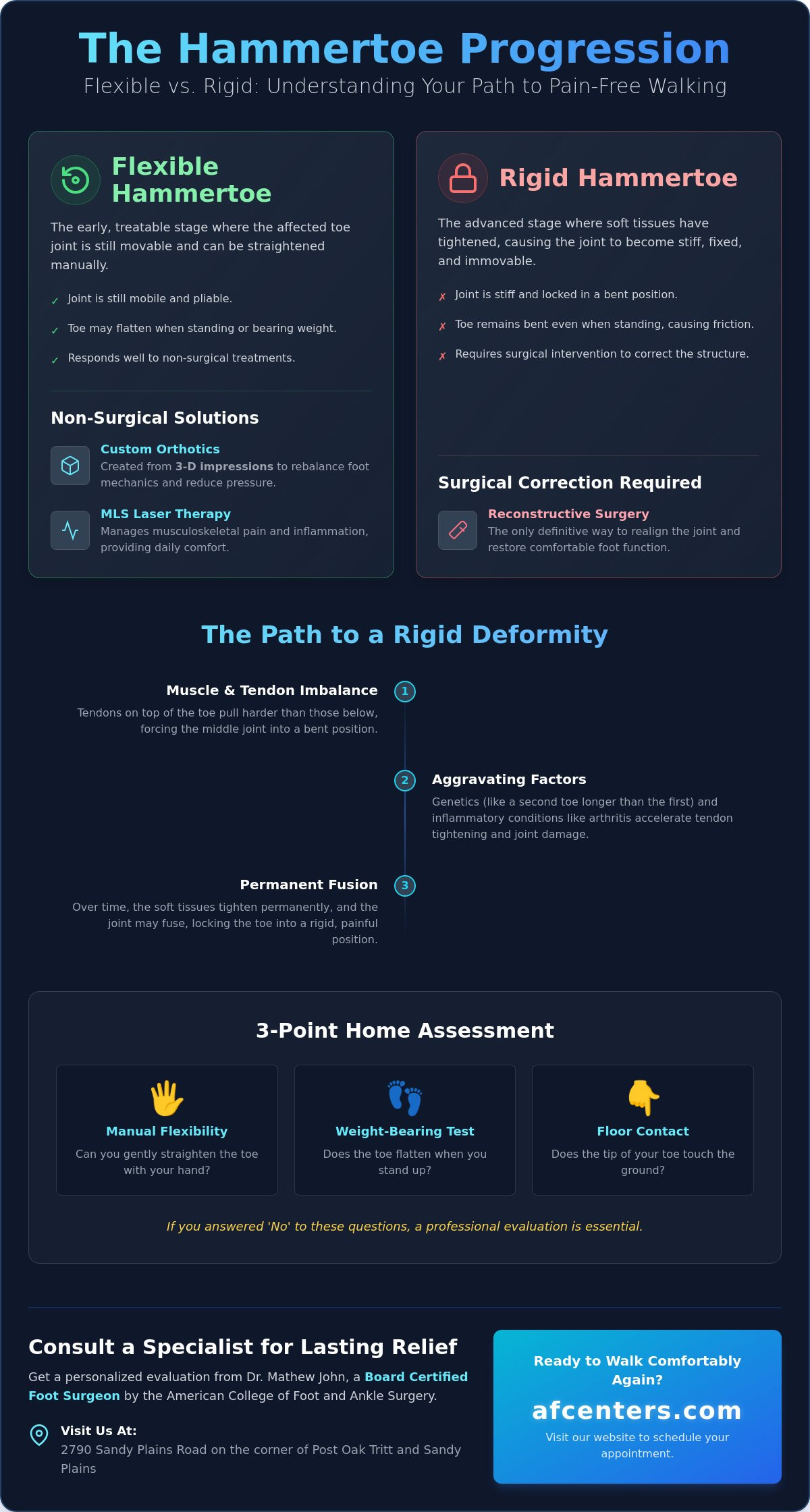
Answering that question is the first step in your flexible vs rigid hammertoe treatment journey. If you can still straighten the toe by hand, or if it flattens out when you put weight on your foot, it's considered flexible. If the joint is stuck in a bent position and resists movement, it has become rigid. This distinction is vital because it dictates whether we can use non-invasive tools to restore your comfort or if we need to discuss reconstructive options. Your treatment path is entirely dependent on this classification, making a professional evaluation essential for your long-term health.
Defining the Flexible Stage
Recognizing Rigid Hammertoes
When a hammertoe is left untreated, the soft tissues eventually tighten into a permanent bend. This transition marks the shift into a rigid deformity. You'll likely experience significant joint stiffness and bone-on-bone friction, which makes walking in normal shoes a painful challenge. At this point, the toe no longer moves when manipulated, and conservative stretching or padding won't unfreeze the joint. Because the deformity is now structural, rigid cases rarely respond to non-surgical intervention alone. We focus on restoring your mobility through advanced correction techniques, ensuring you can return to the activities you love without the constant burden of foot pain.
The Progression Checklist: How Hammertoes Become Fixed
Hammertoes don't reach a rigid state overnight. This transformation is usually a slow, rhythmic progression where the muscles and tendons in your foot lose their natural balance. When the tendons on the top of your toe pull harder than the ones on the bottom, the joint is forced into a permanent bend. Understanding this shift is central to choosing the right flexible vs rigid hammertoe treatment. At our clinic at 2790 Sandy Plains Road on the corner of Post Oak Tritt and Sandy Plains, Dr. Mathew John, a Board Certified Foot Surgeon by the American College of Foot and Ankle Surgery, often sees patients who are surprised by how quickly a flexible toe can become fixed.
Genetics often play a quiet but significant role in this journey. If your second toe is naturally longer than your big toe, it's frequently forced to curl inside your shoes, which accelerates tendon tightening. Additionally, inflammatory conditions like rheumatoid arthritis can damage the joint cartilage. This inflammation causes the joint to stiffen and eventually fuse, moving you further away from simple Treatments for Flexible Hammertoes and toward the need for surgical correction. To help you understand where you stand, try this quick 3-point self-assessment at home:
- Manual Flexibility: While sitting, try to gently straighten the toe with your hand. If it resists even light pressure, the joint is likely becoming rigid.
- Weight-Bearing Test: Stand up and look at your feet. Does the toe flatten out when you put weight on it, or does it stay arched?
- Floor Contact: Check if the tip of your toe actually touches the ground. If it's "floating" or curled under, the contracture is advancing.
Common Triggers for Muscle Imbalance
Your choice of footwear is often the primary culprit. Shoes with a narrow toe box or high heels force your toes into a cramped, clawed position for hours at a time. This constant pressure trains the tendons to stay short. Beyond shoes, your foot structure matters. Whether you have high arches or flat feet, the mechanical stress placed on your toe joints can disrupt normal alignment. Even past trauma, like a broken toe that didn't heal perfectly, can trigger the muscle imbalance that leads to a permanent deformity.
Warning Signs of Rigid Progression
You should watch for persistent redness or swelling at the top of the middle joint, which signals that the bone is rubbing against your shoe. Another major red flag is the development of stubborn corns or calluses. If these painful spots return shortly after you've had them professionally treated, it's a sign that the underlying bone structure is misaligned. As the joint stiffens, you'll find it increasingly difficult to find any shoes that don't cause significant pain. If you notice these changes, exploring our specialized podiatric services early can help you manage the condition before it requires more invasive intervention.
Non-Surgical Treatments for Flexible Hammertoes
Reaching for a non-surgical solution is always our primary goal when we identify a hammertoe in its early, flexible stage. At our office at 2790 Sandy Plains Road on the corner of Post Oak Tritt and Sandy Plains, Dr. Mathew John focuses on stabilizing your foot mechanics to halt the progression of the deformity. Because the joint hasn't yet frozen, we can use conservative tools to realign your toes and reduce the daily friction that causes pain. This proactive approach is the core of effective flexible vs rigid hammertoe treatment, as it aims to keep you active and comfortable without early surgical intervention.
While padding and athletic taping can provide immediate symptomatic relief by repositioning the toe and shielding it from shoe pressure, these are often temporary fixes. To achieve lasting results, we must address why the toe is curling in the first place. This usually involves rebalancing how your foot distributes weight during each step. If we don't intervene while the joint is still mobile, the soft tissues will continue to tighten. Eventually, you may require Surgical Correction for Rigid Hammertoes to restore your foot's natural alignment and function.
Custom Orthotics and 3-D Impressions
Generic, over-the-counter inserts often fail because they don't account for the unique architecture of your foot. We utilize 3-D impressions to create highly precise custom orthotics that serve as a foundation for your recovery. By capturing the exact contours of your arch and heel, these devices provide targeted support that takes the mechanical strain off your smaller toe joints. This precise alignment is often the deciding factor in whether a flexible toe stays mobile or eventually stiffens into a permanent, rigid bend. It's a sophisticated way to ensure your foot moves as nature intended.
Therapeutic Exercises and Splinting
You can play an active role in your healing journey by performing simple exercises at home to strengthen the intrinsic muscles of your feet. Activities like "towel curls," where you use your toes to pull a towel toward you, or "marble pickups" can significantly improve coordination and flexibility. These movements help maintain the length of your tendons and prevent them from shortening further. Along with exercises, we often recommend a supportive footwear transition to shoes with a wide, deep toe box. This gives your toes the space they need to lie flat without being compressed by the sides of your shoes.
Dr. Mathew John, a Board Certified Foot Surgeon by the American College of Foot and Ankle Surgery, may also suggest night splints to gently hold your toe in a straight position while you sleep. If you're struggling with musculoskeletal pain or inflammation during this process, we can integrate MLS Laser Therapy into your plan to support your progress. This comprehensive, non-invasive approach ensures you never feel like you're navigating your path to recovery alone.
Surgical Correction for Rigid Hammertoes in Marietta
When your toe no longer moves even with manual pressure, it has reached the rigid stage. At this point, the soft tissues have shortened and the joint has physically changed. This means that non-surgical tools like padding or orthotics can no longer provide structural correction. Surgery becomes the only reliable way to "unfreeze" the joint and restore your foot to its natural, healthy state. If you find yourself at this crossroads in your flexible vs rigid hammertoe treatment journey, you need a specialist who understands the intricate mechanics of the foot.
Dr. Mathew John is a Board Certified Foot Surgeon by the American College of Foot and Ankle Surgery who provides expert care at our Marietta location. You can find us at 2790 Sandy Plains Road on the corner of Post Oak Tritt and Sandy Plains. His goal is simple: to help you achieve a flat, functional, and pain-free toe so you can wear normal shoes again without hesitation. By realigning the bone structure and balancing the tendons, we can eliminate the source of your discomfort permanently.
Reconstructive Surgery Overview
Recovery and Long-Term Results
Many patients are surprised to learn that recovery is often faster than they imagined. You'll typically be able to walk the same day in a specialized surgical shoe, which protects the correction while you heal. Most people transition back into comfortable, regular shoes within about four weeks. This timeline is supported by the fact that many of our procedures are minimally invasive, sometimes requiring incisions only 4 to 5mm in length. To support your progress, we may use MLS Laser Therapy to reduce post-operative swelling and inflammation, which helps speed up the natural healing process. By addressing the root cause of the imbalance, we ensure that your results are permanent and prevent the deformity from recurring. If you're ready to leave foot pain behind, schedule your surgical evaluation with Dr. Mathew John today.
Personalized Hammertoe Care at Ankle & Foot Centers, PC
Your feet carry you through every milestone in life, and they deserve specialized care that respects your unique journey. At Ankle & Foot Centers, PC, we don't believe in one-size-fits-all solutions. We focus on creating a personalized treatment plan that fits your specific lifestyle, activity level, and long-term wellness goals. Whether you’re just starting to notice a slight bend in your toe or you’ve struggled with a fixed deformity for years, we’re here to guide you. Our Marietta clinic is conveniently located at 2790 Sandy Plains Road on the corner of Post Oak Tritt and Sandy Plains. We encourage you to seek early intervention, as identifying the right flexible vs rigid hammertoe treatment early on can significantly increase your chances of achieving relief through non-surgical means.
Choosing to address foot pain is a rewarding opportunity to reclaim your mobility. By visiting our professional environment, you gain access to a steady hand that prioritizes your progress and long-term health. We understand that foot discomfort can feel like a barrier to your favorite activities, but with the right partnership, you can return to a life of vitality and comfort. Our team is dedicated to lowering that barrier and providing a supportive, non-judgmental atmosphere for every member of our community.
Expert Evaluation with Dr. Mathew John
When you visit us, you’ll receive a thorough diagnostic evaluation from Dr. Mathew John. He is a Board Certified Foot Surgeon by the American College of Foot and Ankle Surgery who brings a high level of expertise to every patient encounter. During your visit, Dr. John carefully assesses your joint mobility and foot mechanics to determine if your condition is still in the flexible stage or has become rigid. This expert evaluation is the only way to truly understand the nuances of flexible vs rigid hammertoe treatment for your specific case. Our office provides a welcoming, community-focused atmosphere where you can feel confident that your health is being managed by a reliable mentor who understands local needs and sophisticated resources alike.
Comprehensive Podiatric Services
Step Toward Permanent Relief and Comfort
Your journey to pain-free walking starts with a single, confident step toward professional care. Understanding the nuances of flexible vs rigid hammertoe treatment allows you to make informed decisions about your health before minor discomfort turns into a permanent deformity. Whether you're a candidate for conservative support through custom orthotics made with 3-D impressions or you require the precision of reconstructive surgery, you don't have to navigate this path alone. Early intervention is the most rewarding opportunity to preserve your joint mobility and keep you moving through your favorite daily activities.
At our Marietta office, located at 2790 Sandy Plains Road on the corner of Post Oak Tritt and Sandy Plains, we provide the expert guidance and sophisticated resources you deserve. Dr. Mathew John is a Board Certified Foot Surgeon by the American College of Foot and Ankle Surgery who is dedicated to helping you achieve lasting results. It's time to stop planning your day around foot pain and start looking forward to a future of vitality and ease.
Schedule Your Hammertoe Consultation with Dr. Mathew John Today and reclaim the comfort you've been missing. We're ready to help you walk with confidence again.
Frequently Asked Questions
Can a rigid hammertoe be straightened naturally?
No, a rigid hammertoe cannot be straightened through natural methods like stretching or splinting. Once the joint reaches this fixed stage, the soft tissues have shortened significantly and the bone structure has physically changed. At our office at 2790 Sandy Plains Road on the corner of Post Oak Tritt and Sandy Plains, we focus on structural correction for these cases. Reconstructive surgery is the only reliable way to realign the joint and restore your toe to its natural position.
How do I know if my hammertoe requires surgery?
Surgery is typically necessary if your hammertoe is rigid or causes persistent pain that prevents you from wearing normal shoes. If you find that padding and wider footwear no longer provide relief, it's time for a professional evaluation. Dr. Mathew John is a Board Certified Foot Surgeon by the American College of Foot and Ankle Surgery who can assess your mobility. He'll help you determine if your condition has progressed beyond the reach of conservative care.
What happens if I leave a flexible hammertoe untreated?
An untreated flexible hammertoe will almost always progress into a rigid, permanent deformity over time. As the muscle imbalance continues, the tendons tighten and the joint eventually loses all mobility. This shift makes flexible vs rigid hammertoe treatment much more complex. Early intervention with 3-D impressions for custom orthotics can often halt this progression, allowing you to avoid the operating room and maintain your active lifestyle without interruption.
Will custom orthotics fix the bend in my toe permanently?
Custom orthotics are designed to manage your foot mechanics and prevent the bend from worsening, but they don't physically straighten an existing deformity. They work by rebalancing the pressure across your foot to take the strain off your toe joints. We use 3-D impressions to ensure your orthotics provide a sophisticated, precise fit. While they don't "unbend" the toe, they are a vital tool for maintaining comfort and preventing a flexible toe from becoming fixed.
Is hammertoe surgery covered by most insurance plans?
Most insurance providers, including Medicare Part B, cover hammertoe surgery when it's deemed medically necessary due to pain or functional impairment. As of 2026, Medicare typically covers 80% of the approved amount after your deductible is met. It's important to remember that insurance generally does not cover surgery for purely cosmetic reasons. We recommend checking with your specific carrier to confirm your benefits and any documentation requirements before proceeding with your personal health journey.
Can I still exercise while treating a flexible hammertoe?
You can certainly remain active, though you may need to choose low-impact activities like swimming or cycling to reduce pressure on your toes. Exercise is a holistic lifestyle choice, and we want to help you stay fit while you heal. If you experience musculoskeletal pain or inflammation after activity, we can integrate MLS Laser Therapy into your plan. This advanced tool helps manage discomfort and supports your recovery without requiring you to sacrifice your fitness goals.
What is the recovery time for hammertoe correction surgery?
Many patients are able to walk in a specialized surgical shoe immediately after the procedure. You can typically expect to transition back into comfortable, regular shoes within about four weeks. Modern techniques, including the use of internal implants like the Ziptoe Hammertoe System cleared by the FDA in early 2026, focus on faster functional recovery. This approach minimizes downtime, allowing you to return to your community and daily routines with a steady hand guiding your progress.
Do hammertoes always come back after they are treated?
Recurrence is very unlikely when the underlying mechanical cause of the hammertoe is correctly addressed. Dr. Mathew John, a Board Certified Foot Surgeon by the American College of Foot and Ankle Surgery, focuses on long-term results by realigning the bone and balancing the tendons. Following surgery, using custom orthotics created from 3-D impressions helps maintain your foot's new alignment. This comprehensive approach ensures that your correction remains permanent, giving you the confidence to move forward without pain.


