

Foot and ankle pain deserves focused care, not guesswork. A foot doctor near Kennesaw State University can evaluate foot and ankle concerns and discuss appropriate treatment options. Choosing a practice also means considering practical details, such as your insurance plan and what to expect at an appointment.
Before scheduling, it helps to know what care a practice provides and how to plan a visit. This guide covers foot and ankle services, common conditions podiatry can address, and practical considerations for patients near Kennesaw State University. Ankle & Foot Centers, PC in Marietta serves patients from Kennesaw, Roswell, Woodstock, Atlanta, and Sandy Springs.
From heel pain and sports injuries to bunions, toenail concerns, and other conditions, the care you need depends on what’s causing the problem. Read on to learn what a local foot and ankle practice can help with, what to consider when reviewing coverage, and how to take a comfortable next step toward care.
Key Takeaways
- Compare your insurance plan’s podiatry benefits with the care you need, and learn which coverage details can affect your visit.
- Understand how podiatry services address foot and ankle concerns, from painful heel conditions to structural problems.
- Consider location and office amenities alongside the type of care you’re seeking when planning appointments.
- Learn what to look for when finding a practice that accepts new patients and offers care suited to your needs.
- See how reconstructive foot and ankle surgery and care for bunions, hammertoes, and fungal toenails may fit into treatment planning.
Insurance acceptance
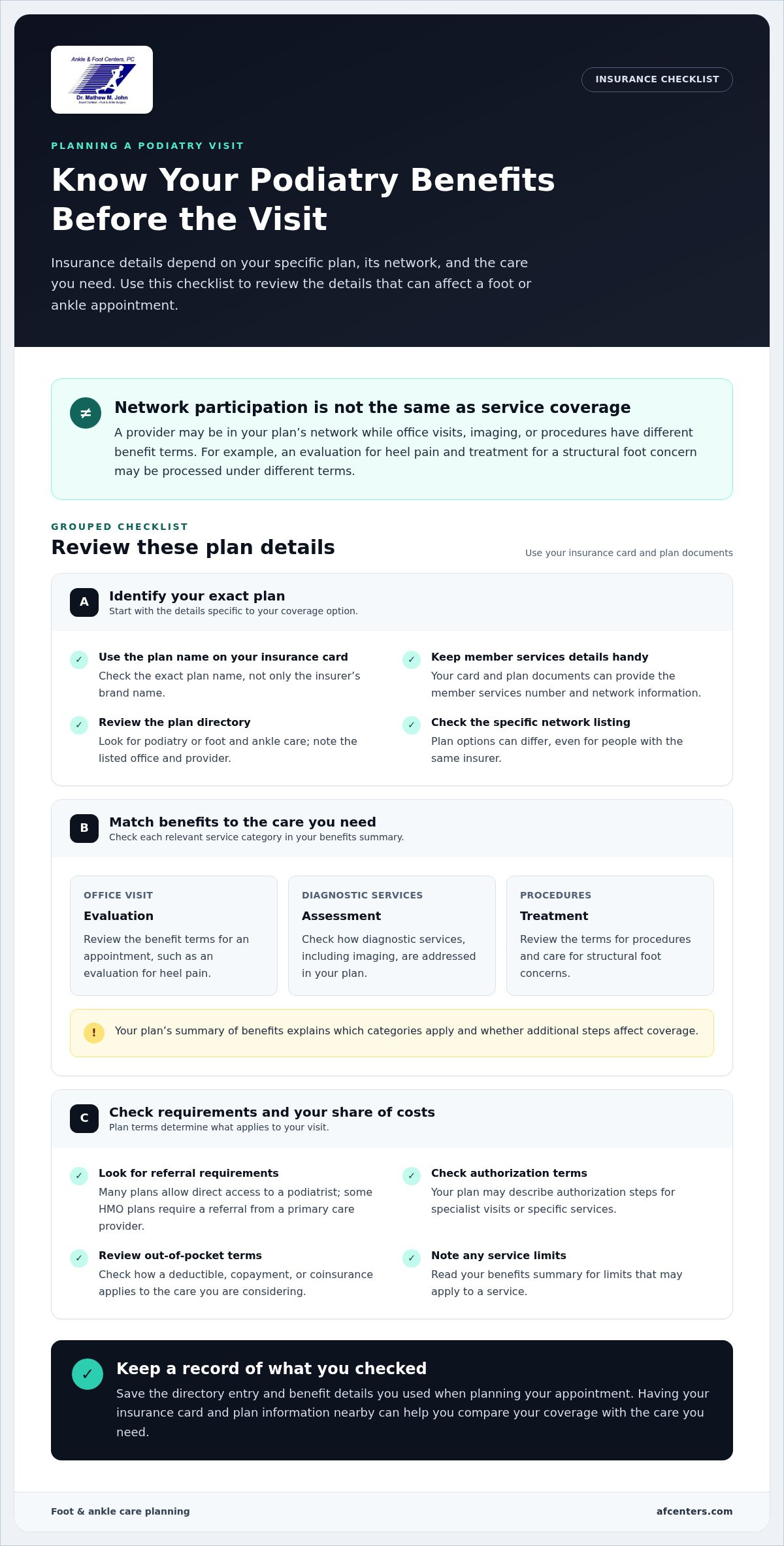
Insurance acceptance depends on your specific plan, its network, and the care you need. Even people with the same insurer can have different benefits because plan options vary. Check your insurance card and plan documents for the plan name, member services number, and network information. These details help you understand how your plan applies to a podiatry visit.
Next, separate network participation from coverage for a particular service. A plan can include a provider in its network while applying different benefits to an office visit, imaging, or a procedure. For example, an evaluation for heel pain and treatment for a structural foot concern may be processed under different benefit terms. Your plan’s summary of benefits explains which categories apply and whether additional steps affect coverage.
- Identify the exact plan. Use the plan name shown on your insurance card, not only the insurer’s brand name.
- Review network status. Look for podiatry or foot and ankle care in the plan directory and note the listed office and provider.
- Read the benefit category. Compare office visits, diagnostic services, and procedures in the plan documents.
- Look for referral or authorization terms. Your plan may describe steps tied to specialist visits or specific services.
- Keep a record. Save the directory entry and benefit details you used when planning your appointment.
Check your plan documents for referral or authorization requirements before arranging care. Many insurance plans allow direct access to a podiatrist, while some HMO plans require a referral from a primary care provider. The terms of your specific plan determine what applies.
Coverage and your out-of-pocket responsibility are also distinct. Your plan may apply a deductible, copayment, coinsurance, or service limit. Review the definitions in your benefits summary and how they apply to the care you are considering, rather than relying on a general statement about an insurer.
Students, faculty, and families around Kennesaw State University can make planning easier by keeping their insurance card and plan details handy. Note the exact plan option and any referral terms, then compare them with the care you need. This helps you make an informed choice when seeking foot and ankle care in Kennesaw, Marietta, or nearby communities.
Podiatry services for foot and ankle conditions
A foot doctor near Kennesaw State University can assess concerns affecting your feet, ankles, and related lower-leg structures. Patient reviews are most useful when you compare recurring details, such as how clearly providers explain care and respond to questions.
Foot and Ankle Injury Care
Foot and ankle injury care can address sprains, fractures, and pain after a fall or sports injury. Describe how the injury happened, where symptoms occur, and which movements make them worse. These details help the podiatrist evaluate the affected area and determine what assessment is appropriate. Suspected fractures may require imaging to clarify the injury and guide next steps.
General Foot and Ankle Care
Podiatrists diagnose and treat conditions affecting the foot, ankle, and related structures of the leg. Care may address heel pain, plantar fasciitis, bunions, hammertoes, neuromas, flat feet, and toenail concerns. Think about how the problem affects walking, exercise, or daily tasks. Sharing when symptoms began and what aggravates them gives the clinician useful context for evaluating your concern.
Some conditions can be managed without surgery, while others may prompt a discussion of surgical options. Reconstructive foot and ankle surgery addresses structural problems that affect function. A clinician considers the diagnosis, symptoms, and impact on movement when discussing treatment. Surgery is not automatic for every painful or structural foot condition.
Sports injuries call for an assessment that considers both the affected area and the activity. If you have ankle pain while running, for example, describe when it starts and whether it changes with training. Share how the injury affects movement so the podiatrist can understand the concern and discuss appropriate care.
Reviews can offer insight into communication and the patient experience, but they cannot diagnose a condition or predict results. Look for specific examples, such as comments about clear explanations, respectful interactions, and follow-up communication. Consider these observations alongside whether the practice treats the foot or ankle problem you need addressed.
To prepare for an appointment, write down your symptoms, when they began, and what activities affect them. Include any injury details, such as a twist during sports or a change in walking. These notes can keep the conversation focused, whether you’re discussing heel pain, a fracture concern, or a structural condition. Explore foot and ankle services to see which types of care address your concern.
Accessibility and patient amenities
Appointment schedules differ by practice. If you’re looking for a foot doctor near Kennesaw State University, check the office’s published hours and plan your visit around your schedule. Consider the type of appointment you need and the time required to get there.
For an urgent concern, clearly explain what happened and how it affects your ability to walk when arranging an appointment. If you need prompt attention, state that when discussing appointment options. Be specific, for example, about a recent ankle twist or difficulty putting weight on your foot.
For students balancing classes, work, and foot care, travel time can shape which appointment fits. Map the route from Kennesaw State University to the office, then consider traffic, parking, and the walk from your vehicle. I-75 and I-575 are regional routes serving the area, but your starting point and appointment time affect the trip. A class ending near the appointment may leave little time for delays.
Accessibility involves more than distance. If walking is painful, consider the route from parking to the entrance and the distance to the treatment area. A person using a cane may prefer a short, level route, while someone with ankle pain may want to avoid stairs. Include these practical needs when planning a visit.
Patient amenities can also affect comfort during a visit. Think about features that matter to your needs, such as convenient parking, accessible entry, or a waiting area that accommodates mobility devices. Don’t assume every practice has the same setup. If you use a wheelchair or plan to bring a support person, include those needs in your location considerations.
Appointment timing matters too. A class schedule, work shift, or recurring visit may make some times easier to manage. Allow time for travel and check-in, and consider that an appointment may involve more than a brief conversation. Planning realistically can help you avoid rushing from campus or missing another commitment.
If an injury makes walking difficult, plan transportation before you leave home. Arrange a ride if driving or walking would be uncomfortable, and wear footwear that is easy to remove for an examination. Note when symptoms began and which movements cause discomfort to help keep the appointment focused.
Before your visit, consider your route, mobility needs, appointment time, and what to bring. For anyone seeking a foot doctor near Kennesaw State University, planning around these details can help fit care into campus and work responsibilities.
Check the practice’s published hours and appointment information when planning a visit. If your concern is urgent, follow the practice’s appointment process and clearly describe your symptoms.
Which foot doctors near Kennesaw State University accept new patients?
New-patient availability depends on each practice’s appointment calendar and the type of visit you need. A foot doctor near Kennesaw State University may have openings for routine evaluations while scheduling other appointment types differently. Look for a practice’s new-patient booking option, then select the concern that best matches yours, such as ankle pain or a sports injury.
Availability can change as appointments are scheduled and clinic capacity shifts. A directory entry or practice profile can help identify podiatrists serving the Kennesaw area, but it may not show current openings. Use the practice’s own scheduling information to see whether it accepts new patients and which appointment types appear. Avoid assuming that a general listing guarantees an available time.
Before choosing an appointment, match the reason for your visit to the care offered. For example, someone with recurring heel pain needs an evaluation focused on that concern, while a person with a recent sports injury may need an injury assessment. A clear description helps distinguish the type of visit you’re seeking and makes it easier to compare relevant appointment options.
Use these steps to narrow your choices:
- Search by specialty. Look for podiatry or foot and ankle care serving Kennesaw, rather than relying only on a broad medical directory.
- Find new-patient scheduling. Review the practice’s appointment options for an intake or first-visit selection.
- Choose the closest visit reason. Select a category that reflects your concern, such as foot pain, ankle symptoms, or an injury.
- Compare practical details. Consider the listed location, available appointment times, and your travel needs from Kennesaw State University.
Your insurance plan is another factor to consider. Use the plan name and network information on your card to understand your benefits. If you’re covered through a family plan, check the exact plan option rather than relying on the insurer’s name alone. Keep your insurance details together with a clear description of your concern.
Reviews can add context about patient communication, but they don’t show real-time appointment availability. Use them to learn whether reviewers describe clear explanations or organized visits, then rely on current scheduling information for openings. If a booking page shows no suitable time, revisit it later if your timing is flexible. Appointment calendars change as practices manage incoming and follow-up visits.
Before your first visit, prepare a short summary of your symptoms: where the discomfort occurs, when it began, and what activities affect it. For example, note whether ankle pain started during a campus walk or after sports practice. These details help you explain your concern and prepare for a focused conversation.
Check each podiatry practice’s own new-patient booking options for current openings and the appointment type that matches your concern. A directory listing alone may not reflect current availability.
What are the office addresses and phone numbers of nearby podiatrists?
A nearby podiatry practice lists two Marietta office locations. One location is 2790 Sandy Plains Road on the corner of Post Oak Tritt and Sandy Plains. Use the full location description when planning a visit from Kennesaw State University, so you can distinguish the office from other Marietta destinations.
Phone numbers are useful for matching your appointment details to the correct office. Before calling, identify the location you plan to visit and compare it with the address on your appointment information. This matters when a practice has two offices: a number associated with one location may not direct you to the other office’s scheduling details.
Use a simple sequence to organize your visit:
- Choose the location. Compare the Marietta office location with your route from campus and your transportation needs.
- Match the address. Keep “2790 Sandy Plains Road on the corner of Post Oak Tritt and Sandy Plains” with the correct appointment details.
- Save the office contact. Store the phone number alongside the matching location, rather than saving a practice name alone.
- Plan the route. Enter the full address description into your map app and review the route before leaving.
- Bring the appointment details. Keep the location, appointment time, and contact number together for reference.
For example, if you’re traveling from Kennesaw State University, compare the route to the Sandy Plains Road location with your schedule and transportation. A saved contact labeled with the office location can help prevent confusion when rescheduling or discussing directions. If you’re arranging a ride, share the full address description rather than simply saying “the Marietta office.”
Keep contact information current in your phone or calendar. If you save a practice’s number, add the corresponding office location in the same contact entry. That small step can make it easier to identify which office your appointment involves, especially when coordinating transportation or reviewing a reminder later.
When reviewing nearby office details, separate location information from general practice information. The practice has two Marietta locations, so confirm that the address in your appointment record matches the place you intend to visit. Treat the address and phone number as a pair: one helps guide your trip, while the other connects you with the office associated with your appointment.
Before setting out, check your saved address, route, appointment time, and office contact together. For a visit to 2790 Sandy Plains Road on the corner of Post Oak Tritt and Sandy Plains, use that exact location description in your travel plan. Keeping these details organized helps you arrive at the intended Marietta office without mixing up locations.
Ankle & Foot Centers, PC: Reconstructive Foot and Ankle Surgery
Ankle & Foot Centers, PC provides care for structural foot and ankle concerns, including reconstructive surgery, bunions, and hammertoes. If these conditions affect your comfort or movement, a focused evaluation can help clarify care options. Dr. Mathew John is a Board Certified Foot Surgeon by the American College of Foot and Ankle Surgery. The practice also treats fungal toenails, giving patients a place to discuss these specific concerns with a foot and ankle specialist.
If a foot or ankle problem is affecting your daily activities, contact Ankle & Foot Centers, PC to discuss care options. The practice is in Marietta and serves patients from Kennesaw, Roswell, Woodstock, Atlanta, and Sandy Springs. Visit afcenters.com to learn more.
Take the Next Step Toward Comfortable Movement
Choosing a foot doctor near Kennesaw State University is an opportunity to address a problem affecting your mobility. Before arranging a visit, note your symptoms, how they affect daily activities, and what you want to discuss. A clear starting point can make the conversation more focused.
Ankle & Foot Centers, PC provides reconstructive foot and ankle surgery and treats bunions and hammertoes. If one of these concerns affects your comfort or movement, the practice can evaluate it and discuss care options. Seeking guidance can help you understand the problem before it further disrupts your routine.
Take a moment to consider what you want help with, then choose a next step that feels manageable. Contact Ankle & Foot Centers, PC to begin a conversation about your foot and ankle care. Steady progress starts with paying attention to your health and finding support for the path ahead.
Ankle & Foot Centers, PC for Foot and Ankle Care
Ankle & Foot Centers, PC offers care for foot and ankle concerns near Kennesaw State University, including heel pain, plantar fasciitis, bunions, hammertoes, and sports injuries. If you’re looking for help with a specific foot or ankle issue, its services include both nonsurgical care and reconstructive foot and ankle surgery.
The practice also provides diabetic foot care, custom orthotics, MLS Laser Therapy, and Sonic Shockwave Therapy for Heel Pain (ESWT). Other concerns treated include fungal and ingrown toenails, neuromas, warts, and flat feet.
Frequently Asked Questions
What podiatrists are closest to Kennesaw State University in Kennesaw, Georgia?
Ankle & Foot Centers, PC is a podiatry practice in Marietta that serves patients from Kennesaw, Roswell, Woodstock, Atlanta, and Sandy Springs. Whether the trip is convenient depends on your starting point, route, and travel conditions. Compare the journey from Kennesaw State University with your schedule, and consider whether the practice treats the concern you want addressed.
Which insurance plans do nearby podiatrists accept?
Insurance acceptance depends on your specific plan. Many insurance plans allow direct access to a podiatrist, while some HMO plans require a referral from a primary care provider. Review your plan documents to find its specialist referral terms and network information. For example, if your plan is an HMO, check whether it requires a referral before arranging a podiatry visit.
Which nearby foot doctors treat common conditions such as plantar fasciitis, bunions, and ingrown toenails?
Ankle & Foot Centers, PC treats plantar fasciitis, bunions, ingrown toenails, fungal toenails, hammertoes, sports injuries, and fractures. If heel pain worsens during walks around campus, describe when it occurs and how it affects your activity. Sharing these details helps the podiatrist understand the concern you want evaluated.
How can students get to nearby podiatry offices by car or public transit?
For a drive from Kennesaw State University, enter the office location into a map app and review the route before leaving. For public transit, use a current trip planner to look for routes, schedules, transfers, and the walk from the final stop. Compare the trip with your class schedule and mobility needs. Students traveling from Kennesaw or Marietta can plan around the route that suits them.
How do patient reviews compare for foot doctors near Kennesaw State University?
When reading reviews, look for specific comments about clear explanations, responses to questions, and respectful communication. These details can offer perspective on the patient experience, but reviews cannot diagnose a condition or predict results.


