
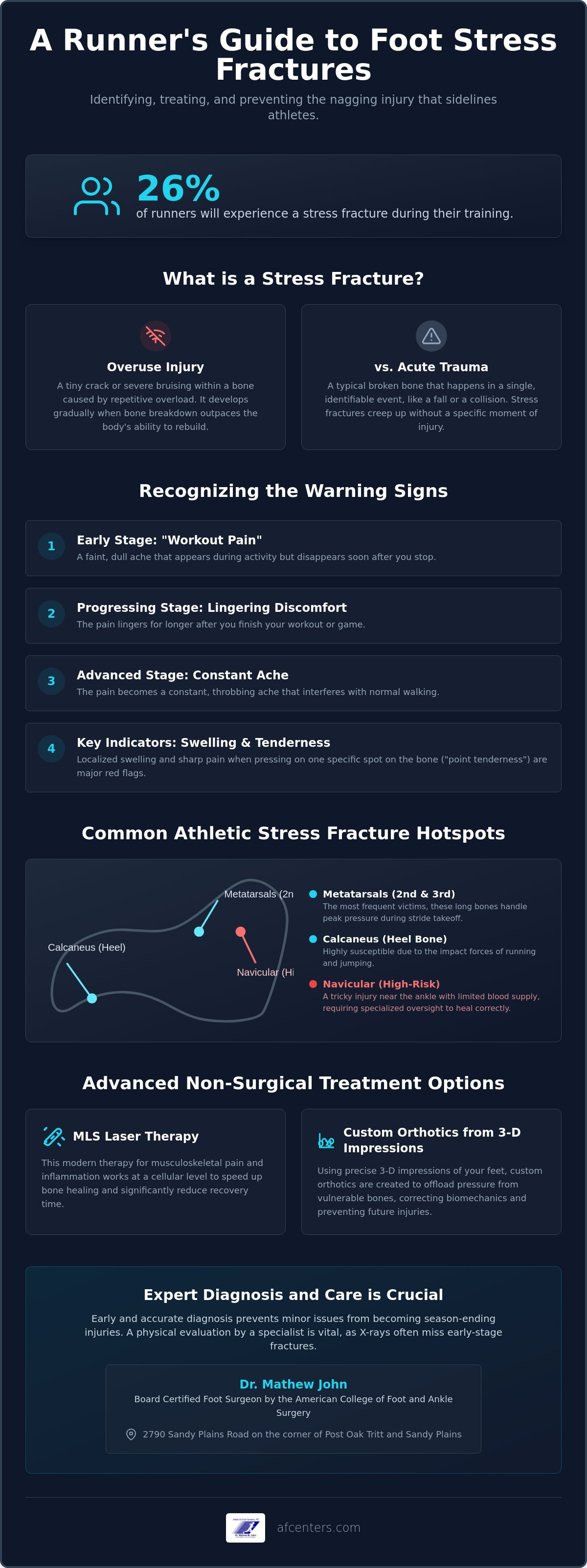
Did you know that over 26 percent of runners will face the nagging pain of a stress fracture at some point in their training? It usually starts as a faint ache that you try to push through, but soon, that "walk it off" mentality feels like it's making the injury worse. If you're feeling anxious about long-term immobilization or the possibility of surgery, you aren't alone. Finding the right foot stress fracture treatment Marietta athletes can rely on is the most important step in protecting your long-term mobility.
We understand your frustration with slow recovery times and the desire to get back to the activities you love. You'll learn how to identify, treat, and prevent these injuries with advanced podiatric care. Dr. Mathew John, a Board Certified Foot Surgeon by the American College of Foot and Ankle Surgery, provides the expert guidance you need at our clinic located at 2790 Sandy Plains Road on the corner of Post Oak Tritt and Sandy Plains. We will preview modern options like MLS Laser Therapy to speed up bone healing and the use of 3-D impressions for custom orthotics, ensuring you have a clear, safe roadmap for returning to your sport.
Key Takeaways
- Discover how specialized foot stress fracture treatment Marietta athletes rely on can help you distinguish between simple training soreness and serious bone bruising in the metatarsals.
- Learn to recognize critical warning signs, such as localized swelling and pain that shifts from exercise-only discomfort to a persistent, constant ache.
- Explore advanced non-surgical options like MLS Laser Therapy, which works alongside traditional RICE protocols to accelerate cellular bone repair and reduce inflammation.
- Identify when high-risk fractures require the reconstructive expertise of Dr. Mathew John, a Board Certified Foot Surgeon by the American College of Foot and Ankle Surgery.
- Understand the "Return to Play" framework and how 3-D impressions for custom orthotics can offload pressure from vulnerable bones to prevent future injuries.
Understanding Foot Stress Fractures and Bone Health
A stress fracture isn't like a typical broken bone that happens in an instant. Instead, it is a tiny crack or severe bruising within the bone caused by repetitive overload. If you’ve been wondering what is a stress fracture, think of it as the result of your bones being pushed beyond their current structural limit. Before a full crack appears, you might experience a "stress reaction." This is essentially a state of bone exhaustion where the internal structure begins to weaken. Identifying these subtle changes early is where professional guidance becomes invaluable. Dr. Mathew John, a Board Certified Foot Surgeon by the American College of Foot and Ankle Surgery, specializes in detecting these early warning signs before they sideline you for the season.
Acute Trauma vs. Overuse Injuries
Most people associate broken bones with a specific fall or a dramatic collision on the field. These are acute injuries. Stress fractures are different because they are overuse injuries that creep up without a single, identifiable event. For runners and court athletes in our community, the cause is almost always repetitive overload. Bone remodeling is a natural process where your body replaces old bone with new tissue, but this system fails when the rate of breakdown from overtraining outpaces the body's ability to rebuild. When you don't give your feet enough time to recover between sessions, those micro-cracks don't heal; they grow into painful injuries.
Common Locations for Athletic Stress Fractures
Your feet bear the brunt of every step, especially on the hard concrete paths at local Marietta parks or the rigid courts where many local teams practice. The second and third metatarsals are the most frequent victims because these long, thin bones handle the most pressure during your stride's takeoff phase. The heel bone, or calcaneus, is also highly susceptible to these tiny fractures. However, some areas are more dangerous than others. Navicular stress fractures, located near the top of the ankle, are particularly tricky because this bone has a limited blood supply. These high-risk injuries require specialized surgical oversight to ensure they heal correctly without long-term complications. If you are searching for effective foot stress fracture treatment Marietta athletes can trust, our team at 2790 Sandy Plains Road on the corner of Post Oak Tritt and Sandy Plains is here to guide your recovery journey.
Recognizing Symptoms and Seeking Expert Diagnosis in Marietta
Identifying a stress fracture early is the best way to ensure a fast recovery. Many athletes initially mistake the dull ache for a minor strain, but the pain typically follows a predictable path. It often begins as a faint discomfort during a workout that disappears once you stop. As the injury progresses, the pain lingers longer after you finish your run or game, eventually becoming a constant, throbbing ache that interferes with walking. Unlike a sprain, which often involves generalized swelling around a joint, a stress fracture usually presents with localized swelling and tenderness directly over the bone. If you suspect an injury, seeking foot stress fracture treatment Marietta athletes trust can prevent a small crack from becoming a complete break.
One of the biggest challenges in self-diagnosis is that standard X-rays are often misleading during the first few weeks. Because the micro-crack is so small, it might not appear on film until your body begins the healing process and forms a callus around the break. This is why a comprehensive physical evaluation at our office, located at 2790 Sandy Plains Road on the corner of Post Oak Tritt and Sandy Plains, is so vital. We don't just look at the bone; we look at the entire mechanical structure of your foot to understand why the injury occurred.
The 'Point Tenderness' Test
During your evaluation, Dr. Mathew John, a Board Certified Foot Surgeon by the American College of Foot and Ankle Surgery, uses specific palpation techniques to pinpoint bone sensitivity. If pressing on one specific spot on the top of your foot causes sharp pain, it's a major red flag for a metatarsal issue. Swelling in this area is also a significant indicator of bone distress. You should follow this simple checklist: if your pain persists for more than three days of rest, or if you notice visible swelling on the top of your foot, it's time to seek a professional evaluation. Catching it early often means the difference between a few weeks of rest and months of immobilization.
Advanced Diagnostic Technology
When standard imaging isn't enough, we utilize advanced diagnostic protocols to confirm micro-fractures. Current guidelines on foot stress fracture treatment and recovery emphasize that early confirmation is key to avoiding long-term displacement or a "non-union," where the bone fails to heal. Dr. John also evaluates your gait and biomechanics to find the root cause of the repetitive overload. This might involve looking at your wear patterns or foot structure to see if you're putting uneven pressure on certain bones. If you're concerned about persistent pain, you can explore our specialized sports medicine services to get an accurate diagnosis and a clear path forward.
Advanced Foot Stress Fracture Treatment in Marietta
Recovery starts with the basics, but modern science offers much more than just sitting on the sidelines. While the traditional RICE protocol (Rest, Ice, Compression, and Elevation) is a foundational part of any recovery plan, it often isn't enough for athletes who want to return to their peak performance quickly. Providing effective foot stress fracture treatment Marietta residents can rely on means combining these time-tested methods with cutting-edge regenerative technologies. This dual approach ensures that you aren't just waiting for the bone to knit back together; you're actively supporting the biological environment required for a full recovery.
If a fracture is slow to heal or located in a high-risk area, you may need an advanced treatment for stress fractures to stimulate the body's natural repair mechanisms. Dr. Mathew John is a Board Certified Foot Surgeon by the American College of Foot and Ankle Surgery, and he oversees every aspect of this recovery process at our clinic located at 2790 Sandy Plains Road on the corner of Post Oak Tritt and Sandy Plains. We prioritize non-invasive solutions that help you avoid the operating room whenever possible. Your health is our priority.
Regenerative Therapies: MLS Laser and ESWT
MLS Laser Therapy is a breakthrough for managing musculoskeletal pain and inflammation. It uses specific wavelengths of light to penetrate deep into the tissue, triggering cellular repair and reducing the time you spend in pain. For more stubborn or recalcitrant bone injuries, we often recommend Extracorporeal Shockwave Therapy (ESWT). This treatment uses acoustic pressure waves to stimulate blood flow at the site of the bone injury, effectively restarting the healing process in areas where circulation might be poor. You can explore our services to see a full list of available therapies that accelerate your journey back to the field.
Swift Treatment for Athletes
Maintaining total foot health is essential because even a minor issue can change how you walk. For instance, athletes struggling with stubborn plantar warts often shift their weight to avoid discomfort, which creates an uneven load on the metatarsals and leads to stress fractures. We offer Swift Treatment, an advanced solution for recalcitrant warts that uses microwave ablation technology. This protocol typically involves four sessions spaced one month apart. Since there is absolutely no downtime, you can stay active while we address the underlying cause of your gait changes. To ensure long-term stability, we also use 3-D impressions to create protective custom orthotics that offload pressure from vulnerable bones. These specialized inserts provide the precise support your unique foot structure requires.
When Surgery is Necessary: Reconstructive Expertise
While most bone stress injuries respond well to rest and the regenerative therapies we've discussed, some cases require a more definitive intervention. Certain "high-risk" locations, such as the navicular bone or the base of the fifth metatarsal, are notorious for their poor blood supply. In these areas, a tiny crack can easily progress to a complete break or fail to knit back together entirely. When conservative methods aren't enough, foot stress fracture treatment Marietta athletes trust shifts toward surgical stabilization to ensure a safe and permanent return to sport.
The decision to move forward with surgery is always made with your long-term goals in mind. Dr. Mathew John is a Board Certified Foot Surgeon by the American College of Foot and Ankle Surgery, bringing a high level of technical precision to every procedure. The primary goal of reconstructive surgery is to stabilize the bone and ensure perfect alignment, preventing future gait imbalances that could lead to secondary injuries. By addressing the structural root of the problem, we help you build a stronger foundation for your future athletic pursuits.
Surgical Stabilization Techniques
Rehabilitation and the Sandy Plains Road Recovery Plan
Your journey doesn't end when the surgery is over; it's just the beginning of a guided transition back to activity. The surgical recovery timeline typically involves a period of non-weight-bearing to allow the bone to fuse, followed by a structured physical therapy program. We provide mentor-like support throughout this process at our office located at 2790 Sandy Plains Road on the corner of Post Oak Tritt and Sandy Plains. We'll monitor your progress closely, moving you from a protective boot back to your favorite running shoes with confidence and care. If you're concerned about a slow-healing injury, contact us today to discuss our reconstructive surgery options and get back on the path to peak performance.
Recovery and Prevention: Returning to Your Active Lifestyle
The final phase of your recovery is the most rewarding part of the journey: the transition back to the trails, courts, and gyms of Marietta. However, this is also the period where patience is your greatest asset. A successful "Return to Play" protocol isn't about testing your limits immediately. It's about a structured, gradual increase in activity that allows your bones to adapt to new loads. When you seek the foot stress fracture treatment Marietta experts provide, you aren't just getting a temporary fix; you're gaining a long-term partner in your athletic health. Our goal is to ensure that when you return to your sport, you do so with a foundation that is stronger than before.
Dr. Mathew John, a Board Certified Foot Surgeon by the American College of Foot and Ankle Surgery, emphasizes that recovery is a personal journey. We provide the steady hand you need to navigate the transition from healing to peak performance. Our clinic, located at 2790 Sandy Plains Road on the corner of Post Oak Tritt and Sandy Plains, serves as a local hub for athletes who refuse to let a bone injury define their future.
The Precision of 3-D Impressions
Generic, store-bought inserts often fall short because they don't account for the unique geometry of your stride. We utilize 3-D impressions to capture the exact contours of your feet, allowing us to craft custom orthotics that provide medical-grade support. These devices are essential for correcting biomechanical issues like overpronation or high arches, which are often the hidden culprits behind repetitive stress fractures. By offloading pressure from vulnerable bones, custom orthotics act as a protective shield during high-impact activities. We invite you to schedule a biomechanical evaluation to see how specialized medical footwear can stabilize your gait and enhance your comfort.
Proactive Bone Health and Prevention
Prevention is a holistic lifestyle choice that requires consistent attention to how you train. One of the most effective ways to avoid re-injury is the "10 percent rule," which means never increasing your workout intensity, duration, or mileage by more than 10 percent per week. This steady progression gives your skeletal system the necessary time to remodel and strengthen. You should also incorporate cross-training, such as swimming or cycling, to reduce the constant impact on your metatarsals. Surface selection also matters; alternating between soft trails and hard pavement can help distribute stress more evenly across your feet. Regular check-ups at Ankle & Foot Centers, PC allow us to monitor for early signs of overuse. We're here to help you stay ahead of injuries and maintain the vitality you need for an active life.
Step Forward Toward Your Peak Performance
Recovery from a bone stress injury doesn't have to be a lonely or frustrating process. By prioritizing an accurate diagnosis and utilizing advanced technologies like MLS Laser Therapy and custom orthotics made from 3-D impressions, you can protect your long-term mobility. Whether you require conservative guidance or specialized reconstructive expertise, finding the right foot stress fracture treatment Marietta athletes trust is the key to a successful return to play.
Dr. Mathew John is a Board Certified Foot Surgeon by the American College of Foot and Ankle Surgery. He is dedicated to helping you achieve your personal health goals at our clinic, conveniently located at 2790 Sandy Plains Road on the corner of Post Oak Tritt and Sandy Plains. Don't let a small crack become a major setback for your athletic lifestyle. We are here to provide the expert, professional support you deserve.
Schedule Your Foot Stress Fracture Evaluation with Dr. Mathew John today and take the first step toward a stronger foundation. You have the power to overcome this injury; we are here to guide you every step of the way.
Frequently Asked Questions
How do I know if my foot pain is a stress fracture or just a strain?
Stress fractures typically cause "point tenderness," which is sharp pain felt when pressing on one specific spot on the bone. Soft tissue strains usually produce a more generalized, dull ache across a muscle group or joint. If your pain worsens during activity, lingers after you stop, and is accompanied by localized swelling on the top of your foot, it is likely a bone injury rather than a simple strain.
What is the typical recovery time for foot stress fracture treatment in Marietta?
Most athletes require six to eight weeks of modified activity for a bone to heal completely. The exact timeline for foot stress fracture treatment Marietta depends on the location of the injury and how early it was diagnosed. High-risk areas like the navicular bone may take longer. We often use MLS Laser Therapy during this period to manage inflammation and support the body's natural repair processes.
Does insurance cover custom orthotics made from 3-D impressions?
Many insurance plans provide coverage for custom orthotics when they are medically necessary to treat a diagnosed condition or prevent recurring injuries. We use 3-D impressions to ensure the most accurate fit possible for your unique foot structure. Because every plan is different, we recommend contacting your provider to verify your specific benefits for durable medical equipment and custom foot supports.
Can MLS Laser Therapy really help my bone heal faster?
MLS Laser Therapy is highly effective at reducing the intense inflammation and musculoskeletal pain associated with stress fractures. By using specific wavelengths of light, the treatment stimulates cellular activity and improves local circulation. This creates an optimal biological environment for the bone to knit back together. It is a non-invasive, painless option that helps you move through the initial phases of recovery more comfortably.
Why should I see a Board Certified Foot Surgeon for a stress fracture?
A Board Certified Foot Surgeon by the American College of Foot and Ankle Surgery has the specialized training to identify subtle bone changes that might be missed elsewhere. Dr. Mathew John understands the complex mechanics of the athletic foot. This expertise is vital for determining if your injury can be managed with conservative care or if it requires surgical stabilization to prevent long-term displacement.
What happens if I continue to run on a stress fracture?
Continuing to run on a weakened bone can turn a microscopic crack into a full, displaced break. This often leads to a "non-union," where the bone fails to heal on its own, potentially requiring invasive reconstructive surgery. Ignoring the pain also causes you to shift your weight unnaturally. These gait changes often lead to secondary injuries in your other foot, ankles, or knees, further delaying your return to sport.
Is Swift Treatment safe for athletes with warts while recovering from an injury?
Yes, Swift Treatment is a safe and highly effective option for athletes dealing with stubborn plantar warts during their recovery. It utilizes microwave ablation technology to target the source of the wart without damaging the surrounding tissue. The protocol involves four sessions spaced one month apart. There is no downtime afterward, so it won't interfere with your physical therapy or non-weight-bearing requirements.
Do I need a referral to visit your Sandy Plains Road location?
Most patients don't need a formal referral to visit our office at 2790 Sandy Plains Road on the corner of Post Oak Tritt and Sandy Plains. We welcome athletes from across the community who are seeking expert care for sports injuries. While we accept most major insurance plans, it's always a good idea to check with your specific carrier to see if they have any unique requirements for specialist visits.


