
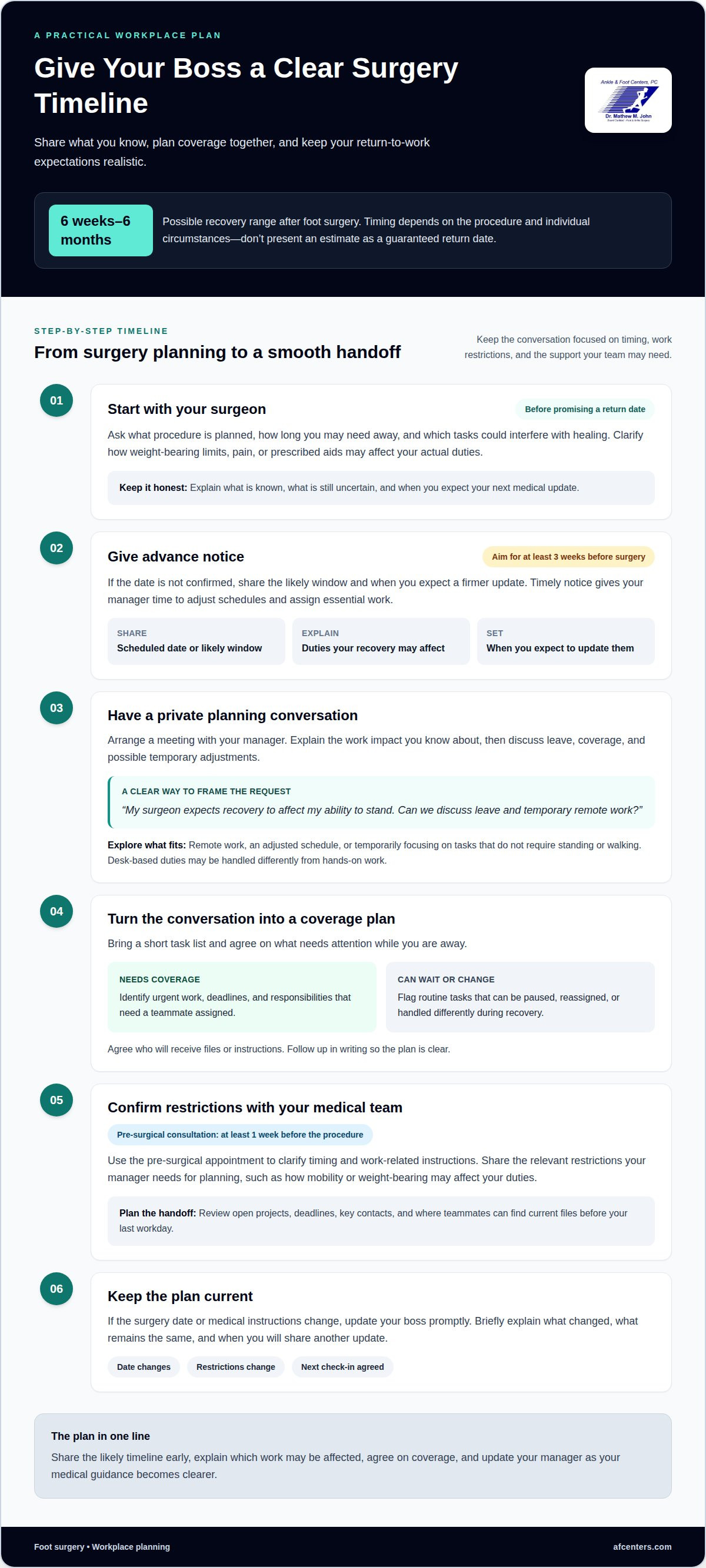
A clear plan is more persuasive than leaving your boss to guess what recovery will involve. If you’re figuring out how to convince your boss you need foot surgery, share your expected time away and ask for it at least three weeks before surgery. Recovery may take 6 weeks to 6 months, depending on the procedure and your individual circumstances.
It’s understandable to worry about how your absence could affect your team or how your request will be received. A calm, practical conversation can help you explain what you know, discuss coverage for your work, and explore remote work if it is feasible during recovery.
This guide will help you prepare what to say, give your employer useful advance notice, and plan possible workplace accommodations. You’ll also learn how to discuss leave options and frame the conversation around a realistic recovery plan, so you can focus on healing while helping your workplace prepare.
Key Takeaways
- Prepare a practical request that explains the time away you expect and how your work could be covered.
- Discuss whether remote work or temporary changes to your duties could fit your recovery needs.
- Ask your surgeon for documentation that explains relevant work restrictions and expected time away.
- According to the U.S. Department of Labor, the Family and Medical Leave Act provides certain eligible U.S. employees with up to 12 weeks of unpaid, job-protected leave per year.
- Learn how to frame an accommodation request and what details can help your employer plan.
1. Discussing time off work and possible remote work
Start with your surgeon, not a promised return date. Ask your doctor what procedure is planned, how long you may need away, and which tasks could interfere with healing. Recovery after foot surgery may take 6 weeks to 6 months, depending on the procedure and individual factors. A job spent at a desk may require different planning from work involving standing, walking, or lifting.
Tell your boss when you have a realistic surgery window. Explain what you know, what is still uncertain, and when you expect an update from your doctor. You might say, “My surgeon expects recovery to affect my ability to stand. Can we discuss leave and temporary remote work?” If you’re figuring out how to convince my boss I need foot surgery, a specific request is more useful than general claims.
Bring options, not assumptions. Ask whether you could handle essential duties remotely, adjust your schedule, or temporarily focus on tasks that don’t require standing or walking. For example, a role involving customer calls may allow remote work, while hands-on duties may need coverage. Explain what you can do comfortably and what your surgeon’s restrictions may prevent.
The Family and Medical Leave Act provides certain eligible U.S. employees with up to 12 weeks of unpaid, job-protected leave per year, according to the U.S. Department of Labor. The U.S. Department of Labor lists having worked for the employer for at least 12 months as one eligibility requirement for leave provided annually. It also lists at least 1250 hours for the employer in the last 12 months as a requirement for leave provided annually. Another listed requirement is an employer with 50 or more employees within 75 miles of the employee’s job site. Ask your human resources contact how your workplace handles leave requests and required paperwork.
Short-term disability benefits may replace part of your income during recovery, rather than protect your job. Coverage could pay up to 60% of base salary if you have it before your medical leave starts. Review your plan’s terms and ask the benefits administrator about eligibility, claim forms, and when to submit them.
Before agreeing to a return date, ask your doctor how weight-bearing limits, pain, and prescribed aids could affect your actual duties. Share the relevant restrictions with your boss and suggest a date to check in. A clear plan can cover time off first, followed by a gradual return or flexible schedule as healing progresses.
2. Giving your boss advance notice
Tell your boss when your foot or ankle surgery date is scheduled. Aim to give at least three weeks’ notice before surgery so your workplace can plan coverage. If the date is still being arranged, share the likely window and when you expect a firmer update. A timely conversation gives your manager time to adjust schedules and assign essential work.
Before the meeting, write down three details: your scheduled date, the duties affected, and when you expect to provide an update. Your medical team at Ankle & Foot Centers, PC can explain how the procedure may affect mobility, weight-bearing, or crutch use. Don’t present a recovery estimate as a fixed return date. Instead, explain the restrictions you know and when you’ll discuss your progress with your doctor.
Arrange a private meeting with your manager, then follow up in writing. You could say: “My foot surgery is scheduled for next month on a Friday. I’d like to plan coverage for duties I can’t perform during recovery.” Give a practical example, such as transferring in-person appointments to a team member or preparing a handoff for an active project.
Bring a short task list that separates urgent work from duties that can wait. For example, identify a weekly report that needs backup and a routine task that can be paused. Ask your boss which responsibilities need immediate coverage and agree on who will receive files or instructions. This keeps the conversation focused on planning, rather than leaving colleagues to guess what you need.
If your surgery date or medical instructions change, update your boss promptly. Briefly state what changed, what remains the same, and when you’ll share another update. For instance, explain that your doctor adjusted the planned date, then confirm whether your handoff meeting still works. Clear updates help your manager revise the schedule without relying on assumptions.
Schedule a handoff before your last workday. Review open projects, deadlines, key contacts, and where teammates can find current files. If your job involves walking between locations, explain which physical tasks may be affected and identify work that can be reassigned. Raise practical issues early, such as whether crutches or limited mobility could affect how you enter the workplace.
Use the pre-surgical appointment to clarify questions about timing and restrictions. A pre-surgical consultation is recommended at least one week before the procedure. Ask your doctor which instructions may affect work, then share only the details your manager needs for planning. A clear timeline, task handoff, and scheduled update make advance notice useful for you and your team.
3. Post-surgery workplace accommodations
Build your accommodation request around your surgeon’s weight-bearing instructions and your actual job tasks. After rear foot or ankle reconstruction, fusion, or osteotomy, patients may need a cast, removable CAM walker, or crutches and may remain non-weight-bearing for six to eight weeks. This can affect commuting, moving between work areas, and standing during meetings. Ask which duties need temporary coverage and which could be adjusted.
For a desk role, suggest a workstation where you can keep your operative foot elevated. After foot surgery, patients may be able to walk and bear weight on the operative foot, but usually need to stay off it and keep it elevated most of the time. Swelling can make a long commute or extended time at a desk uncomfortable. Discuss remote work, shorter shifts, or breaks that fit your medical instructions.
If your job requires walking, identify specific changes instead of making a broad request. You might ask to handle phone-based tasks, avoid carrying items while using crutches, or work in one accessible area. The walking aid needed after surgery depends on weight-bearing instructions, balance, and arm and upper-body strength. When preparing to transition back to full activity, rehabilitation practices like Functional Movement Physio highlight how gait analysis helps ensure you walk safely without compensatory strain. Explain which restrictions affect your duties, then agree on who will cover tasks you cannot safely perform.
Consider the route from the entrance to your desk, meeting rooms, and restroom. The page recommends clearing pathways to at least 36 inches wide for crutches or a walker during recovery. At work, ask whether furniture or stored boxes can be moved from your route. If your role includes stairs or frequent trips across a building, discuss a temporary alternative with your manager.
A surgical shoe may also affect your work plan. After many podiatric surgeries, patients may need to wear one for two to four weeks. Ask your doctor whether your footwear or mobility aid affects driving, walking through the workplace, or a required uniform. A bunion procedure and a more extensive reconstruction can involve different instructions, so base your request on your procedure, not a coworker’s experience.
Set a review point with your manager after receiving updated guidance from your foot and ankle specialists. Use that conversation to adjust duties, hours, or remote-work arrangements as mobility changes. Don’t treat a scheduled date as proof that your foot feels normal. If swelling or a new restriction affects a task, contact your medical team and ask whether you should schedule an appointment before changing your work routine.
4. What medical documentation should I provide my employer for foot surgery?
Start with the forms your employer uses for medical leave or workplace adjustments. Ask your manager or human resources contact which form applies, who receives it, and how to submit it. This keeps your request organized and helps you avoid sending a full medical record when a focused note can explain your work needs.
Ask your surgeon for a concise letter stating the procedure date and expected time away from work. The letter can also describe relevant restrictions, such as limits on standing, walking, driving, or carrying items. Your employer needs practical information to plan coverage, while your doctor determines which restrictions accurately reflect your care.
Request details that connect medical instructions to your job duties. For example, a note might say you cannot stand for extended periods or need to keep your operative foot elevated. If you work at a desk, that can support a discussion about remote work or adjusted breaks. If you work on your feet, the restriction can help your manager plan temporary coverage.
Ask the medical office to distinguish the initial absence from any restrictions after your return. A sample note could say, “Out from [date] through [date], then limited standing until reassessment.” Use dates only when your care team can provide them. If your return timeline is still being assessed, ask the office to describe the next review point instead.
Keep supporting paperwork in a simple folder. Include your employer’s leave form, the surgeon’s note, submission confirmation, and any updated restriction letter. Label each file with its date and purpose. If your employer requests a revised form after a follow-up appointment, send the new document through the same approved channel.
Share only the information needed for the workplace decision. A diagnosis or detailed treatment history may not help a manager arrange coverage; specific functional limits usually make the request clearer. Send clinical paperwork to the designated human resources contact rather than sharing it with coworkers. Keep a copy of every document and response.
Before sending paperwork, compare the dates and restrictions across each form. If a document lists a different absence period, contact the medical office to correct the discrepancy. Then write a brief cover message identifying the attached form and the accommodation it supports. For example, connect a standing restriction to temporary seated duties, not unrelated personal details.
As recovery progresses, request updated documentation when your surgeon changes your restrictions. A follow-up note can clarify whether you can resume commuting, walking between work areas, or regular duties. Give your manager the revised work information and keep medical discussions with your healthcare team. This creates a clear record without asking your boss to interpret clinical instructions.
5. Does the Americans with Disabilities Act require workplace accommodations for foot surgery?
The surgery name alone doesn’t determine which workplace change suits you. Describe how recovery affects specific duties, then ask your human resources contact how to submit an accommodation request. For example, explain that your role requires standing while your medical instructions limit how long you can remain on your feet.
Make the request practical. Identify the task you can’t perform, the change that could help, and how it affects your work. You might request seated duties for tasks usually done standing. Or, if commuting is difficult, ask whether remote work could cover duties you can perform from home.
Support your request with documentation focused on work-related restrictions. A note from your surgeon can explain limits on walking, standing, or using stairs without sharing unrelated medical details. If you need to elevate your foot, explain when that affects your workday. A clear example helps your manager understand the change you’re requesting.
Consider whether the proposed adjustment addresses the actual barrier. A desk-based task won’t solve a job that requires frequent movement across a worksite. In that case, ask about temporarily reassigning those duties or changing your schedule. Match each suggestion to a specific restriction instead of requesting a broad change without explaining its purpose.
Keep the conversation focused on your ability to work and the restrictions your care team provides. Your manager can explain workplace procedures, while your surgeon can describe medical limits. If an initial idea doesn’t fit, offer another option. For instance, discuss shorter shifts, remote tasks, or a temporary change in responsibilities.
Record the request and response in writing. After a meeting with human resources, send a short recap listing the adjustment discussed, the duties affected, and any next step. Keep copies of relevant medical notes and workplace messages together. If your surgeon updates your restrictions, submit the revised information through the same workplace process.
Plan to revisit the arrangement as recovery changes. A restriction on standing may affect your first return differently from later workdays. Agree with your manager when to discuss updated medical guidance and whether your current duties remain workable. Don’t resume tasks that conflict with your surgeon’s instructions just to meet a schedule.
For a productive discussion, bring three things: the relevant restriction, an example of an affected task, and a workable adjustment to consider. That keeps your ADA conversation grounded in your actual foot surgery recovery, rather than assumptions about what every employee needs.
Ankle & Foot Centers, PC: Reconstructive Foot and Ankle Surgery
Ankle & Foot Centers, PC offers Reconstructive Foot and Ankle Surgery for conditions that may require surgical care. If persistent symptoms or a structural problem affect your mobility, a podiatry appointment can help you discuss your condition and possible next steps with a foot specialist. Dr. Mathew M. John is board certified by the American Board of Foot and Ankle Surgery. Understanding your treatment plan can also help you explain expected work restrictions and recovery needs to your employer.
For guidance about foot or ankle surgery, contact Ankle & Foot Centers, PC.
Take Your Next Step With Confidence
A conversation with your boss doesn’t have to settle every detail at once. Treat it as the start of a practical plan that can change as your care and work needs become clearer. If you’re considering how to explain that you need foot surgery, focus on your health needs and the work decisions ahead.
Make room for your own questions, too. Understanding the treatment being considered and what it means for your daily routine can help you approach work decisions with greater clarity. Share relevant information, discuss a workable plan, and take each conversation one step at a time.
For support with your foot health, contact Ankle & Foot Centers, PC to discuss a path forward. Take the next step when you feel ready, with your health at the center of the plan.
Ankle & Foot Centers, PC for Foot and Ankle Care
Ankle & Foot Centers, PC offers reconstructive foot and ankle surgery and care for conditions such as bunions, hammertoes, heel pain, plantar fasciitis, and sports injuries.
If a foot problem is affecting your work and you are considering surgery, turn to Ankle & Foot Centers, PC to discuss your foot and ankle care options. The practice also offers custom orthotics, MLS Laser Therapy, and Extracorporeal Shockwave Therapy (ESWT).
Frequently Asked Questions
How do I talk to my boss about taking time off work for surgery?
Ask for a private conversation and state what you need to decide together: leave dates, coverage, or a temporary duty change. Bring a simple outline of deadlines, recurring tasks, and the colleague who could cover each priority. You could say, “I’m planning surgery and would like to discuss a workable coverage plan.” Follow up with a brief written recap so you both have the same next steps.
How long will I be off work or convalescing?
Time away depends on the procedure and the physical demands of your job. Recovery after foot surgery may take 6 weeks to 6 months, while someone with a standing or walking job may need four to ten weeks off. A desk-based role may allow an earlier return, especially if duties can be adjusted. Ask your surgeon to relate recovery guidance to your actual work tasks, not just your job title.
What are my rights for taking medical leave for surgery?
Eligible employees may have job-protected leave under the Family and Medical Leave Act. The U.S. Department of Labor says FMLA provides up to 12 weeks of unpaid, job-protected leave per year to certain eligible employees. The law also requires employers to maintain eligible employees’ group health benefits during leave. Eligibility and employer coverage matter, so ask human resources which leave process applies to your situation.
How do I request medical leave for foot surgery from my boss?
Use your employer’s leave process and make your request in writing, even if you discuss it in person first. Include the anticipated absence dates, the work duties needing coverage, and when you expect to provide an update. Ask human resources which forms are required and where to send them. Keep copies of your request and any response so you can refer to the same information during later planning.
Does the Family and Medical Leave Act cover foot surgery and recovery?
Foot surgery may qualify for FMLA leave when the employee and employer meet the law’s requirements. According to the U.S. Department of Labor, eligibility includes working for the employer for at least 12 months and at least 1250 hours for the employer in the last 12 months for leave provided annually. The employer must also have 50 or more employees within 75 miles of the employee’s job site. Human resources can explain the workplace application process.
How long is recovery from common foot surgeries, and when can you return to work?
Recovery and return timing vary by procedure and job duties. After bunionectomy, hammertoe correction, Morton’s neuroma surgery, or heel spur surgery, someone with sedentary work may be able to return in a couple of days. A job involving frequent standing or walking can require more time away. Across Marietta, Roswell, Woodstock, Kennesaw, Atlanta, and Sandy Springs, work demands vary, so discuss your specific duties with your surgeon.
How should I explain the medical necessity and work limitations of foot surgery to my boss?
Explain the work impact without sharing more personal medical details than necessary. For example, say your treatment plan includes surgery and your condition makes a required task difficult. Then describe the relevant restriction, such as limited standing, and propose a practical adjustment. A note from your surgeon can document relevant restrictions and help your manager plan duties.
Can my employer deny time off for medically necessary foot surgery?
The answer depends on the leave protection involved and whether you meet its eligibility requirements. FMLA provides job-protected leave to certain eligible employees, but it isn’t automatically available to every worker or employer. If your request is denied, ask for the reason in writing and which workplace policy applies. You can then compare the response with your submitted leave paperwork and discuss next steps with human resources.


