

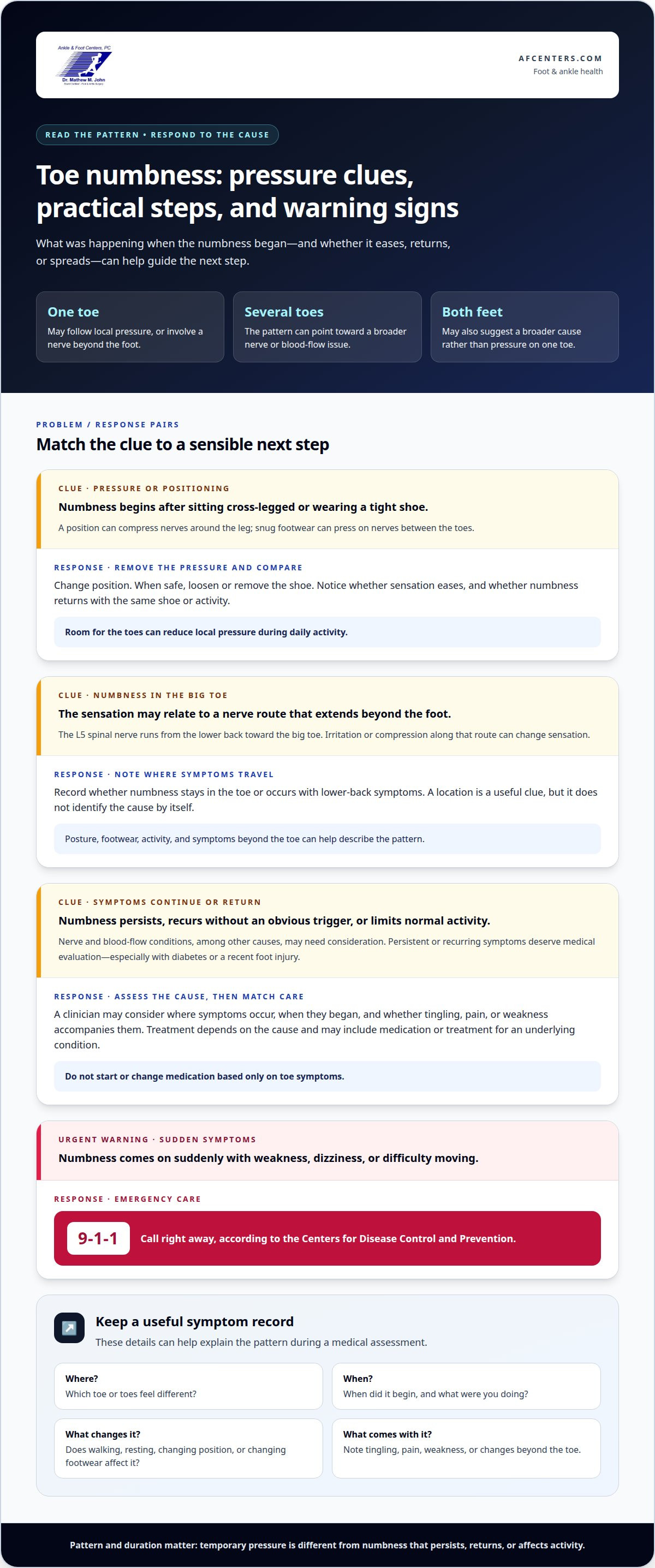
Numbness in one toe may come from pressure or a tight shoe, while numbness in several toes or both feet can point to a broader nerve or blood-flow issue. A doctor in Woodstock can help assess what the pattern and duration of your symptoms may mean. If numbness comes on suddenly with weakness, dizziness, or difficulty moving, call 9-1-1 right away, according to the Centers for Disease Control and Prevention.
It’s understandable to wonder whether numb toes will pass on their own or need attention. If you’re searching for a numbness in toes doctor in Woodstock, this guide explains common causes, what may help, and when persistent or recurring symptoms warrant medical evaluation. You’ll also learn why it matters whether numbness affects one toe, several toes, or both feet, and which accompanying symptoms call for urgent care. Paying attention to these details can help you choose a sensible next step without assuming the cause.
Key Takeaways
- Notice whether numbness affects one toe, several toes, or both feet; the pattern can help point toward a local pressure issue or a broader cause.
- Tight footwear or positioning can temporarily compress nerves, so pay attention to whether symptoms ease when the pressure is removed.
- Toe numbness can have several causes, including nerve and blood-flow conditions, so treatment depends on what’s behind the sensation.
- Persistent, recurring, or activity-limiting numbness deserves medical attention, especially if you have diabetes or a recent foot injury.
- If numbness comes on suddenly with weakness, dizziness, or trouble moving, the Centers for Disease Control and Prevention says to call 9-1-1 right away.
Temporary nerve compression from posture or footwear
A brief episode of toe numbness can follow pressure on a nerve. Sitting cross-legged, for example, can compress nerves around the leg, while a tight shoe can press on nerves between the toes. The sensation may ease after you change position or remove the shoe. Note what you were doing when it began and whether standing, walking, or changing footwear affects the numbness.
Footwear can affect both nerve pressure and circulation. Narrow toe boxes crowd the forefoot, and tight socks can squeeze the toes. If numbness starts during a walk in snug shoes, loosen or remove them when safe, then compare how your toes feel. Shoes with room for your toes can reduce local pressure during daily activity. Notice whether numbness returns with the same pair or activity.
Big toe numbness can also involve nerves beyond the foot. The L5 spinal nerve runs from the lower back toward the big toe, so irritation along that route can change sensation there. A pinched nerve in the lower back can occur when spinal nerves are compressed or irritated. Pressure from a herniated disc or spinal misalignment can affect the L5 nerve and contribute to numbness in the big toe.
The location of the sensation offers a useful clue, but it doesn’t identify the cause by itself. Numbness limited to the big toe after wearing tight shoes, for instance, differs from numbness accompanied by lower-back symptoms. Spinal cord damage, pinched nerves, and disc problems can all lead to nerve-related toe numbness. Record whether symptoms appear with a particular posture, shoe, or activity, and whether they extend beyond the toe.
Autoimmune conditions can also affect nerves and contribute to numbness. If you have an autoimmune condition, pay attention to new toe symptoms, especially if they recur or involve other areas. Numbness can reflect a nerve issue rather than footwear pressure alone. Note when it started, which toes feel different, and whether weakness or other changes occur. These details help you describe the pattern clearly during a medical assessment.
Try a simple comparison: notice the sensation before and after removing tight footwear, then observe whether a posture change affects it. A short-lived episode linked to pressure differs from numbness that continues, returns without an obvious trigger, or follows the L5 pathway from the back toward the big toe. Keep track of those changes alongside your daily activity. Persistent symptoms need attention, even if a shoe or posture first seemed responsible.
Treatment options for numb toes
Treatment depends on what is causing the altered sensation. A toe compressed by tight footwear calls for a different response than numbness linked to an underlying medical condition. A clinician considers where symptoms occur, when they began, and whether tingling, pain, or weakness accompanies them. Symptoms that start during a walk in narrow shoes, for example, offer a useful clue. The first goal is to identify the likely cause, then match care to it.
When shoe pressure seems responsible, changing footwear can be a practical first step. Choose shoes that give your toes room, and notice whether sensation changes during ordinary walking. If symptoms follow a particular pair, pause wearing it and compare how your toes feel in a better-fitting option. A footwear change won’t address every cause, but this comparison can help reveal whether local pressure contributes to the problem.
Other treatment options focus on an underlying condition. Depending on the cause, care may include medication or treatment for that condition. Numbness associated with a medical problem, for example, won’t necessarily resolve through shoe changes alone. Don’t start or change medication based only on toe symptoms. Share the timing, affected toes, and related symptoms with a healthcare professional so the proposed treatment addresses the suspected cause, not only the sensation.
A written treatment plan can clarify the suspected cause, recommended treatment, and next steps. It can also describe what changes to monitor, such as reduced tingling or easier physical activity. For care pricing, the price depends on the case and is given after a quote request; cost factors include the cause, recommended treatment, and whether additional care is needed. A clear written outline helps you understand how each recommendation relates to your symptoms and what progress to watch for.
Track your symptoms as treatment begins. Record which toes feel numb, when tingling occurs, and whether walking or resting changes it. Note, for example, whether symptoms improve after switching shoes or continue despite reduced pressure. These observations help show whether the current approach is addressing the likely cause. If numbness continues or returns, share the pattern and any changes in normal activity during follow-up care. Don’t treat temporary improvement as proof that an underlying cause has resolved.
If toe symptoms are affecting your movement, explore foot and ankle services as a next step toward understanding appropriate care. A treatment plan should connect the cause, the recommended approach, and the changes you can monitor in daily life.
When persistent numbness warrants medical attention
Persistent, recurring, or activity-limiting toe numbness deserves medical evaluation, especially if you have diabetes or a recent injury. Sudden symptoms with weakness, dizziness, or difficulty moving need emergency attention.
Evaluating Persistent Toe Numbness
Medical evaluation considers the numbness pattern, related symptoms, and possible underlying causes. Note which toes are affected, when symptoms began, and whether walking or rest changes them. Mention any recent injury, known diabetes, or medications you take. Those details help distinguish a local nerve problem from peripheral neuropathy or another condition and guide the next steps in care.
Choosing a Doctor for Toe Numbness
A primary care doctor, podiatrist, or neurologist may assess toe numbness, depending on its pattern and suspected cause. A podiatrist evaluates foot-related symptoms, while a neurologist focuses on nerves; primary care can assess broader health factors. If you’re unsure where to begin, describe the affected toes, duration, and any weakness when seeking care. Sudden emergency symptoms call for 9-1-1, not a routine appointment.
Timing can help you decide when to arrange an assessment. For suspected tarsal tunnel syndrome, seek evaluation when symptoms persist for more than 2-3 weeks, or sooner if you have diabetes. Numbness related to lumbar radiculopathy or a herniated disc warrants assessment if it lasts more than 1-2 weeks, recurs, or limits activity. For possible Morton’s neuroma, seek care when numbness persists beyond 2-3 weeks, keeps returning, or affects activity.
Don’t wait if numbness follows a recent foot injury or occurs with a pinched nerve or spinal cord damage. Diabetes also calls for attention because numbness can accompany nerve or blood-flow problems and may lead to serious foot complications. Peripheral neuropathy can cause numbness, weakness, or pain, so report these changes rather than treating them as ordinary soreness.
Call 9-1-1 right away if you or someone else has sudden foot numbness with weakness, dizziness, or difficulty moving, according to the Centers for Disease Control and Prevention. These symptoms can signal an emergency. Don’t drive yourself if movement or balance is affected.
Home care should not delay evaluation of persistent symptoms. If tight footwear seems to trigger numbness, reduce pressure with roomier shoes and notice whether sensation changes. Don’t start medications or supplements on your own to treat numbness; the right approach depends on its cause. Keep a brief record of symptoms and current medications to share during an assessment.
Conditions that can cause toe numbness
Toe numbness can arise from nerve changes, reduced blood flow, injury, or an underlying health condition. Diabetes can affect the signals nerves send to the extremities, contributing to peripheral neuropathy and reduced sensation. It can also reduce blood flow to the toes. You may notice numbness alongside weakness or pain, so recording these symptoms helps show how they change over time.
Peripheral artery disease can limit blood flow to the feet and cause numb toes. Autoimmune conditions may also affect nerves, while Raynaud’s syndrome can change blood flow in response to cold or stress. Primary Raynaud’s phenomenon is more common among women, people who smoke, and people younger than 30 years. Note whether symptoms appear in cold conditions, affect both feet, or occur with another known condition.
Morton’s neuroma is a nerve-related condition that can cause burning, tingling, or numbness in the adjacent third and fourth toes. This pattern may feel different from numbness across the whole foot. A recent accident can also leave a toe numb; after an injury, numbness may indicate a fracture requiring podiatric care. Persistent symptoms following an injury deserve assessment rather than being treated as ordinary soreness.
Spinal causes can reach the toes through nerves traveling from the lower back. A pinched nerve or disc problem may affect the L5 spinal nerve, which extends toward the big toe. This can contribute to altered sensation there. Notice whether numbness occurs with lower-back symptoms or follows a particular path down the leg. That pattern gives useful context, though it doesn’t establish the cause by itself.
Nutrient levels can matter, too. Vitamin B12 supports nerve-cell health, and deficiency may contribute to peripheral neuropathy. Low vitamin B1, or thiamine, may lead to nerve inflammation and numbness. Vitamin B9, or folate, also plays a role in nerve health. Both inadequate and excessive vitamin B6 can be harmful to nerves. Don’t assume supplements are the answer; describe symptoms and current supplements during an assessment.
Some nerve problems affect sensation even when routine nerve conduction results are normal. Small fiber neuropathy can cause sensory and autonomic symptoms despite normal nerve conduction studies. Lyme disease has also been associated with peripheral neuropathy and distal tingling. In a 1990 study of chronic neurologic Lyme disease, 19 of 27 patients had polyneuropathy associated with radicular pain or distal paresthesias. This example shows why persistent numbness needs context, not guesswork.
Numbness in one toe, several toes, or both feet
The number and location of numb toes can help describe the symptom pattern, but they don’t identify its cause alone. One toe, neighboring toes, and both feet can reflect different processes. Note the exact area, whether symptoms stay in place, and whether weakness or changes in balance accompany them. Numbness limited to one toe, for example, differs from a sensation spreading across both feet.
A single numb toe may point toward a local issue, such as footwear pressure or an injury. A tight shoe pressing near the big toe can affect sensation there, while an accident may leave one toe numb after damage. Notice whether the symptom began after a specific activity or event. One affected toe doesn’t rule out a nerve problem elsewhere, including irritation along the spinal pathway to the big toe.
Several neighboring toes can suggest a more localized nerve pattern. Morton’s neuroma commonly causes burning, tingling, or numbness in the adjacent third and fourth toes. Compare the location with footwear pressure and the activity that brings symptoms on. A repeated pattern in those toes differs from numbness across the whole forefoot. It still needs context, especially if symptoms persist, recur, or limit walking.
Numbness in both feet can involve a broader process affecting peripheral nerves or circulation. Diabetes can contribute to peripheral neuropathy and reduced blood flow, and peripheral artery disease can also reduce blood flow to the extremities. When several areas feel numb, note whether both feet are affected similarly or one side feels different. Include any weakness, changes in balance, or difficulty with ordinary walking in your symptom record.
Compare the pattern over time rather than relying on one moment. Write down which toes feel numb, whether symptoms shift between feet, and what activity was happening. Record footwear changes, recent injury, or a known condition such as diabetes. Arthritis may also affect foot comfort and shoe fit, but toe numbness alone doesn’t establish arthritis as the cause. These details help a clinician assess the whole pattern.
Seek evaluation when numbness continues, returns, or interferes with walking, regardless of whether one toe or both feet are involved. Sudden symptoms with weakness or difficulty moving need emergency attention, as covered earlier. For recurring foot symptoms, arrange an evaluation through foot and ankle care services. A clear description of the affected toes and accompanying changes helps guide that conversation.
Ankle & Foot Centers, PC: Reconstructive Foot and Ankle Surgery
Ankle & Foot Centers, PC can assess foot and ankle concerns when numbness persists, recurs, or affects walking. An evaluation can help determine whether a foot-related condition needs care; numbness alone doesn’t mean surgery is needed.
Dr. Mathew John is a Board Certified Foot Surgeon by the American College of Foot and Ankle Surgery. If an evaluation identifies a structural problem, such as a bunion or hammertoe, the care discussion can address appropriate options, including reconstructive foot and ankle surgery when indicated. The practice also treats ingrown toenails and fungal toenails.
If persistent toe numbness is affecting your daily activity, contact Ankle & Foot Centers, PC to discuss your next step.
Take the Next Step Toward Comfortable Movement
Toe numbness can make everyday movement feel less certain. Before your appointment, consider what you’d like to do more comfortably, such as walking, exercising, or keeping up with daily routines. If you’re looking for a doctor in Woodstock for numbness in your toes, bring those goals into the conversation. They can help focus attention on how the symptom affects your life.
A doctor in Woodstock evaluating numbness in your toes can use your description of its impact to guide a more useful discussion. Think about when the sensation disrupts your routine and what you most want to understand. These details help you take an active role in planning your next steps.
Ankle & Foot Centers, PC welcomes you to move forward at your own pace. Contact Ankle & Foot Centers, PC to start a conversation about your foot and ankle concerns. A clear next step can support greater confidence in your movement.
Ankle & Foot Centers, PC for Numbness in Toes
Ankle & Foot Centers, PC offers foot and ankle care, including diabetic foot care, neuromas, and custom orthotics. If numbness in your toes is a concern, turn to the practice for care related to your foot and ankle needs.
The practice also offers reconstructive foot and ankle surgery, bunion and hammertoe care, and treatment for heel pain, plantar fasciitis, fungal and ingrown toenails, warts, sports injuries, and flat feet.
Frequently Asked Questions
Should I worry about numbness in my toes?
Pay attention to whether numbness affects your awareness of minor foot irritation. If you have diabetes or reduced sensation, check your toes and soles regularly for cuts, blisters, or areas rubbed by shoes. A mirror can help you see the bottom of your feet. New skin changes, an unnoticed wound, or worsening symptoms are reasons to arrange medical attention rather than simply adjusting your routine.
What can cause a single toe to go numb?
A single numb toe can have a local cause or reflect irritation along a nerve pathway. To describe it clearly, note whether numbness affects the toe pad, top, one side, or the entire toe. Also record whether it began suddenly or gradually. If you’re seeking a doctor in Woodstock for numbness in your toes, these specific observations can make your description more useful than simply saying the toe feels strange.
How Do Doctors Evaluate Persistent Toe Numbness?
Doctors evaluate persistent toe numbness by matching your symptom history with examination findings. For a more productive visit, bring the shoes you wear most often and any inserts or orthotics you use. If you’ve had earlier foot or ankle imaging, bring those records too. These items can show how your usual footwear fits and give the clinician context for discussing the next step.
What If Only One Toe Is Numb?
If only one toe is numb, track whether the affected area stays the same or expands. Note any change in color, swelling, or ability to move the toe, and whether the symptom interferes with a specific task, such as pushing off while walking. This record can help distinguish a stable, localized symptom from one that is changing and needs more prompt attention.
What causes numbness in the toes?
Toe numbness can stem from several different processes, and more than one factor may be relevant. Nerve problems, circulation changes, injuries, and underlying health conditions are among the possibilities discussed earlier. The useful next step is not to guess from one symptom, but to share your overall health history and any recent changes with a clinician. That context helps narrow the possibilities.
When is toe numbness a medical emergency?
Sudden toe or foot numbness with new weakness, dizziness, or difficulty moving calls for emergency help rather than a routine appointment. Tell the emergency dispatcher when symptoms started and describe any changes since then. Don’t wait to see whether movement returns before seeking help. If you’re with someone experiencing these symptoms, stay nearby and help communicate what has changed.
What tests diagnose the cause of toe numbness?
No single test can diagnose every cause of toe numbness. A clinician chooses any further testing based on your history and examination, then explains what the test is intended to clarify. Ask how the result would affect the next care decision. This can help you understand why a test is being considered and how its findings fit with your symptoms.
How is toe numbness treated?
Treatment is chosen to address the suspected cause, rather than numbness as an isolated sensation. Ask what change the plan is intended to make and what should prompt a follow-up discussion. Don’t stop prescribed medication or add supplements without discussing it with a healthcare professional. If numbness changes while following a plan, note when it changed and how it affects daily tasks.


