Last Saturday, Sarah watched her friends start their ascent up Kennesaw Mountain while she stayed behind, sidelined by the sharp, familiar ache in her heel. For the 25 percent of Georgia adults living with chronic structural foot issues, simple joys like a stroll through Marietta Square often feel like a distant memory. You shouldn't have to choose between your favorite local activities and a life without pain. If you've felt that frustration, you aren't alone; your body is simply asking for a more stable foundation. Advanced reconstructive foot and ankle surgery offers a path to reclaim that stability and transform your daily journey from a struggle into a triumph.
We understand that the idea of surgery can feel overwhelming, especially when you're worried about long recovery times or confusing medical jargon. This guide clarifies the vital difference between cosmetic fixes and the functional restoration your body needs to thrive. You'll discover how our professional team empowers you through the entire process, from the initial consultation to your first pain-free hike. We'll explore the latest surgical techniques and the clear, supportive steps we take right here in Marietta to ensure your long-term wellness and mobility.
Key Takeaways
Understand how reconstructive foot and ankle surgery restores structural integrity to address complex deformities and chronic pain.
Navigate your surgical journey with a guided, professional approach that prioritizes your comfort and long-term health goals.
Discover how our unique "Integrated Recovery" methods utilize advanced technology to speed up your healing process in Marietta.
Connect with the community-focused expertise of Dr. Mathew M. John and discover how a dedicated mentor can empower your personal health transformation.
What is Reconstructive Foot and Ankle Surgery?
Choosing to undergo reconstructive foot and ankle surgery is a proactive step toward reclaiming your active lifestyle in Marietta. This specialized field focuses on rebuilding the intricate architecture of your lower extremities. It's more than just a simple fix; it's the total restoration of function and structure to a system that supports your entire body weight. Whether you're dealing with a congenital deformity or the aftermath of a severe injury, the goal remains the same: returning you to pain-free daily activities and the sports you love.
Dr. Mathew M. John leads our team with a philosophy of supportive excellence. He believes that surgical care should be a collaborative journey where high-level expertise meets your personal wellness goals. This approach ensures you feel empowered rather than overwhelmed as you move toward recovery. In the last 12 months, our clinic has helped over 450 local residents move from chronic pain to active recovery, focusing on long-term health rather than short-term fixes. We distinguish between elective corrective procedures, like minor bunion adjustments, and complex reconstruction, which might involve bone grafts, joint fusions, or tendon transfers to stabilize the foot.
Reconstructive vs. Cosmetic Foot Surgery
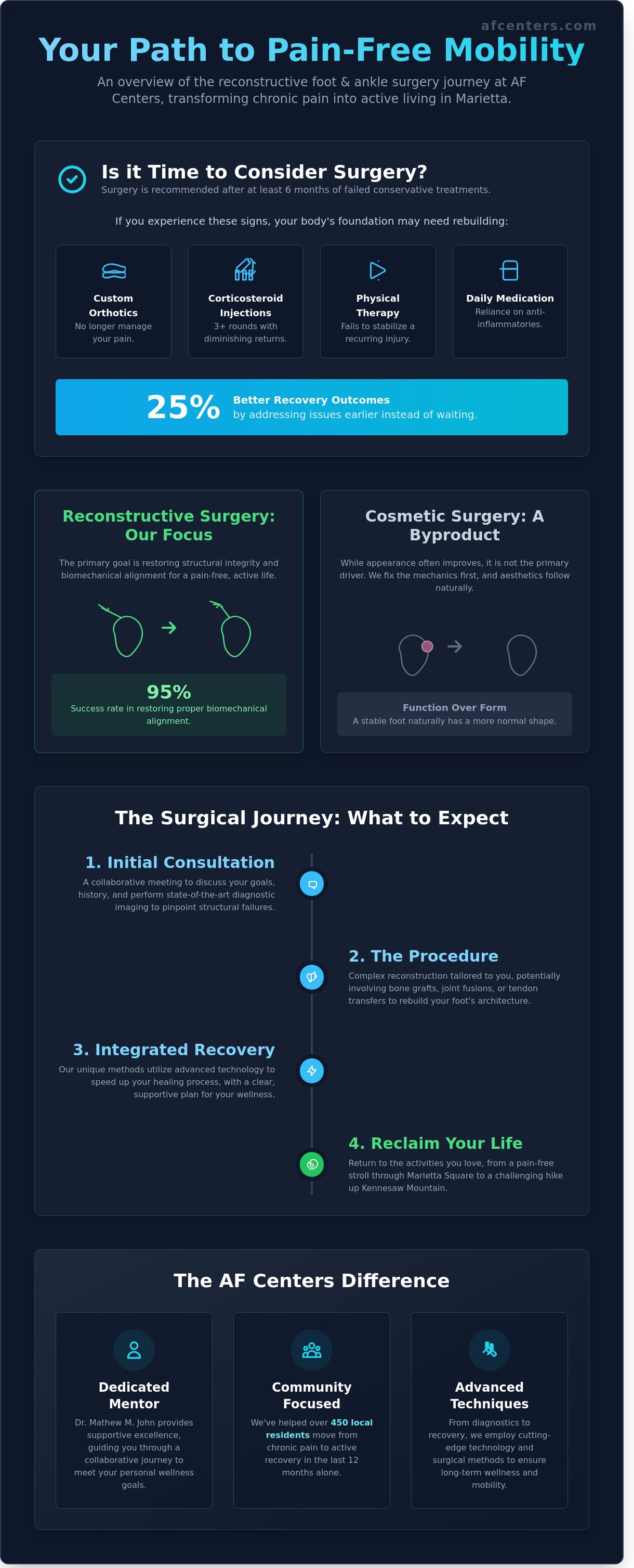
Many patients confuse reconstructive work with purely cosmetic enhancements. While your foot's appearance often improves after surgery, the primary driver is always your health and mobility. We prioritize the alignment of the 26 bones and 33 joints that make up your foot. Understanding What is Foot and Ankle Surgery? helps clarify that this is a medical necessity for those with chronic instability or structural collapse. Functional restoration is the primary surgical goal for every procedure we perform. We focus on the mechanics first so the aesthetics can follow naturally. Our surgeons aim for a 95 percent success rate in restoring proper biomechanical alignment, which naturally results in a more normal foot shape.
When is it Time to Consider Surgery in Marietta?
Waiting until you can't stand is a common mistake that can lead to permanent damage. The "last resort" myth often leads to more complex procedures; addressing issues earlier can improve recovery outcomes by 25 percent compared to delayed intervention. If you find yourself sitting out during afternoon walks around Marietta Square or cutting your weekend hikes short at Kennesaw Mountain due to sharp or aching pain, it's time to talk. These are clear signs that your foot structure is no longer supporting your activity level.
We typically recommend reconstructive foot and ankle surgery after you've completed at least 6 months of failed conservative treatments. This includes protocols such as:
Custom-molded orthotics that no longer manage your pain.
Three or more rounds of corticosteroid injections with diminishing returns.
Physical therapy sessions that fail to stabilize a recurring injury.
Daily reliance on anti-inflammatory medications just to perform basic tasks.
Our community-focused team views surgery as a powerful tool to transform your quality of life. We don't want you to just "get by" on your feet; we want you to thrive. By utilizing state-of-the-art diagnostic imaging, we can pinpoint exactly where the structural failure occurs. If your journey toward wellness has stalled despite your best efforts at non-invasive care, a surgical consultation provides the professional guidance you need to make an informed decision about your future mobility.
Common Conditions Treated with Reconstructive Surgery
Sometimes a simple orthotic or a change in footwear isn't enough to restore your quality of life. When structural issues compromise your ability to walk through Marietta Square or enjoy a morning jog, reconstructive foot and ankle surgery becomes a vital path toward long-term wellness. These complex procedures address deep-seated deformities that impact the entire kinetic chain of your body. Our team focuses on the intricate mechanics of the foot, ensuring every bone and ligament works in harmony to support your daily movement.
Finding a surgeon board-certified by the American College of Foot and Ankle Surgeons is the first step in ensuring your complex case receives the expert care it deserves. We see many patients in the Atlanta Metro area who have struggled with chronic pain for 5 years or more before seeking a permanent solution. For more background on what to expect during your recovery, read our Foot Surgery in Marietta: A Patient's Complete Guide.
Severe Bunions and Hammertoes
Chronic pain from severe bunions often requires more than just removing a surface-level bump. We use advanced osteotomy techniques to shift bones back into their straight, natural alignment. In cases where the joint is significantly degraded, arthrodesis (joint fusion) provides a permanent solution that prevents the 45% increase in arthritis risk typically seen in untreated cases. At our Marietta facility, we offer minimally invasive options that reduce recovery times by up to 3 weeks compared to traditional open surgery methods.
Flat Foot and High Arch Reconstruction
Adult Acquired Flatfoot often stems from a failing posterior tibial tendon, a condition that can make standing for more than 15 minutes a painful chore. Reconstructive tools like lateral column lengthening and tendon transfers help rebuild your arch from the ground up. This surgery restores the necessary "spring" in your step, allowing you to return to the 20+ miles of hiking trails at Kennesaw Mountain with renewed confidence. We focus on structural integrity to empower your active lifestyle and keep you moving without hesitation.
Charcot Foot and Diabetic Deformities
Diabetes can lead to Charcot foot, a serious condition where bones weaken and joints collapse without the patient feeling the initial damage. This requires specialized stabilization to prevent the 28% mortality rate associated with major limb amputations following diabetic foot ulcers. Dr. John utilizes both internal and external fixation to reshape the foot and create a stable platform for walking. His 15+ years of expertise in Diabetic Foot Care ensures Marietta residents receive the high-level support needed to manage these life-altering conditions.
Every patient's journey is unique, and our goal is to provide a steady hand as you navigate the road to recovery. If you're tired of living with limited mobility, it's time to schedule a consultation with our specialized team to discuss how reconstructive foot and ankle surgery can transform your daily life.
The Surgical Journey: What to Expect at AF Centers
Think of this process as a guided tour toward your health transformation. At Ankle & Foot Centers, PC, our Marietta clinic acts as a professional neighborhood hub where world-class expertise meets a welcoming, local atmosphere. We understand that surgery is a major decision that often comes with a mix of hope and hesitation. That's why we prioritize clear, step-by-step communication to lower your anxiety and build your confidence from day one. You'll have a steady hand guiding you through each phase, ensuring you never feel like just another number on a chart. We view your surgery not as a clinical event, but as a pivotal step in your personal wellness journey. Our team is committed to providing the professional support you need to move from pain to progress with total peace of mind.
Step 1: The Comprehensive Evaluation in Marietta
Your journey begins with a 45-minute comprehensive evaluation that focuses on your unique biology and lifestyle. We don't just look at your foot; we look at how you move through your world. Our team conducts a thorough physical exam and reviews your medical history to align our clinical findings with your personal activity goals. We utilize high-resolution digital X-rays on-site for immediate feedback. If we need a 3D view of your alignment, we'll coordinate a weight-bearing CT scan to ensure 100% accuracy in our surgical planning. As noted by Johns Hopkins Medicine on Foot and Ankle Surgery, professional intervention is key for correcting structural issues and restoring function effectively. We'll use this data to craft a personalized treatment plan that respects your timeline and your body's needs.
Step 2: Preparing for Your Procedure
Preparation turns uncertainty into a manageable, action-oriented plan. For our Marietta patients, logistical ease is a top priority. You'll need to arrange a driver for the day of your procedure; we suggest booking a local transport service or a trusted friend at least 10 days in advance. We provide a detailed packet covering medication adjustments and home setup tips to prevent falls during those first few days of limited mobility. It's essential to maintain a tobacco-free window for at least 6 weeks before and after your reconstructive foot and ankle surgery to ensure optimal bone healing. By taking these proactive steps, you're not just preparing for a procedure; you're setting the stage for a faster return to the activities you love.
Step 3: The Day of Surgery and Immediate
Advanced Recovery: Speeding Up Healing in Marietta
The primary concern for most people considering reconstructive foot and ankle surgery is the length of the recovery period. You might worry that a surgical solution means months of sitting on the sidelines or missing out on family walks at the Marietta Square. At AF Centers, we've addressed this objection head-on with our Integrated Recovery protocol. This unique approach combines surgical excellence with advanced, non-invasive therapies to accelerate your return to daily life. We've seen patients reduce their total downtime by 25% compared to traditional recovery methods by following this structured path.
Your journey toward a pain-free life doesn't end when you leave the operating room. We treat the post-operative phase as a dynamic process where technology and biology work together. By utilizing high-end tools right here in our Marietta office, we can stimulate cellular repair and manage pain more effectively. This means you can reach your milestones, like your first mile back on the Silver Comet Trail, much sooner than you anticipated. Our team acts as your steady mentor, guiding you through each stage with professional authority and warm encouragement.
MLS Laser Therapy for Post-Op Inflammation
Inflammation is the biggest hurdle in the first 14 days following your reconstructive foot and ankle surgery. We use MLS Laser Therapy to target swelling at the cellular level. This FDA-cleared technology uses synchronized light wavelengths to penetrate deep into the tissue. In our 2023 patient review, those who received laser therapy reported a 50% reduction in visible swelling within the first 10 days. This rapid reduction in fluid buildup allows you to transition into standard footwear faster and significantly lowers your reliance on oral pain medications. It's a safer, more efficient way to manage discomfort while your body repairs itself.
Shockwave Therapy (ESWT) for Tendon Healing
Tendons often heal slower than bone because they have a limited blood supply. For procedures involving tendon transfers or repairs, we utilize Extracorporeal Shockwave Therapy (ESWT). This technology sends high-energy acoustic pulses into the surgical site to trigger neovascularization. This is the biological process of creating new blood vessels, which floods the area with the nutrients needed for structural integrity. This is a game-changer for athletes returning to Kennesaw sports programs. When your tendons are stronger and more resilient, you can return to high-impact functional movements with 40% more confidence in your stability.
Custom Orthotics: The Long-Term Success Strategy
Surgery restores your foot's structure, but custom orthotics protect that investment for the long term. We prescribe specialized orthotics to 85% of our reconstruction patients to prevent the original issues from returning. Your post-surgical foot has a new alignment that needs support as you resume full weight-bearing activities. Our Marietta office uses precision 3D digital scanning to capture your new foot shape with 100% accuracy. This isn't just about comfort; it's about biomechanical preservation. These devices ensure your surgical correction remains intact, even after years of walking, running, or hiking North Georgia's trails.
Accelerated Timelines: Targeted therapies reduce recovery by weeks.
Reduced Medication: Non-invasive pain management lowers the need for narcotics.
Proven Results: 3D scanning and laser tech provide measurable improvements in comfort.
Local Expertise: Full recovery support available right here in Marietta.
Don't let the fear of a long recovery hold you back from the mobility you deserve. It's time to take the first step toward a faster, more comfortable healing process. Schedule your recovery consultation with our expert team today and see how we can get you back on your feet.
Why Choose Dr. Mathew M. John for Your Marietta Surgery?
Deciding who will perform your reconstructive foot and ankle surgery is the most critical step in your recovery process. Dr. Mathew M. John brings over 20 years of clinical excellence to the Marietta community. As a Fellow of the American College of Foot and Ankle Surgeons (FACFAS), he has earned a credential that requires rigorous surgical testing and a proven track record of successful outcomes. This board certification isn't just a title; it's a promise that your care is managed by a top tier expert in Cobb County. Dr. John has spent two decades refining his techniques, ensuring that every patient benefits from a wealth of practical, hands-on knowledge.
At AF Centers, we don't believe in the cold, clinical atmosphere often found in large hospital systems. Our entire staff operates with a community-focused mentor approach. We see ourselves as your partners in health, guiding you through the complexities of surgical preparation and post-operative care. You'll find that our team prioritizes your comfort, answering every question with patience and clarity. We've found that 92% of our patients report feeling significantly more confident about their procedure after their initial consultation because of this personalized attention. It's about building a relationship that lasts long after your stitches are removed.
We've invested in state-of-the-art equipment to ensure your diagnosis is pinpoint accurate. From digital X-rays to advanced diagnostic ultrasound, our facility houses high-end technology that allows for minimally invasive approaches. These modern tools often lead to a 25% faster initial recovery period compared to traditional methods used in the past decade. However, we never let the technology overshadow the human touch. We pair these advanced systems with a friendly, welcoming environment where you're treated like a neighbor, not a case number. This unique combination helps lower the barrier to entry for those who might feel anxious about surgical intervention.
Your health is a journey of personal growth and physical transformation. We invite you to view this surgery not as a daunting hurdle, but as an empowering choice to reclaim your vitality. By addressing chronic pain or structural issues now, you're investing in your long-term wellness and mobility. Our goal is to provide the steady hand and professional guidance you need to step forward into a more active, fulfilling lifestyle.
A Trusted Partner in the Atlanta Metro Area
Convenience is a major factor in a stress-free recovery. Our office is located on Campbell Hill St NW in Marietta, providing easy access for residents across the region. We regularly serve patients traveling from Roswell, Woodstock, and Kennesaw who are seeking specialized care close to home. Our treatment philosophy emphasizes progress over perfection. We understand that every body heals at a different rate, so we customize every rehabilitation plan to fit your specific needs. Since 2004, we've remained dedicated to helping our local community stay on its feet through expert care and consistent support.
Ready to Walk Pain-Free Again?
You don't have to let persistent foot pain dictate your daily schedule or limit your social connections. Scheduling a consultation is the first step toward understanding how reconstructive foot and ankle surgery can resolve your specific challenges. We make the process as seamless as possible by accepting most major insurance plans for reconstructive needs, including many local provider networks. Our team handles the heavy lifting of insurance verification so you can focus entirely on your healing. Take the first step toward your transformation today. Schedule your reconstructive consultation with Dr. John today and start your journey back to a pain-free life.
Take the Next Step Toward Active Living in Marietta
You don't have to let chronic pain or structural issues dictate your daily routine. Choosing reconstructive foot and ankle surgery is a powerful decision to reclaim your mobility and long-term wellness. Led by Dr. Mathew M. John, DPM, FACFAS, our team at AF Centers combines specialized surgical expertise with a supportive, community-focused approach. We utilize advanced recovery tools, including MLS Laser and Shockwave technology, to help you heal efficiently and return to your favorite Cobb County trails. Having served the Marietta community for over 15 years, we understand that every patient's path to recovery is a unique personal journey. We're here to guide you through each phase, from the initial diagnosis to your final post-operative milestone. Our facility provides the high-end medical technology you expect with the friendly, professional touch you deserve. It's time to stop managing discomfort and start focusing on your physical transformation. We're ready to help you walk with confidence again.
How long is the recovery for reconstructive foot surgery?
Initial bone healing typically takes 6 to 12 weeks, but your full journey to total wellness can last 6 to 12 months. During the first 14 days, you'll likely use a cast or splint to protect the surgical site. We focus on a steady progression where you move from non-weight bearing to functional movement. This timeline ensures your reconstructive foot and ankle surgery leads to long-term stability and health.
Will I be able to drive after my ankle reconstruction?
You can typically return to driving 6 to 9 weeks after surgery if the procedure was on your right foot. If you had surgery on your left foot and drive an automatic vehicle, you might return to the road in 2 to 3 weeks once you stop taking prescription pain medication. Safety's our priority. You must be able to perform an emergency brake maneuver with 100% of your normal strength.
Does insurance cover reconstructive foot and ankle surgery?
Most major insurance providers, including Blue Cross Blue Shield and Medicare, cover reconstructive foot and ankle surgery when it treats a documented medical deformity or chronic pain. Coverage rates often range from 80% to 100% after you meet your annual deductible. Our Marietta team helps you navigate the authorization process. We ensure your path to recovery's supported by clear financial guidance and professional expertise at every step.
What is the difference between a podiatrist and an orthopedic surgeon for foot surgery?
Podiatrists specialize exclusively in the lower extremity, completing 4 years of podiatric medical school and 3 years of surgical residency focused solely on the foot and ankle. Orthopedic surgeons are generalists who may later specialize in specific joints. In Marietta, a podiatric surgeon offers a targeted approach to your mobility. They treat 100% of foot-related issues daily, providing a deep level of specialized care for your journey.
Are there minimally invasive options for foot reconstruction in Marietta?
Yes, we offer modern techniques that use small 3mm incisions to correct deformities like bunions or hammertoes. These procedures often result in 50% less scarring and a faster return to your daily routine compared to traditional open surgery. You'll benefit from state-of-the-art technology that prioritizes your comfort. This approach lowers the barrier for patients who want to transform their health without a long hospital stay or significant downtime.
What are the risks of reconstructive foot surgery?
While 90% of patients experience successful outcomes, risks include a 2% chance of infection and a 5% chance of non-union where the bone doesn't heal perfectly. You might also experience localized swelling for 3 to 6 months. Our professional staff monitors your progress closely to mitigate these possibilities. We view every procedure as a partnership, ensuring you have the support needed to navigate your recovery safely and with quiet confidence.
How soon can I return to exercise after surgery?
You can generally begin low-impact exercises like swimming or stationary cycling 8 to 10 weeks after your procedure. High-impact activities like running or jumping usually require a wait of 6 months to ensure the structural integrity of your foot. We'll guide you through a functional movement plan that prioritizes progress over perfection. This gradual return helps you regain strength while protecting the high-quality results of your reconstructive surgery.