

Imagine swinging your legs out of bed, only to have that first step feel like treading on a sharp tack. For many in Marietta, this daily reality makes you wonder if shockwave therapy for plantar fasciitis is the answer to your persistent heel pain. You've likely tried the stretches and ice packs, yet the discomfort continues to sideline your favorite workouts or simple walks through the neighborhood. It's frustrating to feel like your own body is holding you back from the active life you deserve.
At our clinic, Dr. Mathew John, a Board Certified Foot Surgeon by the American College of Foot and Ankle Surgery, offers a sophisticated solution that doesn't involve scalpels or weeks of recovery. We'll show you how Extracorporeal Shockwave Therapy (ESWT) uses targeted energy to jumpstart your body's natural healing process. In this guide, we'll explore how the treatment works, what you can expect at our office located at 2790 Sandy Plains Road on the corner of Post Oak Tritt and Sandy Plains, and how this non-invasive path helps you reclaim a pain-free lifestyle.
Key Takeaways
- Discover how you can resolve chronic heel pain effectively without the need for invasive surgery or significant downtime.
- Learn why shockwave therapy for plantar fasciitis is a breakthrough treatment that uses acoustic waves to jumpstart your body's natural healing process.
- Understand the convenient treatment timeline, which typically consists of three to five short sessions at our Marietta clinic.
- Explore how our comprehensive approach integrates MLS Laser Therapy and custom orthotics using 3-D impressions for long-term foot health.
- Benefit from the expert guidance of Dr. Mathew John, a Board Certified Foot Surgeon by the American College of Foot and Ankle Surgery, at our office at 2790 Sandy Plains Road on the corner of Post Oak Tritt and Sandy Plains.
Understanding Plantar Fasciitis: Why Traditional Remedies Often Fail
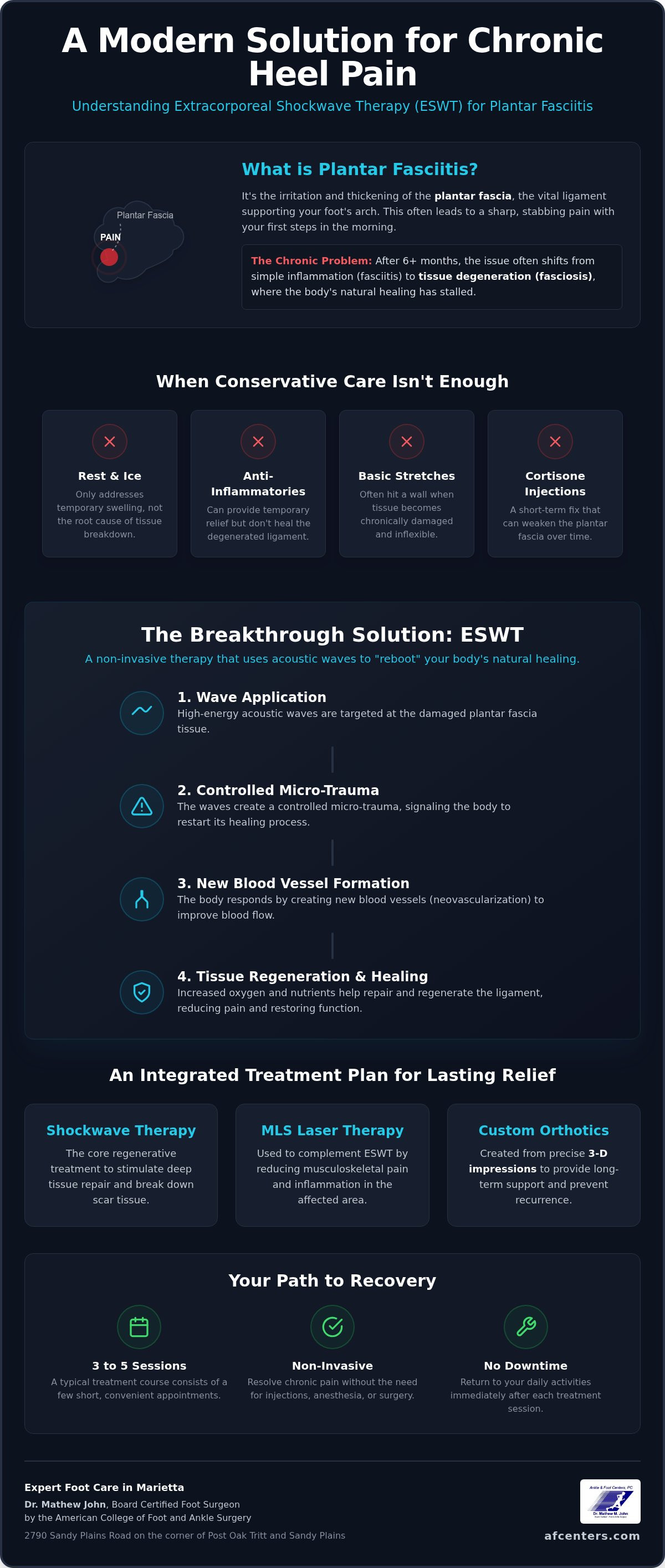
Plantar fasciitis is more than just a sore heel. It's a condition involving the thickening and irritation of the plantar fascia, the thick ligament that supports the arch of your foot. For many Marietta residents, this pain starts as a minor ache after a morning run at Kennesaw Mountain or a long day standing on hard surfaces. Over time, however, that ache can turn into a debilitating barrier to your active lifestyle. While many people associate this pain with simple inflammation, the reality is often more complex. Chronic heel pain frequently signals a shift from acute inflammation to tissue degeneration, a state where the body's natural repair mechanisms have essentially stalled.
Traditional remedies like rest and ice are designed to calm temporary swelling. They don't always address the structural breakdown of the ligament. If you've been struggling for more than six months, you may be dealing with fasciosis rather than fasciitis. This is a key reason why many patients find themselves stuck in a cycle of temporary relief followed by recurring pain. At our clinic located at 2790 Sandy Plains Road on the corner of Post Oak Tritt and Sandy Plains, we focus on moving beyond these surface-level treatments to provide lasting recovery.
The Anatomy of Heel Pain
Your plantar fascia acts like a bowstring. It absorbs the shock of every step you take. When this tissue is overtaxed by improper footwear or high-impact sports, it develops micro-tears. These tears are what cause that sharp, stabbing sensation during your first steps in the morning. As you sleep, the ligament tries to heal in a contracted position. When you stand up, you're essentially re-tearing that partially healed tissue. Without early intervention from an expert like Dr. Mathew John, a Board Certified Foot Surgeon by the American College of Foot and Ankle Surgery, these micro-tears can lead to permanent structural changes in your foot's mechanics.
When Conservative Care Hits a Wall
You might have tried over-the-counter anti-inflammatories or basic calf stretches with little success. While these are good starting points, they often hit a wall when the tissue becomes chronically degenerated. Repetitive cortisone injections might offer a quick fix, but they don't actually heal the ligament; in some cases, they can even weaken it over time. This is where regenerative options like Extracorporeal Shockwave Therapy (ESWT) become essential. By choosing specialized podiatric services, you can access treatments that address the root cause of the pain. Using shockwave therapy for plantar fasciitis allows us to "reset" the healing process, offering a non-invasive alternative for those who want to avoid the risks and long recovery times associated with surgery.
How Extracorporeal Shockwave Therapy (ESWT) Heals Your Feet
Extracorporeal Shockwave Therapy (ESWT) is a non-invasive procedure that uses high-energy acoustic pressure waves to treat chronic tissue issues. When we apply shockwave therapy for plantar fasciitis, these waves travel through the skin to reach the deep layers of the fascia. This creates a controlled micro-trauma in the damaged area. While the word trauma sounds concerning, it's actually the key to recovery. It signals your body to restart the healing process in tissues that have become stagnant or degenerated. This biological "jumpstart" is often what's missing in cases where rest and stretching have failed.
The physical energy from these waves also helps break down painful scar tissue and calcifications that often develop in chronic cases. This mechanical action smooths out the fascia, making it more flexible and resilient. By clearing out these obstructions, your foot can move more naturally without the tugging and pulling that causes morning pain.
The Science of Acoustic Pressure Waves
There are two primary types of shockwaves used in modern podiatry: radial and focused. Radial waves disperse energy over a larger area, while focused waves penetrate deeper into specific tissue sites to target the root of the pain. These waves do more than just vibrate the foot. They trigger the release of essential growth factors at a cellular level. This process leads to neovascularization, which is the formation of new blood vessels. By improving the local blood supply, your body can deliver the oxygen and nutrients necessary to repair the ligament. This approach aligns with NICE guidelines on shockwave therapy, which recognize it as a safe and effective option for patients seeking alternatives to surgery.
Biological Benefits for Chronic Pain
ESWT effectively resets the chronic pain cycle by over-stimulating nerve endings in the affected area, which helps reduce the immediate transmission of pain signals to the brain. This isn't about masking your symptoms with a temporary fix. The therapy actively promotes collagen production, which is the essential building block of a healthy, strong ligament. Because this is a regenerative process, the results tend to improve over time as the tissue rebuilds itself. Under the guidance of Dr. Mathew John, a Board Certified Foot Surgeon by the American College of Foot and Ankle Surgery, you can ensure that your treatment plan is tailored to your specific anatomy. If you're ready to move toward a more active lifestyle, exploring our advanced foot care services at 2790 Sandy Plains Road on the corner of Post Oak Tritt and Sandy Plains is a great first step.
ESWT vs. Other Modern Treatments: A Comprehensive Approach
While surgery was once the primary option for stubborn heel pain, modern podiatry offers more sophisticated paths to relief. Dr. Mathew John, a Board Certified Foot Surgeon by the American College of Foot and Ankle Surgery, prioritizes these non-invasive options because they respect your body's integrity while delivering real results. Choosing shockwave therapy for plantar fasciitis means you can skip the risks of anesthesia and the long weeks of post-surgical immobilization. There is virtually no downtime with this treatment, allowing you to walk out of our clinic and continue your daily routine immediately. This approach is particularly beneficial for active Marietta residents who can't afford to spend months on the sidelines.
Our philosophy focuses on using the right tool for the right job. By addressing the root cause of the pain rather than just the symptoms, we help you achieve a more sustainable recovery. This often involves looking at how different therapies can work together to support your foot's complex structure and biological needs.
Synergy with MLS Laser Therapy
We often find that the most effective recovery plans involve a multi-layered approach. While ESWT focuses on repairing the structural damage of the ligament, MLS Laser Therapy serves as a powerful partner by managing musculoskeletal pain and reducing inflammation. It's important to understand that in our clinic, we use MLS Laser Therapy specifically for these musculoskeletal conditions and difficult-to-heal wounds. By combining these technologies, we create an environment where the tissue can heal faster while you experience significant pain relief. This synergy accelerates your return to the activities you love, whether that's hiking local trails or playing a weekend round of golf. Using these tools together allows us to attack the problem from two different biological angles.
Supporting the Arch with Custom Orthotics
Healing the fascia is only half the battle; we also need to ensure the pain doesn't return. This is where custom orthotics play a vital role. Instead of relying on generic store-bought inserts, we create precise 3-D impressions of your feet to map every unique contour of your arch. These impressions allow us to design a support system that maintains the gains made during your specialized podiatric treatments. By providing structural support, orthotics take the strain off the ligament during the healing phase and beyond. This comprehensive strategy at our office at 2790 Sandy Plains Road on the corner of Post Oak Tritt and Sandy Plains ensures that we aren't just treating a symptom but building a foundation for long-term health. You'll feel the difference that a tailored fit makes for your daily comfort and mobility.
What to Expect During Your Marietta Shockwave Therapy Sessions
A typical course of shockwave therapy for plantar fasciitis involves three to five sessions, usually scheduled about one week apart. This specific rhythm allows your body to respond to the regenerative signals without being overwhelmed. Each visit is efficient, lasting only about 15 to 20 minutes, which makes it easy to fit into a busy schedule. Because this is a non-invasive procedure, there's no need for local anesthesia or lengthy prep time. You'll find the process straightforward and designed to get you back on your feet as quickly as possible.
One of the most rewarding aspects of this treatment is the lack of downtime. You can walk out of our office and return to your normal daily tasks immediately after your appointment. While you might feel a bit of soreness, similar to the feeling after a deep tissue massage, it shouldn't stop you from navigating your day. This convenience is why so many patients choose this path over surgical alternatives.
The Consultation and First Session
Your journey begins with a thorough evaluation by Dr. Mathew John, a Board Certified Foot Surgeon by the American College of Foot and Ankle Surgery. At our clinic located at 2790 Sandy Plains Road on the corner of Post Oak Tritt and Sandy Plains, he'll identify the precise trigger points where your pain is most concentrated. During the session, we apply a conductive gel to your heel to ensure the acoustic waves travel efficiently into the tissue. As the hand-held device moves over the area, you'll hear a rhythmic clicking sound. Most patients describe the sensation as a deep, intense tapping. We always monitor your comfort level and can adjust the intensity of the sound waves to ensure the treatment is tolerable yet effective.
Post-Treatment Guidelines
To maximize the success of your recovery, we provide a clear set of guidelines to follow between your sessions. These steps help your body focus its energy on repairing the plantar fascia.
- Modify high-impact activity: Avoid running or jumping for at least 48 hours after a session to let the tissue stabilize.
- Skip the ice: While it's tempting to ice a sore spot, we want to encourage blood flow to the area, not restrict it.
- Avoid NSAIDs: Refrain from taking anti-inflammatory medications like ibuprofen or naproxen. These can blunt the natural healing response that the shockwaves are trying to trigger.
- Support your feet: Continue wearing supportive shoes or the custom orthotics created from your 3-D impressions to maintain proper alignment.
It's helpful to set realistic expectations for your recovery timeline. While some patients notice a decrease in pain after just one visit, the most significant relief typically occurs four to six weeks after your final session as the new collagen matures and strengthens the ligament. Ready to reclaim your active lifestyle? Schedule your consultation for shockwave therapy with our expert team today.
Expert Foot Care in Marietta: Why Choose Ankle & Foot Centers, PC
Choosing the right partner for your health journey is a significant decision. At Ankle & Foot Centers, PC, we don't just treat symptoms; we focus on your long-term vitality and mobility. Our practice serves as a high-tech local hub where sophisticated resources meet a welcoming, community-focused atmosphere. Whether you're a weekend hiker at Kennesaw Mountain or a busy professional, we're dedicated to returning you to a pain-free lifestyle. By offering advanced options like shockwave therapy for plantar fasciitis, we provide a clear path to relief that avoids the risks and downtime associated with surgery.
We believe that every patient deserves a steady hand to guide them toward their personal wellness goals. Our approach emphasizes progress over perfection, ensuring you feel supported at every stage of your recovery. We take pride in maintaining a professional environment that remains approachable for everyone in our community.
Board Certified Expertise You Can Trust
When you visit our clinic, you're under the expert care of Dr. Mathew John, a Board Certified Foot Surgeon by the American College of Foot and Ankle Surgery. This certification represents a high level of expertise in both reconstructive surgical methods and modern regenerative treatments. Dr. John has extensive experience managing complex and chronic heel pain cases that haven't responded to standard conservative care. His deep understanding of foot physiology ensures that your treatment plan is scientifically sound and tailored to your unique anatomy. As a leader in non-surgical regenerative medicine, he utilizes specialized tools like ESWT and MLS Laser Therapy to stimulate natural healing for musculoskeletal pain without invasive measures.
A Community-Focused Practice
We take immense pride in being a reliable mentor for our neighbors in Marietta, Roswell, Woodstock, Kennesaw, and Sandy Springs. Our environment is designed to feel professional yet warm, lowering the barrier for anyone seeking better foot health. You'll find us conveniently located at 2790 Sandy Plains Road on the corner of Post Oak Tritt and Sandy Plains. From the moment you arrive, our team works to ensure you never feel like you're navigating your path alone.
Our commitment to excellence extends to every service we offer. From creating custom orthotics via 3-D impressions to providing shockwave therapy for plantar fasciitis, we utilize the best technology available to help you succeed. We invite you to take the first step toward a more active life by joining our community. Visit our services page to see how we can help you reach your health goals. Don't let chronic pain define your daily routine any longer when professional support is just around the corner.
Reclaim Your Active Lifestyle in Marietta
You don't have to let chronic heel pain dictate your daily activities or keep you from the trails at Kennesaw Mountain. By choosing shockwave therapy for plantar fasciitis, you're opting for a regenerative solution that addresses the root cause of your discomfort without the risks of surgery. We've explored how this advanced technology, paired with custom orthotics made from 3-D impressions and MLS Laser Therapy, creates a powerful path toward long-term relief. This comprehensive approach ensures that your feet have the structural support and biological boost they need to heal properly.
Dr. Mathew John, a Board Certified Foot Surgeon by the American College of Foot and Ankle Surgery, is ready to help you navigate your recovery with precision and care. Our clinic, conveniently located at 2790 Sandy Plains Road on the corner of Post Oak Tritt and Sandy Plains, serves as your local partner in health. It's time to stop merely managing pain and start focusing on lasting progress. Schedule your consultation with Dr. Mathew John today and take that first step toward a more vibrant, pain-free life. We look forward to supporting you on your journey back to the activities you love.
Frequently Asked Questions
Is shockwave therapy for plantar fasciitis painful during the session?
Most patients describe the sensation as a deep tapping or intense vibration rather than sharp pain. Dr. Mathew John, a Board Certified Foot Surgeon by the American College of Foot and Ankle Surgery, can adjust the intensity of the sound waves to ensure your comfort. While you might feel some mild discomfort as the energy reaches the targeted fascia, the procedure is generally well-tolerated and lasts only about 15 to 20 minutes.
How many sessions of ESWT will I need to see results?
A standard treatment plan typically involves three to five sessions spaced approximately one week apart. This schedule allows your body to respond to the regenerative signals and begin repairing the tissue. While some patients in Marietta report a decrease in pain after just one visit, the most significant improvements usually appear four to six weeks after the final session as new collagen strengthens the ligament and reduces chronic irritation.
Can I drive home or go back to work immediately after treatment?
You can drive yourself home and return to your professional or daily duties immediately following your appointment. Since this is a non-invasive procedure at our office at 2790 Sandy Plains Road on the corner of Post Oak Tritt and Sandy Plains, there is no downtime. You won't need anesthesia or sedation, making it a convenient choice for busy individuals who want to avoid the recovery time and risks associated with traditional surgery.
Is ESWT covered by insurance in Georgia?
Insurance coverage for Extracorporeal Shockwave Therapy varies significantly depending on your specific provider and plan. While some major carriers recognize it as a beneficial treatment for chronic proximal plantar fasciitis, others may consider it an out-of-pocket expense. Our staff at Ankle & Foot Centers, PC can help you review your benefits or discuss our specialized therapy session fees to ensure you have a clear understanding of your options before starting treatment at our Marietta clinic.
How does shockwave therapy compare to cortisone injections for heel pain?
Cortisone injections primarily mask inflammation for temporary relief, whereas ESWT is a regenerative treatment that addresses the underlying tissue degeneration. Repeated steroid shots can sometimes weaken the plantar fascia over time. In contrast, shockwave therapy for plantar fasciitis "resets" the healing cycle and promotes long-term ligament strength. Dr. Mathew John often recommends this non-invasive path for patients who want to avoid the potential side effects of steroids or invasive surgical procedures.
Are there any side effects or risks associated with ESWT?
Side effects are typically mild and temporary, often resolving within a few days. You might experience some local redness, swelling, or a dull ache in the treated heel, similar to the feeling after a deep tissue massage. Because the procedure is non-invasive, the risks of infection or nerve damage are extremely low compared to surgery. It is a safe and effective option for most residents in the Atlanta Metro area looking for advanced foot care.
What is the success rate of shockwave therapy for chronic plantar fasciitis?
Clinical research generally indicates a success rate between 60% and 80% for patients with chronic symptoms that haven't responded to other conservative care. Many medical studies highlight its effectiveness in reducing pain and improving mobility. At our clinic, we often combine this technology with custom orthotics made from 3-D impressions to maximize these outcomes and ensure your feet remain supported throughout the entire healing process. Dr. Mathew John oversees every aspect of this regenerative journey.
Will I need to wear a special boot or cast after the procedure?
You will not need to wear a walking boot, cast, or any restrictive footwear after your session. We encourage you to wear supportive shoes or your custom orthotics to maintain proper alignment, but you are free to walk normally. We simply recommend avoiding high-impact activities like running or jumping for about 48 hours to allow the treated area to stabilize as the natural repair process begins in your fascia at our Sandy Plains Road location.


