
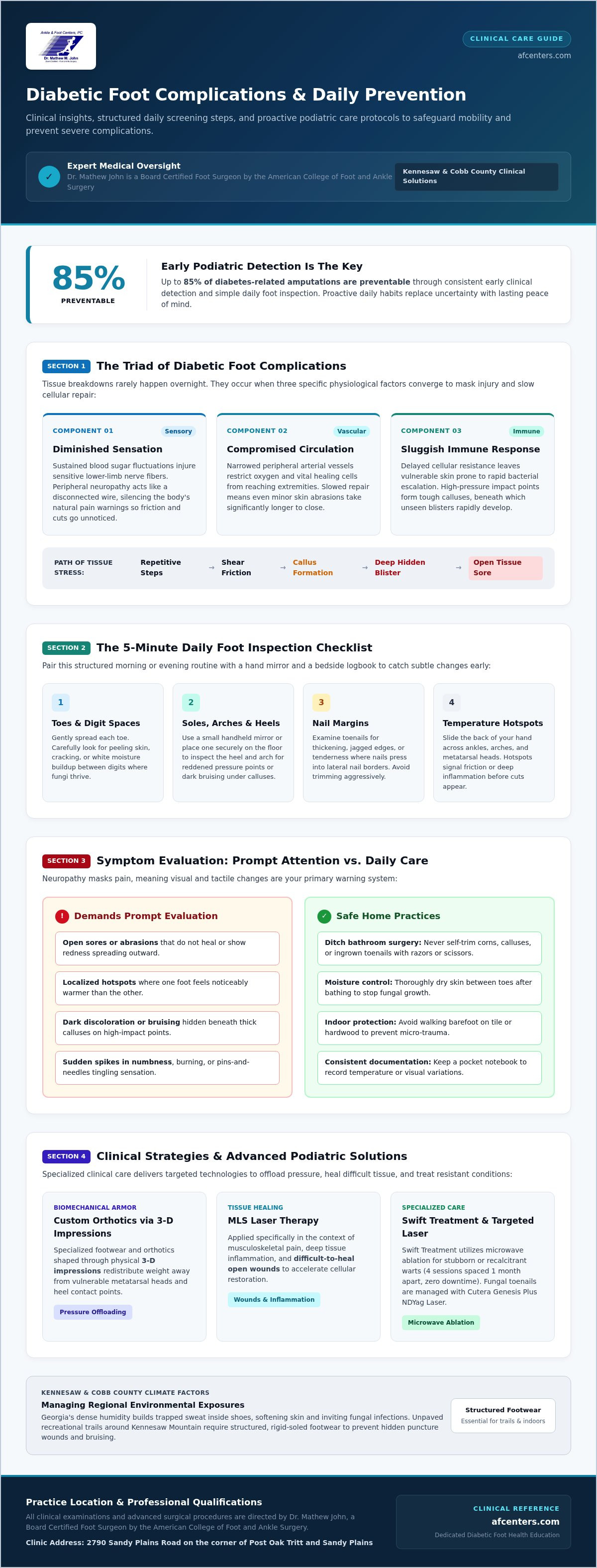
Did you know that up to 85% of diabetes-related amputations are preventable through early podiatric detection and simple daily inspection? If you want to stop worrying about diabetic foot complications Kennesaw provides dedicated clinical solutions and practical tools to keep you moving forward. It's completely understandable to feel persistent anxiety when peripheral neuropathy dulls your sensation. The fear that an unnoticed blister or minor cut could quietly escalate into an infection can weigh heavily on your daily peace of mind.
You shouldn't have to second-guess every step you take. In this guide, you'll discover an actionable daily checklist and expert clinical strategies to protect your feet, identify subtle warning signs, and preserve your independent lifestyle. We'll preview straightforward self-care habits you can practice at home, clarify which specific symptoms demand prompt evaluation by Dr. Mathew John, a Board Certified Foot Surgeon by the American College of Foot and Ankle Surgery, and show you how proactive care transforms uncertainty into lasting confidence.
Key Takeaways
- Adopt an easy five-minute daily checklist to catch subtle skin changes early and stop worrying about diabetic foot complications Kennesaw residents often face.
- Understand how peripheral neuropathy masks pain signals so you can rely on visual cues rather than waiting for discomfort to alert you.
- Ditch risky bathroom surgery by discovering why trimming calluses or corns at home invites serious infection risks.
- Protect vulnerable pressure points with specialized footwear and custom orthotics shaped through physical 3-D impressions.
- Build peace of mind by partnering with Dr. Mathew John, a Board Certified Foot Surgeon by the American College of Foot and Ankle Surgery, for proactive exams and personalized care.
Understanding Diabetic Foot Risks to Stop Worrying in Kennesaw
Living with diabetes often brings an unspoken weight, especially when you think about the threat of nerve damage, ulcers, or losing your physical mobility. It is entirely natural to feel guarded, but you can stop worrying about diabetic foot complications Kennesaw residents often face once you understand how these issues develop. Knowledge replaces anxiety with purposeful, confident action.
The primary reason foot issues escalate quietly is peripheral neuropathy. Sustained blood sugar fluctuations gradually injure the sensitive nerve fibers in your lower limbs, acting like a disconnected wire that silences your body's natural warning system. When your feet lose the ability to sense pressure, heat, or rubbing, a tiny pebble or a stiff shoe seam can create an open sore without causing any discomfort. Simultaneously, reduced peripheral arterial circulation limits the delivery of oxygen and healing cells to the skin. This slowed cellular repair means that even a minor abrasion takes longer to close. Reframing your foot care around proactive daily monitoring rather than fear puts you firmly back in control of your health.
The Triad of Diabetic Foot Complications
Serious tissue breakdowns rarely happen overnight. Instead, they occur when three physiological factors converge: diminished sensation, compromised circulation, and a sluggish localized immune response. Neuropathy hides friction, while narrowed blood vessels starve the skin of vital nutrients. Under heavy impact points, such as the metatarsal heads or the heel, tough calluses frequently form. Repetitive daily steps create shear stress that causes unseen blisters to develop beneath that thickened skin. Examining the biological progression of diabetic foot complications shows that routine pressure offloading and timely evaluations easily interrupt this cycle before tissue breakdown occurs.
Why Local Kennesaw Patients Face Elevated Lifestyle Risks
Staying active around Cobb County comes with specific environmental factors that require smart daily habits. Georgia's dense summer humidity leads to excess moisture inside socks and shoes, encouraging fungal organisms that weaken the skin barrier between your toes. Walking along unpaved paths around Kennesaw Mountain without structured, protective footwear invites hidden puncture injuries and deep bruising. Danger isn't limited to the outdoors, either. Walking barefoot across slick tile or hardwood flooring at home exposes numb feet to unexpected micro-trauma. Committing to indoor supportive shoes and breathable materials makes it easy to stop worrying about diabetic foot complications Kennesaw routines might otherwise trigger.
The 5-Minute Daily Foot Inspection Checklist
Building a predictable habit is the simplest way to gain peace of mind. Pairing a quick exam with your morning routine or evening bedtime preparations helps you stop worrying about diabetic foot complications Kennesaw routines might otherwise mask. Grab a small handheld mirror or place one securely on the floor to see your heels and arches without straining. Keep a pocket notebook on your nightstand to record any subtle skin changes or temperature shifts so you can share them during your next podiatric visit.
Visual Inspection: What to Check from Heel to Toe
Sit down in a well-lit space and look closely across every curve of your feet. Following established daily foot inspection guidelines protects fragile tissue from progressing toward severe skin breakdown. Take a structured approach each day:
- Toes and spaces: Gently spread each toe to check for peeling skin, cracks, or white moisture buildup between the digits.
- Soles and arches: Use your mirror to spot blisters, reddened pressure points, or dark spots beneath existing calluses.
- Toenails and margins: Look for thickening, jagged edges, or tenderness where nails press into lateral nail borders.
Sensory and Temperature Checks at Home
Visual clues tell half the story; touch reveals the rest. Slide the back of your hand across your ankles, arches, and metatarsal heads. Because the skin on the back of your hand is sensitive to heat, you can easily detect localized hotspots that indicate underlying friction or deep inflammation. Note any sudden spikes in numbness, burning, or pins-and-needles sensations. If one foot feels noticeably warmer than the other, jot it down in your log.
Proper Foot Hygiene and Moisture Balance
Cleanliness shields vulnerable skin against opportunistic bacterial and fungal organisms. Wash both feet daily in lukewarm water, always testing the temperature with your elbow or wrist first to prevent thermal burns on numb toes. Pat your skin dry with a clean cotton towel rather than rubbing roughly, paying special attention to the spaces between your toes. Smooth a thin layer of moisturizing cream across your heels and the soles of your feet to prevent cracking, but avoid applying lotion between your toes where excess dampness breeds infection. For personalized help setting up your routine, explore our preventative foot care services to keep your feet resilient every day.
Red Flags vs Normal Changes: When to Call Your Podiatrist
Sorting routine skin variations from dangerous clinical emergencies is how you truly stop worrying about diabetic foot complications Kennesaw residents face. When you spot a blemish, panic shouldn't be your default reaction. Instead, lean on a clear mental filter to decide whether a symptom warrants gentle at-home monitoring or an immediate clinical phone call. Never attempt "bathroom surgery" by using clippers, razor blades, or medicated chemical pads to pare down corns or calluses at home. These aggressive DIY remedies create jagged portals of entry for severe bacterial infections that can travel quickly into deeper tissue layers.
Low-Risk Foot Changes Requiring Monitoring
Certain minor shifts simply demand close observation rather than an urgent appointment. You can track these mild presentations safely at home:
- Superficial flaking: Fine, chalky dryness across the perimeter of your heels without cracks, bleeding, or deep fissures.
- Fleeting shoe friction: Mild pinkness over a toe knuckle that completely disappears within 15 minutes of removing your shoes.
- Stable thickening: Smooth, hard callus build-up beneath your weight-bearing bones that remains painless, dry, and uniformly pale.
Document these minor occurrences in your log and present them during your next scheduled office visit.
Critical Warning Signs Demanding Immediate Evaluation
Other symptoms leave zero room for hesitation. According to the American Diabetes Association foot complications guide, early intervention halts the rapid escalation of vulnerable skin tears. If you uncover subtle warning signs, such as faint yellowish stains or clear fluid seeping onto your white cotton socks, your skin integrity has already broken down. Seek prompt medical care if you observe any of the following critical triggers:
- Open breaks and drainage: Any punctured blister, bleeding crack, or open sore, regardless of whether you feel pain.
- Spreading infection markers: Streaks of red warmth expanding up your ankle, dark discolored skin patches, or an unusual foul odor.
- Sudden joint distortion: Acute localized swelling, severe heat, and architectural flattening of your midfoot arch, which frequently signals the onset of Charcot foot.
While calling your specialist, keep your weight completely off the affected foot. Clean the area with mild saline, cover it gently with sterile dry gauze, and avoid putting pressure on the limb until it receives professional evaluation.
Protective Footwear and Offloading: Your Daily Armor
Standard footwear is rarely designed with diabetic nerve sensitivity in mind. A narrow toe box, rough internal seams, or rigid leather uppers create localized friction that silently degrades skin over thousands of daily steps. In fact, ill-fitting shoes contribute to a vast majority of preventable diabetic foot ulcers. Equipping yourself with the right footwear acts like daily protective armor, empowering you to stop worrying about diabetic foot complications Kennesaw walking paths might otherwise induce.
Shoe Selection Guidelines for Diabetic Patients
Proper diabetic footwear focuses on structural space, stability, and friction reduction. When selecting your shoes, prioritize features engineered to minimize direct tissue contact:
- Broad, deep toe box: Gives your toes room to rest naturally without rubbing against the top or sides of the shoe.
- Cushioned rocker soles: Helps propel your stride forward smoothly while absorbing ground-reaction impact.
- Firm heel counters: Stabilizes your rearfoot to eliminate dangerous slippage and internal chafing.
- Moisture-wicking seamless socks: Eliminates coarse interior stitching that can irritate tender skin.
Make it a non-negotiable habit to run your hand inside each shoe before slipping it on. Feeling along the footbed catches loose pebbles, bunched liners, or stray objects that your feet might not perceive.
Custom Orthotics Created with 3-D Impressions
Even the finest shoes cannot fully compensate for individual biomechanical high-pressure spots. This is where personalized offloading plays an indispensable role. By taking physical 3-D impressions of your feet, your podiatrist maps your exact arches and plantar topography. These precision 3-D impressions allow for custom orthotics that gently redistribute your body weight away from vulnerable bony prominences, such as prominent metatarsal heads or bunion joints.
Offloading disperses repetitive downward pressure across the entire plantar surface, halting tissue breakdown long before a callus or sore can form. Because orthotic materials compress under daily mileage, scheduling periodic evaluations ensures your inserts maintain their intended support. If you are ready to stabilize your gait and shield vulnerable pressure points, explore our custom orthotics and diabetic foot care services to schedule your personalized fitting.
Partnering with Dr. Mathew M. John for Advanced Diabetic Care
Daily home checks give you vital early visibility, but combining your routine with a specialized clinician is the true foundation of long-term mobility. Building an ongoing partnership helps you stop worrying about diabetic foot complications Kennesaw residents face. When you have an experienced specialist tracking subtle shifts in your circulation and nerve function over time, small concerns get resolved before they ever threaten your lifestyle.
What to Expect During a Professional Diabetic Foot Exam
Clinical visits are thorough, gentle, and centered entirely on limb preservation. Dr. Mathew John begins with a detailed vascular assessment, checking pedal pulses and skin perfusion to verify adequate blood delivery. Sensory testing using a calibrated monofilament then measures protective nerve responses across distinct plantar zones. During these visits, routine maintenance such as paring down stubborn calluses and trimming thickened toenails is performed safely using sterile surgical tools, removing the dangerous temptation of at-home bathroom trimming.
Advanced Healing with MLS Laser Therapy
When unexpected skin irritation or tissue breakdown occurs, specialized non-invasive modalities make a major difference. We offer MLS Laser Therapy for musculoskeletal pain, inflammation, and difficult-to-heal open wounds. This therapeutic light technology works deep beneath the skin to reduce localized inflammatory distress while stimulating cellular energy. By supporting micro-circulation and accelerating cellular repair, MLS Laser Therapy aids in faster wound closure and helps protect compromised tissue from invasive procedures.
Convenient Expert Care for Kennesaw Residents
High-level podiatric care is located right around the corner. Our practice is conveniently located at 2790 Sandy Plains Road on the corner of Post Oak Tritt and Sandy Plains. Dr. Mathew John is a Board Certified Foot Surgeon by the American College of Foot and Ankle Surgery, providing Cobb County patients with focused, compassionate guidance at every stage of their diabetic wellness. You can explore all treatment options through our comprehensive podiatry services, or connect with our team to schedule your diabetic foot evaluation. Stepping into proactive care today is the surest way to stop worrying about diabetic foot complications Kennesaw life brings and protect your walking independence for years to come.
Step Into Every Day with Total Peace of Mind
Protecting your vitality starts with simple, consistent choices. By pairing a five-minute daily mirror inspection with well-fitted protective footwear, you build an effective defense against silent tissue breakdown. You don't have to carry the burden of uncertainty when you have reliable routines and clear red flags in place. It's time to stop worrying about diabetic foot complications Kennesaw residents face and start enjoying your daily strolls with genuine confidence.
Expert clinical guidance gives you the ultimate reassurance. Dr. Mathew John is a Board Certified Foot Surgeon by the American College of Foot and Ankle Surgery, providing specialized diabetic foot evaluations, custom offloading, and MLS Laser Therapy for difficult-to-heal open wounds and inflammation. Our clinic is conveniently located at 2790 Sandy Plains Road on the corner of Post Oak Tritt and Sandy Plains. Protect your mobility and schedule your diabetic foot exam today with Dr. Mathew M. John. Your feet carry you through life's best moments, and we're here to help you protect every single step.
Frequently Asked Questions
How often should diabetic patients in Kennesaw have their feet checked by a podiatrist?
Diabetic patients should undergo a comprehensive podiatric foot exam at least once a year if they don't have active symptoms, or every one to three months if they have neuropathy, poor circulation, or a history of ulcers. Regular preventive visits with Dr. Mathew John allow our team to catch small tissue changes early. Scheduling these visits helps you stop worrying about diabetic foot complications Kennesaw lifestyle routines can trigger.
Can I cut my own calluses or thick toenails if I have diabetes?
No, you shouldn't attempt to cut, shave, or trim your own calluses or thick toenails at home. Over-the-counter blades, clippers, and chemical pads frequently puncture the skin or cause burns that quickly invite infection. Numbness from neuropathy makes precision difficult. Dr. Mathew John safely trims thickened nails and debrides calluses using sterile surgical instruments during routine clinical visits.
What happens if a diabetic foot ulcer goes untreated for several days?
An untreated diabetic foot ulcer can rapidly progress from a superficial skin breach into a severe deep-tissue infection or osteomyelitis. Because diabetes impairs immune response and blood flow, bacteria multiply rapidly in open wounds. Leaving an ulcer open without professional offloading and specialized wound dressings allows localized necrosis to spread into tendons and bone, dramatically increasing the risk of surgical intervention or limb loss.
How does peripheral neuropathy cause foot wounds without noticeable pain?
Peripheral neuropathy damages sensory nerve fibers in the lower extremities, effectively blocking the pain signals that alert you to injury. Without pain sensation, repetitive friction from a snug shoe, a folded sock, or a foreign object inside your footwear goes completely unnoticed. Continuous pressure breaks down delicate skin layers beneath calluses over time, producing deep sores before you realize an injury has occurred.
Can custom orthotics made from 3-D impressions prevent diabetic ulcers?
Yes, custom orthotics created from physical 3-D impressions are highly effective at preventing diabetic ulcers by redistributing abnormal plantar pressure. Precise 3-D impressions capture your foot's exact contours without distortion. Custom inserts cushion high-impact bony prominences like the heel and ball of the foot, dispersing shear forces across a broader area. This offloading protection helps patients stop worrying about diabetic foot complications Kennesaw walks might create.
Is MLS Laser Therapy safe for treating non-healing diabetic open wounds?
Yes, MLS Laser Therapy is a non-invasive, painless, and safe treatment for difficult-to-heal open wounds and localized inflammation. This specialized laser therapy works by delivering synchronized light energy deep into compromised tissue. It stimulates micro-circulation, reduces painful swelling, and accelerates cellular repair to promote faster wound closure. It serves as an advanced supportive care tool to encourage healing in chronic diabetic sores.
What should I do immediately if I discover an open cut or blister on my foot?
Clean the wound immediately with mild soap and lukewarm water, apply sterile dry gauze, and call your podiatrist to schedule an urgent evaluation. Avoid soaking the foot, popping blisters, or applying harsh antiseptics like rubbing alcohol or iodine. Stay off the affected foot as much as possible to eliminate pressure, and have Dr. Mathew John evaluate the break promptly at our clinic at 2790 Sandy Plains Road on the corner of Post Oak Tritt and Sandy Plains.


