

Imagine waking up and feeling a sharp, stabbing pain the very moment your feet touch the floor. It's a discouraging way to start your morning, especially when that ache lingers after a long day of standing at work or prevents you from enjoying a simple walk. You deserve to move through your day without constant discomfort. If you're searching for effective plantar fasciitis treatment in Marietta GA, understanding these early warning signs is the most important step you can take for your long-term health.
At Ankle & Foot Centers, PC, we believe that your journey to wellness should be supported by expert guidance. Dr. Mathew John, a Board Certified Foot Surgeon by the American College of Foot and Ankle Surgery, provides a personalized approach to healing at our office located at 2790 Sandy Plains Road on the corner of Post Oak Tritt and Sandy Plains. In this article, you'll learn how to accurately identify your symptoms and discover advanced, non-surgical relief options. We will explore how 3-D impressions for custom orthotics and innovative MLS Laser Therapy can help you reclaim your active lifestyle and get back to the activities you love.
Key Takeaways
- Identify the hallmark signs of plantar fasciitis, such as stabbing heel pain during your first morning steps or after you've been standing for long periods.
- Understand how ignoring persistent heel discomfort can lead to chronic structural changes, making early professional intervention essential for your long-term mobility.
- Explore advanced options for plantar fasciitis treatment in Marietta GA, featuring non-invasive technologies like MLS Laser Therapy and ESWT to reduce inflammation.
- Learn how Dr. Mathew John, a Board Certified Foot Surgeon by the American College of Foot and Ankle Surgery, uses 3-D impressions to create precision custom orthotics.
What Does Plantar Fasciitis Feel Like?
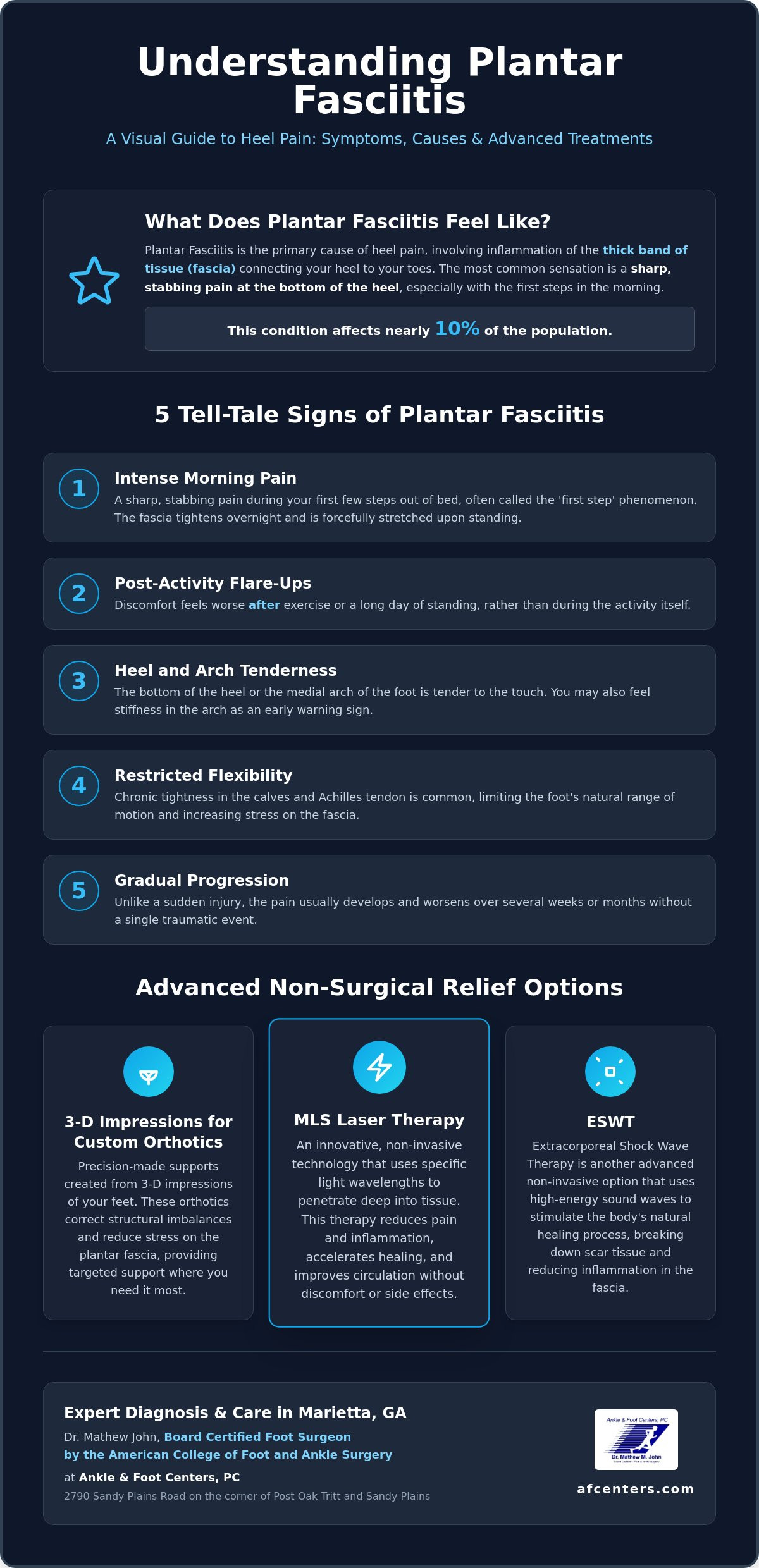
Plantar fasciitis is the primary cause of heel pain, involving inflammation of the thick band of tissue, or fascia, connecting the heel to the toes. This progressive inflammatory condition affects nearly 10% of the population at some point in their lives. When you're dealing with this level of discomfort, finding effective plantar fasciitis treatment Marietta GA becomes a top priority to protect your mobility. Understanding What is Plantar Fasciitis starts with recognizing these common sensations:
- A sharp, stabbing feeling localized to the bottom of the heel bone.
- Increasing discomfort after standing for long periods or rising from a chair.
- Pain that feels worse after exercise rather than during the activity.
Dr. Mathew John, a Board Certified Foot Surgeon by the American College of Foot and Ankle Surgery, often sees patients at our office located at 2790 Sandy Plains Road on the corner of Post Oak Tritt and Sandy Plains who describe a distinct shift in their pain throughout the day. You might experience an intense, acute pain during those first morning steps, which then transitions into a dull, heavy ache after a long day of activity. Seeking professional plantar fasciitis treatment Marietta GA early on can prevent this cycle from becoming a permanent part of your life. This condition is a signal from your body that the ligament is under significant stress.
The 'First Step' Phenomenon
If you've ever felt like you're stepping on a sharp pebble or a nail the moment you get out of bed, you're experiencing the 'first step' phenomenon. While you sleep or sit for long periods, your plantar fascia ligament naturally tightens and contracts. When you suddenly stand up, that cold, shortened ligament is forced to stretch instantly. This sudden tension causes micro-tearing at the point where the tissue attaches to the heel bone. This results in that familiar jolt of pain that often subsides after a few minutes of walking as the tissue begins to warm up.
Stiffness vs. Sharp Pain
Stiffness in the arch can often be an early warning sign of inflammation before the sharp pain fully takes hold. You might notice that your foot feels unusually tight, especially if your Achilles tendon is also constricted; these two structures are closely linked in your foot's mechanics. Many people try to 'walking it off,' and while the pain might temporarily fade, this actually worsens the underlying damage. Without professional guidance, this repetitive micro-trauma can lead to chronic structural changes that make daily activities a challenge. Addressing these sensations early with conservative care ensures a smoother path back to your personal health goals.
5 Tell-Tale Signs Your Foot Pain is Plantar Fasciitis
Recognizing the specific patterns of your discomfort is the first step toward effective relief. While many foot conditions cause general aching, this specific issue presents with unique clinical markers. If you've been searching for plantar fasciitis treatment Marietta GA, you've likely noticed that your pain follows a very predictable schedule. Understanding these five signs helps you differentiate between a temporary strain and a condition that requires professional attention.
- Intense morning pain: That sharp jolt during your first few steps out of bed is the most common indicator.
- Post-activity flare-ups: The pain often intensifies after you finish exercising or a long walk rather than while you're active.
- Heel and arch tenderness: You'll feel significant discomfort when pressing on the bottom of the heel or along the medial arch.
- Restricted flexibility: Chronic tightness in your calves and Achilles tendon often limits your foot's natural range of motion.
- Gradual progression: Unlike a sudden injury, this discomfort usually worsens over several weeks without a single traumatic event.
Seeking professional diagnosis and treatment early is vital because approximately 83% of cases occur in active working adults. Dr. Mathew John, a Board Certified Foot Surgeon by the American College of Foot and Ankle Surgery, specializes in identifying these subtle signs to create a customized recovery plan. If these symptoms sound familiar, it's time to visit us at 2790 Sandy Plains Road on the corner of Post Oak Tritt and Sandy Plains for a thorough evaluation.
Pain After Prolonged Standing
Many Marietta residents spend their workdays on hard surfaces, which puts constant, unrelenting tension on the fascia. This often leads to rebound pain. You might feel fine while sitting for lunch, but the moment you stand up to return to work, the stabbing sensation returns with a vengeance. Resting provides temporary relief, but it doesn't address the underlying inflammation or the micro-tears in the tissue. Consistency in your plantar fasciitis treatment Marietta GA is the only way to break this cycle of irritation.
Identifying Arch Discomfort
While the heel is the epicenter, the pain frequently radiates into the middle of the arch. This is especially common if you have flat feet or overpronation, as these structural issues place extra stress on the ligament. When your arch isn't supported, your body tries to compensate. This can lead to secondary pain in your knees, hips, and even your lower back. Addressing the root cause with 3-D impressions for custom orthotics can help realign your gait and protect your entire kinetic chain. You don't have to navigate this path alone; professional support is available to guide you back to a pain-free life.
Why is This Happening? Common Causes and Risk Factors
Heel pain doesn't happen in a vacuum. It's usually the result of several factors converging at once, creating a perfect storm of irritation for your feet. While it might feel like the discomfort appeared overnight, it's typically the cumulative result of repetitive stress on the plantar fascia ligament. According to the Mayo Clinic, this thick band of tissue acts as a shock absorber for your arch, but excessive tension can lead to painful inflammation and micro-tears.
Age is a significant contributor, as tissue elasticity naturally decreases over time. Most individuals begin to notice these symptoms between the ages of 40 and 60. You might also experience a flare-up following a sudden increase in activity, such as starting a new exercise routine or tackling a home renovation project. These bursts of intensity put more pressure on the fascia than it's prepared to handle, especially if your foot's anatomy, like high arches or flat feet, already creates an uneven weight distribution.
At Ankle & Foot Centers, PC, Dr. Mathew John, a Board Certified Foot Surgeon by the American College of Foot and Ankle Surgery, emphasizes that understanding these risks is essential for successful plantar fasciitis treatment Marietta GA. Our team at 2790 Sandy Plains Road on the corner of Post Oak Tritt and Sandy Plains uses 3-D impressions to identify these structural imbalances. This allows us to provide solutions that go beyond temporary relief and address the root cause of your strain.
Lifestyle and Occupational Factors
Your daily environment plays a massive role in your foot health. Many Marietta residents work in healthcare, retail, or education, which requires standing for eight to ten hours on unforgiving, hard floors. This constant mechanical load increases the stress on your heel bone. Your body weight also directly affects the amount of force applied to your feet with every step. Even small adjustments in your daily routine can significantly reduce the strain on your ligament.
The Footwear Connection
Your shoe choice is your first line of defense against heel strain. Worn-out athletic shoes or unsupportive flats lack the necessary cushioning to protect your fascia. It's also tempting to walk barefoot on hardwood or tile floors at home, but this provides zero support and often aggravates active inflammation. Evaluate your current shoe rotation regularly. If the soles are uneven or the arch support feels non-existent, it's time for an upgrade. Investing in quality footwear is a simple yet powerful step in your journey toward a pain-free life.
Professional Diagnosis: When to See a Marietta Podiatrist
Waiting for heel pain to resolve on its own is a common mistake that often leads to more complex issues. When inflammation persists, your body may attempt to protect the area by creating calcium deposits, which result in chronic structural changes like heel spurs. Obtaining a professional diagnosis ensures that you aren't just treating the symptoms, but addressing the underlying mechanical failure. Dr. Mathew John, a Board Certified Foot Surgeon by the American College of Foot and Ankle Surgery, uses comprehensive physical exams to identify the root cause of pain and develop a targeted recovery plan.
During your first visit to our office at 2790 Sandy Plains Road on the corner of Post Oak Tritt and Sandy Plains, we focus on precision. A clinical evaluation is essential to rule out other conditions that mimic heel pain, such as stress fractures, nerve entrapment, or bursitis. By pinpointing the exact source of your discomfort, we can provide the most effective plantar fasciitis treatment Marietta GA, saving you months of frustration and ineffective home remedies.
The Precision of 3-D Impressions
Many providers still rely on outdated terminology or simplified methods to assess your gait. At Ankle & Foot Centers, PC, we utilize 3-D impressions to capture the exact, unique contours of your feet while they are in a corrected position. These 3-D impressions are essential for creating custom orthotics that provide true therapeutic support. Unlike generic, off-the-shelf inserts that offer a one-size-fits-all approach to cushioning, custom orthotics made from high-quality materials are designed to realign your foot and permanently reduce the strain on your ligament. This level of personalized care is a cornerstone of sophisticated plantar fasciitis treatment Marietta GA.
When Pain Becomes a Medical Priority
You should consider your foot health a priority if your pain prevents you from completing daily tasks or if the stabbing sensation persists even after a period of rest. These red flags indicate that the tissue is no longer able to repair itself without intervention. Early professional care is the most effective way to avoid invasive surgical procedures in the future. A structured, professional treatment plan doesn't just manage your pain; it provides a faster, safer return to the active Marietta lifestyle you enjoy. If your morning steps have become a chore rather than a start to your day, schedule a comprehensive evaluation with our expert team today.
Advanced Relief Options at Ankle & Foot Centers, PC
Finding the right plantar fasciitis treatment Marietta GA means choosing a path that prioritizes healing without immediately jumping to invasive surgery. At our office at 2790 Sandy Plains Road on the corner of Post Oak Tritt and Sandy Plains, we focus on conservative, high-tech care. Dr. Mathew John, a Board Certified Foot Surgeon by the American College of Foot and Ankle Surgery, believes in using the most advanced tools available to stimulate your body's natural repair mechanisms. This philosophy ensures you receive professional guidance that respects your personal health journey and long-term wellness goals.
For those struggling with chronic heel pain that hasn't responded to traditional stretching, Extracorporeal Shockwave Therapy (ESWT) offers a powerful alternative. This technology uses high-energy sound waves to target the damaged fascia, triggering a healing response in the tissue. When combined with custom orthotics made from 3-D impressions, these treatments provide a comprehensive shield against future injury. We don't just want to fix your current pain; we want to prevent it from ever returning so you can remain active in our local community.
MLS Laser Therapy: A Modern Approach
MLS Laser Therapy represents a major shift in how we manage musculoskeletal pain and inflammation. This drug-free, painless treatment uses specific wavelengths of light to accelerate tissue repair and significantly reduce swelling in the foot. During a typical session, you won't feel any heat or discomfort, and there's absolutely no downtime involved. It's an ideal solution for acute flare-ups, allowing you to return to your daily routine in Marietta with renewed vitality. Many patients report feeling relief after just a few sessions as the laser works to restore cellular function and improve local circulation.
Comprehensive Care for Every Foot Condition
Our expertise extends beyond heel pain to cover your entire foot health. If you're dealing with fungal toenails, we utilize fungal laser therapy or the Cutera Genesis Plus NDYag Laser to target the infection safely and effectively. For patients suffering from stubborn or recalcitrant plantar warts, we offer the advanced Swift Treatment. This microwave ablation technology is highly effective, typically involving four sessions spaced exactly one month apart. Because there's no downtime for patients following the procedure, you can walk out of our office and continue your day without interruption. Our multi-disciplinary approach ensures that whether you're dealing with inflammation or a persistent skin condition, you're never navigating your recovery alone.
Take the First Step Toward Lasting Relief
You don't have to accept stabbing heel pain as a permanent part of your daily routine. Recognizing those sharp morning aches as a clear warning sign is the most important step you can take for your long-term mobility. By choosing professional plantar fasciitis treatment Marietta GA, you're opting for a path that prioritizes non-invasive healing and addresses the underlying mechanical causes of your discomfort. Whether through precision 3-D impressions for custom orthotics or advanced MLS Laser Therapy, effective solutions are within reach.
Dr. Mathew M. John, a Board Certified Foot Surgeon by the American College of Foot and Ankle Surgery, is dedicated to helping you reclaim your active lifestyle. Our clinic is conveniently located at 2790 Sandy Plains Road on the corner of Post Oak Tritt and Sandy Plains, providing a supportive environment for your recovery journey. Don't let persistent foot pain limit your potential or keep you from the community activities you love. Schedule your consultation with Dr. Mathew John at our Marietta clinic today and move forward with confidence. We look forward to being your partner in health and helping you achieve your wellness goals.
Frequently Asked Questions
How can I tell the difference between a heel spur and plantar fasciitis?
A heel spur is a calcium deposit that forms a bony protrusion on the heel bone, while plantar fasciitis is the inflammation of the actual tissue band. You can't usually feel a spur through the skin, but it often appears on imaging alongside ligament inflammation. Dr. Mathew John, a Board Certified Foot Surgeon by the American College of Foot and Ankle Surgery, can differentiate these during your clinical exam to ensure your care plan is accurate.
Will my plantar fasciitis symptoms eventually go away on their own?
Most cases of heel pain don't simply disappear without a change in activity or professional support. While minor irritation might subside with rest, approximately 90% of patients require a structured non-surgical plan to become completely asymptomatic. Ignoring these early warning signs can lead to chronic structural changes, so it's best to seek guidance early in your journey to protect your mobility.
What are the best types of shoes to wear if I have heel pain?
You should prioritize footwear that offers a rigid mid-sole, a deep heel cup, and excellent arch support. Avoid flimsy flip-flops or unsupportive flats that allow your arch to collapse and strain the ligament. For the most precise fit, we offer custom orthotics created from 3-D impressions at our office at 2790 Sandy Plains Road on the corner of Post Oak Tritt and Sandy Plains.
Is it safe to continue exercising if my heel hurts in the morning?
It's best to switch to low-impact activities like swimming or cycling until your inflammation is under control. High-impact exercises like running or jumping can exacerbate micro-tears in the fascia, leading to much longer recovery times. Modifying your routine doesn't mean stopping your progress; it's a strategic choice to ensure your long-term health and a faster return to your favorite activities.
How long does it typically take to see relief with professional treatment?
Many patients begin to feel a noticeable reduction in pain within two to four weeks of starting a professional plan. However, a full return to high-impact sports typically takes several months of consistent plantar fasciitis treatment Marietta GA. Your specific timeline depends on the severity of the inflammation and how consistently you follow your customized stretching and orthotic regimen.
Can tight calf muscles really cause pain in the bottom of my heel?
Tight calf muscles are a leading contributor to heel pain because they pull on the Achilles tendon, which is physically linked to your plantar fascia. This creates a chain reaction of tension that increases the mechanical load on the bottom of your foot. Stretching your calves regularly is a vital part of a holistic approach to foot health and achieving long-term vitality.
Are there specific stretches I should do before getting out of bed?
You should perform gentle toe flexes and ankle rotations before your feet ever touch the floor. Gently pulling your toes back toward your shin for thirty seconds helps warm up the ligament and reduces the shock of that first morning step. This simple habit prepares your feet for the day and protects the tissue from sudden micro-tearing during those initial movements.
When should I consider seeing a Board Certified Foot Surgeon for heel pain?
Schedule an appointment if your pain persists for more than two weeks or if it's severe enough to disrupt your work and exercise. Seeking plantar fasciitis treatment Marietta GA from Dr. Mathew John ensures you're working with a reliable expert partner. Visit us at 2790 Sandy Plains Road on the corner of Post Oak Tritt and Sandy Plains to explore advanced options like MLS Laser therapy.


