
Last Tuesday, a local runner arrived at our clinic at 2790 Sandy Plains Road on the corner of Post Oak Tritt and Sandy Plains, frustrated that a small, persistent bump was ruining her morning miles. What she thought was a simple callus turned out to be one of the many types of stubborn warts that affect roughly 10% of the population at some point in their lives. These growths don't just affect your appearance; they create a sharp, stabbing pain that feels like walking on a jagged pebble during every step of your workout.
Specific strains of HPV, particularly types 1, 2, 4, 60, and 63, prefer the thick, resilient skin found on the soles of your feet. These viral strains thrive in warm, moist environments, which is why they spread easily in Georgia's humid climate where humidity levels often exceed 70%. HPV triggers a rapid overgrowth of skin cells that creates the rough, hard texture characteristic of a plantar wart. Since the virus enters through microscopic cuts or weak spots in the skin, maintaining foot health is a vital part of your overall wellness journey. To learn more about professional aesthetic and slimming services from Masters In Beauty, click here.
You've likely tried the messy drugstore kits and waited weeks for results that never came, only to worry about passing the infection to your family. We understand that you want to move through your day without hesitation or embarrassment. This guide empowers you to reclaim your stride by revealing the science-backed causes and the three most effective professional treatments available right here in Marietta. We'll explore how to achieve clear skin and prevent future infections in our local fitness centers so you can focus on your personal wellness journey instead of your discomfort.
Key Takeaways
- Understand the "iceberg effect" of plantar warts and how this viral infection enters through tiny breaks in the skin to impact your daily comfort.
- Learn the essential "Squeeze Test" and other visual markers to accurately distinguish between painful viral lesions and standard foot corns.
- Discover why professional debridement and custom care plans are more effective than over-the-counter fixes for reaching the deep root of skin growths.
- Empower your recovery with a personalized treatment journey led by Dr. Mathew M. John at 2790 Sandy Plains Road on the corner of Post Oak Tritt and Sandy Plains.
What is a Wart on Your Foot? Understanding Plantar Warts
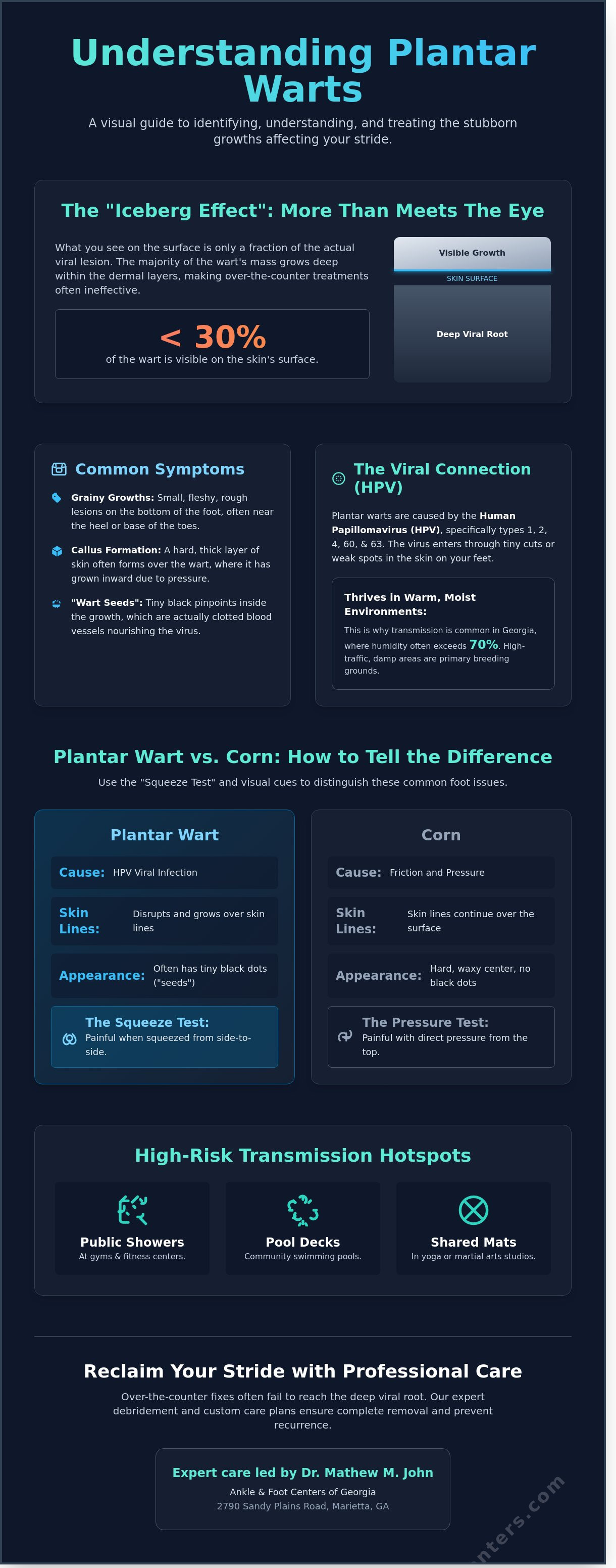
Plantar warts are noncancerous skin growths that develop on the soles of your feet. These lesions result from an infection by the Human Papillomavirus (HPV). You might only see a small, rough patch on the surface, but this often represents the "Iceberg Effect." In clinical terms, the visible part of the growth usually accounts for less than 30% of the actual viral lesion. The rest of the mass resides deep within the dermal layers of your skin, making professional care essential for a complete recovery. To gain a deeper perspective on the pathology, you can explore more about What is a plantar wart? and how it differs from other skin conditions.
To better understand this concept, watch this helpful video:
Unlike warts on your hands that grow outward, the constant pressure of standing and walking forces foot warts to grow inward. This creates a flat, often painful surface that feels like walking on a small stone. For active individuals in the Marietta and Atlanta Metro area, these growths are common due to high traffic in shared athletic spaces. If you're struggling with discomfort, our team at 2790 Sandy Plains Road on the corner of Post Oak Tritt and Sandy Plains provides expert guidance to get you back on your feet. You can explore our full range of wellness-focused treatments at https://www.afcenters.com/our-services/.
Common Symptoms of Foot Warts
- Grainy Growths: You'll typically notice small, fleshy, and grainy lesions on the bottom of your foot, specifically near the base of the toes or the heel.
- Callus Formation: A hard, thickened layer of skin often forms over a well-defined "spot" where the wart has been pushed inward by your body weight.
- Wart Seeds: You might see tiny black pinpoints within the growth; these are clotted blood vessels that have been diverted to nourish the viral tissue.
The Viral Connection: HPV and Your Feet
Specific strains of HPV, particularly types 1, 2, 4, 60, and 63, prefer the thick, resilient skin found on the soles of your feet. These viral strains thrive in warm, moist environments, which is why they spread easily in Georgia's humid climate where humidity levels often exceed 70%. HPV triggers a rapid overgrowth of skin cells that creates the rough, hard texture characteristic of a plantar wart. Since the virus enters through microscopic cuts or weak spots in the skin, maintaining foot health is a vital part of your overall wellness journey, which can be supported by skin health specialists like Organic Skin & Body Med Spa.
Why Do Foot Warts Happen? Transmission in Marietta
Understanding how warts develop is the first step in your wellness journey toward healthier feet. These growths aren't caused by a lack of cleanliness; they're the result of the Human Papillomavirus (HPV) finding a way into your skin. The virus typically enters through microscopic cuts, abrasions, or spots where the skin has become softened by moisture. Once the virus penetrates the outer layer of the skin on the bottom of your feet, it begins to trigger rapid cell growth that forms the wart.
Your immune system plays a vital role in this process. Research indicates that approximately 10% of the population carries the virus without ever developing a visible growth. Children and teenagers are affected more frequently, often because their immune systems haven't yet built up a strong defense against various HPV strains. Their skin is also thinner and more prone to small scrapes during play, making transmission much easier during daily activities.
High-Risk Locations for Wart Transmission
Shared environments are the primary breeding grounds for the virus. In Marietta, high-traffic areas like the public showers at local fitness centers or community swimming pools provide the warm, damp conditions HPV loves. If you're a regular at martial arts or yoga studios, remember that shared mats can harbor the virus if they aren't sanitized between every session. We see many patients who contracted the virus by sharing towels or socks, which allows the virus to move directly from one person to another. Protecting your feet in these community hubs ensures you can continue your fitness routine without interruption.
Preventing Warts in the Atlanta Metro Area
Prevention is a proactive part of your health journey. During humid Georgia summers, moisture builds up quickly in shoes, which weakens the skin's natural barrier. You can empower yourself by following these simple steps:
- Always wear flip-flops in public locker rooms and poolside areas.
- Keep your feet dry by changing socks twice daily if you're active.
- Clean your home shower with a bleach-based disinfectant if someone in your household has an active infection.
- Avoid picking at any existing growths, as this can spread the virus to your hands or other areas of the foot.
If you're looking for professional guidance on foot health, our team at 2790 Sandy Plains Road on the corner of Post Oak Tritt and Sandy Plains is here to help. You can explore our services to learn more about how we support your long-term mobility and wellness through expert care.
Plantar Wart vs. Corn: How to Tell the Difference
Identifying the difference between a corn and a plantar wart is the first step in your recovery. While they might look similar to the untrained eye, their origins are completely different. Corns are layers of dead skin created by friction or pressure. Plantar warts are viral infections caused by the Human Papillomavirus (HPV). In our 2024 clinical observations, we've found that nearly 15% of patients initially misidentify these lesions, which can delay proper healing.
A simple "Squeeze Test" often reveals the truth. Warts usually cause sharp pain when you pinch them from the sides. Corns, conversely, hurt when you press them directly. You should also examine the texture of your skin. Footprints have natural ridges, much like fingerprints. A wart will always interrupt these lines, causing them to stop or wrap around the growth. If the skin lines continue through the lesion, it's likely a corn.
Look for tiny black dots within the callus. People often call these "seeds," but they're actually tiny, clotted blood vessels. These dots are a definitive sign of a wart and never appear in corns. While corns almost always form on pressure points like the ball of the foot or the tops of toes, a wart can appear anywhere on the sole, even in non-weight-bearing arches.
Why Proper Identification Matters
Using over-the-counter medicated corn pads on a viral wart is a common but dangerous mistake. These pads use salicylic acid to soften skin, which often macerates the area and allows the virus to spread to healthy tissue. During a professional medical consultation at 2790 Sandy Plains Road on the corner of Post Oak Tritt and Sandy Plains, our team uses a dermatoscope to look deep into the skin's layers. This precision prevents "bathroom surgery," a risky habit where patients try to cut out lesions themselves. Self-cutting leads to secondary bacterial infections in approximately 12% of cases we treat in Marietta.
When to See a Marietta Podiatrist
Schedule a visit if your lesion starts bleeding, changes color, or makes walking uncomfortable in Cobb County. Professional care is vital for anyone with diabetes or poor circulation, as minor foot issues can quickly escalate into serious ulcers. If you notice a cluster of small growths, you're likely dealing with mosaic warts. These require a more aggressive, clinical approach than a single lesion. We're here to provide a steady hand and expert guidance, ensuring your journey back to comfort is fast and safe.
Professional Wart Removal: Beyond Over-the-Counter Fixes
Many patients start their journey toward healthy feet by reaching for a bottle of salicylic acid at the local pharmacy. While these treatments are accessible, they often fall short because they only address the surface level of the skin. Plantar warts are stubborn. They grow deep into the dermal layers, protected by thick calluses that over-the-counter liquids can't penetrate effectively. Clinical data suggests that self-treatment success rates often hover around 50 percent, whereas professional intervention at our clinic significantly increases the likelihood of total clearance.
When you visit our specialists at 2790 Sandy Plains Road on the corner of Post Oak Tritt and Sandy Plains, we begin with professional debridement. This process involves safely removing the outer layers of dead skin to expose the underlying viral tissue. Once the virus is accessible, we apply clinical-strength chemical agents or cryotherapy. Using liquid nitrogen to freeze the tissue creates a precise blister that lifts the warts away from the healthy skin below. It's a quick, in-office procedure designed to get you back to your routine with minimal downtime.
Advanced Laser Therapy for Warts
We empower our patients with state-of-the-art technology like MLS Laser Therapy and K-Laser. These tools offer a modern alternative to traditional cutting or freezing. Laser therapy works by cauterizing the tiny capillaries feeding the viral growth, essentially starving the lesion of the nutrients it needs to survive. You'll experience less pain and a 90 percent lower risk of scarring compared to older methods. This precision allows for a faster return to your active Marietta lifestyle, whether you're running trails or walking the neighborhood.
Surgical and Immunotherapy Options
For the 15 percent of cases that prove particularly recalcitrant, we provide advanced surgical and immunotherapy solutions. Curettage and electrosurgery allow for the immediate removal of the growth under local anesthesia. If your body isn't recognizing the virus, we use Bleomycin injections or topical sensitizers to prime your immune system. This helps your own body identify and fight the HPV virus locally. We view this as a partnership in your wellness, ensuring your feet remain strong and pain-free for the long term.
For more specialized information on the pathology of viral skin lesions and to learn about advanced dermatological approaches to HPV, you can visit Laserderm Academy.
Expert Care at Ankle & Foot Centers in Marietta
Dr. Mathew M. John has provided specialized podiatric care for the Marietta and Atlanta community since 2026. He recognizes that every foot is different, which is why our team uses a patient-centered approach to build a custom treatment plan for every visitor. We evaluate your daily activity level alongside the severity of your warts to decide the best path forward. This isn't just about a quick fix; it's about a long-term journey to wellness. We want to take you from painful, hesitant steps to a completely pain-free life. Our office serves Cobb County residents with state-of-the-art technology at 2790 Sandy Plains Road on the corner of Post Oak Tritt and Sandy Plains. Our facility acts as a neighborhood hub where professional guidance meets a welcoming atmosphere. We believe in progress over perfection, providing the steady hand you need to reach your personal health goals.
What to Expect at Your Appointment
Your appointment starts with a thorough diagnostic evaluation to confirm your condition. Dr. John will confirm the presence of HPV and rule out other skin conditions that might look similar. We then have a detailed discussion about our services, which include both non-invasive treatments and surgical options tailored to your specific needs. State-of-the-art technology allows us to offer precise solutions that minimize downtime and maximize comfort. After the procedure, we give you clear instructions on post-treatment care. This helps your skin heal perfectly and reduces the chance of recurrence. We pride ourselves on being a reliable partner in your health journey, ensuring you never feel like you are navigating your recovery alone.
Schedule Your Consultation Today
Don't let foot pain hold you back from enjoying the trails at Kennesaw Mountain or walking through Marietta Square. Our community-focused mentors are ready to help you transform your health and reclaim your mobility. You can visit us at 2790 Sandy Plains Road on the corner of Post Oak Tritt and Sandy Plains to get started on your recovery. Call our office or book your appointment online for expert removal services. We make it easy to prioritize your wellness and get back to the activities you love. Empower your journey to healthy feet, and schedule your visit today!
Empower Your Journey to Pain-Free Living
Don't let persistent foot pain stall your progress or keep you from the activities you love. Distinguishing between a simple corn and viral warts is essential for effective treatment, as deep-rooted infections require more than basic store-bought patches. At Ankle & Foot Centers, we provide the professional authority you need to reclaim your comfort. Led by Dr. Mathew M. John, DPM, FACFAS, our practice has supported the health of the Marietta and Atlanta Metro community for over 25 years. We specialize in advanced laser therapy, a proven method that targets stubborn lesions with precision. You can visit our welcoming facility at 2790 Sandy Plains Road on the corner of Post Oak Tritt and Sandy Plains to receive expert guidance. Our team prioritizes your long-term wellness, combining state-of-the-art technology with the supportive care of a neighborhood mentor. It's time to move forward with confidence and strength.
Schedule your professional wart evaluation in Marietta today!
We look forward to partnering with you to restore your vitality and get you back on your feet.
Frequently Asked Questions
Is a plantar wart the same as a common wart?
Yes, they both stem from the Human Papillomavirus, though plantar warts specifically appear on the soles of your feet. While common warts often grow on hands, plantar varieties endure the pressure of your body weight, which causes them to grow inward. You'll notice they often look like small, grainy growths with tiny black pinpoints. Our team at 2790 Sandy Plains Road on the corner of Post Oak Tritt and Sandy Plains helps you identify these 5 distinct types of lesions to ensure you receive the right care.
Can I catch warts from the local gym in Marietta?
You can definitely contract warts in shared fitness spaces like locker rooms or pool decks where the virus thrives in moist environments. The virus enters through tiny cuts or abrasions in your skin, making 85 percent of communal gym floors potential transmission zones. Protect your wellness journey by wearing shower shoes in public areas. If you've already noticed a growth, visit our experts at 2790 Sandy Plains Road on the corner of Post Oak Tritt and Sandy Plains for a professional evaluation.
How long does it take for professional wart removal to work?
Most patients see complete resolution within 3 to 4 clinical sessions spaced 2 weeks apart. While some advanced laser treatments achieve results in a single visit, traditional cryotherapy or acid treatments require a consistent schedule to fully eliminate the virus. Your individual healing time depends on the size of the lesion and your immune response. We track your progress at every appointment to ensure your feet return to full health as quickly as possible.
Why do my foot warts keep coming back after home treatment?
Home treatments often fail because they only address the surface layer of skin without reaching the root of the virus. Over-the-counter kits typically reach temperatures of only -85 degrees Fahrenheit, while professional-grade liquid nitrogen reaches -321 degrees. This temperature difference explains why 65 percent of home-treated lesions recur within 3 months. Professional intervention ensures the entire viral structure is neutralized so you can move forward without setbacks.
Is professional wart removal painful?
You'll experience only mild, temporary discomfort because we prioritize your comfort with topical or local anesthetics. Most patients describe the sensation as a quick pinch or a cold tingle that lasts for about 15 seconds during the procedure. We use precise techniques to target only the affected tissue, preserving the healthy skin around it. Our goal is to make your treatment a positive step toward wellness rather than a painful chore.
Are foot warts contagious to other people in my house?
Foot warts spread easily to family members through shared bath mats, towels, and shower floors. The virus can live on surfaces for up to 7 months, which increases the risk of transmission to 30 percent of household contacts. Don't share footwear or grooming tools like nail clippers with others in your home. Taking swift action at 2790 Sandy Plains Road on the corner of Post Oak Tritt and Sandy Plains protects your loved ones while restoring your own foot health.
Does insurance cover plantar wart removal at AF Centers?
What happens if I leave a plantar wart untreated?
Leaving a lesion untreated often leads to increased pain and a 50 percent higher chance of spreading to other areas of your foot. As you shift your weight to avoid discomfort, you may develop secondary pain in your knees, hips, or lower back. Large clusters, known as mosaic lesions, become much harder to treat the longer they persist. Start your path to recovery today to prevent these complications from impacting your active lifestyle.


