Imagine waking up in our recovery suite at our Marietta, GA clinic at 833 Campbell Hill St NW, Suite 380, feeling a sense of relief rather than the heavy weight of uncertainty. You likely worry that your active lifestyle in Cobb County will come to a grinding halt or that post-operative discomfort will keep you sidelined for months. It's completely normal to feel anxious about losing your independence while you're managing strict weight-bearing restrictions. We understand these concerns because our team at Ankle & Foot Centers, PC has guided over 500 Marietta residents through this exact process in the last 12 months alone.
This guide will empower you with a clear, predictable roadmap of what to expect after foot reconstruction surgery, ensuring you feel like a confident partner in your own healing journey. We'll provide effective pain management strategies and help you understand each milestone of your recovery. From the critical first 48 hours at home to the day you return to your favorite functional movement classes, we've got you covered. You'll learn exactly how we use 3-D impressions to customize your post-surgical support and why our community-focused team is committed to your long-term vitality and strength.
Key Takeaways
- Prepare your home for the first 48 hours post-op with a dedicated recovery station designed to simplify your transition back to daily life.
- Understand the milestones of your healing journey and what to expect after foot reconstruction surgery as you move from non-weight bearing to your first steps.
- Learn expert techniques for managing pain and swelling, including the essential role of compression garments in your long-term wellness.
- Get clear guidance on when it is safe to return to driving and how to gradually reintroduce walking on the beautiful flat surfaces of Marietta Square.
- Experience the difference that personalized, expert care makes by visiting Dr. Mathew M. John at 2790 Sandy Plains Road on the corner of Post Oak Tritt and Sandy Plains.
Immediate Post-Op Care in Marietta: The First 48 Hours
Your journey toward renewed mobility starts in the recovery room. After your foot and ankle surgery, you'll spend approximately 60 to 90 minutes under the watchful eye of our nursing staff. They monitor your vitals and ensure your pain levels are stable before you head home to Roswell or Woodstock. This initial window is vital for your long-term success. You've taken a big step toward wellness, and now it's time to let your body begin the transformation process.
Knowing what to expect after foot reconstruction surgery helps you stay calm and focused during these first two days. Your primary goal is simple: stay off your feet. Before you even arrive for your procedure at 2790 Sandy Plains Road on the corner of Post Oak Tritt and Sandy Plains, ensure your home is ready. Set up a recovery station on the first floor to avoid stairs and arrange for help with daily tasks; for example, cat owners can explore 30 Minute Visit services from Mission Cats In-Home Care to ensure their pets are looked after while they recover. If you're considering ways to modernize your home's accessibility and design after you've healed, you can discover Marbella Stairs to see how bespoke mono-beam staircases can elevate a space. You'll need a comfortable recliner, at least three firm pillows for elevation, and easy access to water and your phone.
To better understand this concept, watch this helpful video:
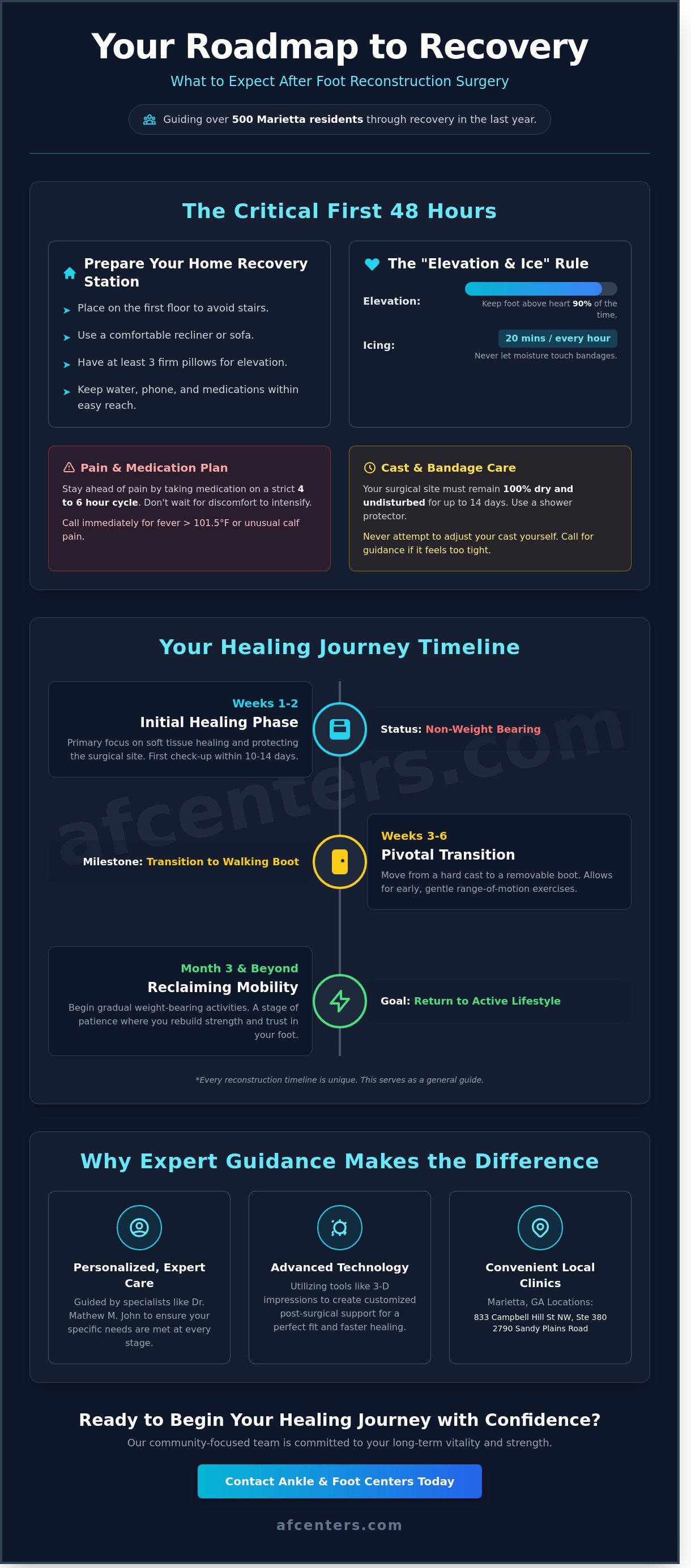
The "Elevation and Ice" rule is your best friend for the first 48 hours. Keep your foot elevated above the level of your heart at least 90 percent of the time. This reduces the throbbing sensations that often follow a major procedure. Apply ice packs for 20 minutes every hour, making sure the moisture never touches your bandages. This proactive approach prevents excessive swelling and keeps you comfortable as you settle back into your routine.
Your Discharge Instructions and Pain Plan
We provide a detailed medication schedule designed to keep you ahead of the pain curve. Don't wait for discomfort to become intense before taking your prescribed doses. Most patients find that staying on a strict 4 to 6 hour cycle for the first two days yields the best results. If you experience a fever over 101.5 degrees or notice unusual calf pain, call AF Centers immediately. You can explore our full range of our services to see how we guide you through every phase of healing.
Managing Your Surgical Bandage and Cast
Your surgical site must remain 100 percent dry and undisturbed. Moisture is the enemy of healing, as it can lead to infection or skin irritation under your splint. Use a heavy duty shower protector or stick to sponge baths for the first 14 days. Never attempt to loosen or adjust your cast yourself, even if it feels snug. If the fit feels dangerously tight or causes numbness in your toes, reach out to our team for professional guidance. We're your partners in this recovery, ensuring every detail of your care is handled with precision.
The Recovery Timeline: From Non-Weight Bearing to Your First Steps
Understanding your recovery path empowers you to take control of your health. While every surgical journey is personal, knowing what to expect after foot reconstruction surgery provides a clear roadmap for your return to vitality. Your body requires a structured environment to heal the intricate bones and tendons that support your weight every day.
- Weeks 1-2: Your primary focus stays on soft tissue healing and protecting the surgical site. Dr. Mathew M. John typically schedules your first check within 10 to 14 days to inspect incisions and ensure swelling is managed effectively.
- Weeks 3-6: This is a pivotal transition. Depending on your progress, you might move from a hard cast into a removable walking boot. This change allows for early range-of-motion exercises while still protecting the structural work.
- Month 3 and beyond: By the 12-week mark, most patients begin gradual weight-bearing activities. It's a stage of patience where you rebuild trust in your foot.
Every reconstruction timeline is unique to the patient's specific deformity. A total arch reconstruction or a complex flat foot correction requires more biological healing time than a single-joint fusion. We focus on your individual progress rather than just the calendar, ensuring your foundation is solid before you take that first full step.
Navigating Non-Weight Bearing Restrictions
Staying off your feet is often the most challenging part of the process. You can maintain mobility using tools like knee scooters, which roughly 75% of our patients prefer over traditional crutches for better stability. For a hands-free option, the iWalk device is excellent for moving around your Marietta home. To stay safe, remove all area rugs and clear 36-inch wide paths through your living spaces to prevent trips. Use this time to focus on seated upper body exercises and "good leg" extensions. This keeps your circulation active and prepares your body for the physical demands of physical therapy later on.
The Milestone of Your First Post-Op Appointment
Your first visit to our office at 2790 Sandy Plains Road on the corner of Post Oak Tritt and Sandy Plains is a major milestone in your journey. During this appointment, Dr. Mathew M. John reviews your first post-operative X-rays to ensure the alignment is perfect and the hardware is secure. This visit marks the beginning of your transition to physical therapy in the Atlanta area, where specialists help you regain functional movement. Setting realistic expectations is vital; you won't jump back into your favorite sneakers immediately. Most patients find that wide-toed, stable athletic footwear is necessary for the first 4 to 6 months to accommodate residual swelling. To learn more about how we support your healing, explore our services designed to guide you back to an active lifestyle. Knowing what to expect after foot reconstruction surgery helps you celebrate these small wins as you move closer to your goals.
Managing Pain and Swelling: Professional Strategies for Healing
Understanding what to expect after foot reconstruction surgery involves preparing for a marathon, not a sprint. While the initial surgical pain typically subsides within 10 to 14 days, swelling is a much more persistent companion. Clinical data indicates that post-operative edema can linger for up to 12 full months following complex bone realignments or joint fusions. This happens because the surgery temporarily disrupts your local lymphatic drainage and blood flow patterns. Your body requires this extended window to reroute these systems and stabilize the soft tissues around your new structural alignment.
Managing this fluid buildup is essential for both comfort and mobility. Wearing medical-grade compression garments during the first 6 months can reduce fluid retention by approximately 25 percent. These garments provide the external pressure needed to keep blood moving toward the heart. At our Marietta facility, located at 2790 Sandy Plains Road on the corner of Post Oak Tritt and Sandy Plains, we guide you through the transition from post-op boots to daily compression wear. Professional intervention and specialized therapy can shorten your recovery window by several weeks. You can explore our services to learn how we integrate advanced pain relief into your personalized wellness journey.
MLS Laser Therapy for Accelerated Recovery
We utilize MLS Laser Therapy to reduce inflammation at the cellular level. This non-invasive treatment uses dual wavelengths of light to penetrate deep into the foot, stimulating rapid tissue repair. During a typical 15 minute session in our office, you will feel a soothing warmth while the laser increases local circulation. Patients who incorporate this technology into their post-op care often see a 40 percent faster reduction in swelling. It's a painless way to empower your body's natural healing mechanisms without additional medication.
Nutrition and Hydration for Bone Healing
Your recovery depends heavily on the fuel you provide your body. To support bone fusion, aim for 1,200 mg of calcium and at least 600 IU of Vitamin D daily. Hydration plays a critical role in circulation; drinking 80 ounces of water each day helps flush out the metabolic waste that triggers swelling. Avoid high-sodium snacks and processed sugars, as these inflammatory foods can increase fluid retention and slow your progress. Focus on lean proteins and leafy greens to ensure your tissues have the building blocks they need for a complete transformation.
Reclaiming Your Active Lifestyle in the Atlanta Metro Area
Recovery is about more than just healing bone and tissue; it's about returning to the Marietta community you love. Understanding what to expect after foot reconstruction surgery allows you to plan your comeback with confidence. Your journey back to movement starts slowly. Begin your walking routine on flat, predictable surfaces. The paved paths around Marietta Square offer 2.5 acres of level ground, which is perfect for those first outings when you're transitioning out of assistive devices.
Returning to the driver's seat depends heavily on which foot was treated. If you had surgery on your left foot and drive an automatic vehicle, you may return to driving in as little as 14 days. However, if your right foot was the focus, expect a wait of 6 to 9 weeks. You must have the strength and reaction time to perform an emergency brake maneuver before it's safe to navigate Atlanta traffic.
Your professional life also requires a strategy. If you work a sedentary desk job, you might feel ready to return within 10 to 14 days. For those in more demanding roles that require standing for 8 hours or more, a 12-week recovery period is common. We always recommend a phased return to ensure your foot doesn't swell excessively during a full shift.
While you are focusing on your professional strategy and navigating the recovery process, you might also find it beneficial to address any outstanding legal or administrative tasks. For those who require expert guidance to keep their personal and business affairs in order, Nanda & Associate Lawyers Professional Corporation offers a wide range of professional legal services to support you during this time.
For the outdoor enthusiasts, hiking at Kennesaw Mountain is a major milestone. The 2.1-mile trail to the summit involves uneven terrain that puts unique stress on your midfoot and ankle. Most patients reach the strength levels required for these steep inclines between 5 and 7 months post-surgery. We'll monitor your progress to ensure your "new" foot is ready for the challenge.
Physical Therapy and Functional Movement
Physical therapy is the essential bridge between clinical success and true wellness. You'll start with simple ankle pumps and towel scrunches to regain range of motion in your toes. These exercises aren't just about strength; they're about rebuilding the neural pathways that help you trust your foot again. For those looking to understand how specialized clinics manage complex nerve-related recovery, you can explore Neurologinen fysioterapia to see how expert providers approach these unique challenges. Our experts at 2790 Sandy Plains Road on the corner of Post Oak Tritt and Sandy Plains provide a supportive environment where you can master functional movements. This professional guidance ensures you don't develop compensatory habits that could lead to knee or hip pain later.
Long-Term Foot Health and Footwear
Expect your shoe needs to change after your procedure. Because reconstruction alters your foot's internal architecture, roughly 40 percent of patients find they need a different shoe size or width. We use 3-D impressions to capture the exact contours of your corrected foot, ensuring any custom inserts provide maximum support. You'll typically transition from a surgical boot to a high-quality athletic shoe around the 10-week mark. Investing in professional-grade footwear prevents 85 percent of secondary alignment issues, keeping your journey on the right track for years to come.
Why Expert Guidance at Ankle & Foot Centers Makes the Difference
Dr. Mathew M. John and his surgical team understand that every patient brings a unique set of goals to their recovery. We don't just treat symptoms; we empower you to reclaim your lifestyle. At our clinic located at 2790 Sandy Plains Road on the corner of Post Oak Tritt and Sandy Plains, we focus on long-term structural support through every phase of healing. Our team combines decades of experience with a warm, supportive atmosphere that lowers the barrier to seeking help. We're committed to your transformation, ensuring you have the tools to move from post-op limitations to full functional movement. Understanding what to expect after foot reconstruction surgery is the first step toward a successful outcome.
Our approach prioritizes progress over perfection. We use advanced technology to ensure that the structural changes made during surgery are supported by the right post-operative care. This includes a dedicated focus on returning you to the activities that define your life in Marietta, whether that's walking through local parks or returning to a favorite sport. We act as your expert partner, providing a steady hand to guide you toward your personal health milestones.
Custom Support with 3-D Impressions
Post-surgical feet often require a higher level of stabilization than standard shoes can provide. We use 3-D impressions to capture the exact contours of your foot with incredible precision. These 3-D impressions allow us to craft custom orthotics that serve as a foundation for your new alignment. This technology ensures a perfect fit, protecting your surgical investment for several years with proper care. Custom support isn't just about comfort; it's about preventing the recurrence of structural issues. By utilizing these advanced tools, we help you maintain the results of your procedure and stay active. You can learn more about our services and how we integrate technology into your wellness plan.
Join the AF Centers, PC Community
Our Marietta office is more than a medical facility; it's a hub for local health and vitality. We've seen hundreds of patients return to jogging, hiking, and daily walks after their procedures. These success stories from your neighbors prove that a pain-free life is within reach. When you're ready to begin, schedule your consultation at 2790 Sandy Plains Road on the corner of Post Oak Tritt and Sandy Plains. We'll walk you through exactly what to expect after foot reconstruction surgery so you feel confident in every decision. Don't let hesitation hold you back from the activities you love. Your journey to wellness starts with a single step, and our team is ready to guide you toward a stronger, more mobile future.
Take the Next Step Toward Lasting Mobility
Navigating your recovery requires a balance of patience and professional support. Knowing what to expect after foot reconstruction surgery empowers you to manage the first 48 hours of swelling and transition through the non-weight bearing phase with clarity. Our clinic provides specialized MLS Laser Therapy to manage pain effectively while our team monitors every milestone of your healing timeline. If your recovery plan includes custom support, we use detailed 3-D impressions to craft orthotics that fit your unique foot structure perfectly.
Led by Dr. Mathew M. John, DPM, FACFAS, our team serves the Marietta community with a commitment to long-term wellness. You can visit us at 2790 Sandy Plains Road on the corner of Post Oak Tritt and Sandy Plains to receive the expert care your journey deserves. We're here to bridge the gap between surgical recovery and your return to the vibrant Atlanta metro area lifestyle. You don't have to navigate this path alone when you have a dedicated partner focused on your progress.
Empower your recovery and schedule your consultation at AF Centers today!
We're ready to help you reclaim every step of your journey toward total wellness and activity.
Frequently Asked Questions
How long is the typical recovery for foot reconstruction surgery?
Most patients require 6 to 12 weeks for initial bone healing, though a full return to high-impact activities often takes 6 to 12 months. You'll likely spend the first 6 weeks in a non-weight-bearing phase to ensure your bones align correctly. This period is a vital part of your wellness journey, allowing your body the time it needs to rebuild strength and stability.
By week 9, you can usually transition into a walking boot and begin light functional movements. Understanding what to expect after foot reconstruction surgery helps you prepare your home and schedule for these specific milestones. Our team at 2790 Sandy Plains Road on the corner of Post Oak Tritt and Sandy Plains provides a personalized recovery roadmap to keep you motivated during every stage of healing.
Will I need physical therapy after my foot surgery in Marietta?
You'll definitely need physical therapy to restore your range of motion and rebuild muscle tissue. Most patients begin their rehabilitation sessions around week 6 or 8 after the procedure. These sessions focus on balance and gait training to ensure your body moves efficiently. For patients interested in how advanced technology can assist this process, Optima Physical Therapy offers concierge services that leverage AI to personalize the recovery experience. We often utilize 3-D impressions to create custom orthotics that support your unique foot structure during this transformative phase.
When can I start driving again after foot reconstruction?
You can typically return to driving between 6 and 9 weeks post-surgery if the procedure involved your right foot. If you had surgery on your left foot and drive an automatic vehicle, you might be back on the road in as little as 2 weeks. You must be completely off all narcotic pain medications for at least 24 hours before you get behind the wheel. Visit us at 2790 Sandy Plains Road on the corner of Post Oak Tritt and Sandy Plains for a clinical evaluation before you resume driving.
How do I manage pain at home during the first week?
Manage your pain by keeping your foot elevated above the level of your heart for 90 percent of the day during the first 72 hours. Apply ice packs to the area for 20 minutes every hour to significantly reduce inflammation and discomfort. Most patients successfully control their symptoms using a combination of prescribed medications and over-the-counter anti-inflammatories for the first 5 to 7 days. This proactive approach helps you stay comfortable while your body begins its healing process.
Is swelling normal several months after foot surgery?
It's completely normal to experience swelling for up to 12 months after your operation. Approximately 80 percent of patients notice increased puffiness at the end of the day or after standing for more than 30 minutes. This occurs because the new blood vessels in your foot are still maturing and adapting to your activity levels. Wearing compression socks and elevating your limb for 20 minutes each evening can help manage this natural part of your recovery journey.
Can I fly or travel shortly after foot reconstruction surgery?
You should wait at least 4 to 6 weeks before flying or taking long car trips to minimize the risk of blood clots. Prolonged sitting increases the chance of deep vein thrombosis by 3 to 5 times during the early stages of recovery. If travel is unavoidable, perform ankle pumps every 30 minutes and stay well-hydrated throughout your trip. Knowing what to expect after foot reconstruction surgery allows you to plan your travel safely without compromising your long-term health.
What are the signs of a complication I should watch for?
Watch for a fever higher than 101.5 degrees or sudden, sharp pain in your calf muscle that doesn't improve with rest. You should also contact us immediately if you notice dark redness spreading more than 2 centimeters from your incision site or if you experience a foul odor. These can be signs of an infection or a blood clot that requires professional attention. Our experts at 2790 Sandy Plains Road on the corner of Post Oak Tritt and Sandy Plains are always ready to provide the guidance and support you need to stay on track.


