
Imagine starting your morning walk through Marietta, only to feel a collapsing sensation in your arch that forces you to cut your exercise short. If you've noticed your foot flattening over time or struggle with persistent ankle pain, you aren't alone. Many people find that standard shoes no longer fit comfortably and the fear of losing their mobility starts to weigh heavily. Finding the right adult acquired flatfoot deformity treatment is the first step toward getting back on your feet without hesitation.
We understand how frustrating it is when chronic pain dictates your daily schedule. You deserve a solution that goes beyond temporary fixes and addresses the root of your discomfort. In this guide, you'll learn how we use advanced 3-D impressions to create orthotics that actually work and how MLS Laser therapy can target deep-seated inflammation. We also provide a look at specialized surgical evaluations. At our clinic located at 2790 Sandy Plains Road on the corner of Post Oak Tritt and Sandy Plains, Dr. Mathew John, a Board Certified Foot Surgeon by the American College of Foot and Ankle Surgery, is ready to help you restore your arch and walk pain-free again.
Key Takeaways
- Understand how a failing posterior tibial tendon leads to arch collapse and why recognizing early symptoms can help preserve your long-term mobility.
- Discover the benefits of 3-D impressions, which provide the precision needed to create custom-molded orthotics tailored to your unique foot structure.
- Learn about advanced adult acquired flatfoot deformity treatment options like MLS Laser Therapy to effectively manage musculoskeletal pain and inflammation.
- Gain insight into when reconstructive surgery is necessary with Dr. Mathew John, a Board Certified Foot Surgeon by the American College of Foot and Ankle Surgery.
- Access expert podiatric care at our Marietta clinic located at 2790 Sandy Plains Road on the corner of Post Oak Tritt and Sandy Plains.
Understanding Adult Acquired Flatfoot Deformity (AAFD)
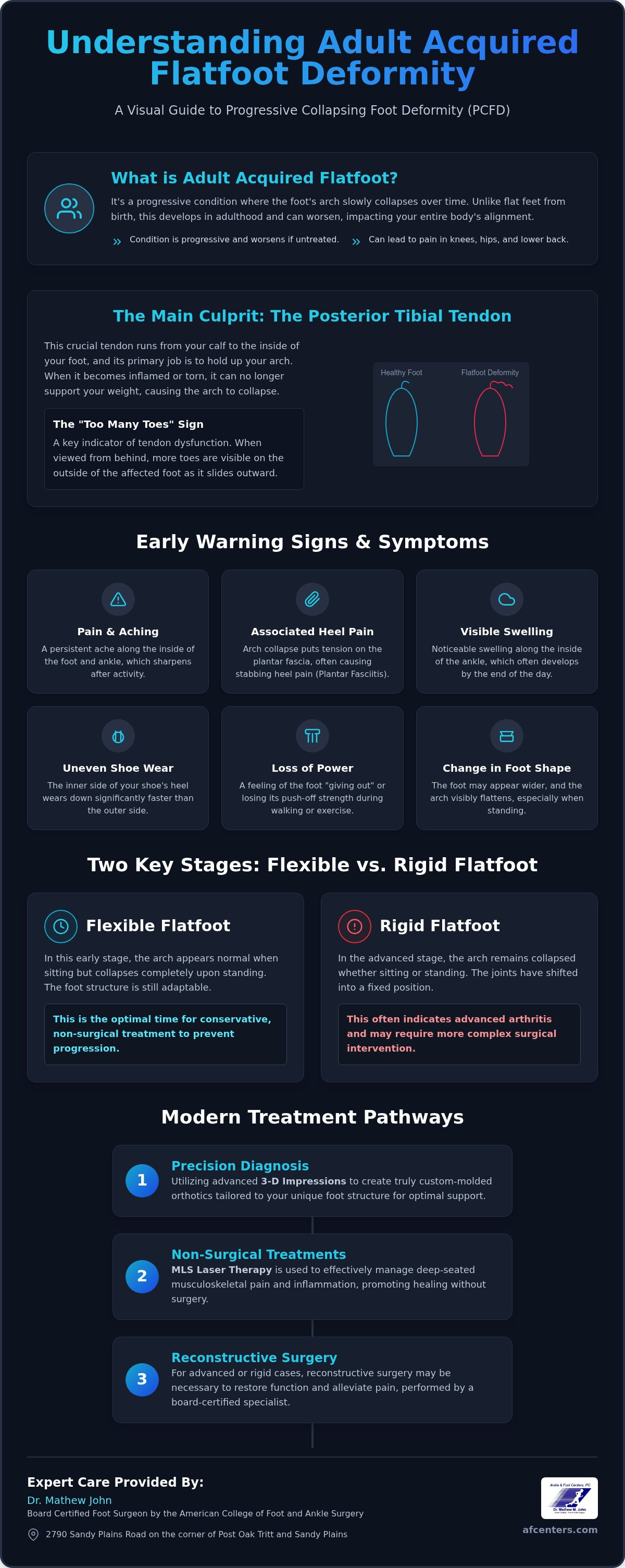
Adult Acquired Flatfoot Deformity (AAFD), recently renamed Progressive Collapsing Foot Deformity, is more than just having Flat feet. It's a complex condition where the arch of the foot slowly loses its structural integrity over time. Unlike the flat feet some people are born with, this is a condition that develops during adulthood and can lead to significant changes in how you move. When you visit our clinic at 2790 Sandy Plains Road on the corner of Post Oak Tritt and Sandy Plains, we look at the whole picture of your foot health. Seeking an early adult acquired flatfoot deformity treatment plan is vital because this condition is progressive. If left alone, it doesn't just stay the same; it often gets worse, affecting your knees, hips, and even your lower back as your body tries to compensate for the lack of a stable base.
The Role of the Posterior Tibial Tendon
Your posterior tibial tendon is one of the most important structures in your lower leg. It starts in your calf, travels down the inside of your ankle, and attaches to the bones in the middle of your foot. Its primary job is to hold up your arch and provide stability when you walk. When this tendon becomes inflamed or starts to tear, it can no longer support your weight. You might notice the "too many toes" sign. If someone looks at your heels from behind, they'll see more toes peeking out on the pinky-toe side than usual. This happens because the front of your foot is actually sliding outward as the arch collapses. This dysfunction is a primary reason why patients seek professional podiatric services to restore their balance and strength.
Flexible vs. Rigid Flatfoot
Understanding where you are in your journey depends on whether your deformity is flexible or rigid. In the flexible stage, your arch might appear normal when you sit down but disappears completely the moment you stand up. This is often the best time to start conservative care. If the condition progresses without intervention, it can become a rigid flatfoot. At this stage, the arch is gone regardless of whether you're standing or sitting. This change usually indicates that advanced arthritis has set in or that the joints have physically shifted into a permanent position. Dr. Mathew John, a Board Certified Foot Surgeon by the American College of Foot and Ankle Surgery, emphasizes that intervening while the foot is still flexible can often prevent the need for more complex reconstructions later. Early care protects your joints from long-term wear and tear.
Common Symptoms: When to Visit Our Marietta Foot Clinic
Identifying symptoms early is the best way to ensure success with adult acquired flatfoot deformity treatment. You might first notice a dull, persistent ache along the inside of your foot and ankle. This pain often sharpens after you spend time standing, walking, or engaging in light exercise. Many patients also report visible swelling that develops by the evening. For a comprehensive overview of AAFD, clinical research suggests that these early warning signs are your body's way of signaling that the structural support is failing. Understanding these changes helps you choose the right adult acquired flatfoot deformity treatment before the condition limits your lifestyle.
Pay close attention to how your body reacts during movement. If you feel like your foot is "giving out" or losing its push-off power during exercise, the posterior tibial tendon may be overstretched. Another clue is often hidden in your closet. Look at the soles of your favorite shoes. If the inner side of the heel is wearing down significantly faster than the outer side, your foot is likely rolling inward due to the collapse of your arch. These mechanical shifts can lead to a chain reaction of pain throughout your lower body.
The Link Between Flat Feet and Heel Pain
When your arch collapses, it doesn't just affect the middle of your foot. This flattening puts immense, constant tension on the plantar fascia, which is the thick band of tissue connecting your heel to your toes. This is why many people struggling with flat feet also experience stabbing pain in their heels. If you've been searching for Heel Pain Relief in Marietta, it's essential to evaluate your arch height. Solving the underlying flatfoot issue is often the missing piece in resolving chronic plantar fasciitis and preventing future flare-ups.
Recognizing Progressive Changes
Progressive collapsing foot deformity is a complex musculoskeletal condition that requires expert care to prevent permanent joint damage. You might notice your foot looks wider or that you've developed new bunions or hammertoes. As the arch drops, the bones in the front of the foot shift, leading to these secondary deformities. Watching your foot shape change over months or years is a clear sign that the internal support structures are no longer holding. Dr. Mathew John is a Board Certified Foot Surgeon by the American College of Foot and Ankle Surgery and has the expertise to stop this progression. We invite you to schedule a comprehensive evaluation at our office located at 2790 Sandy Plains Road on the corner of Post Oak Tritt and Sandy Plains.
Advanced Diagnosis: The Precision of 3-D Impressions
A precise diagnosis is the foundation of any successful adult acquired flatfoot deformity treatment plan. At our clinic, Dr. Mathew John, a Board Certified Foot Surgeon by the American College of Foot and Ankle Surgery, performs a meticulous physical evaluation to determine the specific stage of your condition. This process is essential because treatment approaches for AAFD vary significantly depending on whether the deformity is in an early inflammatory stage or has progressed to joint misalignment. By identifying the exact level of tendon involvement and joint stability, we can tailor a recovery path that matches your specific lifestyle goals.
We've moved beyond generic measurement methods that often fail to capture the subtle nuances of your foot's shape. Instead, we utilize advanced 3-D impressions to create a high-fidelity model of your foot. This precision ensures that any corrective device we create fits your unique anatomy perfectly. To supplement this data, we use weight-bearing X-rays at our facility at 2790 Sandy Plains Road on the corner of Post Oak Tritt and Sandy Plains. These images allow us to see exactly how your bones shift under the pressure of your body weight. It's a critical detail that non-weight-bearing images simply can't provide, giving us a clear view of your internal bone structure.
Capturing Your Unique Foot Structure
3-D impressions provide a perfect anatomical replica of your foot, which is a major leap forward from store-bought inserts. While generic insoles use a "one size fits most" approach, they often fail to address the specific collapse occurring in your arch. When we use 3-D impressions, we're looking at the exact contour of your heel and midfoot. This level of accuracy is vital for correcting the internal mechanical misalignments that cause chronic pain. Custom-molded devices provide the specific support your posterior tibial tendon needs to rest and heal effectively.
What to Expect During Your Marietta Consultation
Your visit includes a detailed gait analysis where we observe how your feet move in real-time. We'll watch your stride to identify exactly where your mechanics are failing and where the most pressure is being applied. At Ankle & Foot Centers, PC, we pride ourselves on a personalized approach that treats you as a partner in your own health journey. We invite you to visit us at the corner of Post Oak Tritt and Sandy Plains for a full evaluation. You can also explore our other comprehensive podiatric services to see how we help the Marietta community stay active and mobile.
Non-Surgical Treatments for Flatfoot Pain
Starting with conservative care is often the most effective way to manage your symptoms and regain mobility. Most patients who seek adult acquired flatfoot deformity treatment in the early stages can find significant relief without the need for an operating room. Our goal at Ankle & Foot Centers, PC is to stabilize your arch and provide the support your posterior tibial tendon needs to rest. By combining advanced technology with lifestyle adjustments, we create a path toward pain-free movement at our clinic located at 2790 Sandy Plains Road on the corner of Post Oak Tritt and Sandy Plains.
Supportive footwear and a consistent stretching routine for the Achilles tendon are vital components of your recovery. Tightness in the calf muscles can actually pull on the heel bone, forcing the arch to collapse further. By addressing these lifestyle factors alongside professional clinical treatments, we can often halt the progression of the deformity and keep you active in the Marietta community.
MLS Laser Therapy for Arch Inflammation
We utilize MLS Laser Therapy as a powerful, non-invasive tool to address the musculoskeletal pain and inflammation that typically accompany a collapsing arch. This technology uses specific wavelengths of light to stimulate cellular repair and reduce swelling without the use of drugs or invasive procedures. Because there is no downtime, you can return to your daily activities immediately after your session. It's particularly effective for difficult-to-heal areas where the tendon has been overstretched or strained by the mechanical shift of your foot.
Swift Treatment for Pressure-Related Warts
When your gait changes due to flatfoot, your feet often develop new pressure points that weren't there before. These areas are frequently more susceptible to stubborn or recalcitrant plantar warts. For these cases, we offer Swift Treatment. This advanced microwave ablation technology targets the underlying cause of the wart by stimulating a natural immune response. The protocol typically involves four sessions, spaced exactly one month apart. One of the biggest benefits for our patients is that there is absolutely no downtime following the procedure, allowing you to stay active throughout your care.
The Power of Custom-Molded Orthotics
Custom-molded orthotics are a cornerstone of effective non-surgical care. Unlike generic store-bought inserts that offer minimal support, our orthotics are crafted using precise 3-D impressions of your feet. This ensures a perfect fit that redistributes your weight and relieves the constant strain on your posterior tibial tendon. Dr. Mathew John, a Board Certified Foot Surgeon by the American College of Foot and Ankle Surgery, oversees the design of these medical-grade devices to ensure they correct your specific mechanical misalignments. You can explore our services to learn more about how custom medical equipment can transform your daily comfort. If you are ready to stop the pain, schedule your orthotic fitting today to get the professional support you deserve.
Reconstructive Surgery with a Board Certified Specialist
While many patients find success with conservative adult acquired flatfoot deformity treatment, there are instances where structural damage requires a more permanent solution. If custom-molded orthotics and physical therapy no longer manage your pain, or if your foot has transitioned into a rigid state, reconstructive surgery becomes a necessary consideration. The primary goals of these procedures are to restore the natural arch, realign the foot, and return strength to the failing posterior tibial tendon. At our office at 2790 Sandy Plains Road on the corner of Post Oak Tritt and Sandy Plains, we specialize in these complex reconstructions to help you regain your quality of life.
Surgery is never a decision we take lightly. It's a collaborative process where we look at your activity levels, the stage of your deformity, and your long-term wellness goals. By choosing a surgical path, you're addressing the underlying skeletal and soft-tissue failures that conservative measures cannot always fix. Our team is here to guide you through every step of this transformative journey, ensuring you feel confident in your plan for recovery.
Dr. Mathew John: Board Certified Expertise
Choosing the right surgeon is the most critical decision in your recovery. Dr. Mathew John is a Board Certified Foot Surgeon by the American College of Foot and Ankle Surgery, which represents the highest standard of surgical training and clinical excellence. This certification ensures that your surgeon has undergone rigorous peer review and demonstrated exceptional skill in reconstructive foot and ankle surgery. When dealing with a progressive condition, having a specialist who understands the intricate relationship between bone alignment and tendon function is essential for a successful outcome.
The Surgical Path to Recovery
Every patient receives an individualized surgical plan tailored to their specific anatomy. This often involves a combination of bone realignment techniques, known as osteotomies, and tendon repair or transfer to provide a more stable base. For example, we may realign the heel bone while simultaneously reinforcing a damaged tendon to ensure the arch remains supported during activity. These precise adjustments allow the foot to function as it was intended, preventing the return of the deformity.
Recovery is a steady, rewarding process focused on long-term success. While the initial weeks involve protecting the surgical site, our ultimate goal is to get you back to walking and enjoying the Marietta community without the shadow of chronic pain. We provide comprehensive guidance throughout your post-operative phase to ensure your transition back to activity is safe. You can learn more about our reconstructive foot and ankle surgery options to see how we help our patients reclaim their mobility and return to the activities they love.
Take the First Step Toward Pain-Free Mobility
You don't have to let arch pain or a changing foot shape limit your active Marietta lifestyle. Understanding the progression of your condition is the first step toward finding the right adult acquired flatfoot deformity treatment. Whether you're in the early stages of inflammation or require more advanced intervention, we offer the specialized care you need to walk with confidence again. Our clinic utilizes advanced 3-D impressions to create custom-molded orthotics that provide a level of support generic inserts simply can't match.
We invite you to visit us at 2790 Sandy Plains Road on the corner of Post Oak Tritt and Sandy Plains. Here, you'll receive a personalized evaluation from Dr. Mathew John, a Board Certified Foot Surgeon by the American College of Foot and Ankle Surgery. From non-invasive MLS Laser therapy to expert reconstructive surgery, our goal is to restore your arch and eliminate your discomfort. It's time to prioritize your long-term health and get back to the activities you love.
Schedule your flat feet evaluation with Dr. Mathew John today and start your journey toward lasting relief. You've got a dedicated partner in your health journey every step of the way.
Frequently Asked Questions
Do flat feet always require treatment even if I have no pain?
Not all flat feet need immediate intervention if they are asymptomatic. However, because flatfoot can be progressive, it's beneficial to have a professional evaluation to establish a baseline. We focus on wellness and long-term health, suggesting supportive footwear or exercises to prevent future issues. If you notice changes in your gait, seeking an adult acquired flatfoot deformity treatment plan early can prevent joint damage and keep you moving without pain.
What is the difference between 3-D impressions and foot scanning?
We utilize 3-D impressions to capture a perfect anatomical replica of your foot structure. This method is superior to generic scanning because it provides the exact detail needed for medical-grade, custom-molded orthotics. By focusing on the unique contours of your arch and heel, we can correct mechanical misalignments that cause chronic pain. This precision ensures your corrective devices work with your body's natural movement rather than against it.
How does Dr. Mathew John determine if I need flatfoot surgery?
Dr. Mathew John, a Board Certified Foot Surgeon by the American College of Foot and Ankle Surgery, uses a combination of gait analysis and weight-bearing X-rays. Surgery is recommended when adult acquired flatfoot deformity treatment through conservative means, like bracing or orthotics, fails to provide relief. He focuses on restoring the natural arch and stabilizing the posterior tibial tendon to ensure you can return to an active, pain-free lifestyle in the Marietta community.
Can MLS Laser Therapy help with the pain from a collapsed arch?
MLS Laser Therapy is an excellent non-invasive option for managing musculoskeletal pain and inflammation. It works by stimulating cellular repair and increasing circulation in the overstretched tissues of your arch. Since there is no downtime or medication involved, it's a popular choice for patients who want to stay active during their recovery. This therapy is specifically designed to target the deep-seated inflammation that occurs when your foot structure begins to collapse.
What is the Swift Treatment for warts and how many sessions are needed?
Swift Treatment is a modern solution for recalcitrant plantar warts using microwave ablation technology. This treatment is particularly helpful for flatfoot patients who develop pressure-related warts due to gait changes. The standard protocol requires four sessions, which are spaced exactly one month apart. There is no downtime for patients, meaning you won't have to miss any work or social activities in Marietta while you complete your specialized treatment plan.
How long does it take to recover from reconstructive flatfoot surgery?
The recovery timeline depends on whether your procedure involves bone realignment or tendon transfers. Most patients transition back to regular activity over several months. We prioritize a steady progression toward your goals, emphasizing long-term health over a rushed return. Dr. Mathew John will provide a detailed, step-by-step guide for your post-operative care to ensure your arch remains stable and functional as you get back to your favorite local walking trails.
Will custom-molded orthotics fit in my regular shoes?
Most custom-molded orthotics are designed to fit comfortably in athletic shoes and supportive walking shoes. During your fitting, we use 3-D impressions to ensure the device is as streamlined as possible while still providing the necessary corrective support. We recommend bringing your most frequently worn shoes to your appointment at 2790 Sandy Plains Road. This allows us to verify the fit and make any minor adjustments needed for your daily comfort.
Where is the Marietta office located exactly?
Our practice, Ankle & Foot Centers, PC, is conveniently located at 2790 Sandy Plains Road on the corner of Post Oak Tritt and Sandy Plains. We are proud to be a local hub for advanced podiatric care in Marietta. Our location is easily accessible for residents of Roswell, Woodstock, and Kennesaw. Whether you need a surgical evaluation or custom orthotics, our professional team is ready to guide you toward better foot health in a welcoming environment.


