
What if the very medical device designed to end your foot pain is actually the reason your recovery has stalled? You spent significant resources on custom orthotics, but your heels still throb every morning when you step out of bed. It's incredibly frustrating to feel like you've wasted your investment while your mobility continues to suffer. You expected a life-changing solution, not a stiff insert that makes your arch pain feel even worse. We understand that disappointment, and we want you to know that you don't have to settle for persistent discomfort.
This guide will help you identify the specific medical signs your orthotics are not working, explain how to navigate the refund process, and show you the path toward genuine, lasting comfort. We'll explore the vital difference between a normal adjustment period and a product that simply doesn't fit your anatomy. You'll also learn how precision tools like 3-D impressions ensure a better fit, and when advanced treatments might be a better choice for your unique journey. Let's get you back on your feet with the professional support you deserve.
Key Takeaways
- Learn to recognize the physical signs your orthotics are not working, such as persistent heel pain or new discomfort in your knees, hips, and lower back.
- Discover why traditional foam box methods often fail and how precision 3-D impressions provide the accurate alignment necessary for true corrective support.
- Understand the critical differences between retail satisfaction guarantees and medical-grade lab warranties to navigate your refund or adjustment options effectively.
- Master a simple documentation process using a wear log to provide the clear evidence needed when requesting a refund or professional modification.
- Find out how a comprehensive diagnostic approach can identify if your pain stems from conditions like neuromas that require advanced treatments beyond simple inserts.
The Frustration of Ineffective Orthotics: Identifying the Signs of Failure
Investing in custom orthotics is a significant commitment of both your time and your resources. When you're dealing with chronic heel or arch pain, you aren't just buying a piece of plastic; you're investing in the hope of walking without a limp. It's deeply frustrating when that investment doesn't pay off immediately. Many people feel guilty or confused when their new inserts cause fresh discomfort. You might wonder if you just need more time or if these are clear signs your orthotics are not working. While a refund is a consumer right you should understand, your top priority is finding a medical fix that actually stops the pain.
To understand why a device might be failing, it helps to first clarify: What are orthotics? Essentially, they are external devices used to modify the structural and functional characteristics of your neuromuscular and skeletal system. If the modification is wrong, the results can be painful. We want to help you distinguish between a normal transition and a failed prescription so you can move forward with confidence.
The Break-In Period vs. Persistent Pain
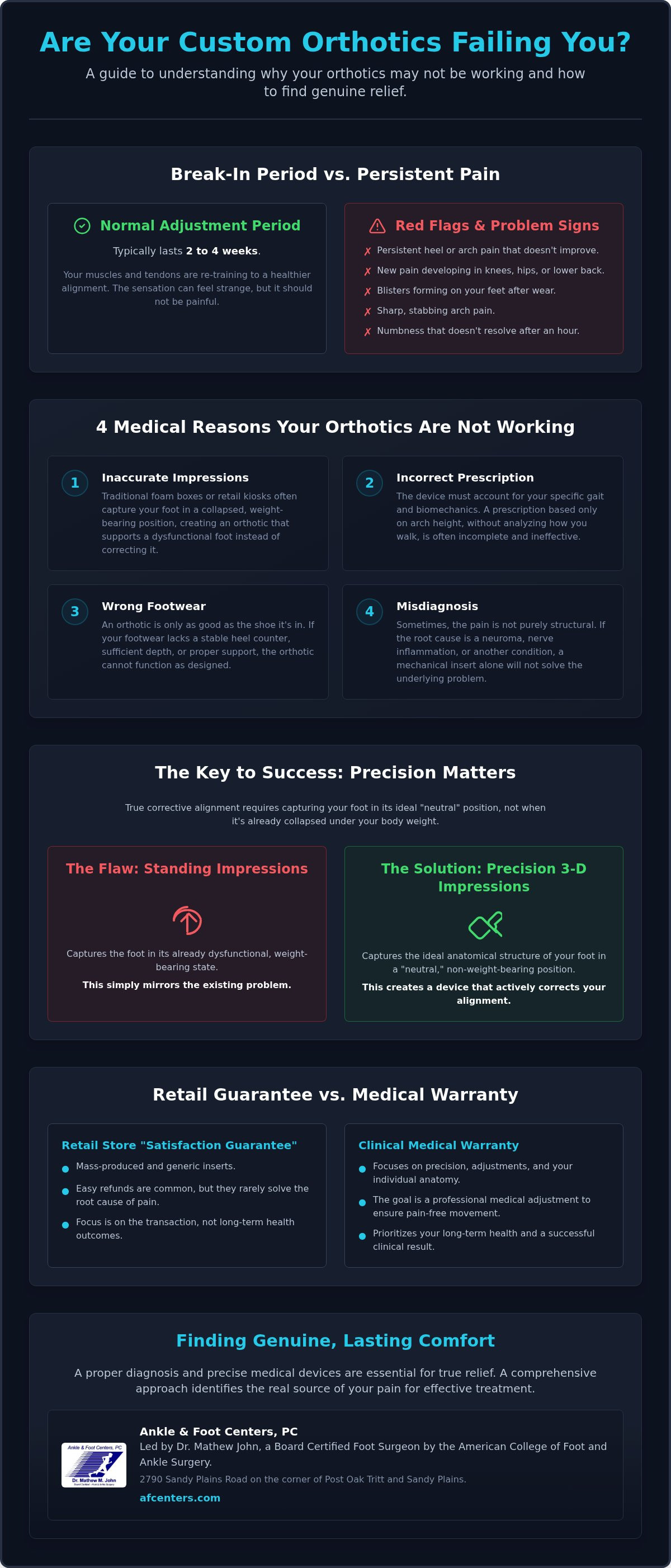
Most patients require a two to four week adjustment period. During this time, your muscles and tendons are literally being re-trained to function in a healthier alignment. This process can feel strange, but it shouldn't be agonizing. You should be alert for specific red flags that indicate a problem. If you experience blisters, sharp arch pain, or numbness that doesn't go away after an hour of wear, these are definitive signs your orthotics are not working as intended. Pushing through "bad" pain isn't brave; it's dangerous. Forcing your feet into a fundamentally flawed prescription can cause secondary injuries, including stress fractures or tendonitis.
Retail Arch Supports vs. Medical Custom Orthotics
There is a massive difference between a retail store's "satisfaction guarantee" and a clinical medical warranty. Big-box retail stores often offer easy refunds because their products are mass-produced and generic. While getting your money back is simple, those inserts rarely address the root cause of your specific biomechanical issues. Medical-grade custom orthotics, like those offered through our comprehensive podiatry services, focus on precision and individual anatomy. A podiatrist can evaluate exactly why a retail product failed your foot structure. While a refund might put cash back in your pocket, a professional medical adjustment ensures you actually reach your goal of pain-free movement. We prioritize your long-term health over a quick transaction.
4 Medical Reasons Your Orthotics Are Not Working
Identifying the signs your orthotics are not working often leads to a deeper question: why did they fail in the first place? Success depends on more than just a piece of plastic in your shoe. It requires a synergy between your unique anatomy, the precision of the device, and the correct medical diagnosis. If any of these elements are off, your pain will likely persist. Here are the four primary medical reasons for orthotic failure:
- Inaccurate impressions: Many retail kiosks or traditional foam boxes capture your foot while it is already in a collapsed, weight-bearing position. This means the orthotic is built to support a dysfunctional foot rather than correcting it.
- Incorrect Prescription: A proper device must account for your specific gait and biomechanical movement. If a provider only looks at arch height without watching how you walk, the prescription will likely be incomplete.
- Wrong Footwear: An orthotic is only as effective as the shoe it sits in. If your footwear lacks a stable heel counter or enough depth, the orthotic cannot function correctly.
- Misdiagnosis: Sometimes the issue isn't structural. If you are actually suffering from a neuroma or severe nerve inflammation, a mechanical insert won't solve the underlying problem.
The Importance of Precision 3-D Impressions
To achieve true corrective alignment, we must capture your foot in its "neutral" position. Unlike retail fit-stations that record your foot while it is already under the stress of your body weight, precision 3-D impressions allow us to see the ideal anatomical structure of your foot. This distinction is vital because a standing impression simply mirrors your current problems. A 3-D impression captured by a professional ensures that the resulting medical device actually guides your foot into a healthier, pain-free state. You can explore our advanced diagnostic services to see how this precision makes a difference.
When Orthotics Aren't the Answer
In some cases, the reason you see signs your orthotics are not working is that your condition requires a different therapeutic approach. For instance, stubborn plantar fasciitis or chronic musculoskeletal pain may respond better to MLS Laser Therapy, which uses specific wavelengths of light to reduce inflammation and speed up healing. If structural deformities like bunions or hammertoes are the culprit, a Board Certified Foot Surgeon may need to discuss reconstructive options. Additionally, if your discomfort is actually caused by stubborn plantar warts, Swift Treatment (microwave ablation) can provide the resolution that an insert never could. We focus on finding the right tool for your specific journey.
Refund or Adjustment? Navigating the Return Policy Landscape
When you start noticing the signs your orthotics are not working, your first instinct might be to ask for your money back. It's a natural reaction to a failed investment. However, the path to a refund depends entirely on where you bought your inserts. Retail foot stores and medical clinics operate under very different rules, and understanding these differences is the first step toward getting the relief you actually need.
Retail chains often advertise bold satisfaction guarantees to lower your barrier to purchase. In reality, these are often limited to store credit or involve complex fine print that makes a cash refund difficult to obtain. More importantly, a retail refund doesn't address the underlying medical issues. If you're still struggling with chronic heel pain, getting your money back won't help you walk better. You'll still have the pain; you'll just have a few extra dollars in your pocket.
Medical-grade custom orthotics come with a lab warranty rather than a simple retail guarantee. This warranty typically covers modifications and adjustments for a set period, often up to 90 days. It's important to understand the distinction between the physical device and the professional services provided. While a clinic might offer a partial refund for a returned device, the professional fees for the comprehensive exam and the precision 3-D impressions are generally non-refundable because those clinical services were fully rendered. Most podiatrists prefer refitting or adjusting your devices over a straight refund because our goal is your long-term health, not just a transaction. If you see signs your orthotics are not working, it often means the device needs a professional tweak to match your specific gait.
The Retail Return Trap
Be wary of the satisfaction guarantee at big-box arch support stores. These businesses are built on high-volume sales, not clinical outcomes. You might find that the guarantee only applies to an exchange for another generic product rather than a cash refund. Before you commit, ask if the refund is returned to your original payment method. Remember, a store credit at a place that couldn't fix your pain is just a different way to lose your investment.
Medical Adjustments: The Path to Proper Fit
A podiatrist can perform sophisticated modifications that a retail clerk simply cannot. We can thin the shells to fit into tighter shoes, add specific pads to offload pressure from a neuroma, or adjust the heel post to stabilize your stride. You should expect a few follow-up visits during the first three months of wear. If these minor tweaks don't resolve the issue, your doctor may decide to start over with fresh 3-D impressions to ensure the second pair is perfect. This collaborative process is how we turn a failed attempt into a successful recovery.
Guide to Requesting a Refund for Ineffective Orthotics
Navigating a refund request requires a calm, evidence-based strategy. If you've observed the signs your orthotics are not working, your first step is to document everything. Start a "wear log" for at least one week. Note exactly when the pain starts, which part of your foot is affected, and what shoes you were wearing. This log transforms a vague complaint into a clinical record that a provider cannot easily dismiss.
Next, pull out your original purchase agreement or medical consent form. These documents often outline the specific window for adjustments or returns. Once you understand your rights, schedule a final "troubleshooting" appointment. This gives the provider a chance to address the failure points you've documented. If the issue remains unresolved after this visit, it's time to formalize your request in writing. Your letter should cite specific clinical failure points rather than simply stating you don't like the product.
If your original provider is unhelpful, a second opinion from a Board Certified Foot Surgeon can provide the leverage you need. You can schedule a comprehensive evaluation with our team to get a clear medical perspective on why your current devices are failing. Professional persistence combined with objective medical evidence is the most effective refund strategy.
Essential Documentation for Your Claim
Keep every piece of paper associated with your purchase. This includes the original receipt, the packaging, and the "wearing instructions" you were given. If the orthotics are causing physical symptoms, take clear photos of your feet. Redness, blisters, or new calluses serve as undeniable proof of a poor fit. A second opinion report from a specialist often acts as the final piece of evidence needed to secure a refund from a stubborn retail chain.
Communication Tips for a Smooth Process
When you speak with the manager or your doctor, focus your language on "clinical failure." Explain that the device is not correcting your biomechanics or is causing secondary injuries. We recommend the Three-Strike Rule: give the provider three distinct opportunities to adjust the device. If the third modification still doesn't stop the pain, you have a strong case for a full return. This patient, structured approach protects your health and your wallet.
Finding Real Relief at Ankle & Foot Centers, PC in Marietta
If you've spent weeks or months noticing the signs your orthotics are not working, it's time to stop the cycle of frustration. Many people turn to retail kiosks or mail-order kits hoping for a quick fix, only to find their heel or arch pain persists. At Ankle & Foot Centers, PC, we believe you deserve a solution tailored to your specific anatomy and lifestyle. Dr. Mathew John, a Board Certified Foot Surgeon, leads our Marietta team with a commitment to finding the root cause of your discomfort. We don't just treat symptoms; we help you reclaim your mobility through sophisticated, personalized care.
Our comprehensive diagnostic approach sets us apart from high-volume retail stores. We understand that an orthotic is a medical tool, and its success depends on precision. That's why we utilize precision 3-D impressions for all our custom fittings. Unlike standing impressions that capture your foot in a collapsed state, our 3-D impressions record your foot in its ideal neutral position. This ensures that your orthotics provide the exact corrective support your unique gait requires. By focusing on the structural integrity of your foot, we create a foundation for long-term health rather than a temporary cushion.
Expert Care Near the Corner of Sandy Plains and Post Oak Tritt
You can find our welcoming practice located at 2790 Sandy Plains Road on the corner of Post Oak Tritt and Sandy Plains. We've designed our Marietta office to be a localized hub of expertise where you can feel supported throughout your entire journey. We maintain a warm, non-judgmental atmosphere because we know how much chronic pain can impact your quality of life. Whether you're a long-distance runner or someone who just wants to walk through the grocery store without pain, our goal is to return you to an active lifestyle. We look beyond the insert to see if other advanced treatments, such as MLS Laser Therapy for musculoskeletal pain, might be necessary to accelerate your healing.
Schedule Your Orthotic Evaluation Today
Don't let another day go by feeling like you've wasted your investment. We invite you to explore our full range of services and schedule a professional evaluation. We encourage you to bring your current "failed" orthotics to your appointment. Dr. John will perform a thorough medical audit of your existing devices to determine exactly why they aren't delivering the relief you expected. Sometimes, the issue is the prescription; other times, it's a misdiagnosed condition like a neuroma or stubborn plantar fasciitis that requires a different approach. With professional guidance and the right technology, you won't have to navigate this path alone. Let's find the real relief you've been searching for.
Step Forward with Confidence and Clarity
Recognizing the signs your orthotics are not working is the first step toward reclaiming your active lifestyle. You don't have to settle for discomfort when your mobility and financial investment are on the line. Whether your current inserts suffer from an incorrect prescription or a lack of anatomical precision, professional guidance can turn your recovery around. By choosing a medical-grade approach, you ensure that every step is supported by expert diagnostic care and advanced technology.
Dr. Mathew John is a Board Certified Foot Surgeon by the American College of Foot and Ankle Surgery who specializes in the precision of 3-D impressions. Our Marietta practice, located at 2790 Sandy Plains Road on the corner of Post Oak Tritt and Sandy Plains, is dedicated to helping you find lasting relief. Stop the cycle of frustration and let us audit your current devices to find a path that actually works for your feet. We are your partners in health, providing a supportive environment where your progress is our priority.
Schedule your orthotic evaluation with Dr. Mathew John today. You deserve to walk without pain; let's find your relief together.
Frequently Asked Questions
Can I get a refund if my custom orthotics still hurt after a month?
Usually, medical clinics offer adjustments rather than cash refunds for the full amount. The professional fees for the exam and 3-D impressions are rendered services, but most labs have a 90-day warranty for modifications. If you notice signs your orthotics are not working after 30 days, your first step is a troubleshooting appointment. We prioritize getting the fit right so you can return to your daily activities pain-free.
Is it normal for new orthotics to cause pain in other parts of my body like my knees or back?
Temporary muscle soreness is normal as your body realigns, but sharp or persistent pain in your knees or back suggests a problem. These are potential signs your orthotics are not working correctly or are over-correcting your gait. While a two to four week adjustment period is expected, new pain that limits your mobility requires a professional audit. We evaluate your entire kinetic chain to ensure the device supports your whole body.
What is the difference between a refund from a retail store and a medical podiatry clinic?
Retail stores often offer simple money-back guarantees because they sell mass-produced, generic products with high margins. In contrast, a medical clinic provides a custom-fabricated prescription device. While a retail refund is easier to get, it doesn't solve the underlying biomechanical issue. A medical clinic focuses on lab warranties and professional adjustments to ensure the device actually provides the corrective support your feet need for long-term health.
How long should I try to 'break in' my orthotics before asking for a refund or adjustment?
You should follow a gradual break-in schedule over a period of two to four weeks. Start with one hour of wear on the first day and increase the time daily. If you still experience significant discomfort or blisters after this window, it's time to stop the break-in and seek a professional adjustment. Waiting too long can lead to secondary injuries, so proactive communication with your podiatrist is essential for success.
Will my insurance cover the cost if I need to replace orthotics that didn’t work?
Insurance coverage for replacements depends on your specific plan's durable medical equipment (DME) benefits and the reason for the failure. Many plans have a frequency limit, such as one pair every one or two years. If your devices failed due to a documented medical misdiagnosis or a structural change in your foot, your provider can help you navigate the claims process. Always check your benefits before starting a new fitting.
What happens if my podiatrist refuses to give me a refund for my custom inserts?
If a refund is refused, focus your efforts on the lab warranty for modifications. Most custom orthotics include a period where the manufacturer will thin the shell, add padding, or adjust the heel post at no extra charge. If communication has broken down, seeking a second opinion from a Board Certified Foot Surgeon can provide an objective report on the device's clinical failure. This documentation often helps resolve disputes with providers or insurers.
Are custom orthotics guaranteed to fix my plantar fasciitis or heel pain?
While custom orthotics are highly effective for managing heel pain, they aren't a universal guarantee because some conditions require multi-modal care. If your pain stems from severe inflammation or a neuroma, we might combine your inserts with MLS Laser Therapy or Shockwave Therapy. Our goal is to find the right combination of treatments that addresses the root cause of your discomfort, ensuring you aren't relying on a single device alone.
How do I know if I need a refund or just a different pair of shoes to fit my orthotics?
An orthotic requires a stable foundation to function, so check your footwear before requesting a refund. Your shoes should have a removable factory insole, a firm heel counter, and enough depth to accommodate the insert without pinching. If your orthotics feel great in one pair of shoes but cause pain in another, the issue is likely shoe compatibility. We can audit your footwear during your evaluation to ensure a proper match.


