
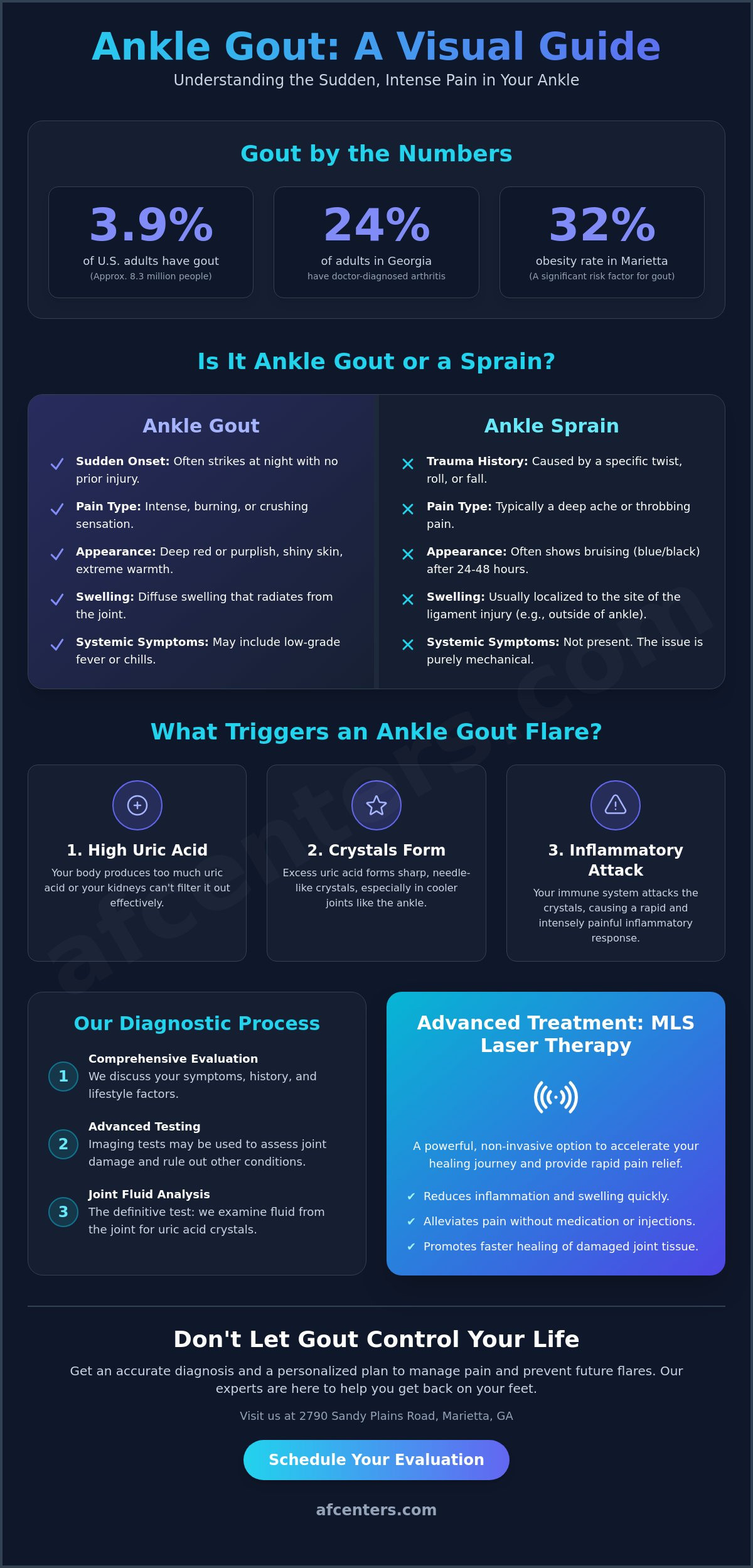
Did you know that nearly 3.9% of adults across the United States, or roughly 8.3 million people, are currently living with the intense, throbbing reality of gout? In Georgia, where 24% of adults face doctor-diagnosed arthritis, many residents in Marietta are discovering that what feels like a sudden injury is actually ankle gout. With a local obesity rate of 32%, many of our neighbors are at a higher risk for these painful inflammatory episodes. It's exhausting to wake up in the middle of the night with a joint that feels like it's on fire, especially when you don't recall any specific trip or fall. You might feel frustrated and confused when a simple walk becomes impossible due to extreme sensitivity and heat.
We understand how disruptive this pain is to your daily wellness journey and your sleep. You deserve a clear path to relief that moves beyond guesswork. This guide will empower you to identify the specific signs of a flare, distinguish them from a common sprain, and explore advanced treatment options like MLS Laser Therapy to reduce inflammation quickly. We'll preview the steps our experts take at 2790 Sandy Plains Road on the corner of Post Oak Tritt and Sandy Plains to provide an accurate diagnosis and a long-term plan to prevent future attacks.
Key Takeaways
- Learn how to distinguish between a sudden gout flare and a common sprain by identifying visual markers like intense redness and nighttime onset.
- Understand the systemic role of uric acid and why your ankle gout might be triggered by metabolic factors rather than a physical injury.
- Discover the specialized clinical process our podiatrists use to provide an accurate diagnosis through advanced testing and joint fluid analysis.
- Explore how MLS Laser Therapy can rapidly reduce inflammation and accelerate your healing journey without invasive procedures.
- Create a proactive plan to manage your wellness and prevent future flares through professional guidance and lifestyle adjustments.
Understanding Ankle Gout: Why Your Ankle Joint is a Target
While many people associate gout strictly with the big toe, ankle gout is a common and incredibly painful reality for many patients. This condition is actually a systemic metabolic issue that chooses to manifest locally in your joints. It occurs when your body either produces too much uric acid or struggles to filter it out through the kidneys. When levels become too high, the acid forms sharp, microscopic monosodium urate crystals. Understanding Gout requires looking at how these crystals settle into the joint space, causing sudden and intense inflammation.
Why does it target the ankle? Your ankles are farther from your heart, which means they maintain a slightly lower temperature than your core. Uric acid is less soluble in cooler environments, making it much easier for those crystals to "precipitate" or fall out of the blood and into the ankle joint. While the hallux (big toe) is the most famous target, the ankle joint is a frequent second, often leading to misdiagnosis as a simple strain. At our office at 2790 Sandy Plains Road on the corner of Post Oak Tritt and Sandy Plains, we see many patients who are surprised to learn their ankle pain isn't an injury, but a metabolic flare.
The Biological Mechanism of a Flare
Once those needle-like crystals settle into the synovial fluid, your immune system views them as foreign invaders. White blood cells rush to the area, creating a massive inflammatory response. This process is remarkably fast. A flare-up can reach its peak intensity within just 12 to 24 hours. During this time, the physical presence of the sharp crystals causes direct damage to the delicate joint lining. This explains why the pain feels so sharp and unrelenting, often described as having glass shards inside the joint.
Why Ankle Gout is Particularly Debilitating
Ankle involvement is often more disruptive than a big toe flare because of the joint's complexity. Your ankle isn't just a simple hinge; it supports your entire body weight and allows for essential side-to-side movement. When ankle gout strikes, the swelling often spreads to the surrounding tendons and ligaments, making any weight-bearing activity nearly impossible. Unlike a toe, which you might be able to protect in a wide shoe, an inflamed ankle prevents the basic mechanics of walking. This often leaves patients completely immobile until the inflammation subsides. You can explore our comprehensive foot and ankle services to learn how we address these complex joint issues and help you regain your mobility.
Recognizing the Signs: Is It Ankle Gout or a Sprain?
Imagine waking up at 2:00 AM with an ankle that feels like it has been crushed, even though you didn't suffer any injury the day before. This sudden onset is a hallmark of ankle gout. Unlike a sprain, which follows a clear twist or fall, gout often strikes during rest. The pain is intense and typically reaches its peak intensity within 24 hours. You might notice the skin over the joint looks tight, shiny, and deep red, almost as if it were infected.
The quality of the pain is also quite distinct. While a sprain feels like a deep ache or throb, gout is frequently described as a burning or crushing sensation. One of the most telling indicators is what podiatrists call the "Bedspread Sign." This occurs when even the weight of a light cotton sheet against your skin feels unbearable. Reviewing Gout symptoms and causes can help you identify if your discomfort aligns with this metabolic condition or a physical injury.
Ankle Gout vs. Ankle Sprain
To help you navigate your healing journey, consider these key differences between a mechanical injury and an inflammatory flare:
- Trauma History: Sprains always have a "moment of injury." Gout appears out of nowhere, often after a heavy meal or during a period of dehydration.
- Swelling Pattern: Sprains usually show localized bruising and swelling on the outside of the ankle. Gout results in diffuse swelling and extreme warmth that radiates from the joint.
- Systemic Response: Because gout is an inflammatory process, you might experience a low-grade fever or chills. These are not typical for a standard mechanical sprain.
If you're unsure about the source of your pain, getting a professional foot and ankle evaluation is the fastest way to find clarity and start the right recovery path.
When to Seek Immediate Podiatric Care
We also need to rule out septic arthritis, a serious joint infection that mimics ankle gout symptoms. At our clinic located at 2790 Sandy Plains Road on the corner of Post Oak Tritt and Sandy Plains, we prioritize rapid relief and accurate diagnosis. Our team utilizes advanced tools like MLS Laser Therapy to manage musculoskeletal pain and inflammation, ensuring you don't have to navigate this painful path alone.
The Root Causes: Uric Acid and Marietta Lifestyle Factors
The root of ankle gout lies in a chemical byproduct called uric acid. Your body creates this acid when it breaks down purines, which are natural substances found in your cells and certain foods. While your kidneys usually filter this out, factors like genetics can hinder this process. If your parents or siblings struggled with joint pain, your body might naturally excrete uric acid less efficiently. Additionally, conditions like hypertension or diabetes can alter kidney function, making it harder to keep levels in check. Understanding these underlying factors is the first step toward Professional Gout Diagnosis and Treatment.
Dietary Triggers and Purine Management
Your diet serves as a powerful tool in managing your health. Certain choices act as fuel for a flare-up. High-purine foods like ribeye steaks, shrimp, and scallops are well-known triggers. Alcohols, particularly beer, can also spike your levels. We also encourage you to look closely at labels for high-fructose corn syrup. This common sweetener, found in many sodas and processed snacks, significantly raises uric acid production. We aren't here to demand a perfect diet. Instead, we want to empower you to make sustainable shifts. Swapping a sugary drink for sparkling water or choosing lean proteins can transform your joint health over time.
Dehydration: The Silent Trigger in Georgia
Living in the Atlanta Metro area means navigating intense summer heat and high humidity. In Marietta, 90-degree days are common, and the resulting sweat loss can be a silent catalyst for ankle gout. When you're dehydrated, your blood volume drops, but the amount of uric acid remains the same. This makes the acid much more concentrated. Dehydration reduces the volume of fluid in your joints, which directly increases the concentration of uric acid and triggers crystal precipitation.
To protect your joints during your daily journey, aim for at least 80 to 100 ounces of water daily, especially if you're active outdoors. If you're visiting our facility at 2790 Sandy Plains Road on the corner of Post Oak Tritt and Sandy Plains, feel free to ask our team about how hydration impacts your recovery. Maintaining a steady intake of fluids is one of the simplest ways to support your wellness and joint function. We're here to help you stay hydrated and moving comfortably through every season.
Professional Diagnosis and Treatment in Marietta
It's vital to differentiate gout from pseudogout, which involves calcium pyrophosphate crystals instead of uric acid. While the pain feels similar, the long-term management strategies differ significantly. By pinpointing the exact cause of your discomfort, we ensure your treatment plan is both accurate and effective. We focus on providing a clear diagnosis so you can move forward with confidence in your recovery journey.
Advanced Diagnostics with Dr. Mathew M. John
As a board-certified podiatrist, Dr. Mathew M. John brings a high level of expertise to every evaluation. He specializes in identifying the subtle joint changes that others might overlook. Our clinic uses advanced, non-invasive imaging to detect tophi, which are clusters of crystals that can form in the soft tissues around the ankle. By visualizing these deposits early, we can develop a personalized treatment plan for our Marietta patients that addresses both the immediate flare and the underlying metabolic causes. We believe in a wellness-oriented approach that prioritizes your long-term mobility over quick, temporary fixes.
Custom Orthotics and Joint Support
Repeated flares can sometimes compromise the structural integrity of your ankle. If your joint alignment has been affected by chronic inflammation, providing physical support is a key part of your recovery. We use 3-D impressions to create custom orthotics that are specifically tailored to the unique contours of your feet. These devices help offload pressure from the sensitive joint, allowing you to walk more comfortably while the tissue heals.
Proper alignment is essential because it prevents secondary injuries that often occur when you change your gait to avoid pain. By using these precise 3-D impressions, we ensure your orthotics provide the exact support needed to stabilize the ankle and protect the joint from future wear. If you are ready to find lasting relief, schedule your expert consultation at our Sandy Plains location today and take the first step toward a pain-free journey.
Managing Inflammation and Preventing Future Flares
Advanced Relief with MLS Laser Therapy
When you're in the midst of a flare, you need more than just general advice. We offer MLS Laser Therapy to specifically target musculoskeletal pain and inflammation. It's important to understand that we use this technology strictly for inflammatory and musculoskeletal conditions; it is never used for fungal issues in our clinic. The laser uses specific wavelengths of light to penetrate deep into the soft tissues surrounding your ankle joint, where the most intense swelling occurs.
This light energy stimulates cellular repair and increases local circulation. It helps your body clear out metabolic waste and inflammatory markers more efficiently than rest alone. The experience is completely painless and non-invasive. Most patients find the sessions relaxing. Since there's no downtime, you can return to your daily life immediately after your appointment. It's a high-end, state-of-the-art solution that feels like a steady hand guiding you back to your personal goals.
Your Long-Term Prevention Checklist
Once the acute inflammation subsides, we shift our focus to preventing the next episode. This often involves a combination of lifestyle adjustments and, when necessary, professional medication management. Your doctor might discuss xanthine oxidase inhibitors to lower uric acid production or uricosuric agents to help your kidneys excrete it more effectively. We'll work together to find the balance that fits your specific needs.
To maintain your results and protect your joint integrity, follow this simple wellness checklist:
- Prioritize Hydration: Aim for 80 to 100 ounces of water daily to keep uric acid concentrations low in your bloodstream.
- Schedule Regular Checkups: Routine visits allow us to monitor your joint health and catch subtle changes before they become painful.
We're your expert partners in this journey, and we're proud to serve as a neighborhood hub for wellness. Visit us at 2790 Sandy Plains Road on the corner of Post Oak Tritt and Sandy Plains to start your recovery. You don't have to navigate the challenges of ankle gout alone. Take control of your foot health today and let us help you rediscover the joy of moving without limits.
Empower Your Journey to Pain-Free Movement
You now have the tools to recognize when ankle gout is the culprit behind your sudden discomfort and how metabolic factors like hydration and diet play a significant role in your recovery. We've explored how professional diagnosis distinguishes these intense flares from mechanical injuries and how state-of-the-art MLS Laser Therapy provides rapid, non-invasive relief for musculoskeletal inflammation. Your path to wellness doesn't have to be a solo effort; it's a partnership built on expert guidance and dedicated local support.
Led by Dr. Mathew M. John, DPM, FACFAS, our team is ready to help you transform your joint health and prevent future disruptions to your lifestyle. We're conveniently located at 2790 Sandy Plains Road on the corner of Post Oak Tritt and Sandy Plains. Don't let the fear of another flare-up hold you back from the activities you love. Schedule your consultation at our Sandy Plains office today and regain your confidence. We're here to support your progress every step of the way and ensure you never have to navigate your health journey alone.
Frequently Asked Questions
Can gout in the ankle be mistaken for a sprain?
Yes, ankle gout is frequently misidentified as a sprain due to shared symptoms like intense swelling and redness. However, a sprain follows a clear physical injury, while gout strikes suddenly without any trauma. Approximately 50% of initial gout cases occur in the big toe, but the ankle is the second most common site. Seeing a specialist at 2790 Sandy Plains Road on the corner of Post Oak Tritt and Sandy Plains ensures an accurate diagnosis through crystal analysis.
How long does an ankle gout flare-up typically last?
An untreated flare typically lasts between 5 and 12 days. The most intense pain usually peaks within the first 24 hours of the episode. While the surface redness might fade sooner, internal inflammation can linger for nearly two weeks. Seeking professional care can reduce this timeframe significantly. Without management, flares may become more frequent and last longer as uric acid crystals continue to accumulate in your joint space.
Is walking good for gout in the ankle?
Avoid excessive walking during an active flare to protect your joint. Resting the ankle prevents the sharp uric acid crystals from causing further physical damage to the delicate synovial lining. Once the acute inflammation subsides, low impact movement is encouraged to maintain your range of motion. We focus on getting you back to your journey quickly, but pushing through acute pain often extends your recovery time and increases discomfort.
What is the fastest way to get rid of gout in the ankle?
The fastest recovery involves a combination of prescription anti inflammatory medications and advanced technology like MLS Laser Therapy. This specific laser treatment targets musculoskeletal pain and swelling at the cellular level. Patients often notice a 50% reduction in pain after just a few sessions. Combining these clinical treatments with high fluid intake helps flush uric acid from your system more effectively than relying on home remedies alone.
Can I get gout even if I don't drink alcohol or eat red meat?
Yes, dietary choices are only one part of the metabolic equation. Genetics account for nearly 60% of the risk for developing ankle gout. Other significant factors include high fructose corn syrup consumption, chronic dehydration, and underlying conditions like hypertension. Your body's natural ability to filter uric acid is often more influential than your intake of red meat. We help you identify your specific triggers during your wellness consultation.
How does MLS Laser Therapy help with gout pain?
MLS Laser Therapy uses synchronized wavelengths to penetrate deep into the inflamed ankle tissues. This process stimulates cellular repair and rapidly reduces the swelling that causes intense pressure and pain. It's a non invasive, painless option with no downtime for the patient. This therapy is strictly reserved for musculoskeletal inflammation and pain, providing a high tech solution that complements traditional medication to accelerate your personal healing journey.
What should I do if my ankle is hot, red, and swollen?
Schedule a professional evaluation immediately to rule out serious issues like septic arthritis. While waiting for your appointment, elevate your foot and stay hydrated with at least 80 ounces of water. Avoid applying direct heat, as this can increase the localized inflammation. Our team at 2790 Sandy Plains Road on the corner of Post Oak Tritt and Sandy Plains provides the expert care needed to stabilize the joint and provide rapid relief.
Are custom orthotics helpful for people with chronic gout?
Yes, custom orthotics are excellent for protecting joints that have suffered structural changes from repeated flares. We use 3-D impressions to create a precise fit that offloads pressure from the sensitive ankle joint. This support helps maintain proper alignment and prevents secondary injuries. These devices empower you to stay active while minimizing the mechanical stress that can sometimes trigger new inflammatory episodes in previously damaged tissues.


