

You step out of bed and a sharp, stabbing pain shoots through your heel. It's a familiar, frustrating start to your day that makes every step feel like a chore. You've likely spent time in drugstore aisles, hoping a generic gel insert would be the magic fix, only to find the relief fades within weeks. It's exhausting to keep spending money on temporary solutions that don't address the root cause of your discomfort.
Asking yourself if are custom orthotics worth it for plantar fasciitis is the first step toward reclaiming your active lifestyle. Dr. Mathew John, a Board Certified Foot Surgeon by the American College of Foot and Ankle Surgery, works with you at our office located at 2790 Sandy Plains Road on the corner of Post Oak Tritt and Sandy Plains to move past the cycle of "quick fixes." You'll discover why professional foot support is a critical investment in your health and how these devices differ from store-bought alternatives. This guide explains how 3-D impressions create a perfect fit for your unique foot structure, helping you eliminate pain and avoid the need for invasive surgery.
Key Takeaways
- Understand how custom orthotics function as prescription medical devices to correct biomechanical issues rather than just providing temporary cushioning.
- Discover why 3-D impressions provide a level of precision and long-term durability that mass-produced, store-bought inserts simply cannot match.
- Evaluate the long-term financial benefits of investing in high-quality support that protects your mobility and helps you avoid expensive future interventions.
- Determine if are custom orthotics worth it for plantar fasciitis by identifying specific physical signs like uneven shoe wear and chronic morning discomfort.
- See how the expertise of Dr. Mathew John, a Board Certified Foot Surgeon by the American College of Foot and Ankle Surgery, ensures your treatment plan is tailored to your unique journey.
Understanding the Role of Custom Orthotics in Plantar Fasciitis Relief
When you're managing persistent heel pain, it's easy to view every insert as just another piece of foam. However, custom orthotics are sophisticated medical devices prescribed by Dr. Mathew John, a Board Certified Foot Surgeon by the American College of Foot and Ankle Surgery. At our office at 2790 Sandy Plains Road on the corner of Post Oak Tritt and Sandy Plains, we use 3-D impressions to ensure your support is matched to your unique anatomy. If you've wondered are custom orthotics worth it for plantar fasciitis, the answer lies in their ability to provide functional correction that drugstore brands simply can't offer. These devices don't just sit in your shoes; they actively work to stabilize your foundation.
While many inserts are merely accommodative, providing extra cushioning for comfort, functional orthotics are designed to actively change how your foot moves. This distinction is vital for those with high arches or flat feet, as it addresses the specific biomechanical flaws causing your pain. By shifting the load away from vulnerable areas, you give your body the chance to heal properly. You can explore our comprehensive foot care services to see how we prioritize long-term stability over temporary fixes. We focus on results that keep you moving through Marietta and beyond.
The Mechanics of Heel Pain
Your Plantar Fasciitis is often the result of a ligament that can no longer act as an effective shock absorber. When your foot alignment is off, it places excessive tension on this tissue, leading to painful micro-tears. Generic supports frequently fail because they don't stop the repetitive trauma caused by this misalignment. They might offer a soft surface to step on, but they don't prevent the arch from collapsing or the ligament from overstretching. Without structural correction, every step you take continues to aggravate the injury, preventing the inflammation from fully resolving and keeping you in a cycle of discomfort.
The Goal of Prescription Support
The ultimate goal of prescription support is to create a stable foundation for your entire skeletal system. By redistributing pressure away from the heel and across the whole foot, we allow the injured tissue to rest and heal. These devices also control abnormal motions like overpronation or supination, ensuring your gait is efficient and balanced. When you consider how these devices protect your mobility and prevent pain from spreading to your knees or back, it becomes clear that are custom orthotics worth it for plantar fasciitis isn't just about comfort; it's about investing in a life of movement. We want to ensure you can stay active in your community without the constant worry of foot fatigue.
Custom Orthotics vs. Store-Bought Insoles: What Your Feet Actually Need
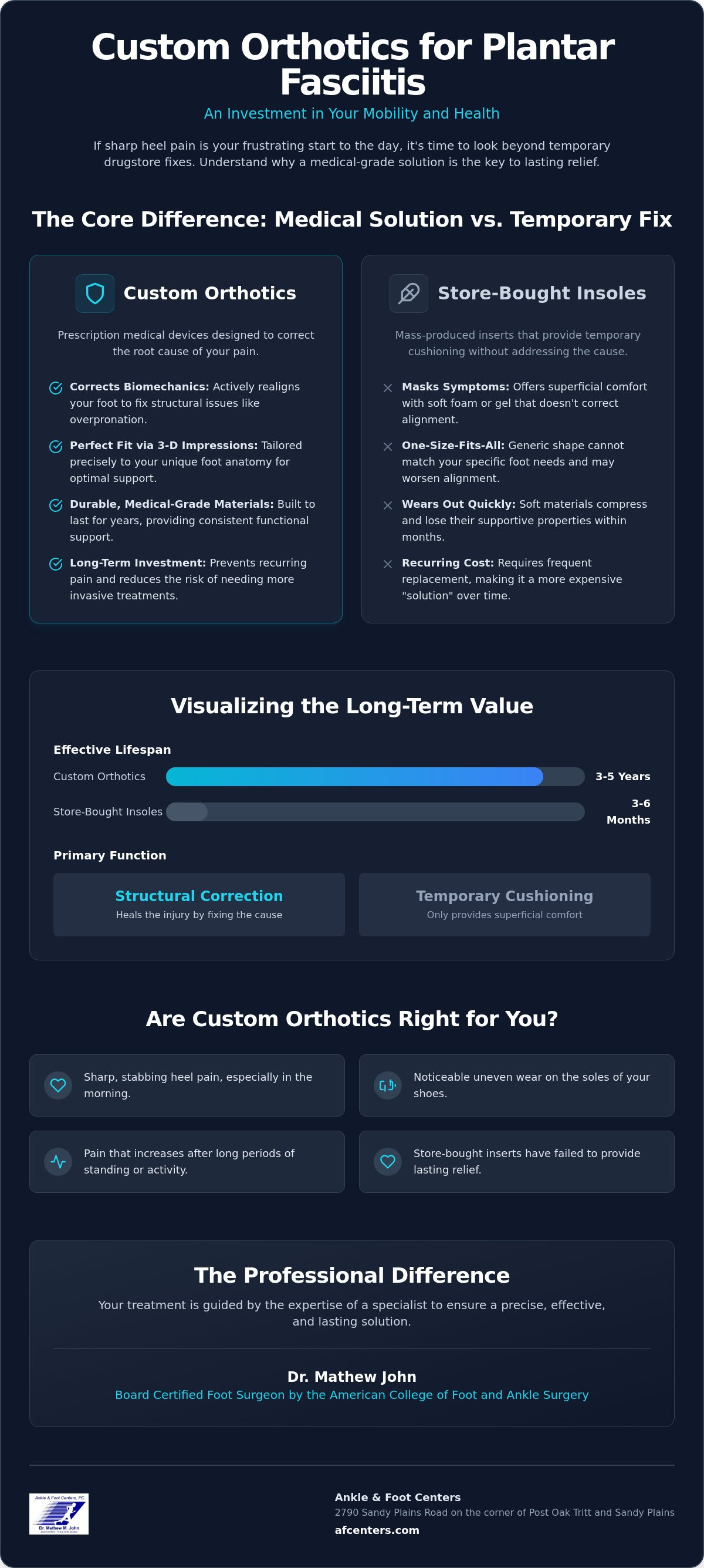
Walking into a pharmacy and picking a pair of insoles off a rack might seem like a shortcut to relief. But when patients ask, are custom orthotics worth it for plantar fasciitis, they're usually looking for a solution that actually lasts. Generic inserts are designed for everyone, which means they're truly designed for no one in particular. They use soft materials that compress quickly. Most drugstore inserts lose their supportive properties within three to six months. Dr. Mathew John, a Board Certified Foot Surgeon by the American College of Foot and Ankle Surgery, provides a different level of care at our office at 2790 Sandy Plains Road on the corner of Post Oak Tritt and Sandy Plains. He focuses on medical-grade devices that offer structural correction, not just a soft layer of foam.
The "one size fits all" approach of over-the-counter (OTC) inserts can be risky. If an insert provides the wrong arch height for your foot type, it can force your body into an unnatural alignment. This often leads to secondary issues like knee, hip, or lower back pain. High-quality prescription support is built to last three to five years, making the long-term investment much more practical than buying new foam inserts every few months. You can learn more about our professional approach and how we prioritize your mobility through specialized care.
The Limitations of Drugstore Inserts
Soft foam and gel inserts provide immediate, superficial comfort that can be deceiving. While they might take the edge off your first few steps, they offer no real structural change to your gait. Without rigid support, your arch continues to collapse, and the ligament continues to stretch. Research on Plantar Fasciitis and Bone Spurs shows that mechanical stability is vital for healing. Generic inserts simply don't have the "bones" to provide that stability. They wear down rapidly, leaving you right back where you started after just a few months of daily use.
The Precision of 3-D Impressions
The process of creating a custom device is where the real value lies. We don't just look at your foot while you're standing on it. We take 3-D impressions of your foot in a non-weight-bearing position. This allows us to capture your foot's "neutral" state, which is the key to corrective success. By understanding your foot's ideal shape without the pressure of gravity, we can build in specific modifications. These might include deep heel seats to stabilize the fat pad or medial flanges to control severe rolling. If you're wondering are custom orthotics worth it for plantar fasciitis, consider the precision of a device made specifically for your anatomy. If you're ready for a foundation that supports your unique journey, it might be time to consult with a specialist who understands your needs.
Evaluating the Long-Term ROI of Prescription Foot Support
When you look at the price tag of professional medical devices, it's natural to wonder if are custom orthotics worth it for plantar fasciitis. To find the true answer, you have to look beyond the initial appointment. Consider the lifespan of the device. While a generic insert might need replacing every few months, a high-quality pair of custom orthotics typically lasts between three and five years. When you break that down into a cost-per-day, you're investing just pennies to maintain your mobility and comfort. This small daily commitment is a proactive step toward a life without the constant shadow of heel pain.
Your financial investment also acts as a shield against more expensive medical interventions. According to current research, fewer than 10% of patients with plantar fasciitis eventually require surgery. By choosing professional support early, you significantly lower your chances of becoming part of that statistic. Many private insurance plans and Medicare Part B offer pathways for coverage when these devices are deemed medically necessary for conditions like severe foot disease. This potential for reimbursement makes the decision to seek expert care at our office at 2790 Sandy Plains Road on the corner of Post Oak Tritt and Sandy Plains even more accessible for your family.
Preventing Progression of Foot Deformities
Custom orthotics do more than just soothe your current pain; they protect your future self. By stabilizing the foot, they slow the progression of common deformities like bunions and hammertoes that often stem from poor biomechanics. For those managing diabetic foot health, this support is vital for preventing pressure points that could lead to dangerous ulcers. ROI in podiatry is the prevention of chronic disability through early mechanical correction. It's about ensuring you can continue to enjoy morning walks and community events without physical limitations holding you back.
Reducing the Need for Advanced Therapies
If you're already experiencing significant inflammation, you might be a candidate for MLS Laser Therapy. This advanced treatment is highly effective for musculoskeletal pain and inflammation, and custom orthotics serve as the perfect partner to maintain those results. While the laser handles the biological healing, the orthotics provide the structural stability to prevent the injury from returning. This synergy is also seen with Extracorporeal Shockwave Therapy (ESWT). Dr. Mathew John, a Board Certified Foot Surgeon by the American College of Foot and Ankle Surgery, often views custom orthotics as the "insurance policy" for long-term wellness. They ensure that once you achieve relief, your feet have the stable foundation they need to stay healthy for years to come.
How to Tell If You Are a Candidate for Custom Orthotics
Identifying whether you need professional foot support often starts with looking for the clues your body leaves behind. One of the most telling signs is hidden on the bottom of your favorite pair of sneakers. Take a look at the soles; if the inner or outer edges are worn down unevenly, your feet aren't distributing your weight correctly. When patients ask are custom orthotics worth it for plantar fasciitis, this uneven wear is often the first "smoking gun" that confirms a biomechanical issue. Persistent morning heel pain that doesn't improve with basic stretching is another clear indicator. If you find yourself dreading those first steps out of bed every single day, your feet are signaling that they need more than just a soft cushion.
Your lifestyle also dictates your need for specialized support. If your career keeps you standing on hard concrete for long shifts or if you're an athlete involved in high-impact sports, the repetitive stress on your arches is significant. Factors like obesity also increase the load on the plantar fascia ligament, making structural correction a vital part of your long-term health. If you've already tried "conservative care" like icing, rest, and drugstore inserts without success, you've likely reached the point where a generic solution won't cut it. At this stage, moving toward a custom device is a proactive choice for your future mobility.
Biomechanical Red Flags
Several structural issues make custom support a necessity rather than an option. Overpronation, where your feet roll inward excessively, puts a constant, painful tug on the plantar fascia. Conversely, high arches, known as pes cavus, often lead to extreme pressure on the heel and the ball of the foot because the arch doesn't touch the ground to absorb shock. We also frequently see patients with leg length discrepancies. In these cases, 3-D impressions allow us to build specific height adjustments into one orthotic, balancing your gait and preventing pain from traveling up into your hips and lower back.
When to See a Specialist in Marietta
While retail "kiosks" might offer a quick suggestion, they can't replace a clinical exam. A machine you stand on in a store doesn't account for your joint range of motion or your specific injury history. It's essential to receive a diagnostic evaluation from an expert like Dr. Mathew John, who is a Board Certified Foot Surgeon by the American College of Foot and Ankle Surgery. At our office at 2790 Sandy Plains Road on the corner of Post Oak Tritt and Sandy Plains, we look at the whole picture of your health. Learn more about our comprehensive foot care services to see how we can help you find a permanent solution. If you're tired of temporary fixes, it's time to schedule a consultation and get a foundation built specifically for your journey.
The Professional Difference at Ankle & Foot Centers in Marietta
Choosing where to receive your care is just as important as the treatment itself. When you ask if are custom orthotics worth it for plantar fasciitis, you're really asking if the results will justify the commitment. At Ankle & Foot Centers, we believe the answer is a resounding yes because of the clinical expertise behind every pair. Dr. Mathew John, a Board Certified Foot Surgeon by the American College of Foot and Ankle Surgery, doesn't just hand you an insert. He provides a comprehensive biomechanical evaluation to ensure your support is medically sound and tailored to your specific needs. You aren't just another patient; you're a member of our community who deserves a foundation built for a lifetime of activity.
Expert Care on Sandy Plains Road
Your journey to better health begins at our convenient office located at 2790 Sandy Plains Road on the corner of Post Oak Tritt and Sandy Plains. We've designed our fitting process to be as precise and comfortable as possible. Our team utilizes 3-D impressions to capture the exact contours of your feet, ensuring a medical-grade fit that generic brands can't replicate. We take pride in serving our neighbors in Marietta, Roswell, and Woodstock. By focusing on local care, we're able to provide the ongoing adjustments and support you need to maintain your progress. We're here to guide you every step of the way, making sure your investment in your feet pays dividends in your overall quality of life.
A Comprehensive Treatment Suite
We understand that heel pain is often complex, which is why we offer a holistic approach to recovery. For many patients, custom orthotics are the baseline for long-term stability, but we also utilize advanced technologies to accelerate your healing. If you're struggling with significant inflammation, we may incorporate MLS Laser Therapy. This advanced tool is specifically designed to reduce musculoskeletal pain and swelling, helping you feel better faster. You can explore our guide to heel pain relief and causes to see how these treatments work together to restore your mobility.
Our commitment to advanced care extends to every aspect of foot health. For those dealing with stubborn or recalcitrant plantar warts, we offer Swift Treatment. This advanced technology utilizes microwave ablation to target the root of the problem. The procedure typically involves four sessions spaced one month apart. One of the biggest benefits for our active patients is that there's no downtime following the procedure. Whether we're correcting your gait or treating a painful skin condition, our goal is to return you to your favorite activities without delay. If you've been questioning if are custom orthotics worth it for plantar fasciitis, visit us to see how professional guidance makes all the difference.
Take the Next Step Toward Lasting Comfort
You've spent enough time managing your pain instead of enjoying your life. Investing in your foundation is the most effective way to break the cycle of morning stiffness and activity-limiting fatigue. By choosing prescription support, you're opting for a medical-grade solution that corrects your unique biomechanics rather than settling for generic foam. Understanding are custom orthotics worth it for plantar fasciitis means recognizing that your mobility and long-term health are invaluable assets. We've explored how these devices redistribute pressure and how the precision of advanced 3-D impressions technology creates a lasting result that store-bought inserts can't match.
This proactive approach helps you avoid invasive procedures while keeping you active in the Marietta community. Schedule your orthotic evaluation with Dr. Mathew John today at our office located at 2790 Sandy Plains Road on the corner of Post Oak Tritt and Sandy Plains. As a Board Certified Foot Surgeon by the American College of Foot and Ankle Surgery, Dr. John is ready to partner with you on your journey to wellness. You deserve a pain-free future, and we're here to help you reach it.
Frequently Asked Questions
Are custom orthotics really better than store-bought insoles for plantar fasciitis?
Yes, custom orthotics are superior because they provide precise mechanical correction tailored to your specific foot structure. While store-bought insoles offer temporary cushioning, they cannot address the underlying biomechanical flaws that cause your ligament to strain. By using 3-D impressions, we create a device that realigns your foot, making the answer to are custom orthotics worth it for plantar fasciitis a clear yes for long-term health.
How much do custom orthotics typically cost in the Marietta area?
The cost of custom orthotics depends on the specific materials and modifications your condition requires. While we don't provide specific pricing without an exam, investing in a medical-grade device often saves money over time by outlasting multiple pairs of cheap inserts. This proactive step also helps prevent the need for more expensive treatments or surgery later on.
Does insurance usually cover the cost of prescription foot orthotics?
Insurance coverage for prescription foot orthotics varies significantly between different providers and plans. Many private employer plans and Medicare Part B may cover them when they're documented as a medical necessity for treating foot disease or severe dysfunction. We recommend contacting your insurance carrier directly to understand your specific benefits and any potential co-payments for durable medical equipment.
How long do custom-molded orthotics last before they need to be replaced?
Custom-molded orthotics are built for durability and typically last between three and five years with regular use. The medical-grade materials used in these devices are far more resilient than the foam found in retail products. You'll know it's time for a check-up if you notice visible cracks in the shell or if your previous symptoms begin to return as the support wears down.
Can I move my custom orthotics between different pairs of shoes?
You can move your custom orthotics between different pairs of shoes as long as the footwear has a similar shape and volume. Most patients find that their orthotics work best in athletic shoes or supportive lace-up styles with removable factory insoles. If you frequently wear different types of footwear, like dress shoes or work boots, we can discuss creating specialized pairs for those specific needs.
Do custom orthotics hurt when you first start wearing them?
It's normal to feel a sense of "newness" or slight pressure as your feet adjust to their corrected alignment. We typically recommend a gradual break-in period, starting with just a few hours of wear each day and slowly increasing the time. If you experience persistent discomfort, Dr. Mathew John, a Board Certified Foot Surgeon by the American College of Foot and Ankle Surgery, can provide precise adjustments at our Marietta office.
What happens if my custom orthotics don’t resolve my heel pain?
If orthotics alone don't provide complete relief, we explore advanced adjunct therapies to accelerate your healing. At our office at 2790 Sandy Plains Road on the corner of Post Oak Tritt and Sandy Plains, we may recommend MLS Laser Therapy to target deep inflammation. Our goal is a comprehensive recovery that addresses both the structural and biological causes of your discomfort.
How long does it take to get my custom orthotics after the 3-D impressions are taken?
The process typically takes about two to three weeks from the time we take your 3-D impressions to the final fitting. Each device is individually fabricated in a specialized laboratory to meet the exact specifications prescribed by Dr. Mathew John. Once they arrive at our clinic, we'll have you return for a fitting to ensure they provide the perfect balance of support and comfort.


