Your custom orthotics are more than just a remedy; they are a sophisticated recalibration of your entire kinetic chain. It's natural to feel some initial arch soreness or muscle fatigue in your legs as your body adjusts to its new alignment. You might feel confused about wear-time limits or wonder why your feet feel different at first. Breaking in new orthotics is a vital phase of your wellness journey that requires a gentle, guided approach to ensure your long-term success.
At our clinic at 2790 Sandy Plains Road on the corner of Post Oak Tritt and Sandy Plains, Dr. Mathew John, a Board Certified Foot Surgeon by the American College of Foot and Ankle Surgery, treats every patient as a partner in health. We've created this guide to show you the exact step-by-step process to transition into your supports while avoiding common foot and ankle pain. You'll discover how to manage your schedule for pain-free walking and corrected posture. We'll also explain how the precision of your 3-D impressions leads to lasting relief from conditions like plantar fasciitis, helping you move forward with confidence and vitality.
Key Takeaways
- Master a gradual, day-by-day wear schedule to ensure you are comfortably breaking in new orthotics while your muscles and tendons adapt to their new alignment.
- Learn to distinguish between normal adjustment sensations, like the "golf ball" feeling in your arch, and warning signs that require professional attention.
- Discover how the precision of custom 3-D impressions, provided by Dr. Mathew John, a Board Certified Foot Surgeon by the American College of Foot and Ankle Surgery, ensures a perfect fit for your unique anatomy.
- Explore how pairing your custom orthotics with advanced treatments like MLS Laser Therapy can effectively manage musculoskeletal inflammation and accelerate relief from heel pain.
- Understand how orthotics shift your center of gravity and foot strike to correct your posture and provide long-term relief from chronic conditions like plantar fasciitis.
Why Breaking in New Orthotics Requires a Strategic Approach
Think of your new prescription as a specialized tool designed to reshape your daily movement. The process of breaking in new orthotics is a necessary adjustment period where your muscles, tendons, and ligaments learn to function in a healthier alignment. When you place these devices in your shoes, you're doing much more than adding a layer of support. You're fundamentally shifting your center of gravity and changing your foot strike pattern to reduce strain on vulnerable tissues.
This realignment doesn't just stay in your feet; it impacts your entire kinetic chain. Because your feet are your body's foundation, a change in their position creates a ripple effect that reaches your knees, hips, and lower back. It's important to understand that instant comfort is a rare experience. If a device feels like a soft cloud immediately, it probably isn't providing the structural correction you need. Your body is being asked to move in a way it hasn't before, and that takes time to feel natural.
The Science of Biomechanical Realignment
Custom devices work by supporting the subtalar joint and the medial longitudinal arch, which are critical for stable movement. As you begin breaking in new orthotics, your brain receives new signals through proprioception, which is your body's internal sense of its position in space. This neurological adjustment can lead to temporary fatigue in the muscles of your lower legs during the first week. Your body is essentially re-learning how to walk correctly, and those tired muscles are a sign that the correction is working as intended.
Custom Orthotics vs. Over-the-Counter Inserts
While a basic removable shoe insert from a retail store might offer temporary cushioning, it lacks the structural integrity of a custom device. Retail inserts are mass-produced to fit a general arch shape, whereas custom orthotics are crafted from precise 3-D impressions of your unique foot morphology. This precision is why custom devices require a more disciplined break-in period. At our clinic, located at 2790 Sandy Plains Road on the corner of Post Oak Tritt and Sandy Plains, we emphasize that professional medical evaluation is the first step toward success. Dr. Mathew John, a Board Certified Foot Surgeon by the American College of Foot and Ankle Surgery, ensures that your treatment plan, which you can explore through our comprehensive services, is tailored to your specific biomechanical needs.
Your Step-by-Step Schedule for Adjusting to Custom Orthotics
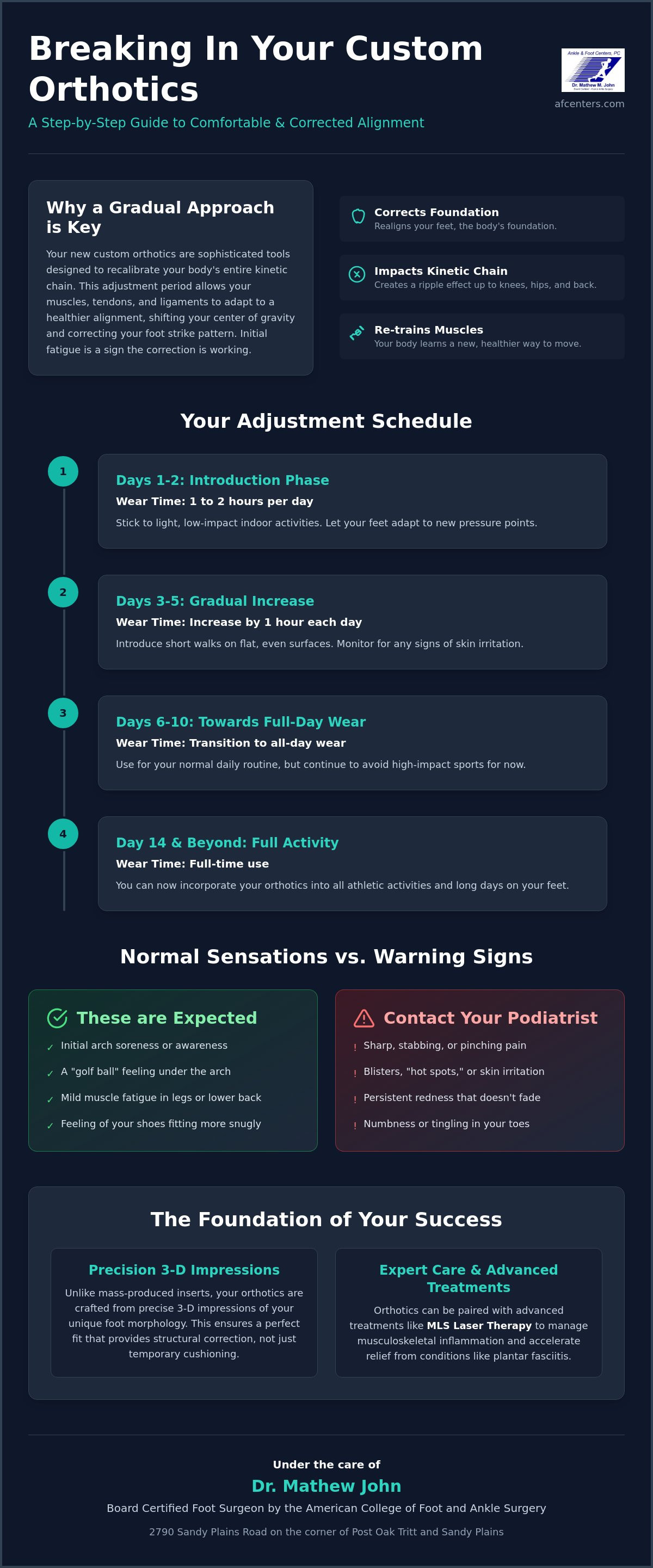
Successfully breaking in new orthotics is a journey that rewards a slow and steady pace. Because these devices are designed to change how your bones and muscles interact, your body needs a structured timeline to adapt without strain. Rushing into full-day wear can lead to unnecessary fatigue or aches. Instead, follow this progressive schedule to ensure a comfortable transition to your new alignment.
- Days 1-2: Limit your wear time to just 1 or 2 hours. Stick to light indoor activities like walking around your home or standing while preparing a meal.
- Days 3-5: Increase your wear time by about 1 hour each day. This is a great time to introduce short outdoor walks on flat surfaces like sidewalks.
- Days 6-10: You should be transitioning toward full-day wear for your normal daily routine. However, you should still avoid high-impact sports or long-distance hiking during this window.
- Day 14 and Beyond: By this point, most people find they have finished breaking in new orthotics and can move back into all athletic activities and long days on their feet.
Managing the First 48 Hours
During the first two days, your focus should be on low-impact movements. This allows your skin and the fascia on the bottom of your feet to adapt to the new pressure points. Every time you remove your shoes, check your feet for "hot spots" or areas of persistent redness. While a slight feeling of pressure is expected, actual skin irritation is a sign to slow down. We recommend keeping your old factory insoles nearby during these first few days. If your feet feel tired before your hour is up, simply swap them back in to finish your day comfortably.
Transitioning to Athletic Activity
When you feel ready to return to the gym or your favorite running trail, check your shoe compatibility first. Prescription orthotics are highly effective, but they must sit flat against the midsole of the shoe to work correctly. Always remove the original factory insole before inserting your custom device. Layering them can cause your heel to sit too high, which often leads to instability. Listen closely to your body’s signals as you increase your physical load. If you feel a sharp pull or unusual joint pain, dial back your activity for a day or two.
At our office at 2790 Sandy Plains Road on the corner of Post Oak Tritt and Sandy Plains, we want you to feel supported every step of the way. Dr. Mathew John, a Board Certified Foot Surgeon by the American College of Foot and Ankle Surgery, utilizes precise 3-D impressions to ensure your devices are a perfect match for your anatomy. If you have questions about how your specific device should feel, our team can review your progress during a follow-up visit for our comprehensive foot care services.
Troubleshooting Discomfort: Normal Sensations vs. Warning Signs
The path to perfect alignment isn't always a straight line. As you continue breaking in new orthotics, you'll likely encounter sensations that feel unfamiliar or even slightly intrusive. Understanding which of these are part of the healing process and which require a professional eye is the key to staying on track with your treatment. Most patients describe a "golf ball" sensation in their arch during the first few days. This localized pressure is actually a sign that the device is successfully supporting your medial longitudinal arch and correcting your foot's structural position. It's a positive indicator that your biomechanics are shifting toward a healthier state.
It's vital to differentiate between "good" muscle fatigue and "bad" joint pain. You might feel a dull ache in your calves or the small muscles of your feet; this is simply your body adapting to a new way of moving. However, if you experience sharp, stabbing pain in your joints or a return of the intense heel pain you were trying to treat, it's time to pause. Sometimes, the issue isn't the device itself but the footwear you've chosen. If your shoes are worn out or have a compressed midsole, they won't provide the stable foundation your custom orthotics need to function correctly. We recommend checking your shoes for uneven wear patterns on the soles, as this can sabotage your progress.
Signs Your Orthotics Need Professional Adjustment
While some adjustment is expected, certain red flags mean you should reach out to us at 2790 Sandy Plains Road on the corner of Post Oak Tritt and Sandy Plains. If you notice persistent blistering or skin irritation that doesn't resolve after a few days of the schedule we discussed, an adjustment may be necessary. Sharp, localized pain in the heel or the ball of the foot is another sign that the pressure distribution needs a tweak. Finally, if you feel any numbness or tingling in your toes while wearing the devices, don't ignore it. Dr. Mathew John, a Board Certified Foot Surgeon by the American College of Foot and Ankle Surgery, uses the data from your initial 3-D impressions to make precision modifications that ensure your comfort.
The Role of Follow-Up Appointments
We typically schedule a three week follow-up for patients who are breaking in new orthotics. This timeframe allows your soft tissues to settle into their new positions while giving us enough feedback to refine the fit. Small modifications, such as adding a slight wedge or thinning a specific area of the material, can significantly improve your long-term compliance and comfort. When you come in for your appointment, please bring the shoes you wear most frequently. This helps us see how the orthotic interacts with your daily environment, ensuring you receive the full benefit of our comprehensive foot care services.
Comprehensive Care: Pairing Orthotics with Advanced Foot Treatments
While you are breaking in new orthotics, it's important to remember that these devices are often just one piece of a larger puzzle. For many residents in the Atlanta Metro area, chronic foot issues like heel pain or plantar fasciitis require a multi-faceted strategy. Orthotics provide the structural foundation your feet need, but they work most effectively when paired with advanced clinical treatments that address active inflammation or underlying skin conditions. This holistic approach ensures that every step you take is supported, balanced, and ultimately pain-free.
At our clinic, located at 2790 Sandy Plains Road on the corner of Post Oak Tritt and Sandy Plains, we look at the big picture of your health. We don't just hand you a device and send you on your way. Instead, we monitor how your body responds to the new alignment and offer supplemental therapies that speed up your recovery. By treating the symptoms and the structural cause simultaneously, we help you achieve lasting results faster than using a single method alone.
Swift Treatment for Stubborn Plantar Warts
Sometimes, walking discomfort isn't just about alignment; it's about persistent skin conditions like plantar warts. Stubborn or recalcitrant warts can cause you to shift your weight unnaturally, which complicates the process of breaking in new orthotics. To address this, we offer Swift Treatment. This is an advanced solution for difficult warts that utilizes microwave ablation technology to trigger a natural immune response. The protocol typically involves four sessions, each spaced one month apart. A major advantage for our patients is that there is zero downtime following the procedure, allowing you to stay active while we resolve the underlying infection.
MLS Laser Therapy for Pain and Inflammation
If you're struggling with musculoskeletal pain or inflammation, we often integrate MLS Laser Therapy into your care plan. While your custom orthotics, designed from precise 3-D impressions, provide necessary mechanical support, the MLS Laser works at a cellular level to manage inflammation and accelerate tissue repair. It's a particularly effective tool for difficult-to-heal open wounds or deep tissue soreness. By reducing the swelling in your fascia and tendons, the laser makes the transition into your new orthotics much smoother. For those seeking deeper insight into managing chronic discomfort, you can read more about Heel Pain Relief in Marietta.
Dr. Mathew John, a Board Certified Foot Surgeon by the American College of Foot and Ankle Surgery, takes the time to evaluate how different treatments can work together for your long-term wellness. Whether you need structural support or advanced technology to handle inflammation, we're here to guide your journey. If you're ready to experience a higher standard of care, we invite you to explore our comprehensive foot and ankle services today.
The Marietta Advantage: Custom 3-D Impressions with Dr. Mathew John
Choosing the right partner for your foot health makes all the difference in your recovery. At our Marietta office, we provide a level of precision that retail stores simply cannot match. Dr. Mathew John, a Board Certified Foot Surgeon by the American College of Foot and Ankle Surgery, oversees every aspect of your care. By visiting us at 2790 Sandy Plains Road on the corner of Post Oak Tritt and Sandy Plains, you gain access to sophisticated diagnostic tools and professional guidance. This medical oversight ensures that breaking in new orthotics is a smooth, predictable process rather than a guessing game.
While retail kiosks often provide a generic pressure map, they don't capture the true anatomical structure of your foot. These mass-market options lack the clinical depth needed to address complex biomechanical issues. A medically-supervised fitting involves a comprehensive evaluation of your gait, joint range of motion, and specific pain points. This high-level expertise allows us to create a device that doesn't just cushion your foot but actively corrects your alignment for long-term vitality. It's about more than just comfort; it's about providing a foundation for your entire lifestyle.
Why 3-D Impressions Matter for Custom Fit
The foundation of a successful orthotic is the accuracy of the initial model. We utilize advanced 3-D impressions to create a perfect anatomical replica of your foot in its ideal neutral position. This technology is significantly more precise than traditional plaster casts, which can sometimes distort the soft tissue during the molding process. Because 3-D impressions capture every contour with digital accuracy, the resulting orthotics fit your shoes and your feet more naturally from day one. This precision often reduces the need for extensive break-in periods because the device is perfectly synchronized with your unique morphology.
Schedule Your Consultation at Ankle & Foot Centers, PC
Your journey toward pain-free movement starts with a professional assessment. We invite you to explore our full range of services to see how we can support your holistic health goals. Whether you're dealing with chronic heel pain or simply want to improve your athletic performance, our team is here to provide the steady hand you need. You can reach our Marietta office easily at 2790 Sandy Plains Road on the corner of Post Oak Tritt and Sandy Plains. We look forward to helping you return to the active, vibrant lifestyle you deserve. Breaking in new orthotics is the first step toward a future where every walk is a rewarding opportunity for health and connection.
Step Into a Life of Lasting Comfort and Mobility
Achieving pain-free movement is a rewarding journey that begins with the right foundation and a patient, structured mindset. By following a gradual wear schedule and trusting the precision of custom 3-D impressions, you ensure that breaking in new orthotics leads to corrected posture and long-term relief. Our Marietta clinic, located at 2790 Sandy Plains Road on the corner of Post Oak Tritt and Sandy Plains, offers a comprehensive environment where your unique needs are always the priority. We believe that progress is a personal path, and we're dedicated to guiding you every step of the way.
Dr. Mathew John, a Board Certified Foot Surgeon by the American College of Foot and Ankle Surgery, combines clinical expertise with advanced options like Swift Treatment for stubborn warts. This advanced technology utilizes microwave ablation over four sessions with no downtime, ensuring your skin health matches your structural alignment. You don't have to navigate this path alone; our team is here to provide the steady hand and professional support you deserve for your long-term health.
Schedule your orthotic consultation with Dr. Mathew John today and take the first step toward a more active, vibrant lifestyle. We look forward to welcoming you into our community and helping you reach your personal wellness goals with confidence and ease.
Frequently Asked Questions
Is it normal for my new orthotics to hurt my arches at first?
Yes, feeling pressure or a "golf ball" sensation in your arches is a normal part of the initial adjustment. This sensation indicates that the device is successfully supporting your medial longitudinal arch as intended. Because your custom orthotics were crafted from precise 3-D impressions, they're holding your foot in a healthier position than your muscles are used to. This initial discomfort should fade within the first two weeks of consistent, scheduled wear.
How many hours a day should I wear my new orthotics during the first week?
You should start with just one to two hours of wear on the first two days of your schedule. Gradually increase this time by one hour each day throughout the first week of use. This measured approach is the most effective way to begin breaking in new orthotics without overworking your tendons or ligaments. If you feel significant fatigue, it's okay to remove them early and try again the next day.
Can I move my custom orthotics between different pairs of shoes?
You can move your orthotics between different pairs of shoes as long as the footwear is structurally compatible. For the best results, ensure each shoe has a removable factory insole so the orthotic can sit flat against the midsole. If you frequently switch between athletic shoes and dress shoes, Dr. Mathew John, a Board Certified Foot Surgeon by the American College of Foot and Ankle Surgery, can help determine if a single pair will meet your needs.
Will orthotics help with my plantar fasciitis pain?
Yes, custom orthotics are a primary treatment for managing the underlying causes of plantar fasciitis pain. They work by stabilizing the subtalar joint and reducing the tension on the plantar fascia ligament during each step. For more comprehensive relief, we often pair orthotic therapy with MLS Laser Therapy at our office at 2790 Sandy Plains Road on the corner of Post Oak Tritt and Sandy Plains to reduce musculoskeletal inflammation and accelerate tissue repair.
What should I do if my orthotics cause blisters?
You should immediately stop wearing the orthotics and inspect your feet for persistent redness or skin irritation. While some muscle soreness is expected, blisters are a sign that the device or the shoe is creating excessive friction. If the issue persists after a short break, visit us for a professional adjustment. Dr. Mathew John can refine the fit to ensure your journey toward better alignment remains both comfortable and rewarding.
How long do custom orthotics typically last before needing replacement?
Custom orthotics typically last between two and five years depending on your activity level and the specific materials used. High-quality polymers and carbon fiber are designed for long-term durability, though the soft top covers may need to be refurbished every year or two. We recommend an annual checkup at our Marietta location to ensure the structural integrity of your devices still provides the correction your feet require for optimal health.
Can I wear my orthotics while running or playing sports immediately?
You should avoid high-impact sports or running for at least the first 14 days of wear. Your body needs this time to calibrate its entire kinetic chain to the new alignment provided by the devices. Attempting intense activity while breaking in new orthotics too quickly can lead to unnecessary leg fatigue or joint pain. Once you can comfortably wear them for a full day of normal walking, you can safely return to your athletic routine.
Do I need a special type of shoe to accommodate custom orthotics?
You don't necessarily need orthopedic shoes, but your footwear must have enough depth and a removable factory insole. If a shoe is too shallow, the orthotic might cause your heel to slip out, which compromises your stability. When shopping for new shoes, we suggest bringing your custom orthotics along to ensure a proper fit. This ensures the 3-D impressions of your feet are supported by a stable and high-quality shoe environment.


