
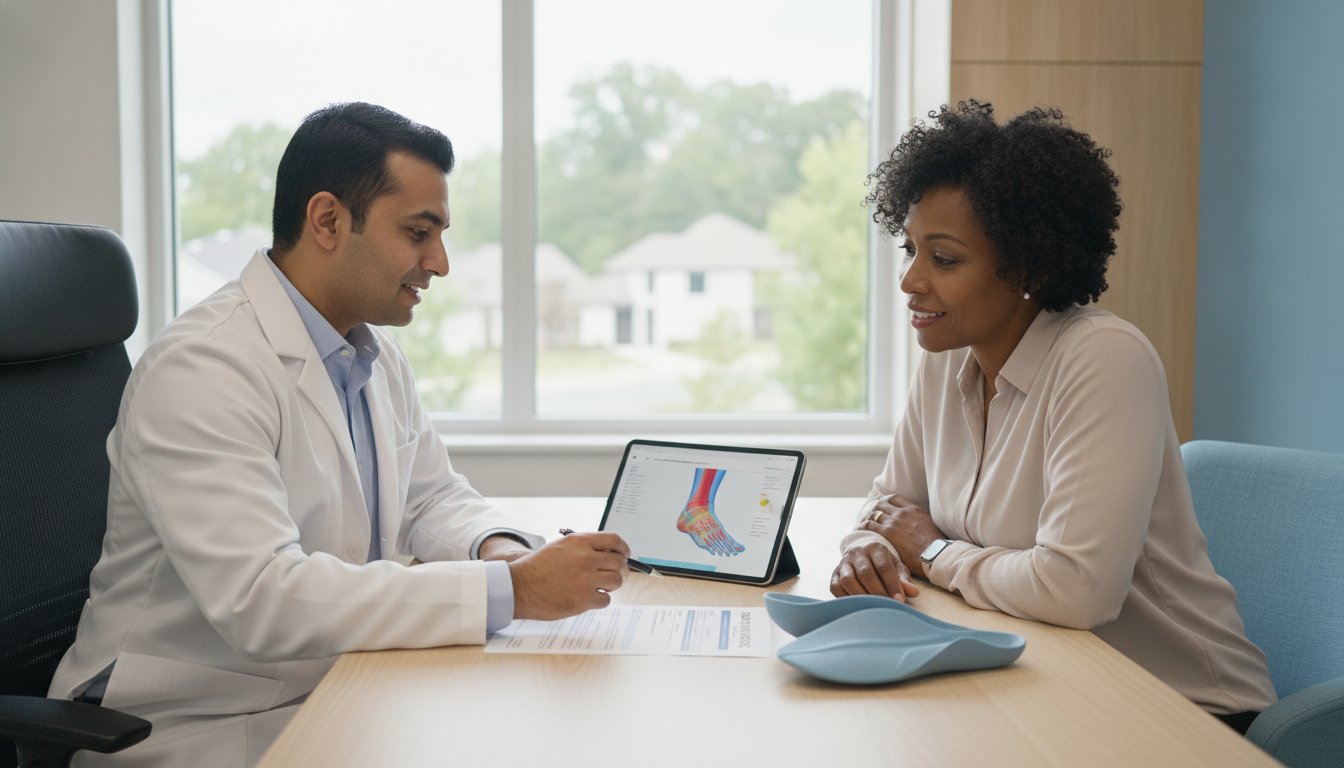
Did you know that custom orthotics can reduce foot pain by up to 75% for those suffering from plantar fasciitis? While the clinical benefits are clear, the path to obtaining them often feels blocked by a wall of paperwork and complex insurance jargon. It's common to feel overwhelmed by the high upfront costs or the fear that your claim might be denied after you've already made the investment. You deserve a clear path to relief that doesn't involve guessing about your "Durable Medical Equipment" benefits. Understanding the nuances of insurance coverage for custom orthotics is the first step toward walking without pain.
This guide provides the roadmap you need to navigate the approval process with confidence. You'll learn how to establish medical necessity through precise documentation and specialized 3-D impressions. We'll also explain how working with an expert like Dr. Mathew John, a Board Certified Foot Surgeon by the American College of Foot and Ankle Surgery, ensures your clinical records meet the highest standards. Whether you're visiting our office at 2790 Sandy Plains Road on the corner of Post Oak Tritt and Sandy Plains or calling your provider, you'll have the tools to secure the support you need for your long-term health.
Key Takeaways
- Learn the critical difference between retail inserts and prescribed medical devices, including how insurance categorizes orthotics as Durable Medical Equipment.
- Discover the essential documentation required to secure insurance coverage for custom orthotics, such as biomechanical gait analysis and specific L-codes.
- Follow a clear roadmap from your first evaluation at our office on the corner of Post Oak Tritt and Sandy Plains to receiving your precision-fit 3-D impressions.
- Understand how to maximize your health benefits by navigating the "Summary of Benefits" and utilizing HSA or FSA funds to reduce out-of-pocket costs.
- See why the clinical authority of a Board Certified Foot Surgeon by the American College of Foot and Ankle Surgery is vital for proving medical necessity to insurers.
Custom Orthotics vs. Store-Bought Inserts: Why Insurance Prioritizes Medical Necessity
You might see rows of colorful insoles at your local pharmacy, but these are not the same as the devices prescribed in a clinical setting. While retail inserts offer a layer of foam for temporary comfort, true custom-molded devices are precision medical tools designed to change the way your foot functions. To understand what are orthotics in a clinical sense, you have to look at them as prescriptions for your feet. Insurance companies don't view these as optional accessories. Instead, they categorize them as Durable Medical Equipment (DME). This classification is the reason why securing insurance coverage for custom orthotics requires a specific process centered on medical necessity rather than personal preference.
The primary difference lies in the goal of the device. A store-bought insert is made for a generic foot shape to provide cushion. In contrast, a custom device is built from 3-D impressions of your unique foot structure to provide correction. Insurers prioritize this corrective aspect. They're looking for evidence that the device is a therapeutic requirement to treat a diagnosed condition. Without a formal diagnosis, an insurance adjuster will likely view the request as a matter of convenience, which is rarely covered.
The Role of the Board Certified Foot Surgeon
Securing approval often depends on the credentials of the person signing the prescription. Dr. Mathew John is a Board Certified Foot Surgeon by the American College of Foot and Ankle Surgery. This high level of expertise is vital when dealing with insurance companies. When a surgeon with these credentials documents your need for orthotics, it carries significant weight. It proves that the device is a necessary part of a professional treatment plan. You can explore our full range of Our Services to see how we integrate these devices into comprehensive care at our office at 2790 Sandy Plains Road on the corner of Post Oak Tritt and Sandy Plains.
Common Diagnoses That Trigger Coverage
Insurers typically look for specific therapeutic reasons to grant insurance coverage for custom orthotics. One of the most frequent reasons is chronic heel pain, often caused by plantar fasciitis. When conservative treatments like stretching haven't worked, custom devices become a primary medical solution. Other common triggers for coverage include diabetic foot care, where offloading pressure is critical to preventing ulcers. Structural issues like bunions, hammertoes, or severe flat feet also qualify. The key is showing that the device treats a functional problem rather than just providing a soft place for your foot to rest. Insurers distinguish between preventative use and therapeutic use, which addresses an existing, painful condition.
Insurance Requirements for Custom Orthotics: The Documentation Checklist
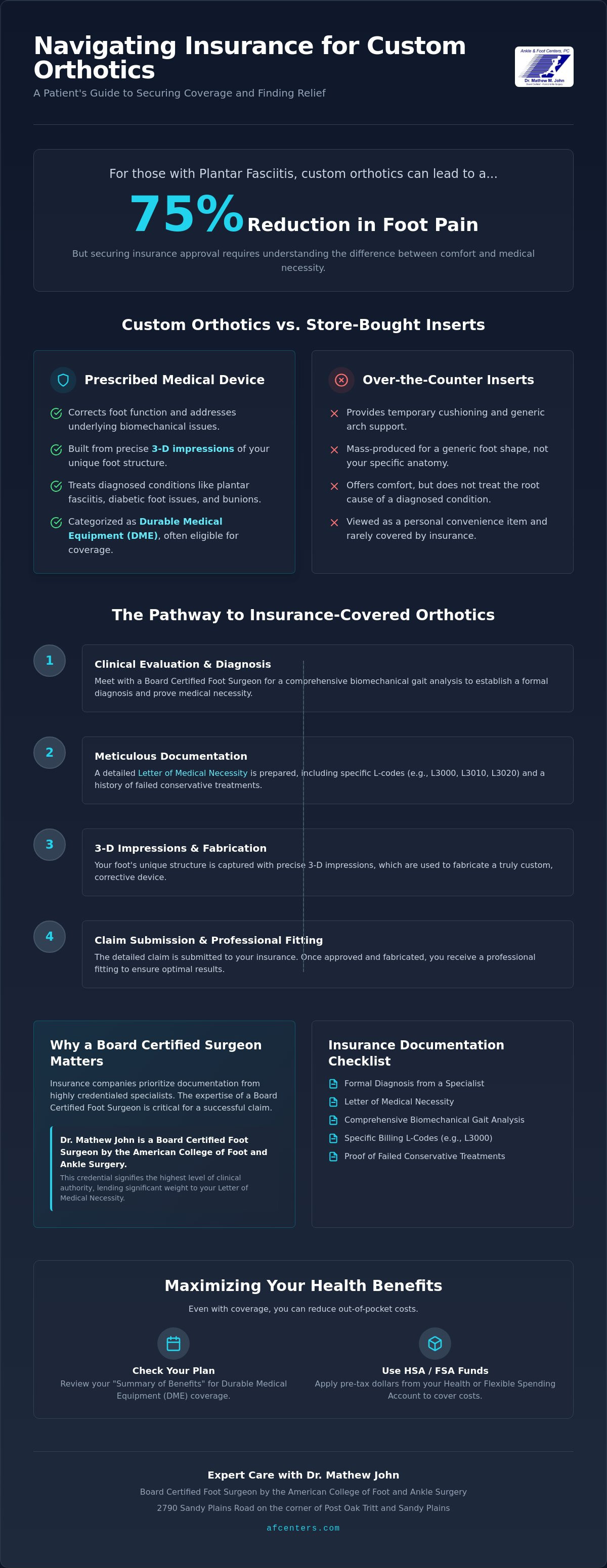
Insurance companies speak a language of data and specific clinical codes. To secure insurance coverage for custom orthotics, your medical record must include more than just a recommendation. It requires a precise set of billing identifiers known as "L-codes." Most custom-molded inserts are billed under codes such as L3000, L3010, or L3020. These codes tell the insurance adjuster that the device is a custom-fabricated medical tool designed for your specific anatomy. Without these codes and a formal Letter of Medical Necessity from a qualified specialist, your claim might be viewed as a retail purchase rather than a therapeutic requirement. This letter must detail your history of failed conservative treatments, such as stretching or over-the-counter inserts, to prove the custom device is the next logical step in your care.
While Medicare coverage for therapeutic shoes and inserts is typically reserved for patients with specific diabetic complications, many private insurers in Georgia offer broader benefits. However, they still demand rigorous proof of a functional deficit. This proof usually takes the form of a comprehensive biomechanical gait analysis and a detailed physical exam report. We meticulously prepare this documentation at our office at 2790 Sandy Plains Road on the corner of Post Oak Tritt and Sandy Plains to ensure your insurer has a clear picture of your clinical needs. Providing this level of detail upfront is the most effective way to avoid the back-and-forth of a claim denial.
The Biomechanical Evaluation
A professional foot exam in Marietta is far more than a quick look at your arches. During your evaluation, we measure the range of motion in your joints and assess the strength of specific muscle groups. This clinical data provides the objective evidence adjusters look for when reviewing a claim. Standing on a pressure mat or a retail kiosk at a local pharmacy does not count as a medical evaluation. Those devices are retail marketing tools; they don't provide the diagnostic depth or the professional oversight required to establish medical necessity for a prescribed device. Our evaluation looks at how your foot moves through every phase of your stride to identify the exact point of mechanical failure.
Why 3-D Impressions Are Superior for Insurance Claims
The method used to capture your foot's shape is a major factor in the approval process. We utilize 3-D impressions to create a perfect replica of your foot structure. This technique allows us to hold your foot in what's called a "subtalar neutral" position. This is the ideal alignment where your foot is neither rolling in nor out. By capturing this specific position, we create a device with maximum corrective power. These detailed 3-D impressions serve as physical proof that the device is truly custom-molded to your unique anatomy. This precision leads to fewer denials because it leaves no doubt about the custom nature of the equipment. If you're ready to start this process, you can view the conditions we treat on our Our Services page.
Dr. Mathew John is a Board Certified Foot Surgeon by the American College of Foot and Ankle Surgery, and his expertise ensures that every gait analysis and impression meets the strict standards set by modern health plans. When a surgeon with these credentials signs your Letter of Medical Necessity, it provides the professional authority needed to move your claim forward. We handle the technical details and the specific requirements for insurance coverage for custom orthotics so you can focus on your journey toward a more active, pain-free life.
The Process of Getting Covered: From Evaluation to Fitting
Securing insurance coverage for custom orthotics is a journey we walk together. It's not just about buying a product; it's about following a clinical sequence designed to meet the high standards of modern health plans. Unlike at-home kits that often lack the clinical validation insurers require, our process is rooted in professional expertise and precise data. This structured approach ensures every detail, from your initial foot exam to the final fitting, is documented to support your claim's success.
- Step 1: Clinical Evaluation. Your journey begins with a comprehensive assessment of your foot health and gait.
- Step 2: 3-D Impressions. We capture your foot structure with high-fidelity impressions to ensure a perfect, corrective fit.
- Step 3: Verification of Benefits. Our administrative team contacts your insurer to confirm your specific DME benefits and out-of-pocket responsibilities.
- Step 4: Claim Submission. We submit the claim using the precise clinical notes and coding required by your specific plan.
- Step 5: Professional Fitting. Once manufactured, you return for a fitting and adjustment session to ensure the device performs as intended for your lifestyle.
Your Visit to Our Marietta Clinic
Our clinic is located at 2790 Sandy Plains Road on the corner of Post Oak Tritt and Sandy Plains. From the moment you walk through our doors, you'll find a professional environment designed to put you at ease. Dr. Mathew John, a Board Certified Foot Surgeon by the American College of Foot and Ankle Surgery, personally evaluates your condition to determine if custom devices are the right step for your vitality. We believe you shouldn't have to navigate the maze of insurance alone. Our team handles the heavy lifting of benefit verification, so you can focus on your progress toward a pain-free lifestyle. This clinical setting is what provides the credibility insurance adjusters look for when reviewing a claim.
Understanding Prior Authorization
Many large commercial health plans now require "Prior Authorization" before a custom device can be manufactured. A 2024 survey indicated that 72% of large commercial plans utilize this step to manage costs. If your plan requires this, our office provides the detailed clinical notes and evidence of medical necessity that adjusters need to see. The approval process typically takes between 7 and 21 business days for commercial insurers in the Atlanta Metro area. We stay in close contact with your provider to move this process along as quickly as possible. This professional oversight is exactly what's missing from retail or home-kit options, making it a vital part of your insurance coverage for custom orthotics success.
Maximizing Your Benefits: Navigating Denials and Out-of-Pocket Costs
Understanding your Summary of Benefits and Coverage (SBC) is the best way to avoid financial surprises. When you review this document, look specifically for the "Durable Medical Equipment" or "Orthotic Devices" section. It's common for plans to have specific rules about how often you can replace your inserts. For instance, some providers only allow one pair every 12 months. If your initial claim is rejected, don't lose heart. There's a big difference between an "exclusion" and a "denial." An exclusion means your policy simply doesn't cover the service at all. A denial, however, often just means the insurance company needs more clinical data to prove medical necessity. We're experts at providing that data to help you secure insurance coverage for custom orthotics.
If you receive a denial, the first step is to request a formal explanation of benefits. Often, a claim is kicked back because a specific code was missing or the clinical notes didn't sufficiently detail your failed conservative treatments. Because Dr. Mathew John is a Board Certified Foot Surgeon by the American College of Foot and Ankle Surgery, his clinical reports carry the professional weight needed for a successful appeal. We work closely with you to resubmit the necessary evidence, ensuring your insurer understands why these custom-molded devices are essential for your mobility.
HSA and FSA: The Secret Weapon for Orthotics
Even if your plan has a high deductible or limited insurance coverage for custom orthotics, you can still save money using pre-tax dollars. Custom orthotics are almost always eligible for reimbursement through a Health Savings Account (HSA) or a Flexible Spending Account (FSA). Using these funds is a smart way to cover your co-insurance or any portion of the cost not picked up by your primary plan. Just make sure to keep your prescription and your itemized receipt from our office at 2790 Sandy Plains Road on the corner of Post Oak Tritt and Sandy Plains. These documents are your proof that the purchase was a medically necessary treatment prescribed by a specialist.
When Orthotics Are Part of a Larger Treatment Plan
Sometimes, orthotics are just one piece of a larger puzzle to restore your foot health. For example, if you're struggling with stubborn or recalcitrant warts, we might recommend Swift Treatment. This advanced technology utilizes microwave ablation to target the underlying cause of the wart. The process typically involves four sessions, each spaced about one month apart. One of the best parts of Swift Treatment is that there's absolutely no downtime for you afterward. While the laser targets the infection, custom orthotics can play a supporting role by redistributing pressure away from the treated area. This combined approach helps prevent future issues and keeps you moving comfortably. You can learn more about how we combine these advanced therapies on our Our Services page.
Ready to see how your benefits can work for you? Contact our Marietta team today to schedule your comprehensive evaluation and start your journey toward lasting relief.
Expert Care in Marietta: Why Choose Dr. Mathew John
Choosing a specialist who understands the local community and the complexities of modern medical requirements is essential for your recovery. Dr. Mathew John is a Board Certified Foot Surgeon by the American College of Foot and Ankle Surgery, providing the high-level expertise necessary to navigate insurance coverage for custom orthotics. Our practice is a dedicated resource for patients in Marietta, Roswell, Woodstock, and Kennesaw who want to return to an active, pain-free lifestyle. We don't just provide a device; we offer a partnership in your long-term wellness journey that emphasizes progress and professional guidance.
Advanced Technology for Faster Healing
We utilize sophisticated tools to address the root causes of your discomfort, ensuring you aren't navigating your path alone. For patients suffering from musculoskeletal pain or inflammation, we offer MLS Laser Therapy to accelerate the healing process. If your concerns involve fungal toenails, we provide targeted fungal laser therapy using the Cutera Genesis Plus NDYag Laser. Stubborn plantar warts are treated with our advanced Swift Treatment, which uses microwave ablation technology over four sessions spaced one month apart. This procedure involves no downtime, allowing you to stay active throughout your care. Every treatment plan is supported by our precision 3-D impressions, ensuring your orthotics provide a level of corrective power that retail alternatives simply cannot replicate.
Schedule Your Consultation Today
Your path to a more vibrant, mobile life starts with a professional evaluation. We invite you to visit our clinic at 2790 Sandy Plains Road on the corner of Post Oak Tritt and Sandy Plains to discuss your needs. Whether you're dealing with structural issues or chronic discomfort, we'll help you understand why these devices are a clinical necessity for your specific gait. For more insights on how these treatments address the underlying causes of foot issues, explore our Heel Pain Relief Guide. Let's work together to restore your vitality and keep you moving toward your goals in a welcoming, non-judgmental environment.
Take the Next Step Toward Lasting Foot Health
Investing in your mobility is one of the most rewarding choices you can make for your long-term health. By moving beyond generic pharmacy inserts and embracing precision-crafted medical devices, you're choosing a path of correction over temporary comfort. We've explored how insurance coverage for custom orthotics relies on a clinical documentation process that proves medical necessity. From understanding L-codes to utilizing 3-D impressions, the details matter when securing your benefits.
At our clinic at 2790 Sandy Plains Road on the corner of Post Oak Tritt and Sandy Plains, we provide the professional guidance you need. Dr. Mathew John is a Board Certified Foot Surgeon by the American College of Foot and Ankle Surgery, ensuring your treatment plan is backed by the highest level of expertise. Don't let confusion over deductibles or DME benefits stand in the way of your vitality. Our team is here to handle the paperwork and verification so you can focus on moving without pain.
Schedule Your Custom Orthotics Evaluation with Dr. Mathew John
You deserve to walk, run, and play without the burden of foot pain. We look forward to being your partner on this journey to wellness and helping you reach your personal goals with confidence.
Frequently Asked Questions
Does Medicare cover custom orthotics for foot pain?
Medicare Part B typically doesn't provide coverage for custom orthotics solely for general foot pain. It primarily covers therapeutic inserts for individuals with diabetes who meet specific criteria related to foot health. For those who qualify, Medicare generally pays 80% of the approved amount after you've met your annual Part B deductible, which is $283 in 2026.
What is the specific insurance code (L-code) for custom orthotics?
The specific billing codes used for custom orthotics are known as L-codes, with L3000, L3010, and L3020 being the most frequent. These codes signify to the insurer that the device is a custom-molded insert made from a physical model of your foot. Our team uses these codes to help secure insurance coverage for custom orthotics by accurately describing the medical device to your provider.
Can I use my FSA or HSA to pay for custom foot supports?
You can absolutely use your Flexible Spending Account (FSA) or Health Savings Account (HSA) to pay for custom foot supports. Since these are prescribed medical devices, they're considered eligible expenses under IRS guidelines. This is an excellent way to use pre-tax dollars to cover your deductible or any co-insurance costs that your primary insurance doesn't pick up.
How long do custom orthotics last before I need a new pair?
Custom orthotics generally last between two and five years, though your activity level and the specific materials used will influence their lifespan. While the devices themselves are durable, many insurance policies limit reimbursement to one pair every 12-month period. Regular check-ups with Dr. Mathew John ensure your devices continue to provide the corrective support you need for an active lifestyle.
What is the difference between a "denial" and an "exclusion" in my insurance policy?
An exclusion means your insurance policy specifically states that orthotic devices are not a covered benefit under any circumstances. A denial is a rejection of a specific claim, often because the insurer requires more documentation to prove medical necessity. If you face a denial, we can often provide additional clinical evidence from your 3-D impressions to help overturn the decision.
Will my insurance cover orthotics if I have diabetes?
Yes, most insurance plans, including Medicare, are much more likely to provide insurance coverage for custom orthotics for patients with diabetes. In these cases, the inserts are viewed as essential preventative care to help avoid foot ulcers and other serious complications. Precise documentation from a specialist is key to showing how the devices protect your long-term vitality.
Do I need a referral from my primary doctor to see a podiatrist for orthotics?
Whether you need a referral depends entirely on your specific insurance plan's rules. If you have a PPO plan, you can usually schedule an evaluation directly at our office at 2790 Sandy Plains Road on the corner of Post Oak Tritt and Sandy Plains. However, HMO plans typically require a referral from your primary care physician before they'll cover a specialist visit or the resulting orthotics.
What happens if my insurance denies my claim for medical necessity?
If your claim is denied for medical necessity, you have the right to file a formal appeal with your insurance provider. Our office supports this process by providing detailed biomechanical reports and clinical notes. Dr. Mathew John is a Board Certified Foot Surgeon by the American College of Foot and Ankle Surgery, and his professional assessment provides the clinical authority needed to challenge a denial effectively.


