What if the high-tech shoe you're wearing is only half the solution to your chronic heel pain? You know the feeling of that sharp, stabbing sensation during your first steps each morning, and the exhaustion of standing all day at work only makes it worse. It's easy to get lost in a sea of conflicting online reviews while searching for the best shoes for plantar fasciitis 2026. We believe you deserve a clear path to relief that combines the right footwear with expert medical guidance.
In this guide, you'll discover the top-rated 2026 footwear models, such as the ASICS Gel-Kayano 32 and Saucony Triumph 23, which provide the stability your arches crave. We'll also explain how Dr. Mathew John, a Board Certified Foot Surgeon by the American College of Foot and Ankle Surgery, uses precision tools like 3-D impressions and MLS Laser Therapy to accelerate your healing. Whether you're a runner or a busy professional, our team at 2790 Sandy Plains Road on the corner of Post Oak Tritt and Sandy Plains is ready to help you move with confidence again. Let's look at the specific models that can change your daily comfort and how professional podiatric care turns a simple purchase into a long-term recovery strategy.
Key Takeaways
- Identify the two non-negotiable structural features every supportive shoe must have to lock your heel in place and prevent further strain.
- Access our curated list of the best shoes for plantar fasciitis 2026 to find the perfect balance of impact protection and daily stability.
- Learn how medical-grade custom orthotics made from 3-D impressions provide the precise biomechanical alignment that retail inserts cannot match.
- Explore advanced, non-invasive recovery options like MLS Laser Therapy and ESWT designed to reduce inflammation and stimulate rapid tissue repair.
- Discover how a personalized evaluation by Dr. Mathew John, a Board Certified Foot Surgeon by the American College of Foot and Ankle Surgery, can transform your long-term recovery.
The Anatomy of Support: What Makes the Best Shoes for Plantar Fasciitis in 2026?
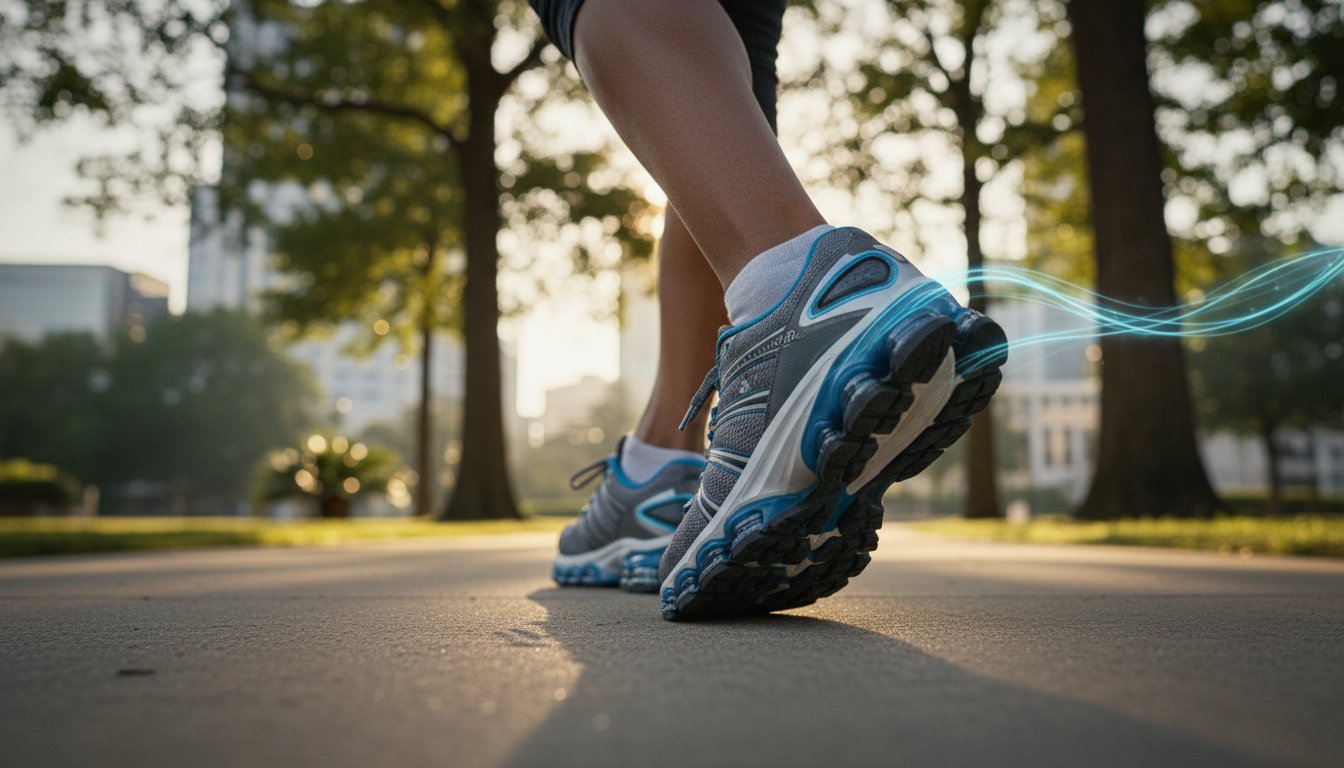
Finding the best shoes for plantar fasciitis 2026 starts with understanding how a shoe interacts with your foot's unique mechanics. Many people assume that a soft, pillowy sole is the answer to heel pain. However, too much cushioning without structural integrity can actually increase inflammation by allowing the foot to collapse. A truly supportive shoe must feature a rigid heel counter. This is the firm back part of the shoe that locks your calcaneus, or heel bone, in place. By preventing excessive side-to-side movement, the shoe reduces the tension on the Plantar Fasciitis ligament, providing immediate relief during your daily activities.
Mid-foot stability is another non-negotiable factor. Before you head to the checkout, perform the "twist test." Grab the shoe at the heel and the toe, then try to wring it like a towel. If the middle of the shoe twists easily, it won't provide the support you need. Modern 2026 designs often incorporate rocker bottom soles. These curved geometries help your foot roll forward smoothly. This significantly reduces the strain on the fascia during the push-off phase of your stride, allowing you to walk with less effort and discomfort.
The Crucial Role of Arch Integrity
Arch support is the foundation of a healthy gait. Proper support prevents the windlass mechanism from overstretching the fascia every time your toes bend. When you visit us for our services, we help you identify whether you need a stability shoe or a neutral model. While many brands offer built-in support, these are often generic. For patients with persistent pain, Dr. Mathew John, a Board Certified Foot Surgeon by the American College of Foot and Ankle Surgery, often recommends replacing factory insoles with medical-grade custom orthotics created from 3-D impressions. These provide the personalized contouring necessary to stabilize the foot and promote healing.
2026 Footwear Trends: What is Changing?
The 2026 market is seeing a major shift toward active recovery footwear. These aren't just for the gym; they're designed for indoor use to ensure your feet never touch a hard, flat floor. This is a key development when searching for the best shoes for plantar fasciitis 2026. New foam technologies are also evolving to balance shock absorption with energy return, so you don't feel like you're walking in sand. Additionally, wider toe boxes are becoming the standard. This extra space allows your toes to splay naturally, which improves overall balance and reduces pressure on the front of the foot.
If these changes aren't enough to manage your pain, it may be time for a professional evaluation at our office located at 2790 Sandy Plains Road on the corner of Post Oak Tritt and Sandy Plains. For those who don't find relief through footwear alone, we often integrate advanced treatments. For example, MLS Laser Therapy is reported to be 85-90% effective in relieving pain and inflammation for patients who complete their course of therapy. Our goal is to ensure you never feel you are navigating your path to recovery alone.
Top Podiatrist-Recommended Shoe Brands for 2026
Brooks remains a staple in our recommendations, specifically the Adrenaline GTS 25. This shoe uses GuideRails technology to control excess movement, making it a top choice for overpronators. If your arch tends to collapse inward, this structural support helps maintain alignment and reduces the pull on your fascia. Similarly, the ASICS Gel-Kayano 32 has evolved its 4D Guidance System to provide adaptive stability. It doesn't just block movement; it guides your foot back to a neutral path. For patients with unique sizing needs, New Balance offers vetted options in various widths, ensuring that a narrow or wide foot doesn't compromise the fit or function of your footwear.
Best Walking Shoes for Daily Activity
Running Shoes for the Active Patient
Staying active is part of a healthy lifestyle, but you need the right tools. The Saucony Triumph 23 balances speed with significant fascia protection. However, be cautious with zero drop brands like Altra. While they promote a natural gait, the lack of a heel lift can put extra strain on the Achilles and fascia if you aren't used to them. We recommend rotating your shoes every 48 hours to prevent foam fatigue. This gives the cushioning time to decompress and return to its original shape.
If you're unsure which brand fits your specific needs, consider a professional evaluation. At our office, located at 2790 Sandy Plains Road on the corner of Post Oak Tritt and Sandy Plains, Dr. Mathew John, a Board Certified Foot Surgeon by the American College of Foot and Ankle Surgery, can provide a comprehensive gait analysis. You can learn more about our services to see how we combine footwear advice with clinical expertise.
Beyond the Box: Why 3-D Impressions and Custom Orthotics Outperform Retail
Even if you purchase the best shoes for plantar fasciitis 2026, you might still feel a lingering ache at the end of the day. Most shoes are manufactured on a generic "last," which is a standard mold that doesn't account for your unique arch height or gait pattern. Retail inserts offer a bit of cushion, but they rarely provide the structural correction needed for lasting relief. They're designed to fit everyone, which often means they don't truly support anyone's specific needs.
Dr. Mathew John, a Board Certified Foot Surgeon by the American College of Foot and Ankle Surgery, believes that true recovery involves looking beyond the shoe box. At our office at 2790 Sandy Plains Road on the corner of Post Oak Tritt and Sandy Plains, we focus on the underlying biomechanical issues that cause your pain. By using 3-D impressions, we create a device tailored specifically to your anatomy. This ensures your foot is held in the most efficient position possible with every step you take.
The Science of 3-D Impressions
Custom vs. Over-the-Counter (OTC) Insoles
Retail foam inserts often lose their shape within a few months of daily use. In contrast, medical-grade custom orthotics are built for durability and can last several years. They also address complex structural issues, such as leg length discrepancies, that generic inserts simply ignore. Choosing our services means investing in a long-term strategy rather than a temporary fix. We see orthotics as a wellness-oriented tool that helps you stay active without the constant fear of a flare-up.
Integrating these custom devices into your 2026 footwear is simple. Most high-quality models, like the Brooks or Hoka series we discussed, feature removable footbeds. By swapping the factory insole for a custom orthotic, you turn a standard shoe into a precision medical tool. This combination ensures that your journey toward health is supported by both the highest quality footwear and professional expertise. You don't have to navigate this path alone; we're here to guide you toward your personal goals.
When Shoes Aren’t Enough: Integrating MLS Laser Therapy and ESWT
While finding the best shoes for plantar fasciitis 2026 is a vital first step, footwear is often just one piece of a larger recovery puzzle. For many patients, chronic inflammation requires a clinical intervention to jumpstart the healing process. Dr. Mathew John, a Board Certified Foot Surgeon by the American College of Foot and Ankle Surgery, takes a comprehensive approach to heel pain. He understands that even the most advanced stability shoes cannot always resolve deep-seated tissue damage on their own. By combining high-quality footwear with advanced clinical modalities, we provide a path toward long-term wellness that goes beyond what you can find in a retail store.
When you visit our office located at 2790 Sandy Plains Road on the corner of Post Oak Tritt and Sandy Plains, we evaluate your gait alongside your symptoms. If your pain persists despite wearing the best shoes for plantar fasciitis 2026, we may recommend integrating non-invasive therapies. These treatments are designed to address the physiological roots of your discomfort, allowing your new footwear to function more effectively as a supportive tool.
MLS Laser Therapy for Heel Pain
MLS Laser Therapy represents a non-invasive breakthrough for managing musculoskeletal pain and inflammation. This technology uses a dual-wavelength system to penetrate deep into the tissues. It works by reducing swelling and accelerating the body's natural repair mechanisms at a cellular level. One of the greatest benefits for our active patients is that there is no downtime. You can receive treatment and return to your daily routine immediately. This specific laser is often considered the gold standard for treating the intense inflammation associated with chronic heel pain. Reports indicate it is 85-90% effective for patients who complete their full course of therapy.
Shockwave Therapy (ESWT) Benefits
For cases where the condition has become recalcitrant or chronic, Extracorporeal Shockwave Therapy (ESWT) offers a powerful solution. This treatment utilizes high-energy acoustic pulses to stimulate blood flow and break up scar tissue within the fascia. It's particularly effective for those who haven't found relief through stretching or shoe changes alone. Meta-analyses report a 60-83% improvement in pain and function at 12 weeks for chronic cases. When we pair ESWT with proper footwear, we address both the immediate symptoms and the biomechanical stresses that caused the injury. This dual approach is essential for preventing pain from returning.
If you're tired of navigating conflicting reviews and want a professional strategy, we're here to help. You can explore our services to learn more about how these therapies fit into your personalized recovery plan. Our goal is to ensure you feel supported and encouraged at every stage of your health journey. We believe in progress over perfection, helping you reach your goals with steady, expert guidance.
Trust Your Feet to a Board Certified Foot Surgeon in Marietta
You've explored the technical specs of the best shoes for plantar fasciitis 2026 and learned how advanced clinical tools can accelerate your healing. However, even the most expensive footwear is only effective if it's addressing the correct issue. Self-diagnosing heel pain can be risky because several conditions mimic the symptoms of a strained fascia. Dr. Mathew John, a Board Certified Foot Surgeon by the American College of Foot and Ankle Surgery, provides the expert oversight you need to ensure your recovery plan is built on a solid medical foundation. At our office, we don't just look at your shoes; we look at the entire biomechanical structure of your foot and ankle.
Investing in the best shoes for plantar fasciitis 2026 is a smart move for your health, but it should follow a professional consultation. Our team at 2790 Sandy Plains Road on the corner of Post Oak Tritt and Sandy Plains is dedicated to helping you return to a pain-free lifestyle. We serve patients across the Atlanta Metro area, including Roswell, Woodstock, Kennesaw, and Sandy Springs. We believe that professional guidance is the bridge between temporary relief and long-term vitality.
Why Credentials Matter for Your Recovery
A retail shoe fitting is designed to sell a product, but a surgical-grade evaluation is designed to find a solution. As a Board Certified Foot Surgeon by the American College of Foot and Ankle Surgery, Dr. Mathew John can identify underlying issues that a store clerk might miss. These include neuromas, stress fractures, or complex tendonitis. We prioritize conservative care, using 3-D impressions for custom orthotics and MLS Laser Therapy to manage inflammation. While we specialize in Reconstructive Foot and Ankle Surgery, our goal is always to get you back on your feet using the least invasive methods possible first.
Our commitment to advanced technology extends to all areas of podiatric care. For example, if you struggle with stubborn plantar warts, we offer Swift Treatment. This advanced technology uses microwave ablation to treat recalcitrant warts effectively. The process typically involves four sessions spaced one month apart, and there's no downtime for patients following the procedure. Whether it's chronic heel pain or a persistent skin condition, we provide the sophisticated resources you expect from a top-tier medical facility.
Visit Our Marietta Clinic
We've created a welcoming, non-judgmental atmosphere where you can feel confident in your care. Our clinic is conveniently located at 2790 Sandy Plains Road on the corner of Post Oak Tritt and Sandy Plains. We're proud to be a localized hub for advanced podiatric medicine, offering everything from diabetic foot care to Extracorporeal Shockwave Therapy (ESWT). Don't let heel pain dictate your daily schedule or keep you from the activities you love. Schedule your professional evaluation today and take the first step toward a more active, comfortable future. We're ready to be your expert partner on this journey.
Step Into Your Pain-Free Future
Finding the best shoes for plantar fasciitis 2026 is a vital investment in your daily comfort and long-term mobility. By choosing footwear with rigid heel counters and combining them with precision 3-D impressions, you address both the symptoms and the source of your discomfort. Remember that clinical advancements like MLS Laser Therapy and Swift Treatment are available to bridge the gap when lifestyle changes alone aren't enough. Professional care ensures you aren't just guessing with retail reviews but following a vetted medical strategy.
Dr. Mathew John, a Board Certified Foot Surgeon by the American College of Foot and Ankle Surgery, provides the expert oversight needed to turn a shoe purchase into a recovery milestone at our office at 2790 Sandy Plains Road on the corner of Post Oak Tritt and Sandy Plains. Book an Appointment with Dr. Mathew John in Marietta to start your personalized journey toward health. You don't have to navigate this path alone; let's work together to restore your vitality and get you back to the activities you love.
Frequently Asked Questions
How can I tell if my heel pain is plantar fasciitis or something else?
Plantar fasciitis typically presents as a sharp, stabbing pain in the heel during your first steps in the morning or after sitting for a long period. While this is the most common cause of heel pain, other conditions like neuromas, stress fractures, or fat pad atrophy can feel similar. Dr. Mathew John, a Board Certified Foot Surgeon by the American College of Foot and Ankle Surgery, provides a comprehensive evaluation to ensure you receive an accurate diagnosis before starting treatment.
Do I really need to spend $150+ on shoes to get relief?
Quality footwear is a fundamental tool for recovery, but the price tag isn't the only factor to consider. Many of the best shoes for plantar fasciitis 2026 fall into this price range because they incorporate specialized technologies like rigid heel counters and multi-density foams. These features are necessary to support your arch and reduce ligament strain. Investing in a structurally sound shoe now can prevent the need for more costly interventions later.
Can I still wear flip-flops or sandals if I have plantar fasciitis?
You can still enjoy open-toed footwear as long as you avoid completely flat, unsupportive styles that allow your foot to collapse. Look for sandals from brands like Vionic or OOFOS that feature built-in arch support and deep heel cups. These designs help maintain your foot's alignment even when you aren't wearing traditional sneakers. We recommend avoiding cheap, foam flip-flops, as they often worsen inflammation by providing zero structural integrity.
What is Swift Treatment, and is it used for plantar fasciitis?
Swift Treatment is an advanced treatment for stubborn or recalcitrant warts that utilizes microwave ablation technology. This procedure typically involves four sessions spaced one month apart. Patients benefit from the fact that there is no downtime following the procedure. While it is a revolutionary option for skin lesions, it is not used for treating plantar fasciitis. For heel pain, we focus on modalities like MLS Laser Therapy or custom orthotics instead.
How often should I replace my shoes if I have chronic heel pain?
Most high-quality athletic shoes should be replaced every 300 to 500 miles or approximately every six months if you wear them daily. Even if the tread looks fine, the internal support structures and cushioning foams lose their ability to absorb shock over time. If you start to feel a return of your morning heel pain, it's a clear signal that your shoes have reached the end of their functional life.
Is MLS Laser Therapy covered by insurance for foot pain?
MLS Laser Therapy is generally not covered by insurance plans and is typically an out-of-pocket expense for patients. This technology is highly effective for reducing musculoskeletal pain and inflammation without the need for injections or surgery. Many patients find the investment worthwhile because it allows them to return to their activities faster. We can discuss package options during your visit to our office located at 2790 Sandy Plains Road on the corner of Post Oak Tritt and Sandy Plains.
What happens if my plantar fasciitis doesn’t respond to new shoes?
If new footwear and stretching don't provide relief, we move toward more advanced clinical treatments. This may include Extracorporeal Shockwave Therapy (ESWT) to break up scar tissue or MLS Laser Therapy to settle deep inflammation. Dr. Mathew John, a Board Certified Foot Surgeon by the American College of Foot and Ankle Surgery, will adjust your plan based on your progress. We don't want you to feel stuck in a cycle of pain when sophisticated medical resources are available.
Are 3-D impressions necessary for everyone getting orthotics?
3-D impressions are essential for creating true medical-grade custom orthotics that address your specific biomechanical needs. Unlike over-the-counter inserts that use generic sizing, these impressions capture the exact contours of your foot in a corrected position. This precision allows us to offload pressure from the painful areas of your heel with surgical-grade accuracy. We utilize this technology to ensure your orthotics fit perfectly into the best shoes for plantar fasciitis 2026 for maximum results.


