
Recent clinical data reveals that 60% to 80% of patients with chronic heel pain achieve significant relief through a biological "reboot" that requires no incisions or downtime. If you're dreading those first sharp steps in the morning or worrying that surgery is your only remaining option, you aren't alone in your search for a better way. It's frustrating to feel like your favorite activities are out of reach because of persistent discomfort, but it's important to know that professional, non-invasive solutions are available.
To learn more about Extracorporeal Shockwave Therapy (ESWT) and the science of tissue regeneration, the Heel Pain Blog offers additional clinical perspectives on how this technology helps patients avoid surgery.
This guide examines the latest 2026 evidence to answer the question: is shockwave therapy for plantar fasciitis effective for your specific health journey? Dr. Mathew John, a Board Certified Foot Surgeon by the American College of Foot and Ankle Surgery, provides this advanced care at our facility at 2790 Sandy Plains Road on the corner of Post Oak Tritt and Sandy Plains. We'll walk through how this technology stimulates natural healing, compare real-world success rates, and explain how you can return to a pain-free life without the risks of invasive procedures.
Key Takeaways
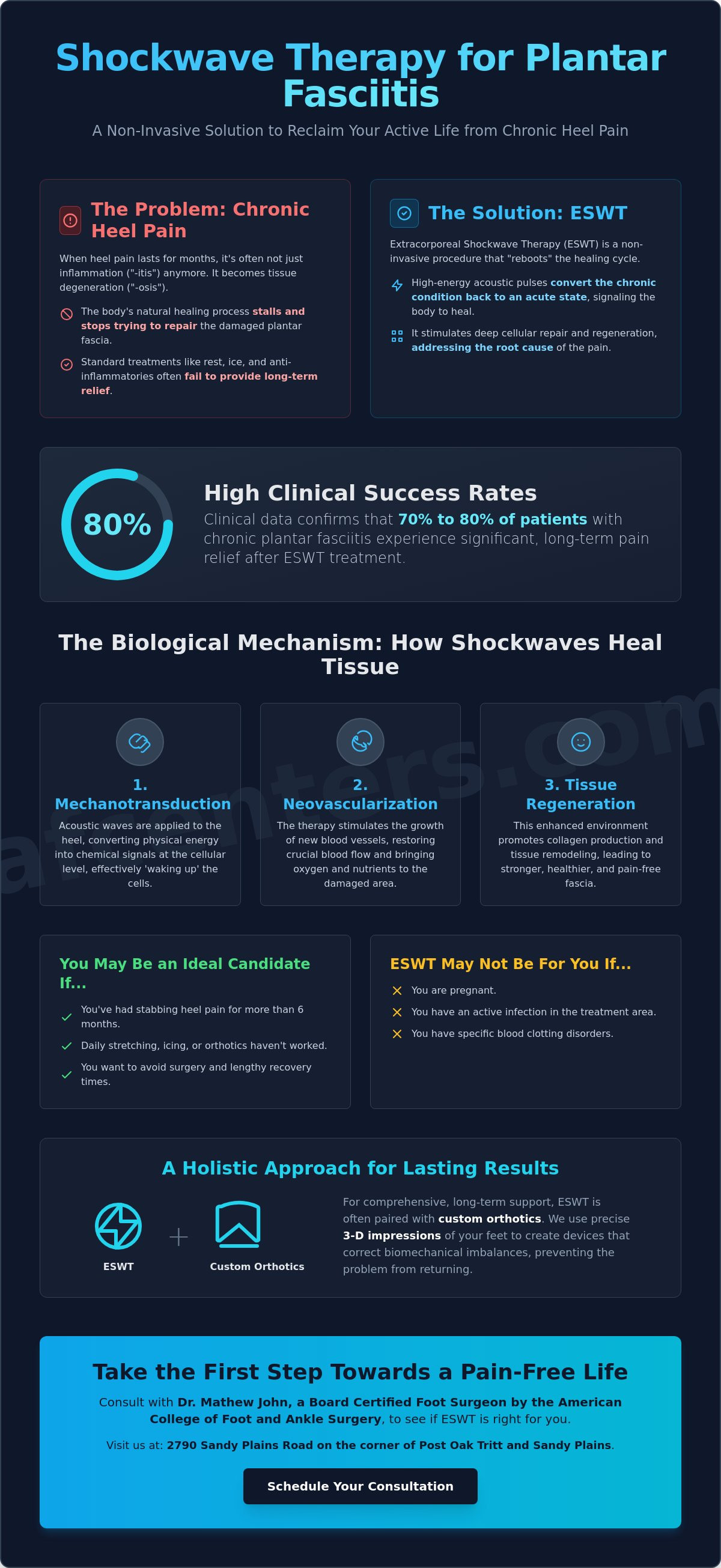
- Learn how acoustic pulses trigger a biological "reboot" in damaged tissue to restart your natural healing process and repair chronic degeneration.
- Discover why clinical data confirms that is shockwave therapy for plantar fasciitis effective, showing success rates of 70% to 80% for patients with chronic heel pain.
- Explore how this non-invasive technology allows you to return to an active lifestyle without the risks or lengthy downtime associated with surgical procedures.
- Understand the benefits of a holistic approach that pairs ESWT with custom orthotics designed from precise 3-D impressions for long-term support.
- Prepare for your professional consultation with Dr. Mathew John, a Board Certified Foot Surgeon by the American College of Foot and Ankle Surgery, at our Marietta office.
Is Shockwave Therapy for Plantar Fasciitis Effective? Understanding ESWT
Many patients come to us asking, is shockwave therapy for plantar fasciitis effective enough to help them avoid the operating room? To answer that, we have to look at what happens when heel pain becomes chronic. Most people assume their discomfort is just lingering inflammation, or "itis." In reality, after several months, the condition often shifts into "osis," which is a state of tissue degeneration. When your plantar fascia reaches this stage, the body essentially stops trying to heal the area. This is why standard rest, ice, and anti-inflammatories often fail to provide lasting relief.
The core goal of Extracorporeal shockwave therapy (ESWT) is to restart that stalled healing process. By using high-energy acoustic pulses, we create controlled micro-trauma in the damaged fascia. This signals your immune system that there's a "new" injury that requires immediate attention. By converting a chronic, stagnant condition back into an acute state, your natural repair mechanisms wake up and begin rebuilding the tissue from the inside out.
The Evolution of Shockwave Therapy in Podiatry
Who is the Ideal Candidate for ESWT?
The Biological Mechanism: How Shockwaves Repair Damaged Tissue
When patients ask is shockwave therapy for plantar fasciitis effective, they're usually looking for proof that it does more than just mask pain. The answer lies in a process called mechanotransduction. This sophisticated biological event occurs when physical sound waves penetrate your heel and interact with your cells. These waves act as a catalyst, converting mechanical energy into chemical signals that tell your body to start repairing itself. It's not just a temporary fix; it's a fundamental change in how your tissue behaves at a cellular level.
One of the most vital results of this process is neovascularization. Chronic heel pain often persists because the plantar fascia has poor blood supply, which prevents essential nutrients from reaching the damaged area. Shockwaves stimulate the creation of new micro-capillaries, effectively "re-plumbing" the tissue to ensure it receives the oxygen and growth factors it needs to thrive. According to this NIH Study on Shockwave Therapy Effectiveness, this influx of blood flow is a primary driver in long-term tissue remodeling and collagen production.
Radial vs. Focused Shockwaves: What You Need to Know
Understanding the difference between radial and focused waves helps you see why your treatment plan is unique. Radial pressure waves are excellent for treating broader, superficial areas of discomfort. They disperse energy over a wider surface, making them ideal for the initial stages of therapy. Focused shockwaves, however, provide precision energy that reaches deeper cellular targets. In complex cases, Dr. Mathew John, a Board Certified Foot Surgeon by the American College of Foot and Ankle Surgery, may recommend a combination of both to ensure every layer of the fascia is addressed.
Breaking Down Scar Tissue and Adhesions
As the acoustic pulses travel through your foot, they physically disrupt calcifications and stagnant scar tissue that have built up over time. This creates "controlled microtrauma," a gentle wake-up call to your immune system. Because this happens extracorporeally, or outside the body, you get the benefits of tissue disruption without the need for a single incision. This process also overstimulates the nerve fibers in the area, which often leads to an immediate reduction in pain levels even before the long-term healing begins.
Clinical Success Rates and Effectiveness Metrics
Long-Term Outcomes vs. Temporary Relief
Why Some Patients Respond Better Than Others
Your daily habits and foot structure play a significant role in your final outcome. Patients who follow our guidance on supportive footwear and activity modification during the 12-week recovery phase often see the best results. To support the newly repaired fascia, we often use 3-D impressions to create custom orthotics. This ensures your foot is properly aligned, preventing the same mechanical stresses from damaging the tissue again. Dr. Mathew John, a Board Certified Foot Surgeon by the American College of Foot and Ankle Surgery, oversees this multidisciplinary approach at our office at 2790 Sandy Plains Road on the corner of Post Oak Tritt and Sandy Plains to help you achieve the best possible result.
Preparing for Your ESWT Appointment in Marietta
Ready to take the next step toward your recovery? Your visit to our facility at 2790 Sandy Plains Road on the corner of Post Oak Tritt and Sandy Plains is designed to be as seamless and supportive as possible. A typical session for Extracorporeal Shockwave Therapy (ESWT) takes only 15 to 20 minutes of your time. Because the procedure is non-invasive, we don't need to use any anesthesia. You'll feel a rhythmic tapping or pulsing sensation against your heel. While this feeling is intense, most of our patients find it very tolerable and appreciate knowing the technology is actively targeting their pain.
What to Bring and How to Prepare
To get the most out of your initial diagnostic evaluation with Dr. Mathew John, a Board Certified Foot Surgeon by the American College of Foot and Ankle Surgery, please bring the shoes you wear most frequently. Whether they are work boots or running sneakers, seeing the wear patterns helps us understand your unique foot mechanics. It's also vital to avoid taking non-steroidal anti-inflammatory drugs (NSAIDs) like Ibuprofen for at least 48 hours before your treatment. Since ESWT works by triggering a natural healing response, we don't want to dampen that signal with medication that suppresses inflammation.
Post-Treatment Protocols for Maximum Healing
After your session, we recommend a brief period of activity modification. For the first 48 hours, avoid high-impact activities like running or jumping to let the treated tissue settle. Most patients follow a schedule of 3 to 5 sessions, usually spaced about one week apart. This rhythm ensures your body receives a consistent signal to continue the remodeling process. We'll monitor your progress closely, and we encourage you to share feedback on your pain levels at each visit. If you're ready to begin your journey, schedule your consultation for heel pain relief today.
A Multidisciplinary Approach to Foot Health at Ankle & Foot Centers, PC
After ESWT restarts the healing process, your foot needs proper alignment to prevent future strain. We use precise 3-D impressions to create custom orthotics that cradle your heel and support the arch. This ensures the newly repaired tissue isn't immediately subjected to the same stresses that caused the injury. For patients dealing with lingering musculoskeletal inflammation, we also offer MLS Laser Therapy. This technology uses specific wavelengths of light to reduce swelling and speed up the recovery of soft tissues, acting as a perfect companion to shockwave treatments.
Swift Treatment for Stubborn Plantar Warts
Comprehensive Care for All Foot Conditions
Reclaim Your Active Lifestyle Today
You don't have to accept chronic heel pain as a permanent part of your life. By choosing a treatment that addresses the biological root of your discomfort, you're prioritizing long-term mobility over temporary fixes. The clinical evidence is clear; is shockwave therapy for plantar fasciitis effective because it restarts the natural healing process in tissue that has otherwise stalled. At our Marietta facility, you'll find a supportive environment where sophisticated technology meets compassionate, expert care.
Dr. Mathew John, a Board Certified Foot Surgeon by the American College of Foot and Ankle Surgery, utilizes advanced tools like 3-D impressions for custom orthotics and MLS Laser therapy to ensure your recovery is complete. Our office at 2790 Sandy Plains Road on the corner of Post Oak Tritt and Sandy Plains is ready to help you get back on your feet. Take the first step today and schedule your heel pain evaluation at our Marietta office today. Your journey toward pain-free movement is a rewarding opportunity to return to the activities you love, and we're here to guide you every step of the way.
Frequently Asked Questions
Is shockwave therapy for plantar fasciitis painful?
Most patients describe the sensation as a series of intense, rhythmic pulses or a tapping feeling. While it's certainly a unique sensation, it's generally tolerable and doesn't require any local anesthesia. The treatment lasts only about 15 minutes, and most people feel a sense of relief shortly after the session ends.
How many sessions of ESWT will I need for my heel pain?
You'll typically need between 3 and 5 sessions to achieve the best long-term results. We usually space these appointments about one week apart to allow your body time to respond to the biological signals. When evaluating is shockwave therapy for plantar fasciitis effective for your specific needs, this cumulative approach is essential for permanent tissue remodeling.
Can I go back to work immediately after shockwave therapy?
You can return to your normal daily routine, including work, immediately after you leave our office. There's no downtime associated with this procedure, and you'll be able to walk and drive yourself home without any issues. We simply recommend that you avoid high-impact activities like running for the first 48 hours to let the treated fascia settle.
What is the difference between ESWT and MLS Laser therapy?
ESWT uses mechanical acoustic pulses to physically restart the healing process in chronic, degenerated tissue. MLS Laser therapy uses specific wavelengths of light energy to target musculoskeletal pain and inflammation. While both are non-invasive and highly effective, they address different aspects of your recovery journey and are sometimes used together for a holistic result.
How much does shockwave therapy cost and is it covered by insurance?
Coverage for ESWT varies depending on your specific insurance provider and plan. While it's often an out-of-pocket investment, many patients find it to be a cost-effective alternative to the high expenses and risks of surgery. Our team at 2790 Sandy Plains Road on the corner of Post Oak Tritt and Sandy Plains can help you navigate these details during your visit.
What happens if shockwave therapy does not work for my plantar fasciitis?
If you don't respond to ESWT, we'll look at other professional options to get you back to your active lifestyle. Dr. Mathew John, a Board Certified Foot Surgeon by the American College of Foot and Ankle Surgery, may recommend custom orthotics created from 3-D impressions or a surgical evaluation. We're committed to being your expert partner until your pain is resolved.
Is Dr. Mathew John a board-certified specialist?
How does Swift Treatment for warts differ from traditional freezing?
Swift Treatment utilizes microwave ablation technology to target the root of the wart, whereas traditional freezing only addresses the surface. The Swift protocol typically involves four sessions spaced one month apart and requires no invasive cutting or downtime. It's a much more predictable and sophisticated way to treat stubborn warts compared to older, more painful methods.


