

What if that sharp, stabbing sensation in your heel didn't have to define your first steps every single morning? You know the feeling well. The frustration of hobbling across the bedroom or the persistent ache after a long day on your feet can make your favorite activities feel like a burden. If you are searching for plantar fasciitis stretches for immediate relief, you are not alone. Roughly 2 million Americans face this struggle every year, often feeling like they are navigating the pain without a clear map to recovery.
Key Takeaways
- Learn why your fascia tightens overnight and how targeted movement can ease those sharp, painful first steps in the morning.
- Discover effective plantar fasciitis stretches for immediate relief that you can perform anywhere to reduce tension in your arch and calves.
- Identify the signs of chronic fasciosis to understand why some heel pain persists even after weeks of consistent stretching and home care.
- Explore advanced regenerative solutions like MLS Laser Therapy and custom orthotics made from 3-D impressions to accelerate your personal healing journey.
- Connect with Dr. Mathew John, a Board Certified Foot Surgeon by the American College of Foot and Ankle Surgery, at our welcoming Marietta location.
Understanding Plantar Fasciitis and Why Stretches Provide Immediate Relief
Plantar fasciitis is an inflammatory condition affecting the thick ligament that runs along the bottom of your foot. This band of tissue serves as a critical support for your arch; it absorbs the impact of every step you take. When this tissue is overused or strained, it develops small micro-tears near the heel. This leads to the characteristic stabbing pain that many residents in Marietta experience daily. Understanding the mechanics of this injury is the first step toward finding lasting comfort.
Many patients find that the most intense pain occurs during those first few steps in the morning. This happens because the fascia tightens and contracts while you are resting. When you suddenly place your full weight on your feet, that tight tissue stretches violently, causing immediate distress. Utilizing plantar fasciitis stretches for immediate relief helps to gently elongate this tissue before it's subjected to the full force of your body weight. This proactive approach reduces the repetitive trauma that occurs every morning and helps you start your day with more confidence.
The Anatomy of Morning Heel Pain
While you sleep, your feet usually rest in a "plantar-flexed" position with the toes pointed away from the shin. This allows the plantar fascia to remain in a shortened state for hours. Your body attempts to knit those micro-tears back together in this position. When you stand up, you are essentially breaking that new, fragile tissue. Performing gentle stretches before your feet hit the floor acts as a warm-up for the ligament. It signals the tissue to expand gradually rather than snapping under pressure. This simple habit can drastically change your morning routine.
How Stretching Relaxes the Plantar Fascia
5 Best Plantar Fasciitis Stretches for Rapid Pain Reduction
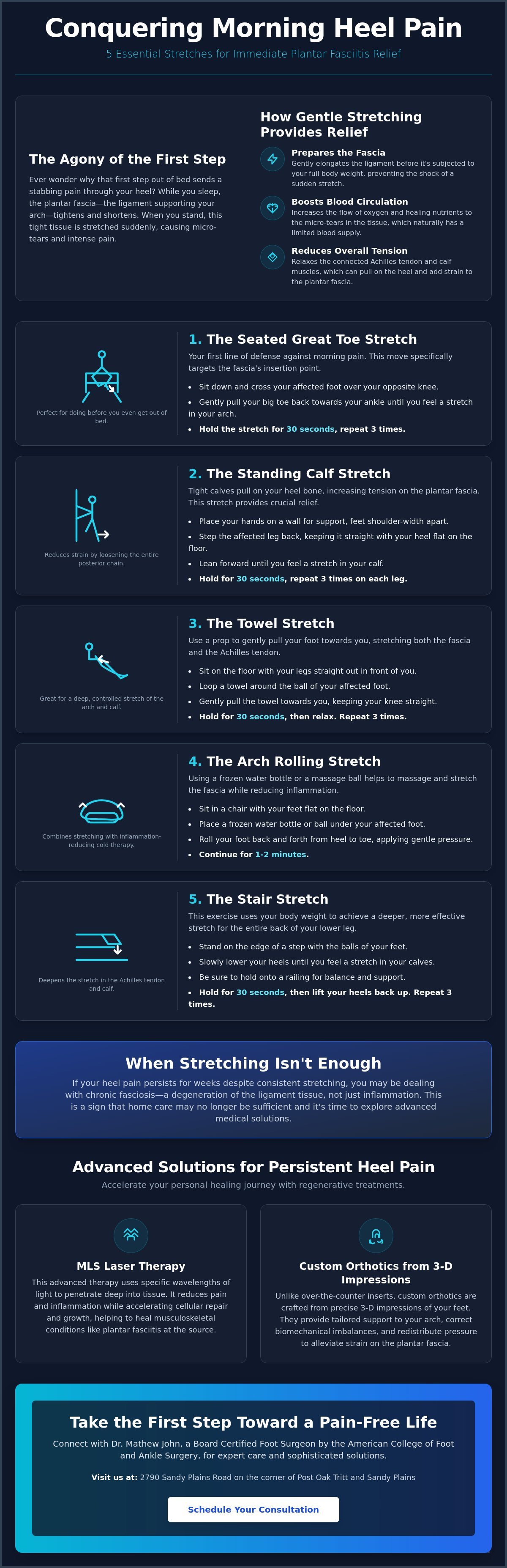
Finding the right plantar fasciitis stretches for immediate relief can be the difference between a productive day and one spent in constant discomfort. These five exercises are designed to target the specific anatomy of your foot and lower leg to release tension where it matters most. By incorporating these into your daily routine, you can start to reclaim your mobility and reduce the sharp sensations that hold you back. While home care is a powerful tool, understanding the symptoms and diagnosis of plantar fasciitis is essential for ensuring you are on the right path to recovery.
- The Seated Great Toe Stretch: Cross your foot over your knee and pull your toes back toward your shin.
- The Standing Calf Stretch: Use a wall for support to elongate the large muscles in the back of your leg.
- The Towel Stretch: Use a prop to gently pull your foot toward you while seated on the floor.
- The Arch Rolling Stretch: Roll your foot over a frozen water bottle for a combination of stretching and cold therapy.
- The Stair Stretch: Let your heels hang off the edge of a step to deepen the stretch in your Achilles tendon.
Seated Foot and Toe Flexor Stretches
The Seated Great Toe Stretch is your first line of defense against morning pain. While sitting, cross your affected foot over your opposite knee. Grab your big toe and gently pull it back toward your ankle, holding the tension for 30 seconds. This move specifically targets the plantar fascia's insertion point at the heel, where most pain originates. Perform this stretch before your feet hit the floor every single morning to prevent the micro-tearing that occurs with those first steps. It's a simple habit that yields significant results.
Wall-Based Calf and Achilles Tendon Stretches
Dynamic Rolling Stretches for the Arch
Using a frozen water bottle or a tennis ball allows you to massage the fascia while you move. Sit in a chair and roll the arch of your foot over the object, applying firm but not painful pressure. Cold rolling reduces inflammation while stretching fibers, providing a double benefit for irritated tissue. If these home remedies don't provide the lasting comfort you deserve, it might be time to explore comprehensive treatment options with Dr. Mathew John. As a Board Certified Foot Surgeon by the American College of Foot and Ankle Surgery, he offers personalized care at 2790 Sandy Plains Road on the corner of Post Oak Tritt and Sandy Plains.
When Stretching Isn’t Enough: Recognizing Chronic Fasciosis
You might find yourself wondering why the discomfort persists despite your best efforts. You've diligently practiced your plantar fasciitis stretches for immediate relief every morning, yet that familiar sting returns by midday. This is a common point of frustration for many patients in Marietta. While stretching is an excellent starting point, it only addresses the symptoms if the underlying condition has transitioned from a temporary irritation to a long-term structural change.
There is a significant difference between acute inflammation, known as plantar fasciitis, and chronic tissue degeneration, called plantar fasciosis. In the early stages, your body is dealing with active swelling that responds well to rest and gentle movement. However, if the pain lasts for months, the tissue begins to thicken and lose its healthy elastic quality. This state of "fasciosis" means the ligament is no longer just inflamed; it's actually breaking down and failing to heal properly on its own.
Recognizing when your condition needs professional attention is vital for preventing permanent damage. Watch for these red flags:
- Persistent pain even when you are sitting or lying down.
- Visible swelling or redness around the heel and arch area.
- Pain that feels significantly worse after you finish exercising rather than during the activity.
- A "burning" sensation that doesn't subside with traditional home care.
If you experience these symptoms, it's time for a professional evaluation. Dr. Mathew John is a Board Certified Foot Surgeon by the American College of Foot and Ankle Surgery. He can help determine if your heel pain has become chronic and requires more than just basic home care to resolve.
The Risk of Over-Stretching
It's tempting to think that pulling harder on your foot will lead to faster results. In reality, aggressive stretching can be counterproductive. When you use plantar fasciitis stretches for immediate relief, you should feel a light tension rather than a sharp sting. If you force a stretch beyond your natural limit, you risk creating new micro-tears in the fascia. This can lead to secondary issues like Achilles tendonitis as your body tries to compensate for the added strain. Always stay below your pain threshold to ensure you're helping rather than hurting.
Identifying Recalcitrant Plantar Fasciitis
Advanced Medical Solutions for Persistent Heel Pain in Marietta
While home care and plantar fasciitis stretches for immediate relief are essential first steps, some cases require a more sophisticated approach. When heel pain transitions from a temporary nuisance to a chronic struggle, the tissue needs more than just flexibility; it needs a catalyst for biological repair. Our Marietta clinic offers advanced, non-invasive technology designed to treat the root cause of heel pain, helping you return to your active lifestyle without the need for invasive procedures.
MLS Laser Therapy for Inflammation and Pain
MLS Laser Therapy is a painless, non-invasive option that specifically targets musculoskeletal pain and inflammation. This technology uses synchronized wavelengths to penetrate deep into the affected tissue, which accelerates cellular repair and significantly reduces swelling. It's a highly effective choice for patients who want to avoid the risks of medication or the downtime associated with surgery. This treatment is specifically reserved for musculoskeletal issues and difficult-to-heal wounds, providing a soothing path toward recovery for your feet. Most patients find the sessions to be a rewarding opportunity to find comfort in a welcoming, professional environment.
3-D Impressions and Custom Orthotics
Generic, off-the-shelf inserts often fail because they don't account for your specific foot mechanics or structural uniqueities. We move beyond these basic solutions by utilizing 3-D impressions of your feet to create custom orthotics. This process captures your foot in its most functional and ideal position, ensuring that the support you receive is tailored exactly to your anatomy. By using 3-D impressions rather than older casting methods, we provide a level of precision that helps redistribute pressure and prevents the recurring strain that leads to fascia damage. These devices act as a steady hand, guiding your feet through every step with the support they truly need.
Extracorporeal Shockwave Therapy (ESWT)
For athletes and active individuals in Marietta who face chronic pain, Extracorporeal Shockwave Therapy (ESWT) serves as a powerful "kickstart" for the healing process. This treatment utilizes high-energy acoustic waves to break up stubborn scar tissue in the plantar fascia, which is often the culprit in long-term cases. Clinical studies show that ESWT provides significant pain reduction in 60% to 80% of patients who haven't responded to other conservative treatments. It typically involves a series of three to five sessions, offering a sophisticated alternative to reconstructive foot and ankle surgery for those with recalcitrant symptoms.
If your pain persists after trying home remedies, explore our advanced treatments with Dr. Mathew John. As a Board Certified Foot Surgeon by the American College of Foot and Ankle Surgery, he can guide you toward the right technology for your recovery. Visit us at 2790 Sandy Plains Road on the corner of Post Oak Tritt and Sandy Plains to begin your personalized journey toward lasting health.
Expert Heel Pain Care with Dr. Mathew John at Ankle & Foot Centers, PC
A Local Hub for Advanced Podiatric Medicine
What to Expect During Your First Visit
Your journey to recovery begins with a comprehensive diagnostic process. During your initial visit, Dr. John performs a thorough physical exam and reviews your medical history to understand the unique mechanics of your feet. We don't believe in one-size-fits-all solutions. After identifying the root cause of your discomfort, Dr. John develops a tailored plan that integrates your home care with advanced office treatments. This might include fine-tuning your plantar fasciitis stretches for immediate relief or implementing more advanced options like custom orthotics designed from 3-D impressions. We explain every step of the process in plain English, ensuring you feel confident and informed about your care.
Don't let persistent heel pain dictate your schedule or limit your lifestyle. Whether you need conservative guidance or advanced reconstructive foot and ankle surgery, our team is ready to support you. We invite you to schedule a consultation today to address your pain permanently. Visit us at 2790 Sandy Plains Road on the corner of Post Oak Tritt and Sandy Plains to take the first step toward a more vibrant, active future. Your feet support you every day; it's time to give them the expert care they deserve.
Take the Next Step Toward Lasting Comfort
Dr. Mathew John is a Board Certified Foot Surgeon by the American College of Foot and Ankle Surgery. He specializes in a balanced approach that combines conservative care with advanced technologies like MLS Laser Therapy and ESWT. Our team at 2790 Sandy Plains Road on the corner of Post Oak Tritt and Sandy Plains is dedicated to helping you reclaim your active lifestyle. We are here to provide the professional guidance and community support you need to move forward with confidence.
Schedule Your Consultation with Dr. Mathew John Today to begin your personalized path to wellness. We look forward to helping you stand tall and move freely once again.
Frequently Asked Questions
How long does it take for plantar fasciitis stretches to work?
Can I over-stretch my plantar fascia?
Yes, it is possible to over-stretch the ligament by using too much force or aggressive techniques. Aggressive pulling can lead to further micro-tears and increased inflammation, which slows down your personal healing journey. Focus on a gentle, steady pull that stays below your pain threshold. If a stretch causes sharp, stabbing sensations, stop immediately and consult Dr. Mathew John at our Marietta clinic for guidance.
What if my heel pain is actually a plantar wart?
Plantar warts can sometimes be mistaken for heel pain, but they typically cause pain when pinched from the sides rather than from direct pressure. Unlike the deep ache of fasciitis, warts are viral infections that often appear as small, grainy growths on the sole of the foot. If you suspect a wart, Dr. Mathew John can provide a definitive diagnosis at our office located at 2790 Sandy Plains Road on the corner of Post Oak Tritt and Sandy Plains.
Is surgery the only option if stretches fail?
How do 3-D impressions help with heel pain?
3-D impressions allow us to create custom orthotics that match the exact contours of your feet while they are in a functional position. Unlike generic inserts, these devices redistribute your weight and correct mechanical imbalances that cause the fascia to strain. By using 3-D impressions, we ensure your orthotics provide the specific support needed to prevent recurring injuries and promote long-term stability.
What is the Swift Treatment for warts mentioned in foot care?
Swift Treatment is an advanced technology for stubborn or recalcitrant warts that utilizes microwave ablation. This modern approach targets the root of the viral infection by stimulating the body's immune response. The treatment typically involves four sessions spaced exactly one month apart. Patients appreciate that there is absolutely no downtime following the procedure, allowing you to return to your daily Marietta activities immediately.
Does MLS Laser Therapy hurt?
MLS Laser Therapy is a completely painless and non-invasive treatment for musculoskeletal pain and inflammation. Most patients report a soothing, warm sensation during the session, but there is no discomfort or recovery period required. It is an excellent option for those looking for a sophisticated way to manage difficult-to-heal open wounds or chronic heel pain without the use of needles or medication.
Can I continue running if I have plantar fasciitis?
You can often continue staying active, but you should modify your intensity and avoid running through sharp pain. Continuing to strain an injured fascia can lead to chronic degeneration, so it's vital to incorporate plantar fasciitis stretches for immediate relief before and after your workouts. If running causes a flare-up that lasts into the next morning, consider low-impact alternatives like swimming or cycling while your tissue heals.


