
What if the secret to a permanent bunion correction isn't just removing the bump, but addressing the foundation of your foot? Many patients understandably ask, can bunions come back after surgery, especially when they've heard stories of recurring pain or deformity. It's natural to feel hesitant about a procedure if you're worried about repeating the process later. While research shows that modern 3D surgical corrections have a recurrence rate as low as 1 to 3 percent, you still deserve the peace of mind that comes with a tailored, expert approach to your care.
At our practice located at 2790 Sandy Plains Road on the corner of Post Oak Tritt and Sandy Plains, Dr. Mathew John, a Board Certified Foot Surgeon by the American College of Foot and Ankle Surgery, focuses on your long-term vitality. We'll explore why traditional methods sometimes fail and how advanced structural correction provides a lasting solution. You'll also learn how we use 3-D impressions to design custom orthotics that protect your results. This guide previews the modern techniques and professional support available to ensure your first surgery is your only surgery, helping you return to the activities you love with total confidence.
Key Takeaways
- Understand the clinical reality behind the question "can bunions come back after surgery" and why modern techniques make permanent relief a realistic goal for your health journey.
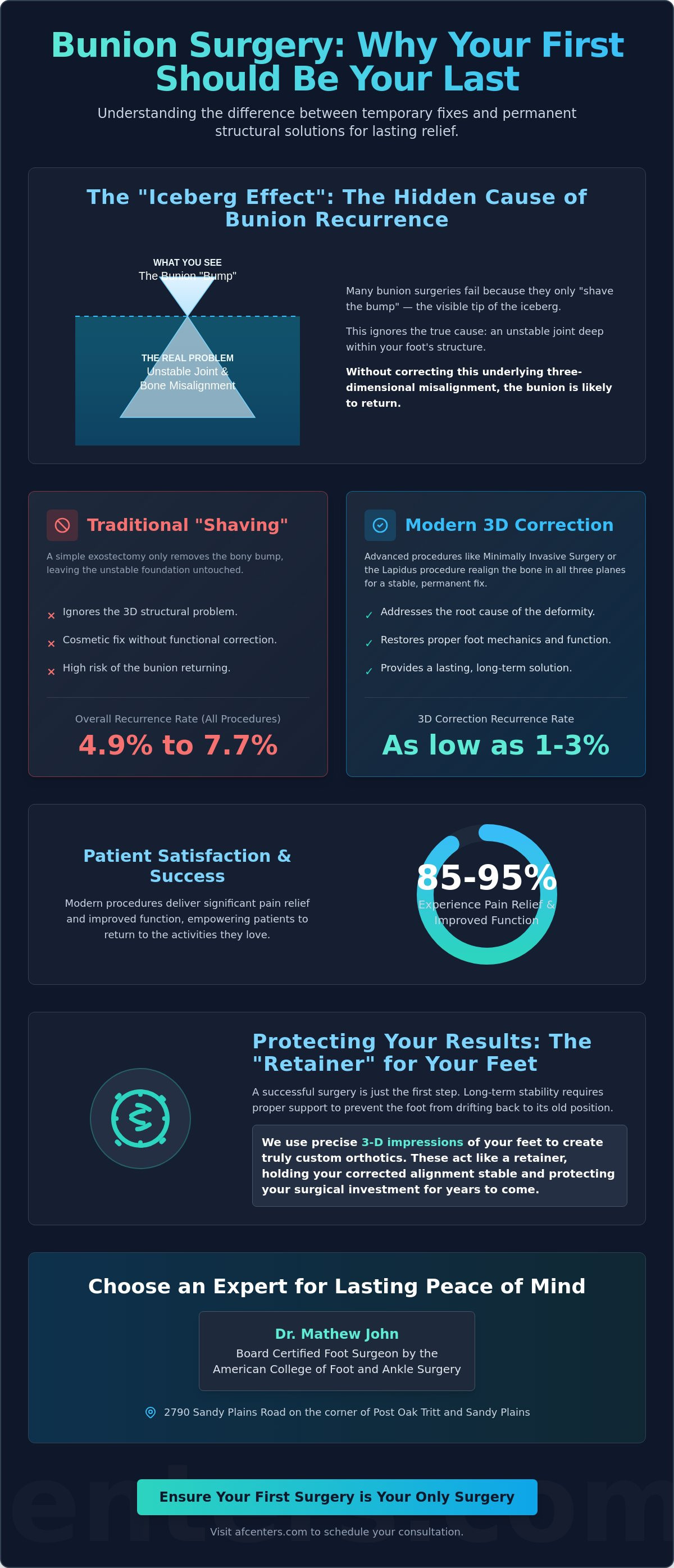
- Discover why addressing the three-dimensional root cause of a deformity is more effective than simply shaving the bone, helping you avoid the common "Iceberg Effect."
- Compare advanced reconstructive options like Minimally Invasive Bunion Surgery and the Lapidus procedure to see which approach best supports your long-term mobility.
- Learn how 3-D impressions for custom orthotics act like a retainer for your feet, providing the necessary support to keep your alignment stable after your procedure.
- Gain confidence by learning what to look for in a specialist, including the expertise offered by Dr. Mathew John, a Board Certified Foot Surgeon by the American College of Foot and Ankle Surgery.
Understanding Bunion Recurrence: Can They Really Return?
You've likely heard the stories from friends or family: "I had the surgery, but it just grew back." This leads many to wonder, can bunions come back after surgery? In clinical terms, we call this a recurrence of hallux valgus, which is the return of the bony protrusion and the leaning of the big toe. Understanding Bunion Recurrence starts with recognizing that a bunion isn't just a bump on the side of your foot; it's a complex structural misalignment.
It's vital to distinguish between a true recurrence and a procedure that didn't fully correct the joint's angle from the start. At our office at 2790 Sandy Plains Road on the corner of Post Oak Tritt and Sandy Plains, Dr. Mathew John, a Board Certified Foot Surgeon by the American College of Foot and Ankle Surgery, focuses on precision from day one. We want you to feel confident that your path to recovery is built on a foundation of expert knowledge and advanced technology.
To see how modern specialists approach these concerns, watch this helpful video:
The Statistics of Bunion Surgery Success
Modern podiatric medicine has come a long way. Current data from 2026 indicates that 85-95% of patients experience significant pain relief and improved function after their procedure. While the overall recurrence rate for all procedures combined ranges between 4.9% and 7.7%, these numbers drop significantly with advanced techniques. Older methods that focused solely on "shaving" the bone often failed because they left the unstable foundation untouched. Today, triplanar 3D corrections have reported recurrence rates as low as 0.8% in recent 2025 studies. Your compliance with post-operative instructions, such as wearing your surgical boot as directed, plays a massive role in maintaining these results. Check out our services to see how we prioritize long-term stability.
Signs Your Bunion Might Be Returning
Knowing what to look for can help you seek professional guidance early. You might notice your big toe drifting back toward your second toe, or you may feel that familiar ache returning to the base of the joint. Some patients find that shoes which felt comfortable three months after surgery are suddenly feeling tight or irritating again. If you notice these changes, it doesn't mean your journey has failed. It simply means it's time to visit a specialist to evaluate your foot's structural health. Early intervention often allows for non-surgical adjustments to keep your progress on track.
Why Bunions Recur: Shaving the Bone vs. Structural Realignment
To understand why a deformity might return, we have to look below the surface. Think of a bunion like an iceberg; the visible bump is just the tip of a much larger structural issue. If you only address the visible part, you haven't solved the underlying bone misalignment. This is the primary reason people ask, can bunions come back after surgery. When the foundation isn't stable, the toe naturally wants to return to its previous, tilted position.
The most common cause of recurrence is failing to address the unstable joint at the base of the metatarsal bone. Many patients also struggle with ligamentous laxity, or hypermobility. This means the connective tissues are naturally more flexible, making it easier for the bones to drift out of alignment again if they aren't properly secured during the procedure. A Systematic Review of Bunion Surgery Outcomes shows that modern techniques focusing on this foundation have much higher success rates than older, simpler methods.
The Problem with Simple Bunionectomies
A simple exostectomy, often called "shaving the bump," usually leads to disappointment because it ignores the angled bone. While the foot looks smoother immediately after the procedure, the muscle imbalance that caused the bunion remains. Over time, these muscles continue to pull the big toe toward the second toe. Shaving a bunion without realigning the bone is like straightening a leaning tower by only trimming the roof. Without changing the angle of the "tower" itself, the structure remains inherently unstable. This lack of structural correction is why many patients wonder if can bunions come back after surgery when they see the bump returning just a few years later.
Addressing the Root Cause: The Metatarsal Angle
Dr. Mathew John, a Board Certified Foot Surgeon by the American College of Foot and Ankle Surgery, prioritizes reconstructive surgery over quick cosmetic fixes. At our office at 2790 Sandy Plains Road on the corner of Post Oak Tritt and Sandy Plains, we evaluate your Intermetatarsal Angle (IMA) to determine the exact degree of correction needed. By utilizing 3-D structural correction, we rotate the bone back into its natural position and stabilize the joint at its source. This comprehensive approach ensures that your foot isn't just "fixed" for now, but is built to stay healthy and pain-free for years to come. If you're ready to find a permanent solution for your foot pain, you can explore our reconstructive options to learn more about our specialized care.
Modern Surgical Solutions: Minimally Invasive and Reconstructive Approaches
Choosing the right procedure is the most critical step in ensuring your results last a lifetime. When people ask, can bunions come back after surgery, the answer often depends on the surgical technique used to correct the deformity. Modern podiatry has shifted toward methods that prioritize structural integrity over simple bone removal. In fact, the adoption of minimally invasive bunion surgery increased by 34% between 2025 and 2026, reflecting a growing preference for techniques that offer both precision and a quicker return to daily life.
The Benefits of Minimally Invasive Techniques
When Reconstructive Surgery is Necessary
For individuals with severe angles or ligamentous laxity, reconstructive surgery remains the gold standard. The Lapidus procedure is a sophisticated reconstructive approach that stabilizes the foundation of the foot. Dr. Mathew John, a Board Certified Foot Surgeon by the American College of Foot and Ankle Surgery, utilizes specialized hardware like medical-grade plates and screws to maintain the correction permanently. This stability is vital for those with hypermobility, as it prevents the bones from shifting back into their old, painful positions. At our Marietta office, located at 2790 Sandy Plains Road on the corner of Post Oak Tritt and Sandy Plains, we tailor every plan to your unique anatomy. You can explore our reconstructive surgery options to see how we provide lasting relief for even the most complex cases.
Success in these procedures relies heavily on the experience of your surgical partner. Proficiency in advanced techniques like MIS is typically achieved after a surgeon has performed 30 to 38 cases, making specialization a key factor in your outcome. By choosing a reconstructive expert, you can feel confident when asking can bunions come back after surgery, knowing your procedure is designed for permanent stability. Our goal is to provide a professional environment where you feel supported throughout your entire personal journey toward better foot health.
Preventing Recurrence: The Role of 3-D Impressions and Post-Op Care
Even with a perfectly executed procedure, your foot's natural mechanics play a massive role in your long term success. Many patients who ask, can bunions come back after surgery, are surprised to learn that their gait is often the culprit. If you have flat feet or a tendency to overpronate, your foot naturally rolls inward as you walk. This movement places excessive pressure on the big toe joint, which is exactly how the original deformity started. Without addressing these biomechanical habits, you risk putting the same stress back on your newly corrected joint.
Why Custom Orthotics Matter After Surgery
Custom orthotics are far more than simple arch supports. They're precision tools designed to redistribute weight away from the big toe joint. By stabilizing the arch and correcting the way your heel strikes the ground, these inserts prevent the drifting that leads people to wonder, can bunions come back after surgery. Dr. Mathew John, a Board Certified Foot Surgeon by the American College of Foot and Ankle Surgery, utilizes 3-D impressions to create a device that fits your unique anatomy. This process captures the corrected position of your foot with incredible accuracy, allowing us to build a foundation that protects your surgical investment. If you're concerned about your foot's stability, you can schedule a biomechanical evaluation to see how custom support can help.
Footwear Choices for Long-Term Success
Your choice of shoes is your first line of defense against recurrence. It's tempting to want to wear stylish, narrow shoes immediately after healing, but rushing this process can be detrimental. We encourage our patients to look for footwear with a wide toe box and robust arch support. This prevents the toes from being squeezed together, which is a major contributor to joint inflammation. Modern orthotics are sleek and versatile, meaning they can often be fitted into your favorite professional shoes without sacrificing comfort or style. By combining expert surgical correction with the right footwear and custom support, you ensure your feet stay vibrant, active, and pain free for years to come.
Choosing the Right Foot Surgeon in Marietta for Lasting Results
Expert Care at Sandy Plains Road
Our practice is a localized hub for sophisticated foot and ankle care. You can find us at 2790 Sandy Plains Road on the corner of Post Oak Tritt and Sandy Plains. This location offers convenient access for our neighbors in Marietta, Roswell, and Woodstock who are seeking professional guidance. We've designed a welcoming environment where you can feel confident in your treatment plan. Our team acts as a steady hand, guiding you through the recovery process and helping you reach your personal goals for movement and comfort. We believe that professional support should be approachable, and we're proud to be a trusted partner in your health journey.
Comprehensive Foot Health Beyond Bunions
Step Toward Lasting Foot Health and Freedom
You deserve to walk and live without the shadow of recurring pain. While the question of can bunions come back after surgery is a common concern, modern reconstructive techniques have transformed the landscape of podiatric care. By prioritizing structural realignment over cosmetic fixes, you address the root cause of the deformity rather than just the visible bump. Pairing this precise surgical approach with custom orthotics created from 3-D impressions ensures your feet remain supported and stable for the long term.
Our team at 2790 Sandy Plains Road on the corner of Post Oak Tritt and Sandy Plains is ready to support your personal journey toward wellness. Dr. Mathew John, a Board Certified Foot Surgeon by the American College of Foot and Ankle Surgery, provides the high-level expertise you need for a permanent solution. Don't let the fear of a returning bunion hold you back from the active lifestyle you love. Schedule a consultation with Board Certified Foot Surgeon Dr. Mathew John today to rediscover your vitality. Your path to progress starts with a single, confident step.
Frequently Asked Questions
Why did my bunion come back after my first surgery?
Bunion recurrence often happens because the initial procedure only addressed the visible bump rather than the underlying bone angle. If the foundation at the base of the metatarsal remains unstable, the toe will naturally drift back into its old position. This is why many people ask, can bunions come back after surgery. Choosing a reconstructive approach that stabilizes the joint at its source significantly lowers this risk and provides a more predictable outcome.
Is it possible to have bunion surgery a second time?
Yes, you can certainly undergo a second procedure, often referred to as revision surgery. If your first surgery didn't provide lasting relief, a specialist can evaluate your foot structure to determine why the correction failed. Dr. Mathew John, a Board Certified Foot Surgeon by the American College of Foot and Ankle Surgery, specializes in these complex cases. He works to restore your mobility and comfort using advanced reconstructive techniques designed for long term stability.
How long does the correction from bunion surgery typically last?
A successful bunion correction should last for decades or even a lifetime. While older techniques had higher failure rates, modern 3D corrections have shown success rates between 85% and 95% in recent clinical data. Your long term results depend heavily on the surgical technique used and your commitment to following post operative care instructions. This includes wearing supportive footwear and using custom inserts to maintain the new, healthy alignment of your foot.
Will wearing orthotics prevent my bunion from returning?
Custom orthotics act like a retainer for your feet, helping to maintain the alignment achieved during surgery. By controlling overpronation and supporting your arch, they prevent the excessive pressure that causes a bunion to reform. We use 3-D impressions to create these devices, ensuring they provide the specific biomechanical support your unique foot structure requires. This proactive step is essential for protecting your surgical investment and ensuring your continued mobility.
What is the most successful type of bunion surgery for preventing recurrence?
Triplanar or 3D surgical corrections are currently considered the most successful for preventing recurrence. These procedures address the deformity in all three dimensions, providing a stable foundation at the joint. Recent 2025 studies indicate that these advanced methods can reduce the chance of a bunion returning to as low as 0.8%. This is a significant improvement over traditional methods, which often leave the foot vulnerable to drifting back out of alignment over time.
How do I know if my foot surgeon is properly qualified?
You should verify that your specialist is a Board Certified Foot Surgeon by the American College of Foot and Ankle Surgery. This specific credential ensures the surgeon has met rigorous standards for both knowledge and surgical experience. Choosing a highly qualified expert at a dedicated facility, like our office at 2790 Sandy Plains Road on the corner of Post Oak Tritt and Sandy Plains, is a great way to ensure a safe and successful outcome.
Can lifestyle changes alone stop a bunion from coming back?
Lifestyle changes, such as switching to wider shoes, are helpful but rarely enough to stop recurrence on their own. Since bunions are primarily caused by your foot's internal biomechanics, you need to address the structural issues. While better footwear choices reduce irritation, they don't fix the underlying bone alignment. This is why many patients find that professional support, such as custom orthotics or surgical intervention, is necessary for achieving a truly permanent solution.
What should I do if I feel pain in my bunion site years after surgery?
If you experience returning pain years later, you should schedule a professional evaluation immediately. Pain can signal that the bone is shifting or that there is an issue with the surgical hardware. It's important to investigate whether can bunions come back after surgery in your specific case or if the pain stems from a different condition. Early intervention often allows for non-surgical solutions, helping you avoid a second procedure and keeping you on your path toward health.


