
Imagine swinging your feet out of bed, only to feel that sharp, stabbing sensation the moment your heels touch the floor. It's a frustrating way to start the day, especially when generic shoe inserts haven't provided the relief you were promised. You're likely tired of sitting on the sidelines while your favorite exercise routine or weekend plans wait for your feet to catch up. At our Marietta clinic, located at 2790 Sandy Plains Road on the corner of Post Oak Tritt and Sandy Plains, we understand that foot pain is more than a nuisance; it's a barrier to the life you love.
We're here to help you move from temporary comfort to lasting correction. By choosing custom orthotics for plantar fasciitis, you aren't just adding a cushion; you're investing in a medical device tailored to your unique biomechanics. Dr. Mathew John, a Board Certified Foot Surgeon by the American College of Foot and Ankle Surgery, uses precision 3-D impressions to map your feet with incredible accuracy. This article will show you how combining these custom devices with advanced MLS Laser Therapy can reduce your daily pain and provide a clear, non-surgical path back to your personal goals.
Key Takeaways
- Identify the biomechanical triggers of your heel pain and understand how inflammation affects your daily mobility.
- Discover why custom orthotics for plantar fasciitis offer a level of correction and durability that over-the-counter inserts can't provide.
- Learn how we use precision 3-D impressions to create a medical device that perfectly aligns with your foot's unique contours.
- Explore how advanced clinical tools like MLS Laser Therapy and ESWT trigger natural healing without the need for surgery.
- Find out how Dr. Mathew John, a Board Certified Foot Surgeon by the American College of Foot and Ankle Surgery, guides your journey back to an active lifestyle at our Marietta clinic.
What is Plantar Fasciitis? Understanding Your Heel Pain
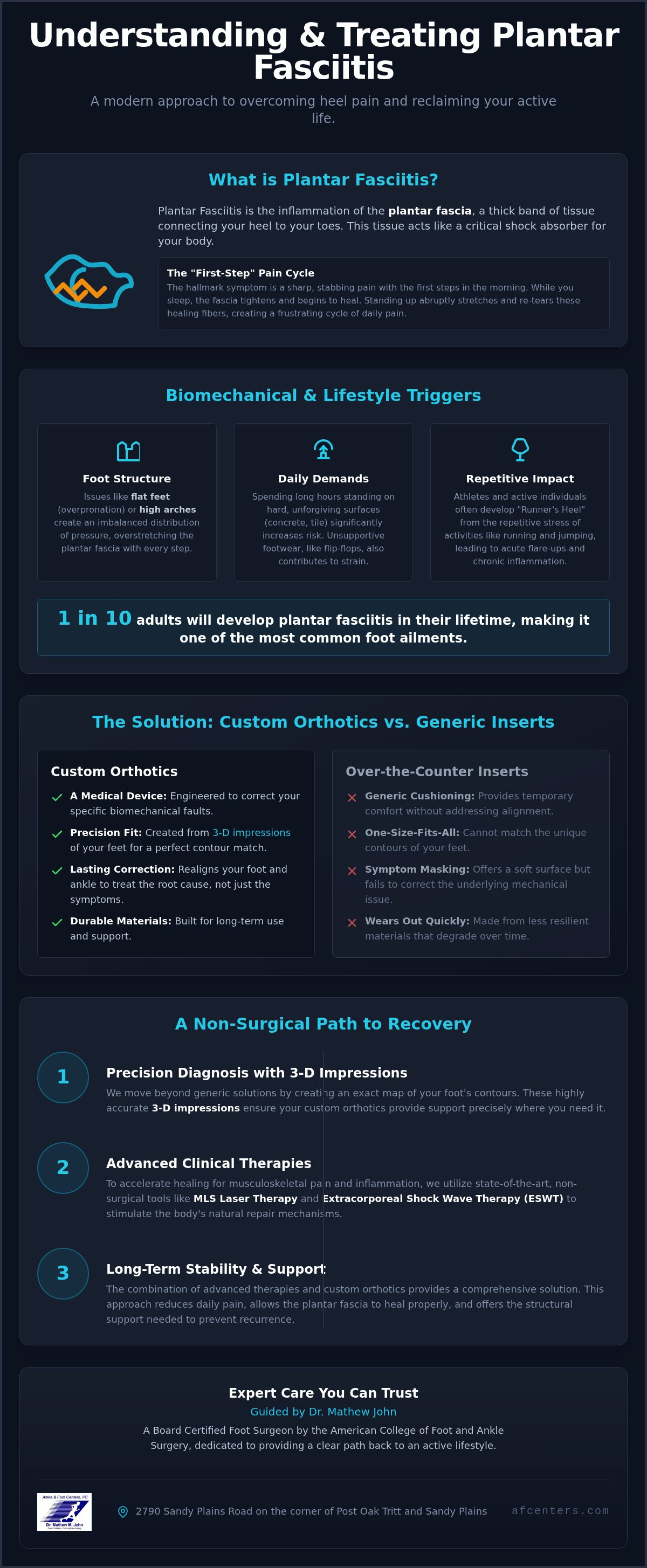
To solve a persistent problem, you first have to understand it. What is Plantar Fasciitis? Simply put, it's the inflammation of the thick band of tissue, known as the plantar fascia, that runs across the bottom of your foot. This tissue connects your heel bone to your toes and creates the arch that supports your body weight. Think of it as a powerful shock absorber. Every time you take a step, it stretches to manage the impact of your movement. When that tension becomes too great, small tears develop. These micro-tears lead to the stabbing sensation that makes every daily activity feel like a chore.
You've likely noticed that the pain is most intense during those first few steps in the morning. While you sleep, your foot relaxes and the fascia begins to knit itself back together. The moment you stand up, your body weight forces that tissue to stretch abruptly, re-tearing the healing fibers. This cycle of damage and partial repair is why many people find that custom orthotics for plantar fasciitis are necessary for long-term recovery. These devices provide the structural support needed to let the tissue heal without constant interruption. Dr. Mathew John, a Board Certified Foot Surgeon by the American College of Foot and Ankle Surgery, often meets patients at our Marietta clinic who are exhausted by this cycle and ready for a permanent solution.
Anatomy of the Heel and Arch
The plantar fascia doesn't work in isolation. It's part of a complex mechanical system. It attaches firmly to the calcaneus, or heel bone, and fans out toward the base of your toes. Your foot's structural alignment determines how much tension this band carries. For instance, if you have flat feet, the arch collapses too far, overstretching the fascia. Conversely, high arches can create a rigid structure that doesn't absorb shock well. We also look closely at the Achilles tendon. If your calf muscles are tight, they pull on your heel bone, which in turn increases the strain on the plantar fascia. Stabilizing these mechanics with custom orthotics for plantar fasciitis helps redistribute that pressure evenly across the foot.
Plantar Fasciitis vs. Heel Spurs
Many people assume a bony growth is the source of their agony. Let's debunk that myth. Heel spurs are often a symptom of chronic strain, not the primary cause of your pain. When the fascia pulls on the heel bone for a long time, your body creates protective calcium deposits to reinforce the area. Research shows that many people have heel spurs but feel no pain, while others have intense pain with no visible spur. Effective treatment focuses on the soft tissue inflammation rather than bone removal. At our office at 2790 Sandy Plains Road on the corner of Post Oak Tritt and Sandy Plains, we prioritize non-surgical care. By utilizing 3-D impressions to create a corrective device, we address the mechanical root cause. You can explore our full range of podiatric services to see how we treat these conditions with a focus on long-term wellness.
Identifying Symptoms and Biomechanical Root Causes
While the "first-step" pain discussed earlier is a major indicator, you should also watch for localized swelling around the heel or a persistent stiffness that makes it hard to flex your toes upward. These sensations aren't random occurrences. They're often tied to specific biomechanical triggers like overpronation, where your foot rolls inward too much, or high arches that fail to distribute weight effectively. Clinical studies on the Clinical Effectiveness of Custom Orthotics confirm that these mechanical issues require more than just a soft cushion; they require a device that realigns your stride and stabilizes the ligament.
Who is Most at Risk in Marietta?
When to Seek Professional Podiatric Care
Pain that forces you to change the way you walk is a clear warning sign. If you start feeling new aches in your knees, hips, or lower back, your body is likely trying to compensate for your foot pain. Dr. Mathew John, a Board Certified Foot Surgeon by the American College of Foot and Ankle Surgery, recommends early intervention to prevent these secondary injuries. Dealing with the problem now is much easier than fixing chronic mobility loss later. If you're ready to find a solution that works, you can explore our comprehensive podiatric services to see how we help our neighbors stay active and pain-free.
The Role of 3-D Impressions in Custom Orthotics
Once we understand the mechanics of your heel pain, the next step is creating a precise roadmap for your recovery. At our Marietta office, we rely on 3-D impressions to capture the exact contours of your feet. Unlike older methods that might rely on flat ink prints or generic templates, these impressions provide a high-resolution, three-dimensional model of your unique anatomy. This level of detail is essential because even a millimeter of misalignment can be the difference between persistent pain and total relief. When you invest in custom orthotics for plantar fasciitis, you're receiving a medical device that's designed to redistribute pressure away from the inflamed fascia, allowing the tissue to finally rest and repair itself.
Professional guidance is the key to ensuring these devices work as intended. Dr. Mathew John, a Board Certified Foot Surgeon by the American College of Foot and Ankle Surgery, oversees the entire process to ensure your biomechanical alignment is restored. We don't just hand you an insert; we partner with you to ensure the fit is perfect for your specific footwear and lifestyle needs. This personalized attention is what sets clinical care apart from retail alternatives.
Why 3-D Impressions Surpass Traditional Methods
Precision is the foundation of effective podiatric care. Traditional foam boxes often capture the foot in a "deformed" state, essentially molding a device to the very problem we're trying to fix. By using 3-D impressions, we can capture your foot in its ideal functional position. This eliminates the guesswork associated with "boil-and-bite" inserts or mail-order kits. When the device fits the actual architecture of your arch, the recovery process accelerates. You aren't just managing symptoms; you're correcting the structural imbalance that caused the injury in the first place, leading to faster results and a more stable stride.
Custom Orthotics vs. Over-the-Counter Inserts
It's common to reach for drug-store inserts when heel pain first strikes. While these products offer temporary, superficial cushioning, they rarely provide true correction. Store-bought options are mass-produced for an "average" foot that doesn't actually exist. In contrast, clinical-grade custom orthotics for plantar fasciitis are investment-grade tools built to last for years. They address specific issues like overpronation or supination by providing rigid support where you need it and flexibility where you don't. At our clinic located at 2790 Sandy Plains Road on the corner of Post Oak Tritt and Sandy Plains, we ensure that every pair is professionally fitted. You can explore our full range of podiatric services to see how we combine these advanced tools with personalized care plans.
Advanced Clinical Therapies for Chronic Heel Pain
Structural support from custom orthotics for plantar fasciitis is the foundation of a solid recovery plan, but some chronic cases need an extra boost to jumpstart the healing process. If you've lived with stabbing heel pain for months, your body's natural repair mechanisms might need a targeted nudge. Many patients come to us after trying traditional steroid shots, which often provide only a temporary mask for the pain. At our Marietta clinic, we prefer regenerative, non-invasive options that address the root of the inflammation rather than just hiding the symptoms.
Dr. Mathew John, a Board Certified Foot Surgeon by the American College of Foot and Ankle Surgery, evaluates each patient to determine if clinical therapies like Extracorporeal Shockwave Therapy (ESWT) are appropriate. ESWT uses acoustic pressure waves to create micro-trauma in the damaged tissue, which sounds intense but actually triggers a powerful healing response from your immune system. This approach is particularly effective for those who have found little relief from stretching or generic inserts alone.
MLS Laser Therapy: A Modern Path to Healing
For deep tissue inflammation and musculoskeletal pain, we utilize MLS Laser Therapy. This advanced technology uses specific wavelengths of light to penetrate deep into the foot, reducing swelling and pain at the cellular level. It's a completely pain-free, non-thermal treatment, making it an inviting option for those who want to avoid the discomfort of more invasive procedures. There's no downtime involved. You can walk out of our office at 2790 Sandy Plains Road on the corner of Post Oak Tritt and Sandy Plains and resume your day immediately. This technology is ideal for difficult-to-heal musculoskeletal conditions because it accelerates the repair of damaged ligaments and tendons without the need for surgery.
Stubborn Foot Conditions: Swift Treatment for Warts
It's also important to ensure your heel pain isn't actually caused by something else. Occasionally, what feels like a localized bruise or a mechanical issue is actually a plantar wart. These can be difficult to distinguish from a callus without a professional evaluation. For stubborn or recalcitrant warts, we offer Swift Treatment. This advanced technology utilizes microwave ablation to target the underlying virus directly. The treatment protocol typically involves four sessions spaced one month apart. Much like our laser therapies, Swift Treatment requires zero recovery time, allowing you to stay active throughout the entire process. If you're ready to move past the frustration of persistent foot pain, explore our full range of advanced podiatric services to see how we can help you reclaim your mobility.
Comprehensive Care with Dr. Mathew John in Marietta
You don't have to navigate your recovery alone. Finding a partner who understands the local community and the specific physical demands of your life in Marietta makes all the difference. Dr. Mathew John, a Board Certified Foot Surgeon by the American College of Foot and Ankle Surgery, has dedicated his career to helping neighbors reclaim their mobility. Our approach isn't about rushing to surgery. Instead, we prioritize non-surgical, regenerative solutions that align with your personal health goals. We see foot health as a holistic lifestyle choice, and our mission is to ensure you can enjoy everything our community has to offer without the distraction of chronic pain.
At our clinic, we've cultivated a supportive and wellness-oriented environment for patients of all ages. Whether you're a young athlete or a grandparent looking to stay active, you'll find a team that values your progress. We understand the frustration that comes with generic treatments that fail to deliver. That's why we focus on personalized care plans that address your specific biomechanical needs. By choosing custom orthotics for plantar fasciitis, you're opting for a solution backed by clinical expertise and a deep understanding of foot physiology. We're committed to returning you to a pain-free, active lifestyle through a steady hand and professional guidance.
The Ankle & Foot Centers, PC Experience
We've equipped our Marietta facility with state-of-the-art diagnostic tools to provide a sophisticated level of care right in your backyard. Our process begins with a thorough evaluation of your gait and foot structure. We use precision 3-D impressions to ensure every pair of custom orthotics for plantar fasciitis provides the exact correction your body requires. This focus on long-term foot health sets us apart from retail outlets. We don't believe in short-term fixes that lead to recurring injuries. As your partner in health, we guide you through every step of your recovery, ensuring you feel confident and supported as you move toward your goals. This organized professionalism ensures that you never feel overwhelmed by technical details.
Visit Our Marietta Clinic Today
Our office is conveniently located at 2790 Sandy Plains Road on the corner of Post Oak Tritt and Sandy Plains. We've designed our practice to be a localized hub for high-end resources, making it easy for professionals, athletes, and families to access the care they need. We offer flexible scheduling options to accommodate your busy life, ensuring that professional podiatric care is never a chore. Dr. Mathew John and the entire team at Ankle & Foot Centers, PC, are ready to welcome you into our community. Take the first step toward lasting relief by scheduling your consultation today. We look forward to helping you rediscover the joy of movement in a welcoming, non-judgmental atmosphere.
Step Into a Future Without Heel Pain
You don't have to accept stabbing heel pain as a permanent part of your morning routine. By addressing the biomechanical root causes of your discomfort and utilizing precision 3-D impressions, you can finally move toward a solution that offers structural correction rather than just temporary cushioning. Combining advanced clinical resources like MLS Laser Therapy with expert guidance ensures that your recovery plan is as unique as your footprint. We're here to help you move past the frustration of generic inserts and toward a lifestyle defined by vitality and movement.
Dr. Mathew John, a Board Certified Foot Surgeon by the American College of Foot and Ankle Surgery, is ready to act as your partner in health. At our Marietta clinic, located at 2790 Sandy Plains Road on the corner of Post Oak Tritt and Sandy Plains, we focus on providing high-quality custom orthotics for plantar fasciitis to help you return to an active, vibrant lifestyle. Schedule Your Evaluation with Dr. Mathew John today and take the first step toward lasting relief. We're excited to help you reach your personal wellness goals with confidence and ease.
Frequently Asked Questions
How can I tell if my heel pain is plantar fasciitis or a heel spur?
Plantar fasciitis is the inflammation of the soft tissue ligament, while a heel spur is a bony growth on the calcaneus. You can't usually distinguish between the two without a professional evaluation and imaging. Most of the stabbing pain you feel is actually caused by the inflamed tissue rather than the bone itself. Dr. Mathew John can provide a precise diagnosis at our clinic on the corner of Post Oak Tritt and Sandy Plains.
Are custom orthotics made from 3-D impressions better than store-bought ones?
Yes, because custom orthotics for plantar fasciitis provide biomechanical correction tailored to your unique foot structure. Store-bought inserts use generic templates that only offer temporary cushioning. Our clinical-grade devices use 3-D impressions to realign your stride and permanently reduce the strain on your plantar fascia, which retail products simply cannot do.
How long does it take for MLS Laser Therapy to reduce plantar fasciitis pain?
Many patients experience a noticeable reduction in swelling and discomfort after just a few sessions. MLS Laser Therapy works cumulatively to repair damaged tissue at the cellular level. While the initial relief can be quick, we typically recommend a full series of treatments to ensure long-term healing of the musculoskeletal inflammation.
Is surgery always necessary if custom orthotics don't work immediately?
Surgery is rarely the first option in our recovery plans. Dr. Mathew John, a Board Certified Foot Surgeon by the American College of Foot and Ankle Surgery, prioritizes non-surgical, regenerative solutions. If orthotics alone aren't enough, we often combine them with advanced therapies like ESWT or MLS Laser Therapy to trigger your body's natural healing response.
What is the difference between 3-D impressions and a simple foam mold?
Foam molds often capture the foot in a collapsed or "deformed" state, which can limit the effectiveness of the device. 3-D impressions allow us to map your foot in its ideal functional position with incredible accuracy. This precision mapping ensures your orthotics provide the exact support and correction needed for your specific arch height and heel mechanics.
Can I still run or exercise while being treated for plantar fasciitis?
You can usually stay active, but you might need to modify your routine to avoid re-injuring the tissue. We often suggest switching to low-impact exercises like swimming while your fascia heals. Once your custom orthotics for plantar fasciitis are ready, they'll provide the structural stability you need to return to your favorite Marietta running trails safely.
How does Swift Treatment work for stubborn plantar warts?
Swift Treatment uses microwave ablation technology to target the underlying virus directly. This advanced approach triggers your immune system to clear the wart without the need for messy acids or bandages. The treatment typically involves four sessions spaced one month apart, and there is no downtime for patients following the procedure.
Does insurance typically cover custom-molded orthotics?
Many private insurance plans and Medicare Part B offer coverage for custom orthotics when they are prescribed as a medical necessity. Coverage levels vary significantly between different policies and providers. Our team at 2790 Sandy Plains Road on the corner of Post Oak Tritt and Sandy Plains can help you navigate your benefits to see what requirements your plan has for coverage.


