
Imagine finally deciding to fix that painful, curled toe, only to find yourself staring at a surgical pin and wondering when you'll ever wear your favorite sneakers again. It's completely natural to feel a mix of relief and anxiety as you begin your hammertoe surgery recovery. You want your mobility back, but the fear of permanent stiffness or the confusion of wound care can feel like a heavy burden. You aren't alone in these concerns, and having a steady hand to guide you is the first step toward a successful outcome.
We promise to replace that uncertainty with a clear, actionable roadmap for your healing journey. This guide offers a week-by-week breakdown of your recovery milestones, from managing initial discomfort to returning to your favorite shoes. You'll learn about advanced strategies like MLS Laser Therapy for inflammation and see how the expertise of Dr. Mathew John, a Board Certified Foot Surgeon by the American College of Foot and Ankle Surgery, ensures you never navigate this path alone. From our clinic at 2790 Sandy Plains Road on the corner of Post Oak Tritt and Sandy Plains, we're here to help you move forward with confidence and strength.
Key Takeaways
- Master the RICE method and the use of protective footwear during the first 72 hours to minimize swelling and protect your surgical correction.
- Follow a structured hammertoe surgery recovery timeline to safely transition from initial weight-bearing restrictions back into your favorite shoes.
- Discover how non-invasive MLS Laser Therapy can accelerate tissue healing and significantly reduce post-operative inflammation and pain.
- Gain clarity on when it is physically safe to resume driving and return to work based on your specific occupational demands.
- Benefit from the specialized care of Dr. Mathew John, a Board Certified Foot Surgeon by the American College of Foot and Ankle Surgery, at our Marietta clinic.
Immediate Post-Operative Care: The First 72 Hours
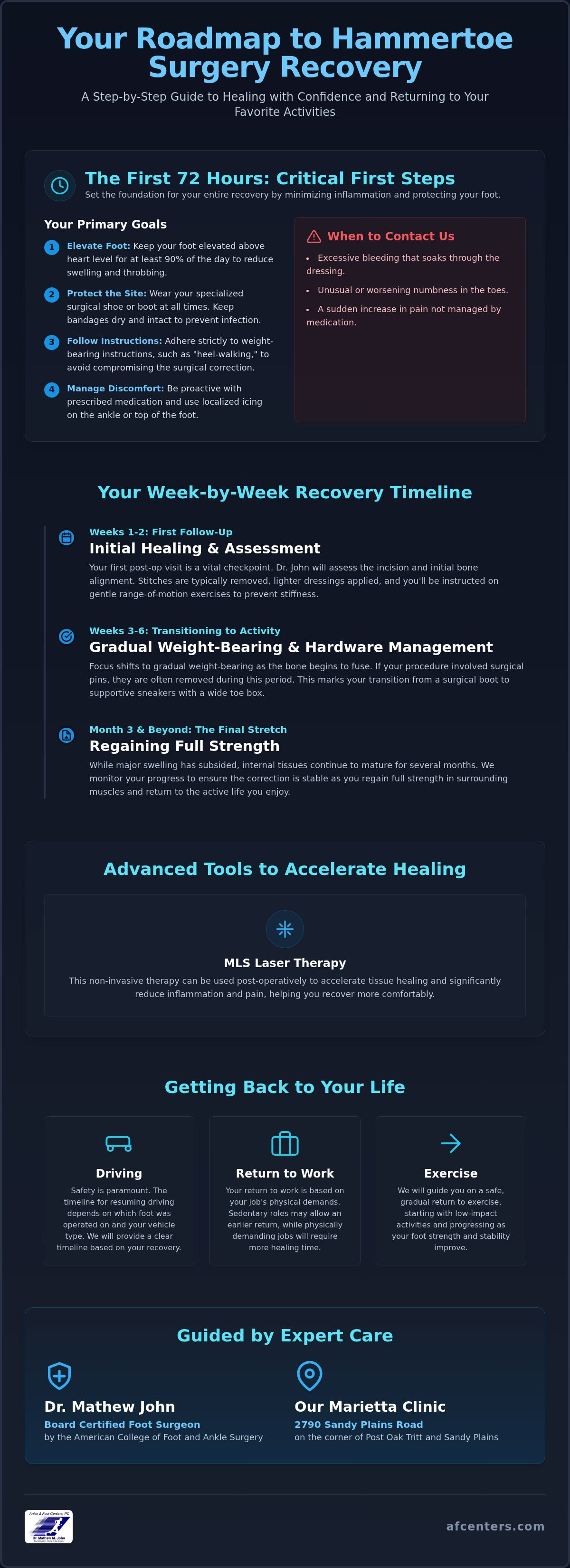
The first three days after your procedure set the foundation for your entire hammertoe surgery recovery. Your primary goal during this window is to minimize inflammation and protect the structural changes made to your foot. You'll leave the clinic wearing a specialized surgical shoe or boot designed to keep your toes in the correct alignment while the bones and soft tissues begin to knit back together. This footwear is essential for maintaining the work performed during your reconstructive foot surgery.
You must follow the weight-bearing instructions provided by Dr. Mathew John, a Board Certified Foot Surgeon by the American College of Foot and Ankle Surgery, with total precision. For many patients, this means strictly "heel-walking" or using assistive devices to keep pressure off the forefoot. Putting too much weight on your toes too soon can compromise the surgical pins or internal hardware that stabilize the correction. Managing discomfort is also about being proactive. Don't wait for pain to become intense before taking prescribed medication. Localized icing on the ankle or the top of the foot helps cool the blood flowing to the toes, reducing the internal pressure that causes throbbing.
Elevation and Swelling Control
Your foot needs to be elevated above the level of your heart for at least 90% of the day during these first 72 hours. Use a stack of firm pillows to create a stable, comfortable incline that supports your leg from the calf down to the heel. This position allows gravity to drain fluid away from the surgical site and back toward your core. Elevation is the primary defense against post-op throbbing.
Protecting the Surgical Site
Keeping your bandages dry and intact is non-negotiable until your first follow-up appointment at our office at 2790 Sandy Plains Road on the corner of Post Oak Tritt and Sandy Plains. Moisture can introduce bacteria to the incision site, which increases the risk of infection. You should avoid removing your surgical shoe, even for short walks to the bathroom. While some light spotting on the bandage is normal, you should monitor your foot closely for certain red flags. Contact our team if you notice any of the following:
- Excessive bleeding that soaks through the surgical dressing
- Unusual or worsening numbness in the toes that doesn't resolve with elevation
- A sudden increase in pain that isn't managed by your medication
Your Hammertoe Surgery Recovery Timeline: Week-by-Week
Understanding the stages of healing helps you stay patient and focused on the end goal of pain-free mobility. While every person heals at their own pace, following a structured hammertoe surgery recovery plan ensures you hit critical milestones safely. This timeline serves as your roadmap from the operating room back to your favorite activities. It provides the clarity you need to move forward with confidence, knowing that each week brings you closer to total healing.
The First Follow-Up (Weeks 1–2)
Your first visit to our Marietta clinic at 2790 Sandy Plains Road on the corner of Post Oak Tritt and Sandy Plains is a vital checkpoint. During this appointment, Dr. Mathew John, a Board Certified Foot Surgeon by the American College of Foot and Ankle Surgery, will assess the incision site and initial bone alignment. We'll typically remove surgical stitches and apply lighter dressings. Reviewing the details of Hammer toe repair can help you understand these clinical steps. If healing is progressing well, we'll discuss gentle range-of-motion exercises to prevent stiffness.
Transitioning to Activity (Weeks 3–6)
By weeks three and four, the focus shifts toward gradual weight-bearing as the bone begins to fuse. You'll likely feel more stable, but it's crucial to follow our guidance on how much pressure to apply. During weeks five and six, we address hardware management. If your procedure involved surgical pins, these are often removed now. This milestone marks your transition from a surgical boot into sneakers with a wide toe box to avoid compressing your healing toes.
Month three and beyond represents the final stretch of your journey. While the initial swelling has likely subsided, internal tissues continue to mature for several months. We'll monitor your progress to ensure the correction remains stable and that you're regaining full strength in the surrounding muscles. This is the time to celebrate your progress and return to the active life you enjoy. We'll guide you through the process of moving from a heel-walking gait to a more natural step, protecting the new alignment of your toe. It's a team effort between you and your surgical team to ensure every step you take brings you closer to full recovery. If you're curious about how specialized treatments can support your progress, you might want to learn more about our advanced therapeutic options designed for long-term foot health.
Advanced Recovery Tools: MLS Laser Therapy and Pain Management
Many patients share a common concern when considering corrective procedures: the fear of intense surgical pain. While traditional methods often rely heavily on oral medications, we prioritize a more holistic approach to your hammertoe surgery recovery. By integrating advanced technology into your healing plan, we can significantly reduce discomfort and speed up your return to daily life. Our Marietta facility, located at 2790 Sandy Plains Road on the corner of Post Oak Tritt and Sandy Plains, is equipped with sophisticated tools that go beyond basic aftercare.
The key to a comfortable experience is proactive management. We don't just wait for pain to occur; we use clinical strategies to prevent it from taking hold. This involves a combination of precision surgical techniques and modern therapeutic aids. Consistent follow-up care is essential during this time. These visits allow us to monitor your progress and adjust your pain management strategy in real-time, ensuring you stay comfortable as your body heals.
Managing Post-Surgical Inflammation
We utilize MLS Laser Therapy to target musculoskeletal pain and inflammation directly at the source. This non-invasive treatment uses specific wavelengths of light to stimulate cellular repair and improve local circulation. It's a painless process that typically lasts about ten minutes per session, and you won't feel any heat or vibration. Most patients benefit from a scheduled series of treatments during the first few weeks of recovery. By accelerating tissue repair at a cellular level, this technology often minimizes the need for prolonged oral pain medication, allowing you to feel better without the side effects of heavy narcotics.
Long-term Pain Prevention
Achieving a successful outcome involves more than just the surgery itself; it requires a commitment to long-term foot health. Once your incision has fully closed, maintaining toe flexibility through gentle stretching exercises is vital. Dr. Mathew John, a Board Certified Foot Surgeon by the American College of Foot and Ankle Surgery, will guide you on exactly when to begin these movements to avoid overexertion. Proper foot hygiene also plays a role in preventing irritation as you transition back into standard footwear. As your comfort levels improve, we'll help you safely taper off any remaining medications. You can view our full range of services to see how we support every stage of your journey toward pain-free mobility.
Resuming Daily Life: Driving, Work, and Exercise
Returning to your routine is an exciting phase of your hammertoe surgery recovery. It's a clear sign that your hard work in the early weeks is paying off. However, this transition requires a balanced approach to ensure you don't overtax your healing foot. Whether you're heading back to the office or getting back to the gym, your re-entry should be gradual and supported by professional guidance. We're here to help you navigate these milestones with confidence.
When Can I Drive Again?
Safety is the primary concern when getting back behind the wheel. If your surgery was on your left foot and you drive an automatic vehicle, you may be able to resume driving once you've stopped taking prescription pain medications. However, if the procedure was on your right foot, the timeline is naturally longer. You must wait until you can pivot your foot comfortably and apply enough pressure for an emergency brake stop without hesitation. Dr. Mathew John, a Board Certified Foot Surgeon by the American College of Foot and Ankle Surgery, will help you determine when your reaction time and strength are sufficient for safe operation.
Returning to work depends heavily on your specific job requirements. If you have a desk job that allows for frequent elevation, you might return within one to two weeks. For those in standing occupations, such as nursing or retail, you may need four to six weeks before your foot can handle the demands of a full shift. Exercise follows a similar rhythmic progression. Start with low-impact activities like swimming or stationary cycling before moving toward high-impact sports or running.
Preventing Future Toe Deformities
Correcting a hammertoe through surgery is a significant achievement, but preventing its return is equally vital for your long-term health. Deformities often stem from underlying structural imbalances in the way you walk. To address these issues, we provide custom orthotics designed specifically for your unique anatomy. We utilize 3-D impressions to capture an exact model of your feet, ensuring a perfect fit that redistributes pressure away from your toes. This data-driven approach allows us to create a supportive environment within your shoes, significantly lowering the risk of recurrence.
Selecting the right footwear is your next line of defense. Choose shoes with a wide toe box that allows your toes to lie flat and move naturally. Avoid high heels or narrow, pointed shoes that force the toes into a cramped position. If you're ready to take the next step in your healing journey, schedule an evaluation for custom orthotics at our Marietta clinic located at 2790 Sandy Plains Road on the corner of Post Oak Tritt and Sandy Plains.
Expert Foot Surgery in Marietta: Why Choose Dr. Mathew John
Choosing the right partner for your surgical journey is the most critical decision you'll make for your long-term health. A successful hammertoe surgery recovery depends on both the precision of the procedure and the quality of the aftercare you receive. When you trust your care to a specialist, you aren't just getting a medical treatment; you're gaining a dedicated mentor who understands the unique demands of your lifestyle. We believe that every patient deserves a clear, guided path to wellness that prioritizes progress and long-term vitality.
Board-Certified Surgical Excellence
Board certification is more than just a title. It represents a rigorous commitment to the highest standards of safety and clinical outcomes. Dr. Mathew John is a Board Certified Foot Surgeon by the American College of Foot and Ankle Surgery, which means he has undergone extensive training and peer review to master the complexities of reconstructive foot and ankle surgery. This level of expertise is vital when addressing the structural causes of toe deformities.
Our approach is always patient-first. We don't believe in one-size-fits-all solutions. Instead, we develop personalized recovery plans that incorporate advanced diagnostic tools and therapeutic options. For instance, we use 3-D impressions to create custom orthotics that support your foot's natural alignment once you're back on your feet. By combining high-level surgical skill with a supportive, non-judgmental atmosphere, we help you feel confident and empowered throughout your entire hammertoe surgery recovery.
Convenient Marietta Location
We know that your time is valuable, especially when you're managing the logistics of post-operative care. Our state-of-the-art facility provides comprehensive services under one roof, from initial consultations to advanced MLS Laser Therapy for pain management. This integrated approach ensures that you never have to navigate your healing journey alone or travel between multiple offices for the resources you need. We've designed our environment to be a localized hub of sophisticated medical care that feels like a welcoming part of the community.
Our clinic offers easy access for patients throughout the Atlanta Metro area, including those in Roswell, Woodstock, and Kennesaw. You can find us at 2790 Sandy Plains Road on the corner of Post Oak Tritt and Sandy Plains. We're proud to serve our neighbors with the same level of care and professional pride that we'd want for our own families. If you're ready to move toward a future of pain-free mobility, we invite you to schedule your consultation to discuss your surgical options and begin your journey toward lasting health.
Step Forward Into Your Pain-Free Future
Your journey through hammertoe surgery recovery is a rhythmic process that rewards patience and precision. By prioritizing elevation in the first 72 hours and utilizing advanced tools like MLS Laser Therapy to manage inflammation, you're setting the stage for a stronger, more mobile version of yourself. This guide has shown you that healing isn't just about waiting; it's about active partnership and expert guidance every step of the way.
Dr. Mathew John, a Board Certified Foot Surgeon by the American College of Foot and Ankle Surgery, is here to provide that steady hand. At our state-of-the-art facility at 2790 Sandy Plains Road on the corner of Post Oak Tritt and Sandy Plains, we combine clinical excellence with a warm, community-focused touch. You don't have to navigate this roadmap alone. We're ready to help you reclaim your active lifestyle and walk with confidence again.
If you're ready to leave toe pain behind and start your personalized healing journey, schedule a consultation with Dr. Mathew John today. Your path to vitality is just a step away, and we're excited to support your progress toward long-term health.
Frequently Asked Questions
How long do I have to wear the surgical shoe after hammertoe surgery?
You'll typically wear the surgical shoe for four to six weeks following your procedure. This specialized footwear protects the correction and keeps your toe in the proper alignment as the bone heals. Dr. Mathew John, a Board Certified Foot Surgeon by the American College of Foot and Ankle Surgery, will monitor your progress at our Marietta clinic to determine exactly when you're ready to transition into supportive sneakers. Staying in this shoe as directed is essential for long-term success.
Can I walk on my foot immediately after the procedure?
Most patients can walk immediately after the procedure using a "heel-walking" technique while wearing the provided surgical shoe. However, you must avoid putting any weight directly on your toes to protect the surgical site. Dr. Mathew John will provide specific weight-bearing instructions tailored to your surgery. Following these guidelines at our facility on the corner of Post Oak Tritt and Sandy Plains is vital for a successful hammertoe surgery recovery.
When is it safe to return to work if I have a desk job?
If you have a desk job that allows you to keep your foot elevated, you can often return to work within one to two weeks. The key is ensuring you can still follow the RICE method throughout the day to manage swelling. If your commute involves driving with your surgical foot, you'll need to wait until you're off prescription pain medication and have regained full control and strength for emergency braking.
What should I do if my surgical dressing gets wet?
Contact our Marietta office immediately if your surgical dressing becomes wet or loose. You shouldn't attempt to change the bandages yourself unless specifically instructed by Dr. Mathew John. Moisture trapped against the incision can increase the risk of infection and complicate your healing. We'll schedule a quick visit at 2790 Sandy Plains Road to safely replace the dressing and ensure the surgical site remains clean and protected throughout your journey.
Is it normal for my toe to feel stiff or numb months after surgery?
Some lingering stiffness is common as the internal tissues mature, which can take several months. While mild numbness occasionally occurs due to local nerve irritation, it usually resolves over time as the swelling subsides. We often recommend MLS Laser Therapy at our clinic to help reduce this inflammation and support nerve recovery. If you're concerned about your progress, we'll evaluate your toe's flexibility and strength during your follow-up visits to ensure optimal results.
How much pain should I expect during the first week of recovery?
You can expect moderate discomfort and throbbing during the first 48 to 72 hours, but this typically improves significantly by the end of the first week. Staying ahead of the pain with your prescribed medication and consistent elevation is the best strategy. Many of our patients in the Marietta area find that utilizing MLS Laser Therapy early in their hammertoe surgery recovery helps dramatically reduce this initial inflammation and speeds up the natural healing process.
Will I need physical therapy after my hammertoe is corrected?
Most patients don't require formal physical therapy, as Dr. Mathew John provides a series of gentle home exercises to restore flexibility. These movements help prevent scar tissue from causing permanent stiffness. If your case was particularly complex, we might recommend a few sessions with a local specialist in Roswell or Kennesaw. We'll also use 3-D impressions to create custom orthotics, which provide the long-term structural support needed to keep your feet healthy and properly aligned.


