
The very stretches you think are healing your feet might be the reason you can't walk comfortably in the morning. It's incredibly frustrating to wake up with that sharp, stabbing pain in your heel, especially when you've been diligently following a fitness routine to fix it. You likely feel caught in a cycle of conflicting advice, wondering why your recovery is moving at a snail's pace. We understand how exhausting it is to manage this condition while trying to stay active and healthy.
You deserve a clear path to recovery that doesn't involve guesswork. In this guide, you'll learn exactly which plantar fasciitis exercises to avoid to prevent further micro-tears and inflammation. We'll show you how to distinguish between helpful movements and dangerous habits that sabotage your progress. Beyond just what to stop doing, we'll explore how professional interventions like MLS Laser Therapy or custom orthotics created from 3-D impressions can accelerate your healing. Under the expert guidance of Dr. Mathew John, a Board Certified Foot Surgeon by the American College of Foot and Ankle Surgery, you can finally move toward a future of pain-free steps. Our team at 2790 Sandy Plains Road on the corner of Post Oak Tritt and Sandy Plains is here to support your journey back to vitality.
Key Takeaways
- Understand how the plantar fascia functions as a shock absorber and why repetitive strain creates micro-tears rather than simple muscle soreness.
- Identify specific plantar fasciitis exercises to avoid, such as running on hard pavement or performing high-impact plyometrics like box jumps and burpees.
- Discover why aggressive "toes-up" wall stretches and ballistic bouncing can actually worsen inflammation and prolong your recovery time.
- Explore low-impact fitness alternatives like swimming and stationary cycling that maintain your cardiovascular health without putting unnecessary pressure on your arches.
- Learn how professional treatments, including MLS Laser Therapy and custom orthotics crafted from 3-D impressions, provide a sophisticated path to long-term healing.
Why Certain Movements Aggravate Plantar Fasciitis
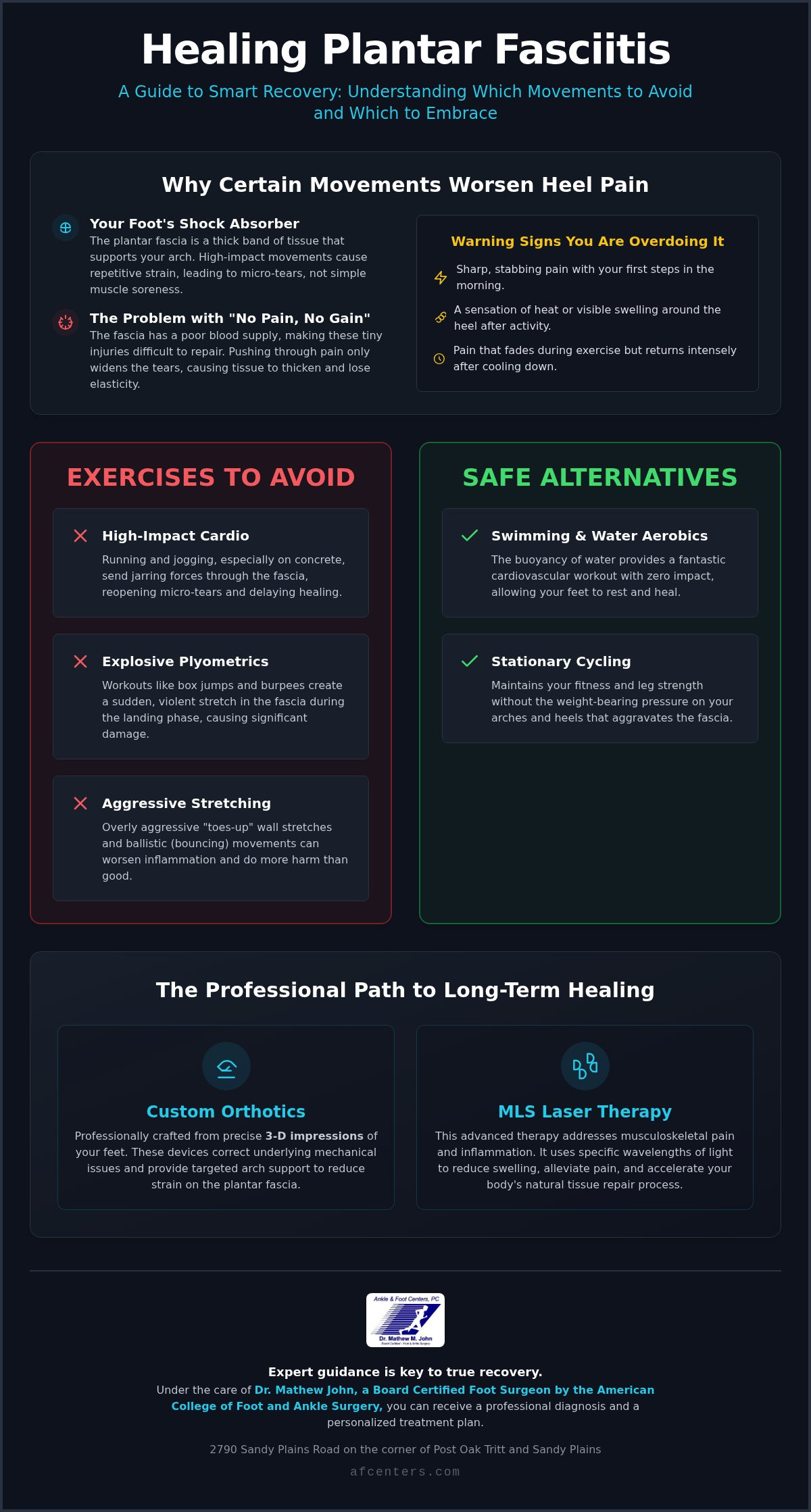
Your foot's arch relies on a thick, fibrous band of tissue called the Plantar Fasciitis to act as a natural shock absorber. Every time your foot hits the pavement, this band stretches to manage the impact and support your body weight. It's a remarkably resilient structure, but it has its limits. When you perform high-impact movements, you're essentially asking this "spring" to handle more force than it can safely manage. Over time, this excessive tension leads to structural changes that make every step a challenge.
If you don't adjust your routine, you risk turning a minor ache into a debilitating injury. Identifying specific plantar fasciitis exercises to avoid isn't about giving up on your fitness goals; it's about pivoting toward movements that support your long-term vitality. While we often think of exercise as a way to "work through" stiffness, the fascia doesn't respond like a typical muscle. It doesn't just get sore; it actually begins to degrade under repetitive stress, leading to a cycle of pain that rest alone won't always fix.
The Mechanics of a Micro-Tear
Think of the fascia like a bowstring under tension. When you run or jump, the string pulls tight to maintain the arch. If the tension is too high or repeated too often without proper recovery, the fibers begin to fray. These are micro-tears. Unlike muscle tissue that heals quickly with robust blood flow, the fascia has a limited blood supply. This makes these tiny injuries difficult for the body to repair on its own. This is why the "no pain, no gain" mentality is so dangerous for heel recovery. Pushing through the discomfort only widens these tears, causing the tissue to thicken and lose its elasticity.
Warning Signs You Are Overdoing It
Your body is excellent at communicating when a workout has crossed the line from helpful to harmful. If you notice these signs, it's time to pause and reconsider your activity choices:
- Sharp, stabbing pain during your first steps out of bed in the morning.
- A sensation of heat or visible swelling around the base of your heel after activity.
- Pain that seems to disappear during exercise but returns with a vengeance once you cool down.
Simply resting isn't always enough if your underlying mechanics are flawed. At our clinic located at 2790 Sandy Plains Road on the corner of Post Oak Tritt and Sandy Plains, Dr. Mathew John, a Board Certified Foot Surgeon by the American College of Foot and Ankle Surgery, emphasizes that true recovery requires a professional partnership. We often use advanced tools like MLS Laser Therapy to address musculoskeletal inflammation or create custom orthotics from 3-D impressions to correct improper foot placement. By understanding the plantar fasciitis exercises to avoid and seeking expert guidance, you can protect your heels and get back to the activities you love.
High-Impact Exercises to Avoid During Recovery
You want to keep moving, and we admire that dedication to your health. However, choosing the wrong activity can turn a healing foot into a chronically inflamed one. Understanding which plantar fasciitis exercises to avoid is essential for protecting your arch while you recover. High-impact movements place several times your body weight on the heel, causing the very micro-tears we discussed earlier to reopen and widen. This creates a cycle where you feel like you're taking one step forward and two steps back.
The Impact of Running and Jogging
Running is often the hardest habit to break for many active individuals. When you jog, the heel strike phase sends a jarring force through the fascia that it simply isn't ready to handle. This is especially true if you're running on the concrete paths in Marietta parks. Concrete provides zero shock absorption, leaving your feet to handle the entire load. According to Johns Hopkins Medicine on Plantar Fasciitis, pain often worsens after vigorous activity. Pushing through a morning run isn't a sign of toughness; it's a recipe for long-term damage. If you must run, seek out synthetic tracks in the Atlanta area, but a temporary pause is usually the safest bet for your recovery journey.
Gym Workouts That Sabotage Your Feet
Your favorite gym classes might be hiding hidden risks. Plyometrics like box jumps and burpees are some of the most common plantar fasciitis exercises to avoid. The explosive landing phase creates a sudden, violent stretch in the fascia. Similarly, HIIT sessions that involve repetitive hopping or dancing can keep your feet in a state of constant inflammation. Be cautious with stair climbing machines too. These keep you on the balls of your feet, putting continuous pressure on the arch. Even heavy weighted lunges or calf raises can be problematic without the support of medical-grade custom orthotics. We also strongly advise against barefoot training during this time. Without a structured shoe to distribute weight, your fascia is left completely vulnerable.
If your fitness routine is causing more pain than progress, it's time for a professional assessment. Dr. Mathew John, a Board Certified Foot Surgeon by the American College of Foot and Ankle Surgery, can help you identify exactly where your mechanics are failing. At our clinic located at 2790 Sandy Plains Road on the corner of Post Oak Tritt and Sandy Plains, we provide comprehensive foot care services to help you stay active safely. We can even create custom orthotics from 3-D impressions to ensure your gym shoes are providing the specific support your feet require.
Common Stretches That Can Actually Hurt Your Feet
It's a common instinct to want to stretch a tight muscle, but the plantar fascia isn't a muscle. It's a ligament. When you treat it like a rubber band that just needs more tension, you may actually be lengthening the time it takes to heal. Aggressive stretching is often at the top of the list for plantar fasciitis exercises to avoid, especially when your feet haven't had a chance to warm up. Many people try to "work out" the stiffness the moment they wake up, but pulling on cold, inflamed tissue can cause further micro-tearing before your day even begins.
According to Harvard Health on activities to avoid, repetitive stress from standing or running is a primary cause of this condition. Adding aggressive or ballistic stretching on top of that stress is counterproductive. Bouncing while you stretch, also known as ballistic stretching, triggers a reflex tension that makes the ligament tighten even further to protect itself. Similarly, using hard, rigid objects like golf balls to roll out a painful heel can be too intense. While a gentle massage is helpful, pressing a hard object directly into the site of inflammation can bruise the bone and irritate the nerves.
The Danger of Over-Stretching the Arch
The goal of recovery is to allow those tiny micro-tears in your fascia to knit back together. When you perform aggressive "toes-up" wall stretches, you're over-extending the arch and pulling those tears apart. You might feel a deep pull that seems like progress, but it's often just a sign that you're stressing the tissue beyond its current capacity. Instead of hard rollers, we often suggest using a frozen water bottle for a gentle, cold massage. This provides the relief you're looking for without the risk of mechanical damage to the heel.
Why Support Trumps Stretching in Early Recovery
In the early stages of healing, your foot needs structural support more than it needs flexibility. Dr. Mathew John, a Board Certified Foot Surgeon by the American College of Foot and Ankle Surgery, often finds that stabilizing the foot is the fastest way to reduce daily pain. This is where medical-grade custom orthotics play a vital role. At our clinic located at 2790 Sandy Plains Road on the corner of Post Oak Tritt and Sandy Plains, we don't rely on generic inserts. We use 3-D impressions to create a perfect fit that offloads the fascia, giving those micro-tears the quiet environment they need to heal. When your foot is properly supported, you won't feel the constant urge to stretch away the discomfort.
Safe Alternatives: Staying Fit Without the Pain
Focusing on plantar fasciitis exercises to avoid is only half the battle. To maintain your vitality and mental well-being, you need to find ways to stay active that don't jeopardize your recovery. The goal is to choose activities that provide cardiovascular and strength benefits without the repetitive heel strikes that reopen micro-tears. By pivoting your routine toward low-impact options, you can stay fit while giving your feet the quiet environment they need to heal.
Low-Impact Cardio for Marietta Residents
Swimming and water aerobics are the gold standards for zero-impact conditioning. When you're in the water, your body is buoyant, which removes almost all weight from your arches. Utilizing local aquatic centers in the Marietta area is a great way to maintain your endurance without any risk to your heels. If you prefer staying on land, stationary cycling is an excellent choice. However, technique is vital. Ensure you use a mid-foot or heel placement on the pedals rather than pushing through the balls of your feet, which can strain the arch. Elliptical trainers can also serve as a middle ground for those who miss running, provided you keep your heels in contact with the footpads at all times.
Beyond cardio, you can focus on upper body strength training and seated core workouts. These exercises allow you to push your limits without putting a single pound of pressure on your feet. Yoga and Pilates are also wonderful for flexibility, though they require specific modifications. Avoid poses that require you to be on your tiptoes or involve deep lunges that over-extend the fascia. Instead, focus on seated or floor-based movements that emphasize core stability and upper body alignment.
Professional Guidance for Your Fitness Journey
Consulting a specialist is the most effective way to ensure your new routine is actually safe. Dr. Mathew John, a Board Certified Foot Surgeon by the American College of Foot and Ankle Surgery, has years of experience helping athletes and active individuals navigate the complexities of heel pain. He understands that "rest" doesn't have to mean "sedentary." His approach focuses on creating a sustainable path back to the activities you love by addressing your unique foot mechanics.
At our clinic located at 2790 Sandy Plains Road on the corner of Post Oak Tritt and Sandy Plains, we don't just tell you which plantar fasciitis exercises to avoid; we partner with you to build a better foundation. Whether through MLS Laser Therapy to calm inflammation or custom orthotics designed from 3-D impressions to support your movement, we provide the professional resources necessary for long-term health. Dr. Mathew John is a Board Certified Foot Surgeon by the American College of Foot and Ankle Surgery, ensuring you receive the highest level of expert care throughout your recovery.
Schedule a consultation today to build a custom fitness plan that protects your heels.
Advanced Treatment at Ankle & Foot Centers, PC
Identifying the plantar fasciitis exercises to avoid is a vital first step, but for many, it's only part of the recovery equation. If your pain persists despite modifying your activity, it's time to look toward advanced, non-invasive clinical treatments that address the root of the problem. At our office at 2790 Sandy Plains Road on the corner of Post Oak Tritt and Sandy Plains, we specialize in modern therapies that move beyond simple rest and ice. Dr. Mathew John, a Board Certified Foot Surgeon by the American College of Foot and Ankle Surgery, utilizes a comprehensive diagnostic approach to determine exactly why your fascia isn't healing on its own.
MLS Laser Therapy for Plantar Fasciitis
MLS Laser Therapy is a breakthrough for those struggling with chronic musculoskeletal inflammation. Unlike traditional methods that may rely on needles or surgery, this technology uses specific wavelengths of light to stimulate cellular repair and reduce swelling. You can expect a painless session that helps eliminate that dreaded "stiff" feeling during your first steps in the morning. Clinical data indicates that approximately 85-90% of patients with musculoskeletal pain, such as plantar fasciitis, report significant pain relief from MLS Laser treatments. It's a sophisticated, drug-free option that fits perfectly into an active lifestyle, helping you return to your favorite activities much faster than traditional rest alone.
Custom Orthotics vs. Over-the-Counter Inserts
While generic inserts are widely available, they often lack the structural integrity needed to actually correct your foot mechanics. A generic approach can sometimes worsen the very issues you're trying to fix by failing to provide specific support where your arch is weakest. We take a different path by creating medical-grade custom orthotics based on precise 3-D impressions of your feet. This ensures the device is tailored to your unique arch height and pressure points, providing the exact support necessary to offload the fascia. For active patients, this structural correction is the key to preventing future injury and ensuring long-term comfort.
For the most stubborn or chronic cases, we also offer Extracorporeal Shockwave Therapy (ESWT). This treatment uses acoustic pressure waves to jumpstart the body's natural healing response in stagnant tissue. By combining these advanced tools with expert guidance on which plantar fasciitis exercises to avoid, we provide a localized hub for sophisticated foot care right here in Marietta. You don't have to navigate your recovery journey alone; we are here to serve as your expert partner in health, ensuring every step you take is a step toward permanent relief.
Take Control of Your Heel Health Today
Understanding the plantar fasciitis exercises to avoid is the first step toward a life without stabbing morning pain. By swapping high-impact running and aggressive stretching for low-impact cardio, you give your body the space it needs to heal those micro-tears. However, true recovery often requires more than just activity modification; it's about correcting the underlying mechanics that caused the stress in the first place.
At our clinic, we provide sophisticated tools like MLS Laser Therapy to calm inflammation and custom orthotics based on 3-D impressions for lasting support. Dr. Mathew John, a Board Certified Foot Surgeon by the American College of Foot and Ankle Surgery, is dedicated to guiding you through every stage of your personal wellness journey. You don't have to navigate this path alone when expert care is available locally.
Schedule your consultation with Dr. Mathew John at our Marietta office today! You'll find us at 2790 Sandy Plains Road on the corner of Post Oak Tritt and Sandy Plains. Don't let foot pain dictate your lifestyle when professional, compassionate support is just around the corner. We're ready to help you rediscover the joy of pain-free movement.
Frequently Asked Questions
Can I still walk for exercise with plantar fasciitis?
Yes, walking is generally safe if you stick to flat, paved surfaces and wear supportive footwear. You should avoid steep inclines or soft sand, as these terrains place excessive tension on your arch. If you feel sharp pain during your walk in Marietta or Roswell, it's a signal to rest. Keeping your strides short and controlled helps minimize the jarring impact on your sensitive heel tissue.
Is it okay to wear flip-flops or go barefoot at home?
You should avoid going barefoot or wearing flat flip-flops, even inside your home in Woodstock or Kennesaw. These habits leave your arch completely unsupported, which can lead to further micro-tears in the fascia. Instead, wear a pair of supportive house shoes or utilize your custom orthotics. Consistent support is essential for allowing the ligament to knit back together without the constant strain of weight-bearing on hard floors.
How long do I need to avoid high-impact exercises?
Most patients need to pause high-impact activities for at least four to six weeks, though this timeline depends on the severity of your inflammation. Returning to jumping or running too soon is one of the most common plantar fasciitis exercises to avoid errors. We recommend waiting until you have been entirely pain-free during daily activities for at least two weeks before slowly reintroducing more intense movements under professional guidance.
Will running with plantar fasciitis cause permanent damage?
While "permanent" is a strong word, continuing to run through the pain is one of the major plantar fasciitis exercises to avoid if you want to prevent chronic tissue degradation. This can lead to fasciosis, where the tissue becomes thicker and less elastic. In extreme cases, repetitive stress can lead to a full rupture. Seeking an evaluation at our office at 2790 Sandy Plains Road on the corner of Post Oak Tritt and Sandy Plains can prevent these complications.
What are the best shoes to wear for plantar fasciitis?
Look for shoes with a firm heel counter and a rigid midsole that doesn't bend easily in the center. Proper arch support is non-negotiable for residents in the Atlanta area dealing with heel pain. While high-quality athletic shoes are a good start, they often require the addition of medical-grade custom orthotics. We create these using 3-D impressions to ensure your specific foot structure is perfectly supported during every step of your day.
Should I use ice or heat for my heel pain after a workout?
You should prioritize ice over heat after any physical activity. Icing the base of your heel for 15 to 20 minutes helps constrict blood vessels and reduce the localized inflammation that causes sharp pain. A frozen water bottle is an excellent tool for a gentle ice massage. Avoid using heat on an acute flare-up, as increasing blood flow to an already inflamed fascia can actually worsen the swelling and discomfort.
How do 3-D impressions help with my specific foot shape?
3-D impressions allow us to create a precise map of your foot's unique architecture. Unlike generic, over-the-counter inserts that use a "one size fits all" mold, these impressions capture the exact height of your arch and the width of your heel. This level of detail is necessary to create orthotics that effectively offload the plantar fascia. By correcting your specific mechanics, we can provide the structural relief needed for long-term healing and comfort.
When should I see Dr. Mathew John for my heel pain?
You should schedule a visit if your heel pain persists for more than two weeks or if the pain is severe enough to change how you walk. Dr. Mathew John, a Board Certified Foot Surgeon by the American College of Foot and Ankle Surgery, specializes in advanced treatments like MLS Laser Therapy. Our clinic is conveniently located at 2790 Sandy Plains Road on the corner of Post Oak Tritt and Sandy Plains, serving patients throughout Sandy Springs and the surrounding communities.


