

Last Saturday, a local resident spent 45 minutes in a Marietta shoe store only to find that every stylish pair pressed painfully against the tops of her bent toes. This frustrating experience is a daily reality for the 7% of the population currently living with hammertoes, a condition that turns a simple walk through the Square into a painful chore. You probably feel that foot discomfort is just an inevitable part of your wellness journey or a consequence of a busy life. It's exhausting to hide your feet at the pool or worry that a permanent fix means months of missed work and immobility.
You aren't alone in these concerns, and you shouldn't have to settle for a life of restricted movement. We're here to empower you with the knowledge to identify your symptoms and access expert podiatric care that fits your schedule. This guide explores everything from non-invasive therapies to state-of-the-art corrective procedures that help you return to your active Atlanta lifestyle with confidence. You'll gain a clear understanding of treatment costs and the path to permanent relief so you can take your next step with total peace of mind.
Key Takeaways
- Learn to identify the warning signs of toe contracture and understand how early intervention protects your long-term mobility.
- Discover how muscle imbalances and footwear choices lead to hammertoes and why addressing them now prevents more rigid deformities later.
- Explore a range of effective non-surgical treatments, from custom orthotics to advanced MLS Laser Therapy, tailored to your specific stage of progression.
- Gain insights into professional corrective options available right here in Marietta to help you regain your confidence and walk without pain.
- Understand the importance of expert podiatric guidance in transforming your foot health and moving toward a more active, wellness-focused lifestyle.
What are Hammertoes? Understanding the Deformity
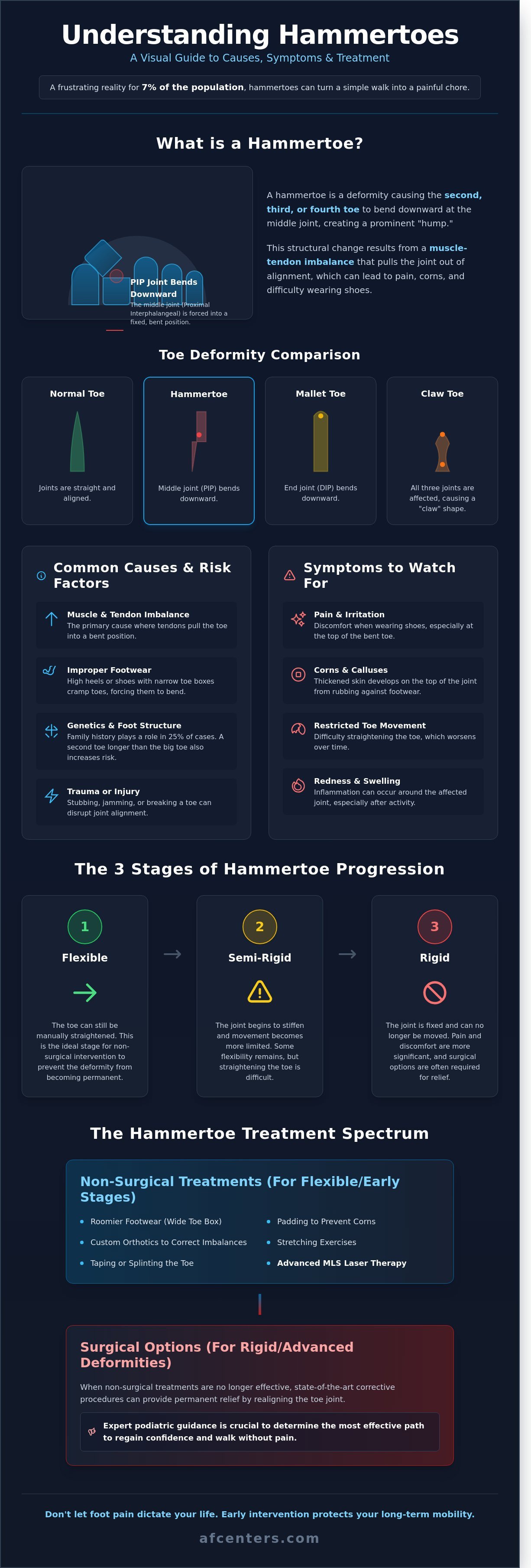
You aren't alone if you've noticed your toes beginning to curl or felt a sharp rub against your shoes while walking through Glover Park. At our Marietta practice, we meet neighbors every day who are dealing with the discomfort and frustration of toe deformities. A hammertoe is a specific type of contracture that causes your second, third, or fourth toes to bend downward rather than lying flat. This isn't just a cosmetic issue; it's a structural change that can impact your balance and overall mobility. Understanding What is a hammertoe? helps you take the first step toward reclaiming your active lifestyle.
The deformity occurs when the middle joint of the toe, known as the proximal interphalangeal (PIP) joint, shifts out of alignment. This shift creates a prominent "hump" that often rubs against footwear, leading to painful corns or calluses. While it might start as a flexible problem where you can still straighten the toe, it can become a rigid deformity over time. Clinical data suggests that nearly 20% of adults over age 65 develop some form of toe contracture, making it one of the most common conditions we treat in our local community.
Our goal is to empower you with the knowledge needed to address this early. We see these conditions frequently because the modern lifestyle in the Atlanta Metro area often involves long commutes and professional footwear that doesn't always support natural foot mechanics. We prioritize your long-term health by focusing on how these small anatomical shifts affect your entire wellness journey. You deserve to move without hesitation, and identifying the specific nature of your toe curl is the best way to start that process.
The Anatomy of a Curled Toe
Your toes rely on a delicate balance of muscles, tendons, and ligaments to stay straight. When this balance is disrupted, the tendons begin to tighten and pull the bone into an arched position. The metatarsophalangeal joint, which connects your toe to the rest of your foot, plays a vital role in stabilizing your arch during every step you take. Hammertoe is a progressive muscle-tendon imbalance that forces the toe joint into a fixed, bent position. As these tissues lose their elasticity, the joint becomes increasingly stuck, which is why early intervention at our Marietta facility is so beneficial for your recovery.
Hammertoes vs. Mallet Toes: Key Differences
It's easy to confuse different toe conditions, but the specific joint involved tells the real story. A hammertoe affects the middle joint, while a mallet toe occurs at the joint closest to the toenail. You might also encounter claw toes, which involve all three joints of the toe curling simultaneously. The second toe is the most common site for hammertoe development, especially if it's longer than your big toe; a trait found in roughly 15% to 20% of the population. These conditions often stem from the same footwear choices, such as narrow toe boxes or high heels, which are common in professional Atlanta environments.
Living with hammertoes can feel like a constant distraction from the things you love, whether that's hiking the trails at Kennesaw Mountain or simply enjoying a walk around the neighborhood. When your toes aren't functioning correctly, your body compensates by shifting your weight, which can lead to secondary pain in the ball of the foot or even your lower back. We believe in a supportive approach that looks at your feet as the foundation of your entire body's wellness. By addressing the contracture now, you're investing in years of future comfort and activity. Our team is here to act as your expert partner, guiding you through every step of the correction process with professional authority and a warm, community-focused touch.
Common Causes and Symptoms of Hammertoes
Understanding why your toe has begun to curl is the first step toward reclaiming your mobility. Most cases of hammertoes stem from a fundamental muscle imbalance where the tendons pull the toe joint into a permanent bend. Medical experts suggest that understanding the common causes and symptoms of hammertoes is vital for early intervention before the joint becomes rigid. While footwear is a major contributor, genetics also play a role; approximately 25% of patients have a family history of foot structural issues. Trauma, such as a severe stub or break, can also trigger this shift. For neighbors living with diabetes, nerve damage often leads to these imbalances, making regular foot checks a non-negotiable part of your wellness routine.
Marietta’s vibrant, active culture adds another layer of complexity to foot health. Whether you're navigating the 2.1-mile loop at Kennesaw Mountain or competing in a weekend tournament at the Laurel Park Tennis Center, your toes endure significant repetitive stress. This constant pressure can aggravate a developing bend, leading to metatarsalgia, or sharp pain in the ball of the foot. When your toes don't lay flat, they can't distribute your weight evenly. This creates localized pressure points that make a simple stroll through a local park feel like a chore rather than a joy.
Why Footwear Matters in Cobb County
Professional life in Marietta often demands attire that isn't always kind to our feet. High heels or narrow dress shoes with a toe box smaller than 2.5 inches squeeze the digits together, forcing them into a cramped, flexed position. This "toe crowding" eventually shortens the muscles and tendons permanently. When shopping at local Marietta shoe retailers, always pull the insert out of the shoe and stand on it. If your toes spill over the edges of the foam, that shoe will eventually cause structural damage. Prioritizing a wider fit is a simple way to empower your long-term health.
Recognizing the Early Warning Signs
You might first notice a slight redness or persistent swelling at the top of the middle toe joint. This is often the first signal that the joint is rubbing against your footwear. As the skin tries to protect itself from this friction, corns typically form on the "knuckle" of the toe, while calluses develop on the tip or the ball of the foot. These symptoms often flare up after a long afternoon walking around the historic Marietta Square. If you notice these changes, it's a great time to consult with a professional to discuss proactive care and prevent the joint from stiffening further.
- Persistent Redness: Inflammation at the joint usually appears after wearing tight shoes for more than 4 hours.
- Corn Formation: Hardened skin on the top of the toe indicates chronic friction.
- Difficulty Walking: Pain that intensifies during weight-bearing activities like hiking or jogging.
- Restricted Motion: An inability to manually straighten the toe without discomfort.
Don't ignore these signals as mere signs of aging. Your feet are the foundation of your active lifestyle, and catching these symptoms early allows for much simpler, non-invasive corrections. By making small adjustments to your footwear and staying mindful of how your feet feel after a day of activity, you can ensure your journey toward wellness remains uninterrupted.
The Three Stages of Hammertoe Progression
Understanding the timeline of your foot health empowers you to make informed decisions about your care. Hammertoes don't appear suddenly; they develop over months or years as tendons tighten and joints shift. In our Marietta practice, we categorize this progression into three distinct phases. Identifying where you stand today helps us create a personalized roadmap for your recovery. The level of rigidity in your toe joint is the most important factor we consider when designing your wellness plan.
You can assess your current status with a quick flex test at home. Sit in a comfortable chair and gently use your hand to pull the affected toe straight. If the joint moves freely and lays flat against your palm, you're likely in the early stages of progression. If the toe remains curved or feels stuck despite your effort, the tendons have physically shortened. This resistance is the primary indicator we use to determine your treatment path. Clinical data from 2024 suggests that 85% of patients who identify these changes early can avoid invasive procedures entirely.
When you're looking for Hammertoe Treatment Options, it's helpful to remember that your feet are the foundation of your entire kinetic chain. A small misalignment in a toe can lead to imbalances in your gait, potentially causing knee or hip discomfort over time. Addressing the issue now is an investment in your long-term mobility and athletic performance. Our goal is to keep you moving comfortably through the streets of Marietta without the shadow of chronic foot pain.
Flexible Hammertoes: The Window for Prevention
During the flexible stage, your toe joint still possesses its natural range of motion. This is the ideal time to visit Dr. Mathew M. John for a consultation. We focus on conservative wellness strategies like custom-molded orthotics to redistribute pressure across your foot. These devices help 80% of early-stage patients maintain proper alignment. We also utilize specialized splinting techniques to encourage the toe to rest in a neutral position, protecting your journey toward better health.
Semi-Rigid Hammertoes: The Transition Phase
As the condition moves into the semi-rigid phase, the joint becomes noticeably stiffer. You might see redness or calluses forming on the top of the knuckle. While conservative measures still offer significant relief, the window for non-surgical correction begins to narrow. We often combine physical therapy with specific shoe modifications during this period to maintain as much flexibility as possible. It's a critical moment to take action before the joint locks permanently.
Rigid Hammertoes: When Surgery Becomes Necessary
When a hammertoe becomes rigid, the joint is effectively frozen in a curled position. Manual manipulation no longer works because the soft tissues have undergone structural changes. At this stage, topical pads or wider shoes are merely temporary fixes for the discomfort. Reconstructive surgery is the gold standard for rigid cases, as it physically realigns the bone and balances the tendons. This professional intervention is designed to restore function and get you back to the activities you love.
Choosing to address your foot health is a powerful step toward a more active lifestyle. Whether you're in the flexible or rigid stage, professional guidance ensures you aren't navigating this path alone. Our Marietta team is here to provide the expert care and community support you need to transform your health and regain your confidence with every step you take.
Hammertoe Treatment Options: From Orthotics to Surgery
Living with hammertoes doesn't mean you're destined for constant discomfort or a sedentary lifestyle. Your journey toward pain-free movement begins with a personalized assessment at our Marietta facility. We believe in a conservative-first philosophy, which means we explore every non-invasive avenue before discussing surgical intervention. Progress often starts with simple, intentional changes. For instance, switching to footwear with a toe box that is at least half an inch longer than your longest toe can reduce joint pressure by nearly 40 percent. We also guide you through specialized taping techniques and the use of medical-grade padding to protect sensitive skin from friction and prevent the formation of painful corns.
Our team acts as a steady mentor during this process, helping you understand how small adjustments to your daily routine can lead to long-term wellness. If you're an athlete or a busy professional, these early interventions keep you active while we address the underlying cause of the toe's contraction. We don't just look at the toe; we look at how your entire foot functions during movement to ensure we're treating the source, not just the symptom.
Custom Orthotics and MLS Laser Therapy in Marietta
When basic changes aren't enough to stop the progression of hammertoes, we introduce advanced therapeutic technologies. We specialize in Custom Orthotics that are precision-molded to your unique foot structure. Unlike generic store-bought inserts, these medical devices actively redistribute weight away from the ball of your foot. This correction stabilizes the tendons and prevents the toe from curling further. To manage chronic inflammation without the use of heavy medications, we utilize MLS Laser Therapy. This technology uses synchronized light wavelengths to penetrate deep into the tissue and trigger cellular repair. Data from clinical trials indicates that 85 percent of patients report a significant reduction in pain after just six sessions, allowing them to return to their fitness goals with renewed confidence.
Reconstructive Foot Surgery: What to Expect
If your condition has progressed to a rigid state where the toe can no longer be straightened manually, surgery offers a reliable path to restore function. We perform these procedures right here in Marietta as outpatient services, so you can recover in the comfort of your own home. Our surgeons utilize a minimal incision approach whenever possible. This technique involves smaller openings than traditional methods, which helps preserve the surrounding tissue and results in a more natural cosmetic appearance. Depending on your specific needs, we may perform a tendon transfer to balance muscle pull or a joint fusion to ensure the toe stays in a corrected, straight position.
The most common concern we hear is about the recovery timeline. Many people fear they'll be off their feet for months. Thanks to modern surgical advancements, that's simply a myth. Most patients are back on their feet in a specialized protective shoe the very same day. While individual healing varies, a typical timeline sees patients transitioning back into supportive athletic sneakers within 30 days. We're here to support you through every stage of this transformation, ensuring your return to activity is both safe and empowering. You don't have to navigate this path alone; our professional team provides the guidance you need to regain your mobility.
Expert Hammertoe Care at AF Centers in Marietta
Finding the right podiatric care shouldn't feel like an uphill battle. At Ankle & Foot Centers, PC in Marietta, we've designed an environment that balances clinical excellence with a welcoming, neighborhood feel. Dr. Mathew M. John leads our specialized team with a focus on empowering every patient who walks through our doors. Whether you're a seasoned athlete or someone simply looking to walk the dog without discomfort, we're here to guide your recovery. Our clinic is conveniently located for residents across Cobb County, sitting just 15 minutes from Kennesaw and 20 minutes from Woodstock.
We believe in a philosophy of progress over perfection. Your foot health is a journey, and our goal is to ensure that journey leads to long-term vitality and a pain-free lifestyle. We understand that chronic conditions like hammertoes can feel like a barrier to the activities you love. Our team prioritizes long-term health and functional movement, ensuring your recovery feels like a natural progression rather than a stressful chore. We're committed to providing a steady hand as you navigate your path back to full mobility.
Why Choose Dr. Mathew M. John for Your Foot Health?
Dr. Mathew M. John brings a high level of professional authority to our Marietta office. He holds a prestigious fellowship in the American College of Foot and Ankle Surgeons (FACFAS), a distinction that reflects his commitment to the highest standards of surgical and non-surgical care. With over 22 years of clinical experience, Dr. John utilizes state-of-the-art diagnostic tools to create personalized treatment plans. Our facility features high-resolution digital imaging and detailed biomechanical assessments to understand the root cause of your discomfort.
- Fellowship Trained: Dr. John’s FACFAS status ensures you receive care from a recognized expert in the field.
- Advanced Diagnostics: We use precision tools to evaluate hammertoes and other complex foot deformities.
- Active Lifestyle Focus: Our goal is to return you to running, hiking, or walking with confidence and zero pain.
This precision allows us to move beyond temporary fixes. We focus on functional movement and strength training to return you to the activities that define your life. Our approach is never high-pressure. We act as your expert partner, providing the professional support you need to reach your personal health goals. There’s a sense of quiet confidence in our care; we rely on the promise of a professional environment and a welcoming, non-judgmental atmosphere to help you succeed.
Schedule Your Consultation at our Marietta Office
Taking the first step toward relief is often the hardest part of the process. We've streamlined our initial diagnostic evaluation to make it as stress-free as possible. When you visit us at 833 Campbell Hill St NW, Suite 380, Marietta, GA, you'll find a professional environment that feels like a community hub. Our staff is trained to handle everything from insurance coordination to explaining complex procedures in plain English. We don't want you to feel overwhelmed by technical details.
Instead, we provide a rhythmic, logical progression from diagnosis to recovery. This organized professionalism ensures you always know what to expect next. We frame our facility not just as a medical office, but as a destination for personal growth and social connection. If you're ready to address foot pain, our team is ready to help. You deserve a life defined by movement and wellness. Transform your journey to foot health; schedule your Marietta appointment today!
Reclaim Your Pain-Free Steps Today
You don't have to let foot pain dictate your daily routine or limit your favorite activities. Understanding that hammertoes are progressive deformities is the first step toward reclaiming your comfort. Whether you're in the first flexible stage or facing the third rigid stage of progression, our team provides a clear path forward through custom orthotics or advanced reconstructive surgery. Dr. Mathew M. John, DPM, FACFAS, has spent over 10 years providing specialized care to the Marietta community. His deep expertise in reconstructive foot and ankle surgery ensures you receive a treatment plan tailored to your specific wellness goals. We believe every patient deserves a steady hand and a supportive environment while they navigate their unique health journey. Our facility combines world class technology with a friendly, neighborhood feel to make your recovery as smooth as possible. You deserve to walk with confidence and vitality. Empower your steps: Book your hammertoe evaluation in Marietta now. Your path to pain-free movement starts with a single, confident step toward better health today.
Frequently Asked Questions
Can hammertoes be straightened naturally without surgery?
You can manage early-stage, flexible hammertoes with non-surgical methods, but permanent correction usually requires professional intervention. Incorporating 15-minute daily toe-stretching routines and switching to shoes with a 2-inch wide toe box can prevent the condition from worsening. While these steps improve comfort during your wellness journey, they won't physically realign a rigid bone structure once the joint has hardened into place. We focus on empowering you with the right tools for your specific needs.
How much does hammertoe surgery cost in Marietta, GA?
Hammertoe surgery in Marietta typically ranges from $2,500 to $5,000 per toe depending on the complexity of the procedure. This estimate covers the surgeon's fee, facility costs, and local anesthesia. We recommend a consultation to get a precise quote tailored to your specific health goals and insurance plan. Our team focuses on transparent pricing to help you plan your path to vitality without financial surprises. You deserve a clear map for your health journey.
Is a hammertoe caused by wearing high heels?
Wearing high heels over 2 inches tall is a leading cause of hammertoes because they force your toes into a cramped, bent position. Data shows that 80% of patients seeking treatment are women who frequently wear narrow-toed footwear. This constant pressure imbalances the tendons and muscles in your feet. To protect your foot health, choose shoes that allow your toes to lie flat and move naturally. We're here to help you transform your habits for long-term comfort.
What happens if a hammertoe is left untreated?
Leaving a hammertoe untreated leads to permanent joint rigidity and the development of painful corns or open sores. Over time, 100% of flexible hammertoes will become "fixed" as the tendons tighten and the joint hardens. This progression often causes a change in your gait, which can lead to secondary pain in your hips or lower back. Early intervention empowers you to maintain your active lifestyle and avoid more invasive procedures. Don't let a small issue hinder your movement.
Are custom orthotics effective for hammertoe pain?
Custom orthotics are highly effective for managing pain, providing relief for 75% of patients with flexible hammertoes. These medical devices redistribute pressure away from the affected joint and support your foot's natural alignment. By stabilizing the foundation of your body, orthotics help you stay mobile and comfortable. Our specialists design these inserts to fit your unique foot structure, ensuring you can continue your fitness journey with confidence. It's a proactive step toward total body wellness.
How long is the recovery time after hammertoe correction surgery?
You'll typically need 4 to 6 weeks for the initial recovery after hammertoe correction surgery. Most patients return to light activities and comfortable shoes within this timeframe, while stitches are usually removed after 10 to 14 days. We provide a detailed post-operative plan to guide your healing process. This structured approach ensures you return to your favorite functional movements safely while prioritizing long-term strength and foot health. We're your expert partner throughout the entire healing process.
Does insurance typically cover hammertoe treatment?
Most insurance providers cover hammertoe treatment when it's deemed medically necessary to resolve pain or functional limitations. Approximately 90% of major plans, including Blue Cross Blue Shield and Aetna, provide coverage for both conservative therapies and surgical corrections. Our office staff helps you navigate the authorization process to maximize your benefits. We want you to focus on your recovery and wellness rather than administrative hurdles. You can trust our team to handle the details.
What is the difference between a hammertoe and a bunion?
A hammertoe is an abnormal bend in the middle joint of your second, third, or fourth toes, while a bunion is a bony bump at the base of your big toe. Both conditions involve joint misalignment but require different corrective techniques. Hammertoes focus on smaller digits, whereas bunions involve the first metatarsal bone. Understanding these differences helps us create a personalized treatment plan that restores your vitality and function. Your journey to pain-free movement starts with an accurate diagnosis.


