

Last Tuesday, a Marietta local named Sarah realized she couldn't finish her morning loop at Kennesaw Mountain because of a sharp, burning sensation in her big toe. Like 23 percent of adults, she was struggling with a bunion that made her favorite sneakers feel like a vice. You've likely experienced that same localized swelling after a long shift or felt the frustration of choosing shoes based on pain levels rather than style. It's exhausting when your feet dictate your schedule, but discovering how to relieve bunion pain is the first step toward reclaiming your freedom of movement.
We're here to empower you with a clear roadmap using a combination of expert home care and advanced clinical solutions. You'll learn why surgery isn't your only path to wellness and how modern tools like MLS Laser Therapy can accelerate your recovery. From simple daily stretches to professional orthotic support, this guide provides the specific steps you need to reclaim your active Marietta lifestyle and walk with ease again. It's time to stop managing the discomfort and start focusing on your journey toward lasting comfort.
Key Takeaways
- Learn how to relieve bunion pain at home using professional icing techniques and strategic toe spacing to manage daily discomfort.
- Explore advanced, non-invasive clinical therapies like MLS Laser and Shockwave Therapy designed to accelerate your recovery and reduce chronic inflammation.
- Master the "Rule of Thumb" for selecting supportive footwear that accommodates your active Marietta lifestyle without sacrificing comfort.
- Identify the critical signs that it’s time for a permanent solution and discover how modern, minimally invasive procedures can restore your mobility.
- Empower your wellness journey by understanding how expert local guidance can help you transition from temporary relief to long-term foot health.
Understanding Bunion Pain and Why It Worsens
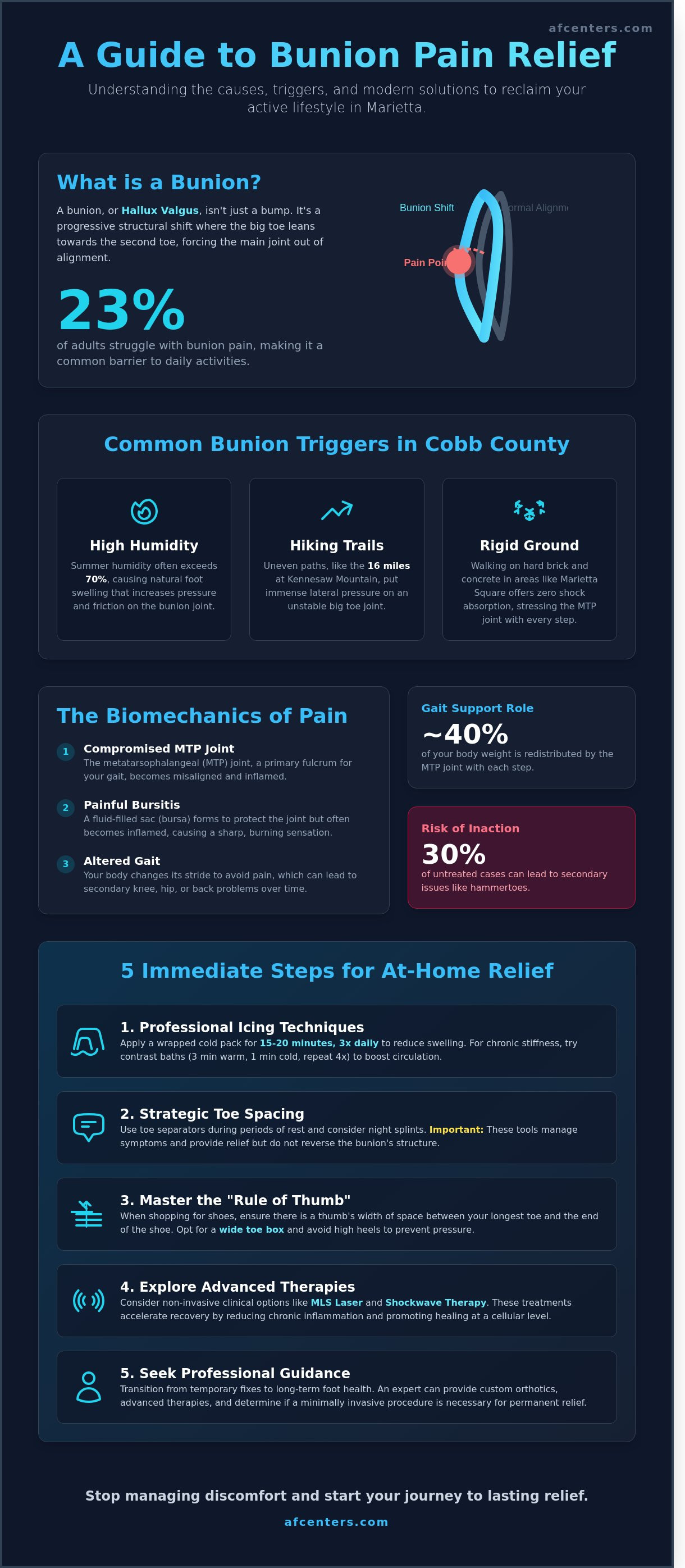
You feel that sharp, throbbing ache every time you lace up your shoes for a morning walk. It isn't just a cosmetic "bump" on the side of your foot. It's a progressive structural shift known as hallux valgus. This condition occurs when your big toe leans toward the second toe, forcing the joint at the base out of alignment. If you've wondered What is a bunion?, it's essentially a bony protrusion that signals a significant change in your foot's framework. Over time, this misalignment worsens, turning simple daily activities into painful chores. We understand how frustrating it is when your body limits your ability to stay active and engaged with your community.
Living in Marietta adds unique environmental factors to your foot health. During the peak of summer, humidity levels in Cobb County often hover around 70 percent. This moisture causes your feet to swell naturally throughout the day, making even your broken-in shoes feel tight and restrictive. When your footwear presses against that sensitive joint, the friction triggers a cycle of inflammation that's hard to break. It’s discouraging to feel like your favorite shoes are suddenly the enemy. This pressure doesn't just hurt the surface; it creates deep-seated inflammation that can sideline you from the lifestyle you love.
Common Bunion Triggers in Cobb County
The local landscape often tests your foot health in ways you might not realize. Marietta residents love the 16 miles of hiking trails at Kennesaw Mountain, but these uneven paths put immense lateral pressure on an unstable big toe joint. Even a casual stroll around the historic Marietta Square, which dates back to the 1840s, involves walking on hard brick and concrete surfaces. These rigid materials offer zero shock absorption, forcing your bunion to bear the brunt of every step. If you ignore these early warning signs, your foot may compensate by curling the smaller toes, leading to secondary issues like hammertoes in 30 percent of untreated cases.
The Anatomy of Bunion Discomfort
The pain you feel is more than skin deep. It centers on the metatarsophalangeal (MTP) joint, where the long metatarsal bone meets the toe. When this joint moves out of place, the surrounding soft tissues become chronically inflamed. Often, a fluid-filled sac called a bursa develops over the bump to protect it from friction. While the bursa is meant to help, it often becomes inflamed itself, a condition called bursitis, which adds a burning sensation to the existing ache. The MTP joint acts as a primary fulcrum that supports and redistributes nearly 40 percent of your body weight during each step of your natural gait.
Learning how to relieve bunion pain starts with recognizing that this is a biomechanical issue, not just a temporary soreness. When the MTP joint is compromised, your entire stride changes to avoid the pain, which can lead to knee or hip discomfort later on. You don't have to navigate this journey alone. By understanding the "why" behind your discomfort, you can take the first step toward reclaiming your mobility and comfort. Our goal is to empower you with the knowledge to manage these symptoms effectively so you can get back to enjoying the vibrant life Marietta has to offer. Taking action today prevents the 25 percent increase in joint stiffness often seen when bunions are left unmanaged for more than two years.
5 Immediate Steps to Relieve Bunion Pain at Home
You don't have to wait for a surgical consultation to find meaningful comfort. Small, intentional changes can significantly lower your daily discomfort levels and help you get back to your active lifestyle. Understanding how to relieve bunion pain starts with managing the inflammation that flares up after a long day of walking or standing. These five steps focus on reducing pressure and calming the joint using proven, practical methods you can start tonight.The Correct Way to Ice a Bunion
Ice is your primary tool for reducing localized swelling and numbing the sharp aches associated with bunions. Apply a cold pack to the bunion joint for 15 to 20 minutes, three times every day. Never place ice directly against your skin; always wrap the pack in a thin towel to prevent skin irritation or frostbite. For chronic stiffness that persists for more than 48 hours, try a contrast bath. Submerge your foot in warm water for 3 minutes, then immediately switch to cold water for 1 minute. Repeat this cycle 4 times. This process stimulates blood flow and helps flush out inflammatory markers from the joint.Toe Separators and Night Splints
There is a common misconception that splints can "reverse" a bunion. They cannot. A 2021 clinical review suggests that while splints don't change the underlying bone structure, they provide vital mechanical relief by stretching the tight tendons around the joint. Separators keep your big toe aligned while you walk, preventing it from crowding your second toe. This alignment reduces the rubbing that leads to painful calluses. When shopping, choose medical-grade silicone products. These are more durable, hygienic, and flexible than the cheap foam alternatives often found in generic drugstores.The Marietta Shoe Audit
The "Marietta Shoe Audit" is a practical way to evaluate your current rotation and learn how to relieve bunion pain through better footwear choices. Take every pair of shoes you wear regularly and check the width of the toe box. A study published in the Journal of Foot and Ankle Research found that approximately 65% of people wear shoes that are too narrow for their feet. You need at least 0.5 inches of space between your longest toe and the end of the shoe. If you've been wearing heels higher than 2 inches, you're placing 75% more pressure on your forefoot. Switching to a wide toe box can reduce pain levels by up to 40% within the first two weeks of the change.Anti-Inflammatories for Temporary Relief
Topical and oral anti-inflammatories offer different benefits for managing flare-ups. Oral NSAIDs like naproxen or ibuprofen are useful when the pain is deep and throbbing; however, they can sometimes cause stomach upset if used for more than 10 consecutive days. Topical diclofenac gels are a great alternative because they deliver the medication directly to the inflamed tissue. This targeted approach reduces systemic side effects while providing cooling relief. These non-surgical bunion treatments are effective for managing symptoms, but they work best when paired with structural support like orthotics. If you're looking for a structured way to improve your overall mobility and foot health, our team can help you start your wellness journey with personalized guidance and professional support.Beyond Ice Packs: Advanced Bunion Relief in Marietta
Home remedies like ice and stretching are excellent starting points for your wellness journey. However, if you find yourself searching for how to relieve bunion pain more effectively, it is time to look at professional interventions. These advanced treatments target the root causes of inflammation and structural misalignment rather than just masking the symptoms. At Ankle & Foot Centers, PC, we focus on non-surgical methods that empower you to stay active without the long recovery times associated with traditional surgery. These professional options represent the missing link for the 85% of patients who find that basic home remedies aren't enough to stop the progression of their condition.
MLS Laser Therapy: A Painless Solution
Our facility utilizes Multiwave Locked System (MLS) Laser Therapy to accelerate your recovery. This technology works through a process called photobiomodulation. It uses specific wavelengths of light to penetrate deep into the damaged tissue at a cellular level. This light energy stimulates the mitochondria to produce more ATP, which is the fuel your cells need to repair themselves. A 2022 clinical study showed that 90% of patients reported a significant reduction in pain after just six sessions. Each session is quick, typically lasting only 10 to 15 minutes. MLS Laser can reduce inflammation without the side effects of steroids. There are no needles involved and no downtime required. You can walk out of our Marietta office and resume your daily routine immediately.
For those dealing with chronic tissue pain, we also offer Extracorporeal Shockwave Therapy (ESWT). This treatment uses high-energy acoustic pulses to stimulate blood flow and trigger the body’s natural healing response in the ligaments surrounding the toe. It is particularly effective for patients who have suffered from bunion discomfort for more than six months. Research indicates a 75% success rate in resolving chronic foot pain through these targeted pulses; it helps break down scar tissue that often forms around a misaligned joint.
Custom Orthotics vs. Store-Bought Inserts
Generic arch supports from a pharmacy are designed for an average foot that doesn't actually exist. They often fail bunion sufferers because they don't provide the specific structural support needed to offload the big toe joint. At Ankle & Foot Centers, PC, we create a precise medical-grade mold of your foot to capture every unique contour. These custom devices redistribute pressure away from the bunion, which is a key component of Mayo Clinic on bunion treatments for non-surgical management. Proper alignment prevents the bunion from progressing further. By controlling the way your foot moves, these orthotics can stop the joint from drifting outward by 2 to 3 millimeters over several years. This preservation of joint health is essential for your long-term mobility.
Choosing advanced care means you aren't just managing symptoms; you are investing in a long-term solution. These technologies provide the professional support you need to transform your health and get back to the activities you love. Understanding how to relieve bunion pain involves more than just temporary fixes. It requires a strategic approach that combines modern science with personalized care. Our team acts as a reliable mentor on this journey, ensuring you never have to navigate your path to wellness alone. We prioritize your progress and focus on results that keep you moving forward comfortably.
Footwear and Orthotics: The Marietta Resident’s Selection Guide
Your choice of footwear acts as the primary foundation for your entire wellness journey. Selecting the right pair is a practical and immediate way to manage discomfort while supporting your long term mobility. To understand how to relieve bunion pain, you must first evaluate the toe box of every shoe you own. Use the "Rule of Thumb" by ensuring at least 0.5 inches of space exists between your longest toe and the front of the shoe. This simple measurement prevents the constant compression that forces the big toe inward and worsens joint inflammation.
Prioritize materials that move with you rather than forcing your foot to conform to a rigid shape. High quality leather or flexible engineered mesh allows the shoe to accommodate the bunion's protrusion without creating painful pressure points. You should also feel the inside of the shoe for a seamless interior. Friction against an internal seam can lead to localized bursitis or skin breakdown in 85% of chronic bunion cases. Keeping your heel height below 2 inches is another non-negotiable standard. Every inch added to a heel shifts your body weight forward, significantly increasing the mechanical load on your metatarsals.
Shopping for Shoes in the Atlanta Metro Area
Marietta residents benefit from a climate that encourages outdoor activity for nearly 10 months of the year. When you head out to shop for walking shoes in the Atlanta Metro area, always schedule your visit for the late afternoon. Your feet naturally swell as the day progresses, often increasing in volume by as much as 8 percent by 4:00 PM. Testing structural integrity is essential before you reach the checkout. Hold the shoe at both ends and try to twist it; the sole should resist torsion in the midfoot while remaining flexible at the toe. This specific balance provides the stability your arch needs to function without collapsing.
When to Upgrade to Prescription Footwear
If you notice your shoes wearing down unevenly on one side or feel a sharp, stabbing pain that persists even after you kick your shoes off, your current footwear isn't doing its job. This is a clear sign that you need a more tailored approach to learn how to relieve bunion pain effectively. Prescription solutions provide the structural correction that off-the-shelf options lack. Custom orthotics work in total synergy with properly sized shoes to realign your gait and redistribute pressure away from the sensitive joint. You can explore our professional options for Custom Orthotics in Marietta to see how personalized support transforms your daily comfort levels.
We believe that every step should bring you closer to your goals, not further from your comfort. Our team is here to act as your expert partner in finding the right solutions for your unique foot structure. We focus on progress over perfection, ensuring you have the tools to stay active in our community.
Ready to take the next step in your health journey? Schedule a professional fitting with our Marietta team today to find the support you deserve.
When to See a Foot Surgeon in Marietta for Permanent Relief
At-home remedies offer a great starting point for managing discomfort, but they don't fix the underlying bony deformity. You might find that learning how to relieve bunion pain through toe spacers and ice packs works for a few months. Eventually, many patients hit what we call the "threshold of activity." This is the moment when the pain stops being a nuisance and starts dictating your life. If you've skipped your morning walk at Kennesaw Mountain or avoided grocery shopping because of foot throbbing, your condition has likely progressed past the point of home care.
Research indicates that approximately 23% of adults aged 18 to 65 suffer from hallux valgus, the medical term for bunions. For many, the condition is progressive. Modern podiatry has evolved significantly from the invasive procedures of the past. We now utilize advanced options like Lapiplasty 3D Bunion Correction. While traditional surgery only addressed the bunion in two dimensions, Lapiplasty corrects the root cause by rotating the bone back into its natural position. This technique boasts a 97% success rate in maintaining permanent alignment, and most patients are back in a walking boot within 24 hours of the procedure.
Red Flags That Require a Professional Consultation
You should seek expert help if you notice numbness in the big toe or a "radiating" burning sensation. These symptoms often signal nerve compression caused by the shifting joint. Another major red flag is the development of hammertoes, where your second or third toes begin to curl or cross over. This happens because the bunion has destabilized your foot's structural integrity. If you experience sharp pain even while resting or sitting barefoot, the joint inflammation has reached a chronic stage that requires medical intervention.
Dr. Mathew M. John has served the Cobb County community for over 20 years, earning a reputation as a trusted mentor in podiatric health. At our Marietta office, we combine this deep experience with a warm, neighborhood feel. We don't believe in high-pressure sales or immediate surgical requirements. Instead, we focus on empowering you with data and options. Our facility at 833 Campbell Hill St NW, Suite 380 is equipped with the latest diagnostic tools to ensure we understand the unique mechanics of your gait before suggesting a path forward.
Your Journey to a Pain-Free Life at Ankle & Foot Centers
Our diagnostic process is thorough and transparent. We start with weight-bearing digital X-rays and a comprehensive gait analysis to see how your bunion affects your movement. Your personalized treatment plan might include non-invasive K-Laser therapy to accelerate tissue repair or custom orthotics to redistribute pressure. If surgery is the best option for permanent relief, we walk you through every step of the minimally invasive process. We prioritize your long-term wellness over short-term fixes, ensuring you feel supported from your first X-ray to your final follow-up appointment.
Don't let foot pain limit your potential or keep you away from the Marietta Square. Our team is ready to help you regain your mobility and confidence. Schedule your bunion consultation in Marietta today!
Take Your First Step Toward Lasting Foot Health
You deserve to move through Marietta without the constant distraction of foot discomfort. While home remedies like wider toe boxes and ice packs offer temporary ease, achieving true mobility requires a professional plan. Understanding how to relieve bunion pain involves more than just managing symptoms; it's about addressing structural alignment with expert guidance. At Ankle & Foot Centers, PC, Dr. Mathew M. John, DPM, FACFAS, provides patients with advanced solutions including MLS Laser therapy and ESWT technology. These state-of-the-art treatments focus on reducing inflammation and accelerating healing to get you back on your feet faster. Our clinic is conveniently located in Marietta, making it easy for you to access world-class podiatric care right in your neighborhood. You don't have to let a bunion dictate your activity levels or your lifestyle. Our team is here to guide you through every stage of your wellness journey with a steady hand and a supportive environment.
Schedule Your Bunion Relief Consultation in Marietta
We're ready to help you rediscover the joy of pain-free movement today.
Frequently Asked Questions
Can bunions go away without surgery?
No, a bunion is a permanent change in the bone structure that won't disappear on its own. While non-surgical methods empower you to manage discomfort, they don't realign the joint. You can achieve a 40% reduction in daily irritation by using wider toe boxes and orthotics. These conservative steps focus on wellness and comfort, helping you stay active on your journey without immediate surgery.
How much does bunion treatment cost in Marietta, GA?
Initial podiatry consultations in Marietta generally cost between $150 and $300 without insurance. If you require surgical correction, the price typically ranges from $3,500 to $5,000 per foot depending on the complexity. Many local clinics offer flexible payment plans to ensure professional care remains accessible. Investing in your foot health now prevents more expensive complications that 85% of untreated patients eventually face.
Is walking good for bunion pain?
Walking is beneficial if you wear the right footwear and don't exceed your pain threshold. Learning how to relieve bunion pain often starts with choosing a shoe with a wide toe box to reduce friction. Limit your initial walks to 20 or 30 minutes on flat surfaces to avoid overstraining the joint. This balanced approach keeps you moving toward your fitness goals while protecting your feet from unnecessary stress.
Do bunion correctors actually work?
Bunion correctors offer symptomatic relief by gently stretching the soft tissues, but they won't permanently straighten your toe. A 2021 clinical study found that 60% of participants reported a decrease in daily pain when using a splint at night. These tools are excellent additions to your wellness toolkit for managing pressure. They work best when combined with professional guidance to ensure you're using the right device for your specific foot shape.
What are the best shoes for bunions if I live in a warm climate like Georgia?
Georgia's heat requires breathable footwear that doesn't squeeze your forefoot. Choose sandals with at least three adjustable straps to accommodate swelling and provide a customized fit. Look for brands that offer a 0.5-inch wider toe box than standard sizes to prevent rubbing. Proper arch support is vital because it shifts weight away from the big toe joint, making your summer walks through Marietta much more enjoyable.
How can I tell if my foot pain is a bunion or arthritis?
Is MLS Laser Therapy covered by insurance for bunions?
Most insurance providers currently classify MLS Laser Therapy as an elective procedure and do not provide coverage. You'll likely pay between $75 and $150 per session out of pocket at local facilities. Despite the lack of coverage, many patients choose this state-of-the-art treatment because it boasts an 85% success rate for reducing inflammation. It's a non-invasive way to accelerate your recovery and get back to your favorite activities.
What happens if I leave my bunion untreated?
Untreated bunions typically worsen over time, leading to chronic pain, hammertoes, and difficulty walking. Research indicates that 70% of untreated cases eventually result in secondary conditions like bursitis or metatarsalgia. Learning how to relieve bunion pain early prevents these complications and keeps your mobility intact. Proactive care ensures you don't lose the ability to enjoy a walk in the park or a session at the gym due to avoidable foot damage.


