

You take one step and a sharp, stabbing pain shoots from your big toe through your entire foot, making even your softest sneakers feel like torture. It's incredibly frustrating when a small nail issue dictates your mobility and comfort throughout the day. You've likely tried soaking your foot or even considered a risky "bathroom surgery" out of desperation, only to have the redness and throbbing return a few weeks later. You aren't alone in this cycle of recurring infections, but you don't have to navigate the pain without professional help.
Finding effective ingrown toenail treatment Marietta residents can rely on means moving beyond temporary home fixes toward professional, lasting relief. In this guide, you'll discover how Dr. Mathew John, a Board Certified Foot Surgeon by the American College of Foot and Ankle Surgery, provides expert care at our office located at 2790 Sandy Plains Road on the corner of Post Oak Tritt and Sandy Plains. We'll preview modern solutions ranging from gentle conservative care to permanent surgical options that ensure the problem never returns. You'll also learn how we use 3-D impressions and advanced tools like MLS Laser Therapy to manage inflammation and support your recovery. It's time to stop worrying about your next step and start your journey toward permanent foot health.
Key Takeaways
- Learn why home remedies often fail to reach the root of the problem and why "bathroom surgery" can lead to dangerous recurring infections.
- Discover how professional ingrown toenail treatment Marietta provides immediate pressure relief through specialized procedures like Partial Nail Avulsion.
- Understand the biomechanical causes of nail pain and how 3-D impressions for custom orthotics can provide a long-term preventative solution.
- Explore permanent surgical options performed by Dr. Mathew John, a Board Certified Foot Surgeon by the American College of Foot and Ankle Surgery.
- Find out how advanced technologies like MLS Laser Therapy can reduce post-procedure inflammation to accelerate your return to daily activities.
Understanding Ingrown Toenails: Symptoms and Stages
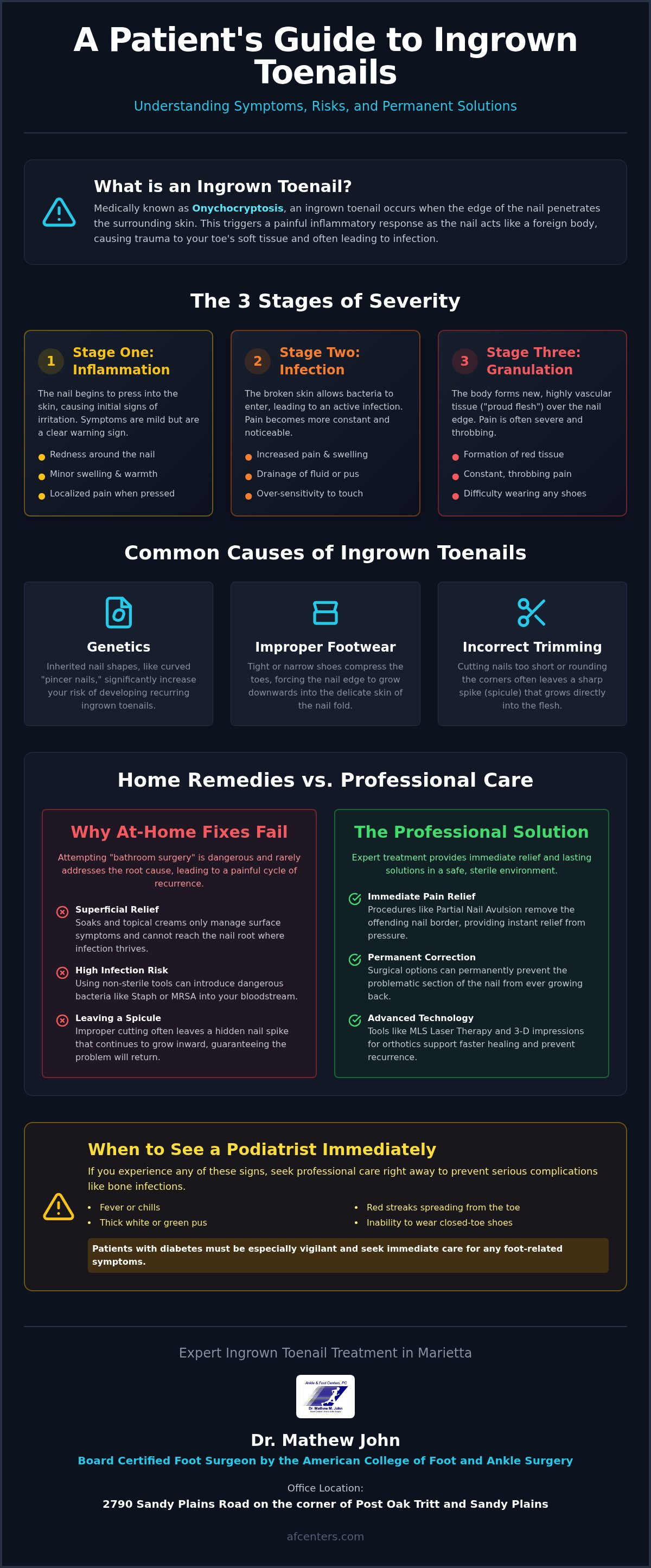
Onychocryptosis, the medical term for an ingrown toenail, is more than a minor annoyance. It happens when the nail edge penetrates the periungual skin, triggering a painful inflammatory response. Understanding Ingrown Toenails helps you recognize when a sore toe is becoming a medical issue. At Ankle & Foot Centers, PC, we provide the specialized ingrown toenail treatment Marietta residents need to regain their comfort. This condition isn't just about a nail being too long; it's about the shape and direction of growth causing internal trauma to your toe's soft tissue.
The condition typically progresses through three distinct stages of severity. Stage one involves redness, slight swelling, and localized warmth as the nail begins its descent into the skin. In stage two, the toe becomes increasingly painful and may start to drain fluid or pus, signaling that bacteria have entered the wound. By stage three, the body produces "proud flesh," which is red granulation tissue that grows over the nail border. This stage often involves a constant, throbbing pain that makes wearing even your most comfortable shoes nearly impossible.
Common Signs of an Infected Toenail
Distinguishing between normal inflammatory fluid and a true infection is critical. Clear or thin yellow fluid often signals simple irritation. However, thick white or green pus indicates a bacterial infection. Watch for red streaks extending from the toe, known as lymphangitis, which means the infection is spreading. Patients with diabetes must be especially vigilant. Because diabetes impacts circulation and sensation, these symptoms require immediate expert attention to prevent serious complications like bone infections.
Why Do Ingrown Toenails Happen?
Genetics often dictate your risk. Some people inherit "pincer nails" that naturally curve into the skin. Your lifestyle also matters. Tight footwear common in active Marietta routines can compress the toes, forcing the nail into the flesh. Many patients inadvertently cause problems through "bathroom surgery." Attempting to cut out a nail corner often leaves a sharp spike behind. Dr. Mathew John, a Board Certified Foot Surgeon by the American College of Foot and Ankle Surgery, frequently treats these injuries at our office at 2790 Sandy Plains Road on the corner of Post Oak Tritt and Sandy Plains. Professional ingrown toenail treatment Marietta is the only way to safely break the cycle of pain.
Why Home Remedies Often Fail for Stubborn Nails
It's common to reach for a bowl of warm water and Epsom salts when your toe starts to throb. While these soaks can temporarily soften the skin and reduce surface bacteria, they don't address the underlying issue of the nail edge piercing your flesh. Cotton wicking, a method where you tuck a small piece of cotton under the nail edge, often does more harm than good by providing a damp breeding ground for bacteria. Seeking Professional Treatment for Ingrown Toenails is the safest way to address the root cause rather than just masking the symptoms. Topical antibiotics also have their limits; they simply cannot reach the deep nail root where the infection often hides. If you continue to cut the nail back yourself, you may experience a "rebound effect" where the nail grows back even deeper into the sensitive nail fold.
The Dangers of "Bathroom Surgery"
Attempting to perform surgery on yourself with non-sterile bathroom tools carries significant risks. You could introduce dangerous bacteria like Staph or MRSA into your bloodstream. When you cut the nail at an angle without professional guidance, you often leave behind a tiny, sharp shard called a spicule. This hidden spike continues to grow forward, puncturing the skin from the inside out. A professional sterile environment, like our facility at 2790 Sandy Plains Road on the corner of Post Oak Tritt and Sandy Plains, is non-negotiable for maintaining your long-term foot health and preventing systemic infections.
When to See a Marietta Podiatrist Immediately
Certain symptoms require urgent ingrown toenail treatment Marietta can provide. If you develop a fever, experience chills, or find it impossible to wear closed-toe shoes, it's time to call an expert. Professional diagnosis is also vital because some "ingrowns" are actually periungual warts or even rare subungual tumors. If our team determines your pain is caused by a stubborn wart, we may recommend Swift Treatment. This advanced microwave ablation technology typically involves four sessions spaced one month apart and offers the incredible benefit of no downtime. Dr. Mathew John, a Board Certified Foot Surgeon by the American College of Foot and Ankle Surgery, can help you determine the exact cause of your pain. Don't wait for a minor ache to become a major complication; schedule a visit to ensure your feet get the specialized care they deserve.
Professional Treatment: From Conservative Care to Permanent Removal
When home care isn't enough, professional intervention becomes necessary to stop the cycle of pain. For minor, non-infected cases, we may perform a "Slant Back" procedure. This involves carefully trimming the offending nail corner to relieve pressure without full removal. However, if the area is infected or the problem keeps returning, a Partial Nail Avulsion (PNA) is often the best path for immediate relief. You can learn more about standard ingrown toenail diagnosis and treatment to understand why these clinical steps are so effective. At our office, Dr. Mathew John, a Board Certified Foot Surgeon by the American College of Foot and Ankle Surgery, ensures every procedure is performed with precision and care.
The Permanent Solution: Chemical Matrixectomy
For many patients in Marietta, the goal is a permanent fix that prevents the nail from ever digging in again. A chemical matrixectomy is the gold standard for stopping recurrence. First, we numb your toe completely using a local anesthetic. You won't feel a thing during the process. Once you're comfortable, the surgeon removes the narrow strip of nail that is causing the irritation. We then apply a chemical agent like phenol or TCA to the nail root. This targets only the specific portion of the matrix responsible for the ingrown edge, preventing it from regrowing. This procedure has a much higher success rate than simple clipping and is a core part of the ingrown toenail treatment Marietta residents trust for long-term health.
Post-Procedure Recovery and Pain Management
Recovery is typically quick and manageable, allowing you to get back to your life with minimal disruption. During the first 24 to 48 hours, you'll keep the toe bandaged and follow simple soaking instructions. We often integrate MLS Laser Therapy into the recovery plan. This advanced technology uses light energy to reduce post-op swelling and speed up tissue repair. Since MLS Laser Therapy is specifically designed to manage musculoskeletal pain and inflammation, it's an excellent tool for getting you back on your feet faster. Most patients return to their normal Marietta routines, including sports and exercise, within just a few days. Our clinic at 2790 Sandy Plains Road on the corner of Post Oak Tritt and Sandy Plains is dedicated to making your recovery as smooth as possible.
If you're tired of dealing with recurring toe pain, it's time to explore a more reliable path. Professional guidance ensures you aren't just treating the symptoms but solving the problem for good. Reach out to see how our comprehensive podiatric services can help you walk comfortably again.
Preventing Recurrence: Biomechanics and Proper Care
Trimming your nails straight across is the first step toward lasting comfort, but it's often only half the battle. You should always use a straight-edge clipper rather than curved ones, as rounding the corners encourages the nail to grow into the surrounding skin. However, even the most meticulous grooming won't help if your foot structure is working against you. Many patients seeking ingrown toenail treatment Marietta residents trust find that their pain is actually driven by overpronation. When your foot rolls inward excessively during each step, it forces the soft tissue of your big toe against the hard nail edge. This constant mechanical pressure makes recurrence almost inevitable without correcting your gait.
Dr. Mathew John, a Board Certified Foot Surgeon by the American College of Foot and Ankle Surgery, looks beyond the immediate infection to analyze your foot's movement. By addressing the root biomechanical cause, we can often prevent the need for repeated procedures. Our office, conveniently located at 2790 Sandy Plains Road on the corner of Post Oak Tritt and Sandy Plains, focuses on holistic foot health that keeps you active and pain free.
The Role of 3-D Impressions in Prevention
Custom orthotics are a powerful tool for redistributing weight away from sensitive nail folds. We use 3-D impressions to create a highly accurate model of your feet, which is significantly more precise than old-fashioned foam boxes. These 3-D impressions allow us to capture the exact contours and functional alignment of your foot. A well-crafted orthotic stabilizes your arch and prevents the "rolling" motion that contributes to nail trauma. By aligning your biomechanics, we provide a long-term solution that protects your toes with every mile you walk or run.
Shoe Fitting Tips for the Marietta Athlete
Your footwear choices play a critical role in preventing future nail issues. When shopping for running or hiking shoes, always check for a generous toe box that allows your toes to wiggle freely. You should have a full thumb-width of space between your longest toe and the tip of the shoe to account for foot swelling during exercise. Additionally, choose moisture-wicking socks to prevent skin softening, also known as maceration. Soft skin is much easier for a sharp nail to penetrate. If you are ready to stop the cycle of recurring pain, schedule a biomechanical evaluation for custom orthotics today to ensure your ingrown toenail treatment Marietta results are permanent.
Expert Care at Ankle & Foot Centers, PC in Marietta
Choosing the right specialist for your foot health shouldn't be a stressful experience. When you're dealing with the persistent, sharp pain of a nail digging into your skin, you deserve a partner who combines high-level expertise with a welcoming, non-judgmental atmosphere. At Ankle & Foot Centers, PC, we've designed our practice to be a localized hub for sophisticated care. We believe in providing a steady hand to guide you through your recovery, ensuring you never feel like you're navigating your health journey alone. From your initial diagnosis to advanced follow-up care, our team is dedicated to your long-term vitality and comfort.
Meet Dr. Mathew John: Board Certified Expertise
The quality of your ingrown toenail treatment Marietta depends heavily on the skill of your provider. Dr. Mathew John is a Board Certified Foot Surgeon by the American College of Foot and Ankle Surgery. This specific certification is a significant marker of professional excellence; it means your surgeon has undergone rigorous training and demonstrated a high level of surgical proficiency and clinical success. For our patients, this translates to a higher standard of safety and more predictable outcomes.
Dr. John’s commitment to the Marietta and Metro Atlanta community is rooted in a simple goal: returning you to an active, pain-free lifestyle as quickly as possible. Whether you're a weekend warrior or someone who simply wants to walk through the grocery store without throbbing pain, his approach focuses on progress over perfection. By utilizing advanced tools like 3-D impressions for biomechanical correction and MLS Laser Therapy for inflammation, he ensures your treatment plan is as unique as your feet.
Visit Our Marietta Office
You can find our specialized foot care center at 2790 Sandy Plains Road on the corner of Post Oak Tritt and Sandy Plains. Our location is designed to be a comprehensive resource for East Cobb residents, offering everything from diagnostic evaluations to permanent surgical solutions in one convenient environment. We've replaced outdated methods with modern technology to provide a more comfortable experience for every visitor.
If you're ready to leave the cycle of "bathroom surgery" and recurring infections behind, we invite you to join our community. Our office isn't just a place for medical procedures; it's a destination for personal growth and physical wellness. Schedule a consultation today to discover how professional ingrown toenail treatment Marietta can change your daily life. Let us help you take that first step toward a future where every move you make is free from pain.
Step Forward Into a Pain-Free Life
You don't have to live with the constant throb of a recurring ingrown nail or the frustration of home remedies that fail to provide lasting relief. Throughout this guide, we've explored how permanent surgical solutions and biomechanical corrections can stop the cycle of pain for good. Seeking professional ingrown toenail treatment Marietta ensures you're receiving specialized care tailored to your specific foot structure. By combining expert surgical techniques with modern tools like 3-D impressions for custom orthotics, we address both the symptoms and the root cause of your discomfort.
Dr. Mathew John, a Board Certified Foot Surgeon by the American College of Foot and Ankle Surgery, is dedicated to helping you return to the activities you love without hesitation. Our office is conveniently located at 2790 Sandy Plains Road on the corner of Post Oak Tritt and Sandy Plains, where we utilize advanced MLS Laser Therapy to accelerate your healing process. Don't let a small toe issue dictate your mobility or comfort level any longer. It's time to prioritize your long-term health and wellness. Schedule Your Consultation with Dr. Mathew John Today and rediscover the joy of walking without pain. We look forward to being your partner in health.
Frequently Asked Questions
Is ingrown toenail surgery painful?
The procedure itself is not painful because we use a local anesthetic to completely numb the toe. You'll feel a small pinch during the numbing process, but the rest of the treatment involves only a sensation of pressure. Many patients find the immediate relief from the sharp nail pain far outweighs the temporary discomfort of the injection. We prioritize your comfort at our Sandy Plains Road location.
How long is the recovery time after a permanent nail removal?
Most patients return to normal daily activities within 24 to 48 hours. While the full healing of the skin may take a few weeks, you can typically wear regular shoes and return to work almost immediately. We often use MLS Laser Therapy to manage musculoskeletal pain and post-op inflammation, which helps speed up your recovery so you can get back to your Marietta lifestyle sooner.
Does insurance cover ingrown toenail treatment in Marietta?
Yes, most major insurance plans cover the ingrown toenail treatment Marietta patients need for medical necessity. Since an ingrown nail can lead to infection and systemic issues, it is considered a medical condition rather than a cosmetic one. We recommend checking with your specific provider to confirm your coverage details and deductibles before your visit to our office located at 2790 Sandy Plains Road on the corner of Post Oak Tritt and Sandy Plains.
Can I go back to work the same day as my ingrown nail procedure?
Yes, most patients can return to work or school the same day as their procedure. Because we use local anesthesia, you are fully alert and able to drive yourself home or back to the office. We suggest wearing a loose-fitting shoe or an open-toed sandal for the remainder of the day to accommodate the light dressing applied to your toe during the visit.
What happens if I leave an ingrown toenail untreated?
Leaving an ingrown nail untreated can lead to serious complications, including deep tissue infections and abscesses. Over time, the infection can spread to the underlying bone, a condition known as osteomyelitis, which requires intensive medical intervention. For individuals with diabetes or poor circulation, an untreated nail is particularly dangerous and can lead to non-healing wounds that threaten the overall health of the foot and lower limb.
How do I know if my ingrown toenail is infected?
You'll recognize an infection by increased redness, significant swelling, and a feeling of localized warmth around the nail border. If you notice pus or drainage, or if the pain starts to throb constantly, the area is likely infected. Seeking expert ingrown toenail treatment Marietta residents trust ensures the infection is managed safely. Dr. Mathew John, a Board Certified Foot Surgeon by the American College of Foot and Ankle Surgery, can provide a definitive diagnosis.
Will my toenail look normal after a partial matrixectomy?
Yes, your toenail will maintain a very natural appearance after a partial matrixectomy. We only remove the narrow sliver of nail that is digging into the skin, leaving the bulk of the nail plate intact. Once the area heals, the nail simply looks slightly narrower than before. Most people won't even notice a difference, and you'll finally be free from the recurring pain that once hindered your daily movement.
Can ingrown toenails be a sign of a larger foot problem?
Recurring ingrown nails often signal underlying biomechanical issues like overpronation or flat feet. If your foot structure causes you to roll inward, it puts excessive pressure on the big toe, forcing the nail into the skin. We use 3-D impressions to create custom orthotics that correct these alignment issues, providing a comprehensive solution that goes beyond just treating the nail itself to ensure long-term foot health and stability.


