

You’ve spent weeks swapping out different gel inserts from the pharmacy, yet that sharp ache in your heel remains every time you step out of bed. It’s frustrating to feel like you’re doing everything right only to end up right back where you started. We understand how confusing the wall of generic arch supports can be, especially when you’re worried that persistent pain might eventually lead to invasive surgery. You deserve a solution that addresses the root cause of your discomfort rather than just masking it with a layer of foam.
In this 2026 guide, you’ll discover why the benefits of custom orthotics vs store bought inserts are so significant for your long-term health and mobility. Dr. Mathew John, a Board Certified Foot Surgeon by the American College of Foot and Ankle Surgery, utilizes precise 3-D impressions at our clinic at 2790 Sandy Plains Road on the corner of Post Oak Tritt and Sandy Plains to create medical-grade devices tailored to your exact physiology. We’ll show you how these professional tools provide the structural alignment needed to eliminate pain and boost your athletic performance. This overview covers how personalized care helps you reclaim your active lifestyle and move forward with confidence.
Key Takeaways
- Understand the fundamental difference between mass-produced cushioning and medical-grade devices designed specifically for your unique foot structure.
- Explore the long-term benefits of custom orthotics vs store bought inserts, focusing on how 3-D impressions ensure a perfect fit that generic sizing cannot achieve.
- Compare the durability and value of professional orthotics, which can last several years, against the frequent replacement costs of over-the-counter alternatives.
- Identify critical health conditions where specialized corrective support is necessary to improve mobility and prevent the need for invasive surgery.
- Learn about the personalized fitting process led by Dr. Mathew John, a Board Certified Foot Surgeon by the American College of Foot and Ankle Surgery.
Understanding the Core Differences: Custom Orthotics vs. Store-Bought Inserts
When you walk into a pharmacy and see a wall of shoe inserts, it's easy to assume they all serve the same purpose. However, there's a massive gap between a simple cushion and a professional medical tool. Store-bought inserts are mass-produced to fit an average foot shape that rarely exists in nature. In contrast, custom orthotics are prescription medical devices built specifically for your unique anatomy. Understanding the benefits of custom orthotics vs store bought options starts with recognizing their purpose. One is designed for temporary comfort, while the other aims for long-term biomechanical correction.
To find the right path for your health, you need an expert diagnosis. Dr. Mathew John, a Board Certified Foot Surgeon by the American College of Foot and Ankle Surgery, identifies the root cause of your pain rather than just treating the symptoms. Visit us at 2790 Sandy Plains Road on the corner of Post Oak Tritt and Sandy Plains to begin your journey toward lasting relief. We believe that professional guidance is the key to moving without limits.
Retail Inserts: The "One-Size-Fits-Most" Approach
Retail inserts usually consist of soft materials like gel, foam, or thin plastic. They provide a layer of padding that feels great for the first few hours, but they lack the structural integrity to fix how your foot functions. Since they're made for everyone, they actually fit no one perfectly. If you have a high arch and the insert is too low, you aren't getting the support you need. If the arch is too high or positioned incorrectly, it can shift your weight in ways that cause new pain in your knees or hips. These products are generally best for people with healthy feet who just want a little extra softness during a long shift on their feet.
Medical-Grade Orthotics: Precision and Correction
True Orthotics are much more than shoe liners. They are sophisticated tools designed to align your foot, ankle, and even your lower back. By using 3-D impressions, we capture the exact contours of your feet in a neutral position. This precision allows the device to redistribute pressure and correct structural issues like overpronation or flat feet. Unlike drugstore foam that compresses and loses its shape within months, medical-grade materials are built to last for years. You can explore our services to see how we integrate these devices into a holistic wellness plan. Investing in the benefits of custom orthotics vs store bought alternatives means prioritizing your skeletal health and preventing the need for more intensive treatments later on.
The Science of 3-D Impressions and Biomechanical Alignment
Drugstore kiosks often use a flat pressure mat to create what they call a footprint. This technology only shows where your foot is currently hitting the ground, but it fails to reveal the underlying bone structure or the reason for your pain. Understanding the long-term benefits of custom orthotics vs store bought alternatives requires looking at the precision of the manufacturing process. At our clinic, we don't just look at where you stand; we look at how you're built. By taking 3-D impressions, we capture every contour and arch height in three dimensions. This allows us to create a corrective mold that supports your foot in its most efficient state. Dr. Mathew John, a Board Certified Foot Surgeon by the American College of Foot and Ankle Surgery, personally interprets these impressions to ensure the final device addresses your specific biomechanical needs.
Capturing the Neutral Position
Most retail machines require you to stand on a pad while a computer takes a measurement. This is a weight-bearing measurement, which is often counterproductive. The problem is that standing on your feet usually forces them into the very collapsed or strained position that's causing your discomfort. We prioritize taking 3-D impressions while the foot is in a non-weight-bearing, neutral position. This process captures your foot in its ideal state, free from the gravity that causes arches to fall or ankles to roll. Ultimately, these 3-D impressions serve as the blueprint for correction by defining the exact geometry your foot requires for optimal function. This level of detail identifies specific pressure points that a flat footprint machine simply misses.
Correcting Gait Abnormalities
When your feet don't hit the ground correctly, your entire body pays the price. Overpronation, where the foot rolls inward, or supination, where it rolls outward, can throw off your entire kinetic chain. This misalignment often leads to secondary issues like persistent knee, hip, or lower back pain. While a Harvard Health study on orthotics notes that generic inserts can provide short-term comfort for simple heel pain, they can't provide the precise structural correction needed for complex gait issues. Dr. Mathew John uses these detailed 3-D impressions to tailor every device to your specific movement patterns. If you're ready to move without the fear of structural strain, you can explore our services to see how we help our neighbors at 2790 Sandy Plains Road on the corner of Post Oak Tritt and Sandy Plains achieve better balance and lasting relief.
Custom Orthotics vs. Store-Bought: A Cost-Benefit Analysis
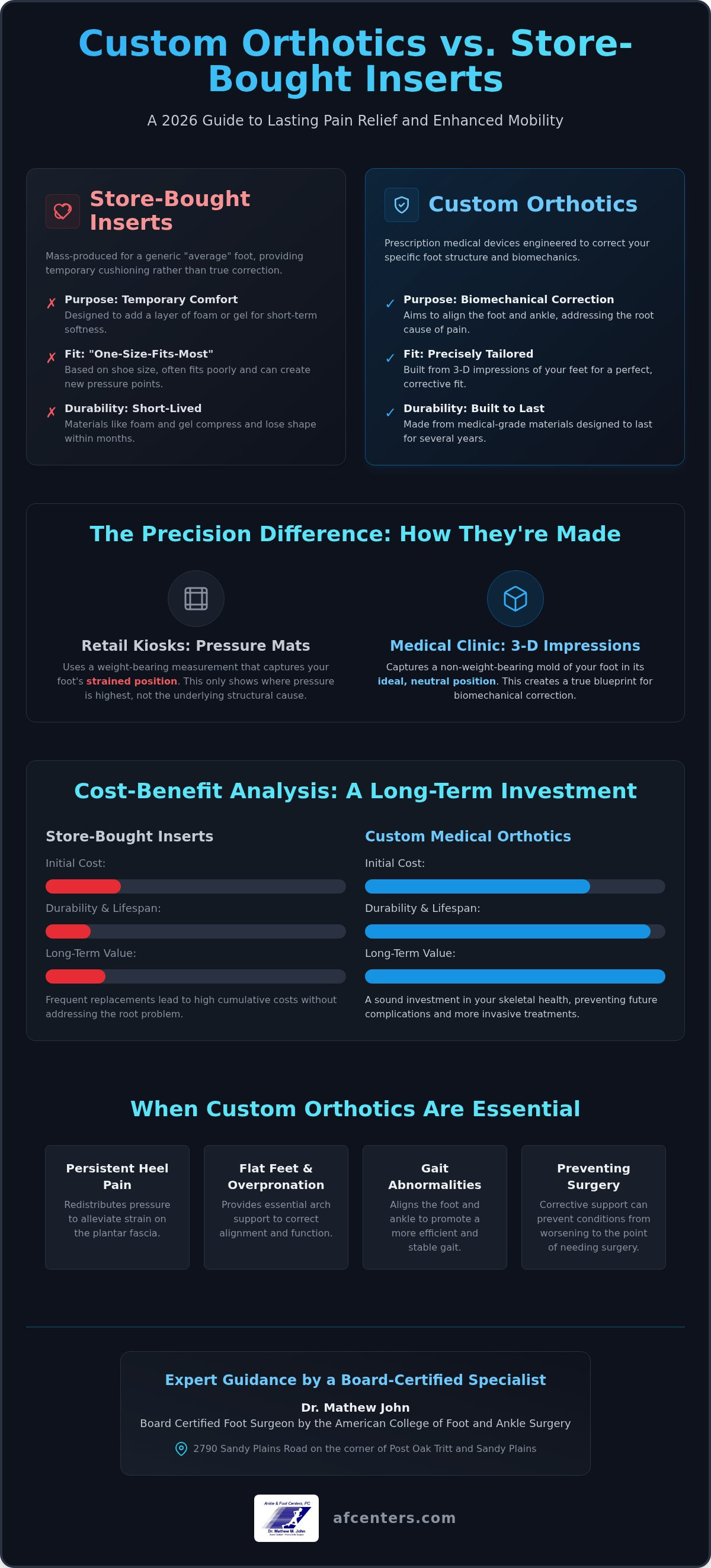
Choosing between an immediate fix and a long-term investment is a common hurdle for many of our patients. While the initial price of a retail insert is lower, the true benefits of custom orthotics vs store bought versions become clear when you look at the timeline of your health. A drugstore insert typically loses its structural integrity and cushioning within three to six months. In contrast, medical-grade custom orthotics are crafted from high-end, durable materials like polypropylene or graphite. These devices often last between three and five years, making the "cost per wear" significantly lower than constantly replacing disposable foam alternatives.
You might have heard about studies suggesting that cheaper inserts perform just as well as custom ones for immediate relief. While generic foam feels good initially because it provides basic padding, it doesn't stop the mechanical issues that cause pain. By investing in professional care, you aren't just buying a product; you're securing a preventative strategy. Custom devices can often prevent the need for expensive reconstructive foot and ankle surgery by keeping your bones and joints in their proper alignment before permanent damage occurs.
Addressing the "Heel Pain" Debate
Proper alignment does more than stop pain; it halts the progression of structural deformities. If you're dealing with bunions or hammertoes, custom orthotics provide the stability needed to keep those joints from worsening over time. Having your journey monitored by Dr. Mathew John, a Board Certified Foot Surgeon by the American College of Foot and Ankle Surgery, ensures your treatment is always optimized for your current needs. Here is a quick checklist to help you evaluate the true value of your investment:
- Durability: Will the device provide consistent support for three to five years?
- Prevention: Is it designed to stop bone deformities from progressing?
- Precision: Was it created from a non-weight-bearing 3-D impression of your foot?
- Expertise: Is the fitting overseen by a Board Certified Foot Surgeon?
When you visit us at 2790 Sandy Plains Road on the corner of Post Oak Tritt and Sandy Plains, we'll help you determine which path best supports your personal health goals.
When Custom Orthotics Are Essential: Critical Conditions
While retail inserts might offer a bit of extra cushion for a long walk, they lack the medical precision needed to manage complex pathologies. One of the most vital benefits of custom orthotics vs store bought inserts is their ability to treat underlying medical conditions that generic products simply ignore. When you're dealing with structural issues or chronic diseases, a "good enough" fit can actually lead to worsening symptoms. Dr. Mathew John, a Board Certified Foot Surgeon by the American College of Foot and Ankle Surgery, emphasizes that true medical intervention requires a device built from your specific 3-D impressions to ensure every bone and joint is supported correctly.
For patients experiencing musculoskeletal pain and inflammation, we often pair custom devices with MLS Laser Therapy. This advanced treatment helps reduce swelling and accelerates healing in the soft tissues, working in tandem with your orthotics to provide a comprehensive recovery plan. Whether you're managing a sports injury or a long-term condition, our clinic at 2790 Sandy Plains Road on the corner of Post Oak Tritt and Sandy Plains provides the high-level expertise you need to stay mobile.
Diabetic Foot Care and Pressure Management
Managing diabetic foot health requires a proactive strategy to prevent serious complications. Custom orthotics are essential for preventing ulcers by offloading pressure from vulnerable areas of the foot. Unlike generic inserts that might cause friction or create new pressure points because they don't match your unique shape, medical-grade insoles are designed to protect your skin. We use 3-D impressions to identify exactly where your foot needs the most protection. This personalized approach is often the difference between maintaining your independence and facing serious risks.
Structural Deformities: Bunions and Flat Feet
Choosing the right support for your feet is a personal journey that requires more than just a quick trip to the drugstore. While we’ve explored the many benefits of custom orthotics vs store bought inserts, the most critical factor in your success is the professional guidance behind the device. At our practice, we don't just hand you a product; we partner with you to ensure your mobility and comfort are restored through expert clinical care. Dr. Mathew John, a Board Certified Foot Surgeon by the American College of Foot and Ankle Surgery, oversees every step of the process to ensure your orthotics are perfectly matched to your lifestyle and anatomy.
Visit Us in Marietta
Your feet are the foundation of every activity you enjoy. Choosing the right support means looking beyond temporary comfort to find a solution that protects your skeletal health for years. We’ve explored how 3-D impressions provide a level of precision that generic inserts simply can’t match. By understanding the benefits of custom orthotics vs store bought options, you're prioritizing prevention and avoiding the risks of worsening structural issues.
Dr. Mathew John, a Board Certified Foot Surgeon by the American College of Foot and Ankle Surgery, is ready to guide you through this process at our clinic located at 2790 Sandy Plains Road on the corner of Post Oak Tritt and Sandy Plains. Professional expertise ensures your orthotics are more than just cushions; they’re corrective tools tailored to your unique journey. Schedule your orthotic consultation with Dr. Mathew John today!
You don't have to navigate persistent pain alone. Let’s work together to keep you moving comfortably and confidently toward your personal wellness goals. Your path to better foot health starts with a single, supported step.
Frequently Asked Questions
How long do custom orthotics typically last compared to store-bought?
Custom orthotics typically last 3 to 5 years, while store-bought inserts usually need replacement every 3 to 6 months. This durability is one of the major benefits of custom orthotics vs store bought options. Because they're made from medical-grade materials like polypropylene or graphite, they maintain their structural integrity much longer. Regular check-ups with Dr. Mathew John ensure your devices continue to provide the corrective support your feet need for long-term health.
Can custom orthotics help with back and knee pain?
Yes, custom orthotics can significantly reduce knee and back pain by correcting your body's alignment from the ground up. When your feet overpronate or roll outward, it creates a chain reaction that puts stress on your joints. By using 3-D impressions to create a corrective mold, we stabilize your gait and redistribute pressure. This structural support helps prevent secondary issues and improves your overall mobility during daily activities.
Does insurance usually cover the cost of custom-molded orthotics?
Coverage varies significantly depending on your specific 2026 insurance plan and documented medical necessity. Many private and employer-sponsored plans offer partial or full coverage for prescription orthotics, though they often require a formal diagnosis from a podiatrist. Medicare Part B may cover them for specific conditions like severe diabetic foot disease. We recommend checking your plan's details regarding durable medical equipment or orthotic benefits to understand your out-of-pocket responsibilities.
How do I know if I need custom orthotics or just a better pair of shoes?
You likely need custom orthotics if you experience persistent heel pain, uneven shoe wear, or structural issues like flat feet that don't improve with high-quality footwear. While a supportive shoe is important, it cannot provide the specific biomechanical correction required for complex conditions. A consultation with Dr. Mathew John, a Board Certified Foot Surgeon, helps determine if you require personalized support or simply a different shoe style for your activity level.
What is the process for getting 3-D impressions for orthotics?
The process begins with a comprehensive evaluation of your gait and foot structure. We then take precise 3-D impressions while your foot is held in a non-weight-bearing, neutral position. This technique captures the exact contours of your feet without the distortion caused by gravity. These impressions serve as the master blueprint for your custom devices. This level of detail is a key part of the benefits of custom orthotics vs store bought inserts.
Are custom orthotics uncomfortable to break in?
Most patients experience a short adjustment period as their muscles and tendons adapt to a new, corrected alignment. We typically recommend a gradual break-in schedule, starting with just a few hours of wear each day. You should feel a sense of support rather than sharp pain. If you experience significant discomfort, visit us at 2790 Sandy Plains Road on the corner of Post Oak Tritt and Sandy Plains for a professional adjustment.
Can I move my custom orthotics between different pairs of shoes?
You can often move your orthotics between similar types of footwear, such as different pairs of athletic sneakers or work boots. However, the fit depends on the depth and shape of the shoe's interior. Some patients choose to have multiple pairs of orthotics designed specifically for different activities, such as dress shoes versus running shoes. Dr. Mathew John can help you decide if one pair will meet all your needs or if specialized devices are better.
What happens if my custom orthotics need adjustment after I receive them?
We encourage you to return to our office if your devices feel like they need fine-tuning after the initial break-in period. Local, follow-up care is a major advantage of professional fitting. Dr. Mathew John, a Board Certified Foot Surgeon by the American College of Foot and Ankle Surgery, can modify the shell or top cover to ensure maximum comfort. These minor adjustments help maintain the corrective benefits that help you stay active and pain-free.


