

Imagine standing at the trailhead of a local Marietta park, feeling the sun on your face and the solid ground beneath your feet without a single twinge of hesitation. For many, the transition to life after reconstructive foot surgery feels like a daunting mountain to climb, especially when you're currently managing the frustrations of non-weight-bearing restrictions and the worry of permanent mobility loss. You aren't alone in these feelings; it's natural to wonder if your foot will truly regain its structural integrity.
At our practice located at 2790 Sandy Plains Road on the corner of Post Oak Tritt and Sandy Plains, we believe your recovery should be a partnership built on professional guidance and cutting-edge care. We're here to help. This guide will show you exactly what to expect during your healing journey and how we use tools like MLS Laser Therapy to manage inflammation and custom orthotics built from 3-D impressions to stabilize your gait. You'll discover a clear path toward pain-free walking and the confidence to reclaim your active lifestyle in 2026.
Key Takeaways
- Navigate the distinct phases of life after reconstructive foot surgery, moving from essential early rest to a confident return to supportive footwear.
- Learn how MLS Laser Therapy uses advanced energy to calm inflammation and speed up your recovery at the cellular level.
- Discover the importance of custom orthotics crafted from precise 3-D impressions to provide the stability your new foot structure requires.
- Identify the specific milestones that signal you are ready to return to local Marietta trails or low-impact sports like swimming.
- Understand why long-term wellness involves addressing secondary issues promptly with sophisticated options like Swift microwave ablation technology for stubborn warts.
The Timeline of Healing: What to Expect in the First Year
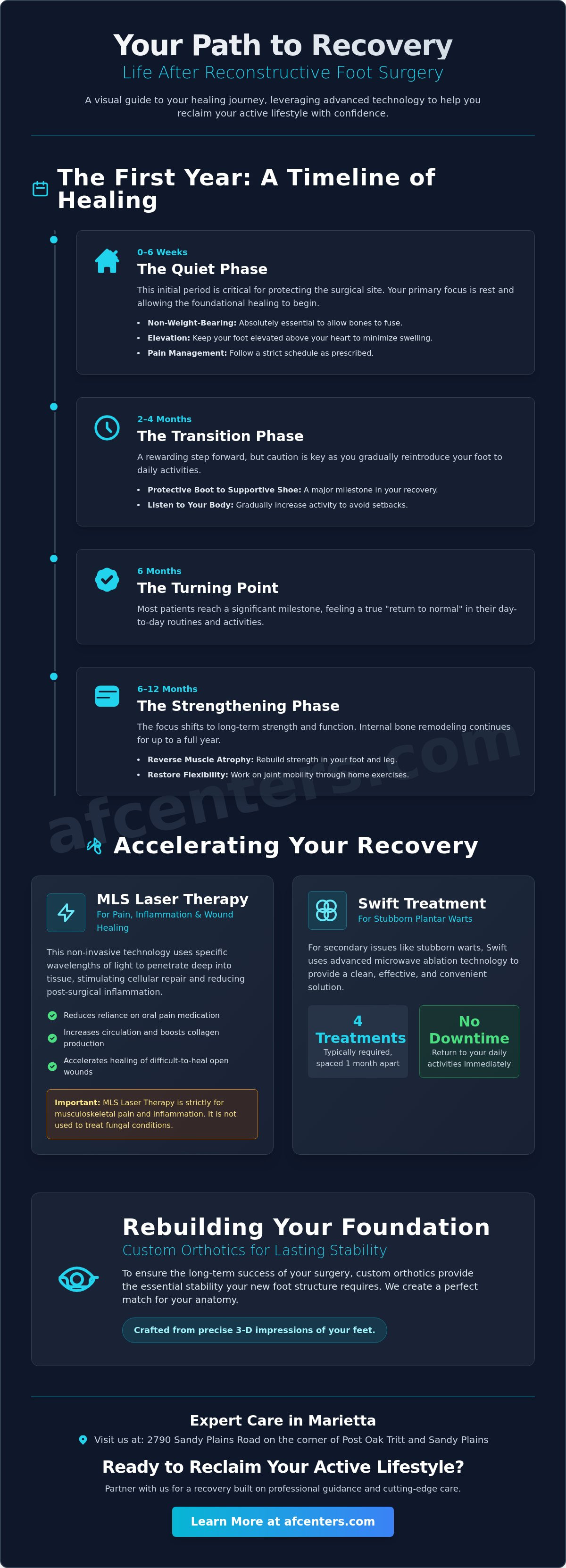
Starting the journey toward mobility requires a realistic understanding of the road ahead. Unlike minor podiatric fixes, complex foot and ankle surgery involves structural changes to bone and soft tissue that take time to stabilize. Your life after reconstructive foot surgery is best viewed in phases, beginning with the "Quiet Phase" during the first six weeks. This initial period is all about protecting the surgical site, prioritizing elevation, and allowing the primary healing process to begin without interference.
To better understand the immediate reality of this process, watch this helpful video covering the first day of recovery:
Immediate Post-Operative Milestones
The first 48 hours are often the most challenging. You'll need to keep your foot elevated above your heart to minimize swelling and follow a strict pain management schedule. Adhering to non-weight-bearing instructions is non-negotiable; your bones need this protected time to fuse or knit together properly. During your first follow-up appointment at our office at 2790 Sandy Plains Road on the corner of Post Oak Tritt and Sandy Plains, we'll check your incisions and ensure your recovery is on the right track. This visit is a great time to discuss how our specialized services can support your specific needs.
The Six-Month Turning Point
As you move into the Transition Phase between months two and four, you'll likely graduate from a protective boot to supportive footwear. This is a rewarding step, but it requires caution. By month six, most patients reach a significant turning point where they feel a true "return to normal" in their daily routines. You'll begin the Strengthening Phase, which lasts through month twelve, focusing on reversing muscle atrophy and restoring joint flexibility. It's common to experience late-stage swelling after a long day of activity during this time, so listen to your body's signals.
Accelerating Your Recovery with Advanced Technology
While the body has a natural healing clock, modern medical advancements allow us to support and potentially speed up that process. Integrating technology into your life after reconstructive foot surgery can make the difference between a long, painful slog and a smooth, manageable transition. One of the most effective tools in our arsenal is MLS Laser Therapy. This sophisticated technology uses specific wavelengths of light to penetrate deep into the tissue, stimulating cellular repair and significantly reducing the post-surgical inflammation that often hinders progress.
MLS Laser Therapy for Pain and Inflammation
It is vital to understand that MLS Laser Therapy is strictly designed for musculoskeletal pain, inflammation, and difficult-to-heal open wounds. It is not used for fungal conditions; those require separate equipment like the Cutera Genesis Plus NDYag Laser. During an MLS session at our clinic at 2790 Sandy Plains Road on the corner of Post Oak Tritt and Sandy Plains, you'll experience a non-invasive treatment that feels like a gentle, warm sensation. This therapy works by increasing circulation and triggering the body's natural anti-inflammatory response. Many patients find that this approach helps them reduce their reliance on oral pain medications, allowing for a clearer, more comfortable recovery period.
Wound Care and Tissue Regeneration
The success of your surgery depends heavily on how well your incisions heal. MLS Laser energy accelerates the closing of surgical wounds by boosting collagen production and metabolic activity in the cells. This is especially critical for preventing chronic scar tissue formation, which can sometimes limit your final range of motion. For diabetic patients undergoing reconstruction, this advanced wound care is a vital safeguard against complications. By focusing on deep tissue and bone repair, we help you stay on track with research-backed return to activity timelines.
Our goal is to ensure that your life after reconstructive foot surgery is defined by progress rather than setbacks. By using these advanced modalities, we address pain at its source rather than just masking the symptoms. If you're curious about how these technologies could fit into your personal healing plan, you can explore our full range of advanced podiatric services to see what might be right for you. We take pride in offering these sophisticated resources to our Marietta community, ensuring you never have to navigate the path to mobility alone.
Rebuilding Your Foundation: Orthotics and Support
Life after reconstructive foot surgery involves more than just waiting for incisions to heal. It's about stabilizing the new alignment created during your procedure. Think of your foot as a newly renovated building; while the structure is sound, it requires a steady foundation to remain durable for years to come. At our clinic located at 2790 Sandy Plains Road on the corner of Post Oak Tritt and Sandy Plains, we guide you through a systematic process to rebuild this foundation and protect your surgical results.
Our approach to post-operative stability follows five essential steps:
- Clinical assessment: We evaluate your new foot structure once initial swelling has subsided to see how your gait has changed.
- 3-D impressions: We capture the unique, anatomical contours of your foot to ensure a perfect fit without the need for generic molds.
- Custom crafting: Your orthotics are built specifically to maintain your corrected alignment and redistribute pressure.
- Acclimation: You'll gradually increase wear-time over several weeks to help your muscles and tendons adapt to a corrected gait.
- Long-term monitoring: We adjust your support as your activity levels grow and your foot continues to settle into its new shape.
The Role of 3-D Impressions in Custom Care
Generic store-bought inserts often fail post-surgical patients because they don't account for the specific structural changes made during reconstruction. We use 3-D impressions to create a highly accurate mold of your foot in its corrected position. This precision ensures the orthotic provides support exactly where you need it, preventing future deformities and protecting the work done during your surgery. By using 3-D impressions, we can address subtle nuances in your arch and heel that make a significant difference in your daily comfort and long-term mobility.
Finding the Right Footwear Post-Surgery
Your choice of shoes acts as the first line of defense for your new foot structure. In the months following your procedure, prioritize "recovery-friendly" footwear. Look for shoes with wide toe boxes to prevent pressure on healing joints and rigid soles that limit excessive motion. You can explore our full range of podiatric services to learn more about how we integrate footwear advice into your overall recovery plan.
Most patients can return to specialized footwear like running shoes or modest heels around the six-to-nine-month mark, depending on their individual progress and the complexity of their life after reconstructive foot surgery. We'll work with you to determine when your gait is stable enough for these transitions. Ensuring your journey remains active and pain-free depends on this careful balance of custom support and smart footwear choices. We're here to provide the steady hand you need as you step back into your favorite activities with confidence.
Returning to an Active Lifestyle in Marietta
Reaching the end of your formal clinical recovery is a significant achievement. For many of our neighbors, the true measure of success in life after reconstructive foot surgery isn't just a clear X-ray; it's that first morning walk through the trails at Kennesaw Mountain. This transition from a controlled medical environment to the unpredictable terrain of daily life is both exciting and nerve-wracking. It's completely normal to feel a bit of anxiety about re-injury. However, your journey is built on a foundation of professional guidance and advanced technology that's designed to withstand these new challenges.
Low-Impact Exercises to Start With
We recommend starting with activities that rebuild your stamina without placing excessive stress on your healing joints. Stationary cycling is an excellent choice because it allows you to work on your range of motion and cardiovascular health while staying seated. Water aerobics is another fantastic option; the buoyancy of the water supports your body weight, letting you move your foot through its full range of motion with minimal impact. Even during the final weeks of your non-weight-bearing phase, you can engage in seated strength training to keep your upper body and core active. These small victories build the momentum you need for a full return to your favorite sports.
Listening to Your Body: When to Push and When to Rest
As you increase your activity, you'll need to distinguish between "good" muscle soreness and "bad" surgical site pain. A dull ache in your calf or arch after a long walk is often a sign that your muscles are waking up. However, sharp or throbbing pain at the incision site is a signal to scale back. You should still use icing and elevation even months after your procedure to manage occasional flare-ups after a particularly active day. If you experience persistent swelling after your hikes, remember that we can still utilize MLS Laser Therapy at our clinic to calm that localized inflammation. It's a great tool for managing the feedback your foot gives you as you push toward higher activity levels.
Set realistic goals for yourself, whether that's returning to a local tennis league or simply walking the dog around the block. If you have questions about your progress or need to adjust your support, explore our podiatric services to see how we can fine-tune your recovery plan at our office at 2790 Sandy Plains Road on the corner of Post Oak Tritt and Sandy Plains. We're here to ensure every step you take is a confident one.
Long-Term Success and Holistic Foot Health
Swift Treatment for Recalcitrant Warts
During your recovery, you might notice secondary issues like stubborn warts that were previously ignored. We offer Swift Treatment, the latest advanced option for recalcitrant warts. This system uses microwave ablation technology to target the root of the problem by stimulating a natural immune response. It typically requires four treatments, each separated by exactly one month. One of the greatest benefits for active patients is that there's no downtime after receiving the Swift microwave ablation treatment. You can walk out of our office and continue your daily routine or your physical therapy exercises without any interruption.
Protecting Your Feet from Fungal Infections
Step Into Your Future with Confidence
Led by Dr. Mathew M. John, DPM, FACFAS, our team is committed to being your partner in long-term health. Our facility is equipped with sophisticated resources, including Swift microwave ablation for recalcitrant warts and MLS Laser therapy for inflammation, ensuring every aspect of your foot health is addressed. We invite you to schedule your post-op consultation or surgical evaluation at our Marietta office today. You can find us at 2790 Sandy Plains Road on the corner of Post Oak Tritt and Sandy Plains. Your path to a vibrant, active lifestyle is within reach; we're ready to guide you every step of the way.
Frequently Asked Questions
How long after reconstructive foot surgery can I walk again?
Most patients begin partial weight-bearing between six and twelve weeks after their procedure. This timeline depends on the complexity of your specific reconstruction and how quickly your bones fuse. You'll typically transition from a protective boot to supportive athletic shoes by the fourth month. We monitor your progress closely at our Marietta office to ensure your transition is safe and steady.
Will I need to wear custom orthotics forever after my surgery?
Many patients continue to wear custom orthotics long-term to protect the structural integrity of their new foot alignment. These devices, created from precise 3-D impressions, provide the necessary stability to prevent future deformities. While you might not need them for every single step, using them during high-impact activities or long walks ensures your surgical results last a lifetime.
Is MLS Laser Therapy safe to use immediately after a surgical procedure?
Yes, MLS Laser Therapy is safe and often recommended immediately following surgery to manage acute inflammation. This non-invasive treatment uses light energy to stimulate cellular repair in deep tissue and bone. By reducing swelling early on, it helps you manage pain more effectively. It also supports the healing of surgical incisions, which is a vital part of your life after reconstructive foot surgery.
What is the Swift Treatment, and does it hurt?
Swift Treatment is an advanced microwave ablation technology used to treat stubborn plantar warts by triggering a natural immune response. Most patients describe the sensation as a brief, intense heat that lasts only a few seconds. The discomfort ends the moment the probe is removed. Because there is no breaking of the skin, you won't have to deal with the lingering soreness associated with traditional wart removal.
Can I treat fungal toenails with the same laser used for my post-op pain?
No, the MLS Laser is strictly for musculoskeletal pain and inflammation and cannot treat fungal infections. For fungal toenails, we use specialized fungal laser therapy such as the Cutera Genesis Plus NDYag Laser. This distinction is important because each laser uses different wavelengths to target specific conditions. Using the correct equipment ensures your nails stay clear while your internal structures heal.
How many Swift Treatment sessions are needed for stubborn plantar warts?
Resolving stubborn or recalcitrant warts typically requires four Swift Treatment sessions. We space these appointments exactly one month apart to allow your immune system to respond to the microwave ablation technology. This structured approach is highly effective for warts that haven't responded to other treatments. Each session is quick, making it easy to fit into your schedule at our office at 2790 Sandy Plains Road on the corner of Post Oak Tritt and Sandy Plains.
What happens if I put weight on my foot too early after reconstruction?
Putting weight on your foot too early can lead to serious complications like hardware failure or bones failing to knit together properly. This premature stress can compromise the structural integrity of your foot and may even require a second corrective procedure. Following your non-weight-bearing instructions is the most important thing you can do to ensure a successful life after reconstructive foot surgery and a return to full mobility.
Is there any downtime after the Swift microwave ablation treatment?
There is absolutely no downtime after receiving the Swift microwave ablation treatment. Unlike traditional methods that leave wounds or require bandages, this technology keeps the skin intact. You can walk out of our clinic and immediately return to your normal daily activities or exercise routine. This makes it an ideal solution for active individuals who don't want to pause their recovery journey for wart treatment.


