
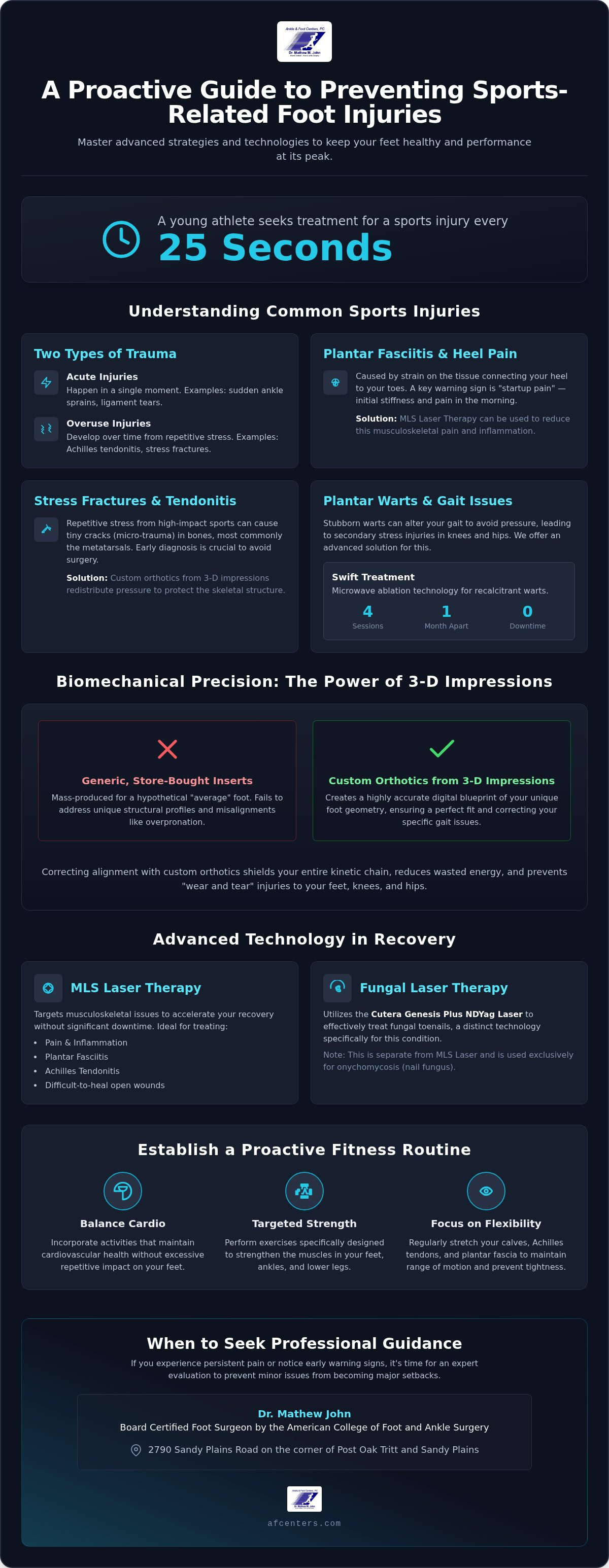
Did you know that a young athlete seeks treatment for a sports injury every 25 seconds? If you're an active individual in Marietta, you understand that your feet are the foundation of every mile, jump, and sprint. Many athletes struggle with recurring heel pain or the fear that a minor ache might lead to a long-term injury. You aren't alone in feeling confused about which shoes provide real support or how to prioritize preventing sports related foot injuries without slowing down.
It's time to move past the old "no pain, no gain" mindset and embrace a smarter way to train. You can master the proactive strategies and advanced podiatric technologies needed to keep your feet healthy and your performance at its peak. This guide previews a clear training routine and explains when to visit Dr. Mathew John, a Board Certified Foot Surgeon by the American College of Foot and Ankle Surgery. From precision 3-D impressions for orthotics to MLS Laser Therapy for inflammation, you'll find the expert care you need at 2790 Sandy Plains Road on the corner of Post Oak Tritt and Sandy Plains.
Key Takeaways
- Learn to identify the early warning signs of common athletic conditions like plantar fasciitis and Achilles tendonitis to stop pain before it progresses.
- Discover why precision 3-D impressions offer a superior biomechanical advantage in preventing sports related foot injuries compared to generic, store-bought shoe inserts.
- Understand how advanced technologies like MLS Laser Therapy and Swift microwave ablation can accelerate your recovery without requiring significant downtime.
- Establish a proactive fitness routine that balances cardio with specific strength and flexibility exercises tailored to your foot type and athletic goals.
- Recognize when it is time to seek professional guidance from Dr. Mathew John, a Board Certified Foot Surgeon by the American College of Foot and Ankle Surgery, in Marietta.
Understanding Common Sports-Related Foot and Ankle Injuries
When you push your limits on the court or the track, your feet absorb several times your body weight with every step. In athletic podiatry, sports-related foot injuries refer to damage sustained by the bones, soft tissues, or joints during physical activity. Understanding Common types of sports injuries is the first step toward a long, healthy athletic career. By focusing on preventing sports related foot injuries, you protect your mobility and ensure that a minor ache doesn't turn into a season-ending setback.
Athletes typically encounter two types of trauma: acute and overuse. Acute injuries happen in a single moment, such as a sudden ankle sprain during a soccer match or a ligament tear. Overuse injuries are more subtle, developing over weeks or months of repetitive stress. These include conditions like Achilles tendonitis or neuromas, which often start as a dull throb before escalating into sharp pain. Mastering the art of preventing sports related foot injuries starts with recognizing these early signals from your body.
You might be surprised to learn that even minor skin issues can lead to major structural problems. For example, a stubborn plantar wart can cause you to subconsciously change your gait to avoid pressure. This shift in movement places undue stress on your knees and hips, often leading to secondary injuries. At our office at 2790 Sandy Plains Road on the corner of Post Oak Tritt and Sandy Plains, we use Swift Treatment for recalcitrant warts. This advanced microwave ablation technology typically involves four sessions spaced one month apart. There's no downtime for patients, allowing you to stay active while correcting your stride.
The Impact of Plantar Fasciitis and Heel Pain
High-impact sports like basketball or long-distance running place immense strain on the plantar fascia, the thick band of tissue connecting your heel to your toes. Many Marietta athletes ignore the initial stiffness they feel in the morning, but this "startup pain" is a hallmark of inflammation. If left unaddressed, it can become chronic. For a deeper look at managing these symptoms, explore our guide on Heel Pain Relief in Marietta: A Podiatrist’s Guide. We often utilize MLS Laser Therapy to reduce musculoskeletal pain and inflammation, helping you return to your routine faster.
Stress Fractures and Tendonitis in High-Impact Sports
Repetitive stress from miles logged on the Silver Comet Trail or local tracks can cause micro-trauma to the metatarsal bones. These tiny cracks, known as stress fractures, require early diagnosis to avoid the need for reconstructive surgery. Dr. Mathew John is a Board Certified Foot Surgeon by the American College of Foot and Ankle Surgery, specializing in identifying these issues before they worsen. During professional diagnostic evaluations, we may recommend 3-D impressions for custom orthotics to redistribute pressure and protect your skeletal structure from further damage.
Biomechanical Precision: The Power of 3-D Impressions
You might spend hundreds of dollars on the latest high-tech running shoes, but if your foot's internal mechanics are misaligned, even the most expensive foam cannot protect you. Generic insoles are mass-produced for a hypothetical average foot. In reality, every athlete has a unique structural profile. By utilizing precision 3-D impressions, we can identify exactly where your gait needs support. This level of detail is a cornerstone of preventing sports related foot injuries like chronic heel pain and stress fractures. Correcting overpronation or supination through these custom devices shields your joints from the repetitive impact of your sport, ensuring your knees and hips don't pay the price for poor foot alignment.
The relationship between proper alignment and athletic longevity is clear. When your feet are positioned correctly, your entire kinetic chain functions more efficiently. This reduces the energy wasted on compensating for structural imbalances. Over time, this efficiency translates to fewer "wear and tear" injuries. It allows you to maintain a high level of intensity throughout your season and into the years ahead.
The 3-D Impression Process for Athletes
Capturing your foot's unique geometry is now a seamless, non-invasive experience. Unlike old-fashioned plaster casts that could be messy and imprecise, 3-D impressions provide a highly accurate digital blueprint. This data serves as the foundation for your Durable Medical Equipment (DME). It ensures that your custom orthotics fit perfectly inside your specific footwear. Whether you're wearing narrow soccer cleats or wide-toe-box distance runners, the precision of this process guarantees that the support is exactly where you need it most.
Custom Orthotics vs. Over-the-Counter Inserts
While retail inserts offer a bit of cushion, they lack the structural integrity required to manage the forces generated during a sprint or jump. Custom devices are medical-grade tools designed by Dr. Mathew John, a Board Certified Foot Surgeon by the American College of Foot and Ankle Surgery. While some athletes hesitate at the initial investment, the long-term value is found in sustained performance and avoiding the high costs of surgery or physical therapy later. Following expert foot and ankle injury prevention tips often means investing in the right equipment before a problem starts. If you're ready to optimize your performance, consider a professional fitting for custom orthotics at our office located at 2790 Sandy Plains Road on the corner of Post Oak Tritt and Sandy Plains.
Advanced Technology in Prevention and Recovery
Staying on top of your game requires more than just grit; it requires the right tools to maintain your body's foundation. When minor aches start to linger, they often signal underlying inflammation that can lead to a major breakdown if ignored. Dr. Mathew John, a Board Certified Foot Surgeon by the American College of Foot and Ankle Surgery, utilizes advanced technologies at our Marietta office to help you stay ahead of the curve. By addressing these issues early, you're actively preventing sports related foot injuries that could otherwise sideline you for months. Taking proactive precautions to prevent foot and ankle injuries is a hallmark of a professional athlete's routine, and modern medicine provides several non-invasive ways to do just that.
At our practice located at 2790 Sandy Plains Road on the corner of Post Oak Tritt and Sandy Plains, we prioritize recovery as much as prevention. High-level performance often results in micro-trauma to the soft tissues. Left untreated, this can progress into chronic conditions like Achilles tendonitis or plantar fasciitis. Leveraging medical-grade technology allows us to target these issues at a cellular level, promoting faster healing and reducing the risk of long-term structural damage.
MLS Laser Therapy for Musculoskeletal Pain
MLS Laser Therapy is a sophisticated tool we use to manage musculoskeletal pain and deep tissue inflammation. It's particularly effective for athletes dealing with chronic tendonitis or difficult-to-heal open wounds. The laser energy penetrates deep into the tissue to stimulate cellular repair and reduce swelling without the need for medication or invasive procedures. It's important to distinguish this from other treatments; while we offer various advanced podiatric services, MLS Laser is reserved specifically for pain and inflammation. For patients dealing with nail concerns, we utilize fungal laser therapy or the Cutera Genesis Plus NDYag Laser to ensure the best results for that specific condition.
Swift Treatment: Microwave Ablation for Plantar Warts
One often overlooked aspect of preventing sports related foot injuries is the management of skin conditions like plantar warts. Stubborn or recalcitrant warts can cause you to subconsciously shift your weight while running or jumping. This subtle change in your gait places uneven stress on your knees and hips, often leading to secondary injuries. Swift microwave ablation technology offers a precise solution for these persistent issues. The treatment typically involves four sessions, each spaced one month apart. Because there's zero downtime following the procedure, you can head straight from our office back to your practice or game without missing a beat. This allows you to maintain your natural stride and protect your overall biomechanical health.
A Proactive Routine to Shield Your Feet from Injury
Success in sports isn't just about what you do during the game. It's about the discipline you maintain every day to keep your body resilient. A balanced fitness plan that incorporates cardiovascular health, strength training, and flexibility is your best defense. By building a strong foundation, you are actively preventing sports related foot injuries before they have a chance to start. Think of your body as a high-performance vehicle; it requires regular maintenance and the right parts to run smoothly at high speeds.
Listening to your body is perhaps the most critical skill you can develop as an athlete. Sharp pain, persistent swelling, or even a change in how your shoes feel are signals that shouldn't be ignored. While it's tempting to push through the discomfort, early intervention is the key to longevity. Incorporating professional check-ups into your seasonal schedule ensures that minor biomechanical shifts are caught early. Dr. Mathew John, a Board Certified Foot Surgeon by the American College of Foot and Ankle Surgery, can help you navigate these signals and adjust your routine to keep you on the field.
This proactive approach is beneficial for all high-performers, including those in the tech industry who often travel for professional development. If you're a developer planning your next trip, you can explore Event Registration and Sponsorship Fees for CityJS Athens; just remember that keeping your feet healthy is vital for a successful conference experience.
Dynamic Warm-ups and Cool-downs
Your preparation should begin with dynamic movements that prepare your muscles for impact. Focus on stretches that target the Achilles tendon and the plantar fascia, as these are common areas for strain. While many athletes rush their recovery, your cool-down should ideally take twice as long as your warm-up. This extended period allows your heart rate to drop gradually and helps flush out metabolic waste from your tissues. Alternating muscle groups during your training week also prevents repetitive strain, giving your feet the rest they need to recover from high-intensity sessions.
Footwear Selection and Maintenance
Your shoes are your most important piece of equipment, but they have a limited lifespan. You should recognize when your athletic shoes have lost their structural integrity, usually between 300 and 500 miles. Look for worn treads or a midsole that feels "dead" when you press on it. For Marietta athletes training on the varied terrains of Post Oak Tritt roads or local gravel paths, matching your shoe features to your specific foot type is essential. This is where your 3-D impressions become invaluable, as they provide the blueprint for the exact support your unique foot structure requires.
Don't wait for an injury to sideline your progress. Take the first step toward a pain-free season by scheduling an evaluation for sports injury prevention at our office located at 2790 Sandy Plains Road on the corner of Post Oak Tritt and Sandy Plains.
Expert Podiatric Care at Ankle & Foot Centers, PC
Your journey toward peak performance shouldn't be a solo trek. Ankle & Foot Centers, PC, serves as a dedicated wellness hub for the Marietta athletic community, providing the sophisticated resources you need to stay in the game. You'll find our welcoming office at 2790 Sandy Plains Road on the corner of Post Oak Tritt and Sandy Plains. We believe that professional guidance is the bridge between short-term intensity and long-term health. Our team is committed to preventing sports related foot injuries by combining advanced medical technology with a deep understanding of your personal fitness goals. Whether you're logging miles on local trails or competing on the court, you deserve an expert partner who prioritizes your progress over perfection.
Dr. Mathew John is a Board Certified Foot Surgeon by the American College of Foot and Ankle Surgery. His leadership ensures that every patient receives care rooted in the highest standards of podiatric medicine. From precision 3-D impressions for custom orthotics to complex reconstructive surgery, our facility offers a comprehensive suite of services. We're here to guide you with a steady hand; we want to ensure you never feel alone while you're navigating your path to recovery or peak performance. Our approach is always forward-looking, focusing on the results that keep you moving and the professional support that builds lasting trust.
Why Choose a Board Certified Foot Surgeon?
Choosing a specialist who is Board Certified by the American College of Foot and Ankle Surgery means you're trusting your health to a professional who has met rigorous, peer-reviewed standards. This certification is a testament to years of specialized training and proven clinical success in the most complex cases. Even if you aren't currently seeking surgery, this high-level expertise is invaluable for preventing sports related foot injuries. A surgeon's deep understanding of internal anatomy allows them to spot subtle biomechanical flaws that others might miss. This insight informs every preventative treatment plan, ensuring your custom orthotics or recovery routines are perfectly aligned with your unique skeletal structure.
Schedule Your Preventative Consultation Today
You don't have to wait for a sharp pain or a sudden injury to seek professional help. Proactive care is the most effective way to ensure your athletic career remains long, healthy, and rewarding. We invite you to explore our full range of Our Services to see how we can support your specific journey. From utilizing 3-D impressions for perfect-fit orthotics to addressing persistent musculoskeletal pain with MLS Laser Therapy, we have the tools to keep you at your best.
Book your appointment today at our Marietta office. Let's work together to create a customized routine that protects your foundation and empowers your performance. It's time to embrace a future of pain-free activity and personal growth. We look forward to welcoming you to our community hub at 2790 Sandy Plains Road on the corner of Post Oak Tritt and Sandy Plains.
Protect Your Foundation for a Lifetime of Activity
Your journey toward excellence shouldn't be interrupted by avoidable pain. By prioritizing a balanced training routine and utilizing precision 3-D impressions for custom orthotics, you've already taken the most important steps in preventing sports related foot injuries. You have the power to stay ahead of chronic inflammation and structural strain by embracing the modern tools designed for your recovery and resilience.
Professional guidance makes all the difference when you're pushing your physical limits. Dr. Mathew John is a Board Certified Foot Surgeon by the American College of Foot and Ankle Surgery who understands the unique demands of Marietta athletes. Whether you need Swift microwave ablation for recalcitrant warts or MLS Laser Therapy to manage musculoskeletal inflammation, expert support is available. Visit our practice at 2790 Sandy Plains Road on the corner of Post Oak Tritt and Sandy Plains to keep your performance at its peak.
Schedule your preventative foot exam with Dr. Mathew John today!
You've worked hard to reach this level of fitness. Let's ensure your foundation is strong enough to carry you through many more seasons of success and personal growth. We're here to help you move forward with confidence and vitality.
Frequently Asked Questions
How can I tell if my foot pain is a serious sports injury or just soreness?
Normal muscle soreness typically fades within two to three days after rest, while a serious injury involves sharp pain or swelling that persists. If you notice bruising, numbness, or a dull ache that intensifies during your workout, your body is signaling a deeper issue. Seeking a professional evaluation early can help you avoid long-term damage and keep your training schedule on track.
What are the best stretches to prevent plantar fasciitis in runners?
Dynamic calf stretches and arch-strengthening exercises, such as towel curls, are highly effective for maintaining foot flexibility. These movements help relieve tension on the plantar fascia and the Achilles tendon. Incorporating these into your daily routine is a vital part of preventing sports related foot injuries, especially if you frequently run on the hard pavement around Marietta.
How often should I replace my athletic shoes to avoid injury?
You should generally replace your athletic shoes every 300 to 500 miles to ensure they provide adequate structural support. Even if the soles look intact, the internal cushioning often loses its ability to absorb shock over time. Training in worn-out footwear increases your risk of stress fractures and tendonitis, particularly when running on varied terrains like the roads near Post Oak Tritt.
Can custom orthotics really improve my athletic performance?
Yes, custom orthotics improve performance by optimizing your biomechanical alignment and reducing the energy your muscles waste on compensating for imbalances. By stabilizing your gait, these devices allow for more efficient movement and power transfer. This precision support helps you maintain high intensity while significantly lowering the risk of fatigue-related injuries during long games or races.
Is there downtime after the Swift Treatment for plantar warts?
There is absolutely no downtime after Swift microwave ablation, so you can return to your athletic activities immediately following the procedure. This advanced treatment for recalcitrant warts typically requires four sessions spaced one month apart. It's an ideal solution for busy athletes who need to resolve painful skin issues without missing a single practice or scheduled game.
What is the difference between MLS Laser and fungal laser therapy?
MLS Laser Therapy is used to treat musculoskeletal pain and inflammation, while fungal laser therapy (or the Cutera Genesis Plus NDYag Laser) is designed for nail infections. We use the MLS Laser to accelerate healing in deep tissues and difficult-to-heal wounds. It's important to use the correct technology for your specific condition to ensure the most effective recovery and results.
When should I see a podiatrist for a sports-related foot issue?
You should book a consultation if your pain doesn't improve with rest or if you experience recurring discomfort during your sport. Dr. Mathew John, a Board Certified Foot Surgeon by the American College of Foot and Ankle Surgery, specializes in advanced diagnostics and preventative care. Visit us at 2790 Sandy Plains Road on the corner of Post Oak Tritt and Sandy Plains for a personalized evaluation.
Are 3-D impressions better than traditional foot molds for orthotics?
3-D impressions provide a much higher level of precision compared to traditional plaster molds, capturing the exact geometry of your foot. This digital accuracy ensures that your custom orthotics fit perfectly within your athletic shoes. Using these detailed blueprints is a superior method for preventing sports related foot injuries because it addresses your unique biomechanical needs with medical-grade precision.


