

Resting your ankle for weeks might feel like the safest path, but it could actually be the very thing keeping you off the trail for longer than necessary. You're likely feeling frustrated by the lingering stiffness in your joint and the nagging fear that one wrong step will send you back to square one. It's tough being sidelined when all you want is to feel the pavement under your feet again. Understanding how to get back to running after ankle injury isn't just about waiting for the swelling to go down; it's about a proactive, medically-sound strategy that rebuilds your strength from the ground up.
At our clinic at 2790 Sandy Plains Road on the corner of Post Oak Tritt and Sandy Plains, Dr. Mathew John, a Board Certified Foot Surgeon by the American College of Foot and Ankle Surgery, emphasizes that recovery is a journey of progressive loading. We'll provide you with the medically-backed phases needed to restore your stability and prevent chronic issues. This guide previews the essential steps of a safe return, including the role of MLS Laser Therapy for inflammation and why 3-D impressions are vital for long-term support. You'll gain a clear timeline to move from that first tentative step to a confident, pain-free stride.
Key Takeaways
- Identify the severity of your injury by understanding the differences between Grade 1 stretching and Grade 3 ruptures to set realistic recovery goals.
- Discover how modern protocols and MLS Laser Therapy reduce inflammation and restore joint function more effectively than rest alone.
- Learn how to rebuild foundational stability through proprioception and balance exercises to protect against recurring ankle rolls.
- Follow a structured, four-week medical protocol on how to get back to running after ankle injury to ensure a safe transition from walking to full strides.
- Partner with Dr. Mathew John, a Board Certified Foot Surgeon by the American College of Foot and Ankle Surgery, to receive expert guidance and 3-D impressions for custom support.
Understanding Your Ankle Injury: Grades and Diagnosis
An ankle injury often feels like a simple setback, but your ankle is a complex network of ligaments, tendons, and bones working in harmony. When you experience a "twist," you aren't just dealing with a sore joint; you're dealing with potential structural changes that affect your entire kinetic chain. Understanding the specific grade of your injury is the first essential step in learning how to get back to running after ankle injury without causing long-term damage or chronic instability.
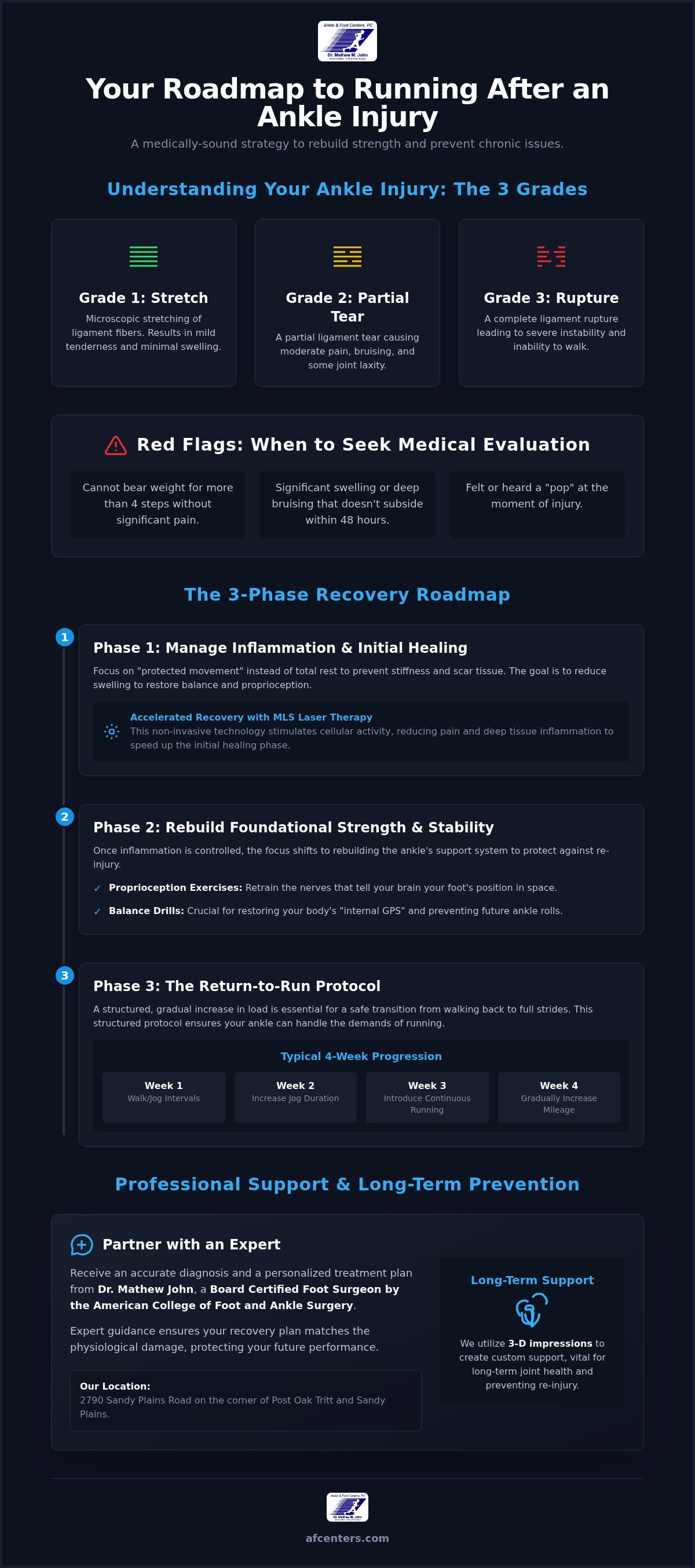
Ligament injuries are categorized into three distinct grades based on the extent of the tissue damage. A Grade 1 injury involves microscopic stretching of the ligament fibers, resulting in mild tenderness and minimal swelling. Grade 2 is more significant, involving a partial tear that causes moderate pain, noticeable bruising, and some joint laxity. A Grade 3 injury is a complete rupture of the ligament, which often leads to severe instability and an inability to walk. Without a clear diagnosis, you might mistake a severe tear for a minor strain, which significantly increases the risk of re-injury. Dr. Mathew John, a Board Certified Foot Surgeon by the American College of Foot and Ankle Surgery, emphasizes that professional grading is the only way to ensure your treatment plan matches the actual physiological damage.
Signs You Need a Medical Evaluation
While many runners try to "walk it off," certain red flags require immediate attention from a specialist. If you cannot bear weight for more than four steps without significant pain, your body is signaling a potential fracture or a high-grade tear. Significant swelling or deep bruising that does not subside within 48 hours indicates that the internal damage is more than superficial. If you felt or heard a "pop" at the moment of injury, it often points to a ligament rupture or a syndesmosis (high ankle) injury that requires professional stabilization to heal correctly.
The Diagnostic Process in Marietta
At our office located at 2790 Sandy Plains Road on the corner of Post Oak Tritt and Sandy Plains, we take a comprehensive approach to your recovery. Dr. Mathew John, a Board Certified Foot Surgeon by the American College of Foot and Ankle Surgery, begins with a thorough physical examination to test joint laxity and pinpoint areas of tenderness. This helps distinguish between common lateral sprains and more complex tendon issues.
We utilize digital X-rays to rule out avulsion fractures, which occur when a ligament pulls a small piece of bone away from the attachment point. This precision is vital for your long-term athletic health. By accurately grading the injury, we can determine the exact timeline for your recovery and establish when it's safe to begin loading the joint. Getting an expert opinion is the most reliable way to understand how to get back to running after ankle injury while protecting your future performance and joint integrity.
Phase 1: Managing Inflammation and Initial Healing
Once you have a clear grade for your injury, the immediate focus shifts to managing the body's inflammatory response. While many people still rely on the old RICE protocol, modern sports medicine has evolved. We now emphasize "protected movement" rather than total rest. Complete immobilization can lead to unnecessary stiffness and muscle weakness. By using gentle, controlled motion early on, you encourage healthy blood flow and prevent the formation of restrictive scar tissue. This is essential for a smooth recovery.
Managing localized edema is about more than just comfort. Excessive swelling puts pressure on the joint's mechanoreceptors. These are the specialized nerve endings that provide your brain with feedback about your foot's position. When these sensors are "muted" by fluid, your balance suffers. Clearing this inflammation is a critical step in learning how to get back to running after ankle injury because it restores your body's internal GPS. Compression and bracing during the first 72 hours help manage this fluid while providing the structural confidence you need to start moving.
This "internal GPS" relies on a clear connection between your brain and your body, which is why maintaining proper spinal health with the help of Chiropractic Lifestyle Family Practice P.C. can be a vital part of a holistic recovery strategy.
Accelerated Recovery with MLS Laser Therapy
MLS Laser Therapy has become a cornerstone of the initial healing phase for athletes in Marietta. This advanced, non-invasive technology uses specific wavelengths of light to stimulate cellular activity in torn ligaments. It effectively reduces pain and deep tissue inflammation without the need for oral medications. At our clinic at 2790 Sandy Plains Road on the corner of Post Oak Tritt and Sandy Plains, we see how this therapy helps patients bypass the standard "waiting game." It's particularly effective for musculoskeletal pain, providing a steady hand to guide your tissues back toward health. It's non-invasive and highly effective.
Early Range of Motion Exercises
You can begin rebuilding your foundation even before you're ready for full weight-bearing. Simple movements keep the joint lubricated and the muscles engaged. Keep it simple. Start with ankle pumps by gently flexing your foot up and down within a pain-free range. You can also try ankle circles or "alphabet drawing," where you use your big toe as a pen to write letters in the air. These movements maintain multi-planar mobility without overstressing the healing ligaments. Avoid "too much, too soon" to prevent scar tissue complications that could limit your future stride.
Dr. Mathew John, a Board Certified Foot Surgeon by the American College of Foot and Ankle Surgery, can help you determine the exact point where you're ready to transition from these gentle movements to foundational strength. Understanding how to get back to running after ankle injury requires patience and professional guidance. If you're ready to start your recovery, exploring our specialized sports injury services is a great first step toward the finish line.
Phase 2: Rebuilding Foundation Strength and Stability
Once the initial swelling subsides and you've regained basic mobility, it's time to focus on the structures that will keep you upright on the trail. Many runners make the mistake of thinking that once the pain is gone, they can immediately lace up and head out. However, a truly safe plan for how to get back to running after ankle injury requires rebuilding your proprioception. This is your body's ability to sense its position in space. Without it, you're at a much higher risk for the chronic "giving way" that leads to repeated sprains and long-term joint wear.
Neuromuscular Training for Runners
Stability isn't just about muscle size; it's about how quickly your brain communicates with your ankle. We recommend starting with single-leg balance drills on a flat, stable surface. Once you feel confident, you can progress to unstable surfaces like a foam pad or a balance disc. A key tool in our assessment is the "Star Excursion" balance test. During this drill, you stand on one leg and reach the other foot out in different directions. This challenges your functional stability and mimics the varied terrain you'll encounter during a run. This type of training is often the most important factor in preventing chronic ankle instability.
Your ankle doesn't work in isolation. To truly protect the joint, you must also address your hips and knees. Weak glutes or unstable knees can cause your foot to land in a way that stresses the lateral ligaments. By strengthening the entire kinetic chain, you provide a more stable platform for every stride. This holistic approach ensures that your ankle isn't overcompensating for weaknesses elsewhere in your body.
To explore how integrative healthcare and physical therapy can strengthen your entire kinetic chain, you can find out more about personalized wellness strategies.
Custom Orthotics and 3-D Impressions
For many runners, an injury reveals underlying biomechanical issues like overpronation or flat feet. To address these, we utilize 3-D impressions to create a precise map of your foot structure. Unlike generic store-bought inserts, our custom orthotics are designed to provide specific rearfoot control. This support is vital for maintaining proper alignment as you increase your mileage. These custom devices provide the structural integrity needed for a safe return to sport. When considering how to get back to running after ankle injury, remember that your equipment is just as important as your exercise routine.
At our clinic at 2790 Sandy Plains Road on the corner of Post Oak Tritt and Sandy Plains, Dr. Mathew John, a Board Certified Foot Surgeon by the American College of Foot and Ankle Surgery, oversees the fitting process. We ensure your orthotics integrate perfectly with your running shoes, giving you the confidence to push forward. If you're ready for a professional evaluation, you can learn more about our services and how we support Marietta's running community.
Phase 3: The Return-to-Run Protocol
Reaching the stage where you can finally lace up your running shoes is an exciting milestone. However, the transition from walking to running is where many athletes stumble by doing too much too soon. When you are researching how to get back to running after ankle injury, you'll find many generic plans, but a medically-backed protocol focuses on objective milestones rather than just the absence of pain. Before you take that first running step, your ankle must demonstrate that it can handle the dynamic loads of impact without compromising its structural integrity.
During this phase, surface selection is critical. While you might miss the challenge of local trails, uneven terrain is too risky for a healing ligament. Stick to flat, predictable surfaces like a local high school track or a paved greenway. These environments minimize the risk of a sudden "roll" while you are still rebuilding your reactive stability. You should also implement the "24-hour rule." This means monitoring your joint for any increased pain or swelling the day after a workout. If your ankle feels stiffer or looks puffier the next morning, it's a clear signal from your body to scale back the intensity.
The Functional Readiness Test
At our clinic at 2790 Sandy Plains Road on the corner of Post Oak Tritt and Sandy Plains, we look for specific "green lights" before clearing a runner for impact. You should be able to complete 20 single-leg calf raises on the injured side with the same height and control as the uninjured side. Stability is also tested through hopping; you must be able to hop in place for 30 consecutive seconds without pain or a sense of the ankle "giving way." These functional tests ensure that your muscles and ligaments are truly ready for the demands of a running stride.
Sample Walk-Run Progression
A structured ramp-up is the safest way to rebuild your mileage. We typically recommend a four-week progression that prioritizes frequency over duration. This allows your tissues to adapt to the new stress without reaching a breaking point. A common starting point includes:
- Week 1: Six sets of 1-minute running followed by 4-minute walking.
- Week 2: Six sets of 2-minute running followed by 3-minute walking.
- Week 3: Five sets of 3-minute running followed by 2-minute walking.
- Week 4: Gradual transition to continuous running for 15 to 20 minutes.
Dr. Mathew John, a Board Certified Foot Surgeon by the American College of Foot and Ankle Surgery, emphasizes that these intervals aren't set in stone. If you feel any sharp pain during a run, stop immediately. It's better to take a "step back" for a few days than to cause a setback that lasts weeks. For a personalized assessment of your readiness, schedule a sports injury consultation to ensure you are moving forward safely.
Just as runners need to be medically cleared to return to their sport, commercial drivers must also meet specific health standards to maintain their livelihoods; those in the South Florida region can discover Miami CDL/DOT Physical Exam Center for their FMCSA-certified medical examinations.
Professional Support and Long-Term Prevention
The journey of how to get back to running after ankle injury doesn't end with your first pain-free mile. True athletic longevity requires a shift from reactive treatment to proactive maintenance. Just as owners of precision vehicles trust Euro Performance Auto Shop LLC for expert mechanical care, runners must keep their biomechanics in check to prevent the subtle compensations that lead to injury. Partnering with a specialist ensures that your progress is protected by a steady, expert hand.
When you're determining how to get back to running after ankle injury, the final piece of the puzzle is long-term maintenance. We recommend annual check-ups for active individuals to assess joint health and wear patterns in your shoes. These visits allow us to make small adjustments to your recovery plan or equipment before minor aches turn into major setbacks. Our focus is always on your long-term health and the joy of staying active in the Marietta community.
Swift Treatment for Plantar Warts
You might not realize that a skin condition can impact your ankle health, but stubborn or recalcitrant plantar warts often cause runners to shift their weight. This change in gait puts uneven stress on your joints and can lead to significant ankle strain. We offer Swift Treatment, an advanced solution that utilizes microwave ablation technology to target the root of the virus. This procedure is highly effective for warts that haven't responded to traditional methods. The protocol typically involves four sessions spaced one month apart. Best of all, there's no downtime for patients, so you can stay on your training schedule while we resolve the issue.
Expert Care with Dr. Mathew John
Dr. Mathew John is a Board Certified Foot Surgeon by the American College of Foot and Ankle Surgery, bringing a high level of expertise to every sports medicine case. He understands the unique demands placed on a runner's body and creates personalized treatment plans that prioritize your specific goals. Whether you're aiming for a personal best or a casual weekend jog, his guidance ensures you're moving with confidence. If you find that your symptoms overlap with other issues, such as discomfort in the arch or back of the foot, you might find our guide on Heel Pain Relief in Marietta helpful for identifying the next steps in your care.
We invite you to visit our localized hub for sports podiatry at 2790 Sandy Plains Road on the corner of Post Oak Tritt and Sandy Plains. Our facility is designed to be a welcoming, professional environment where your health journey is our primary focus. Don't let the fear of re-injury hold you back from the sport you love. Reach out to our team today to ensure your return to the track is safe, stable, and sustainable.
Step Forward with Confidence and Stability
Reclaiming your stride is a journey that rewards patience and professional guidance. By following a structured recovery plan, you move beyond mere rest and actively rebuild the stability your body needs for high-mileage performance. We've explored the essential phases of recovery, from managing initial inflammation with MLS Laser Therapy to ensuring long-term support with 3-D impressions for custom orthotics. Understanding how to get back to running after ankle injury is about more than just crossing a timeline; it's about restoring the neuromuscular control that prevents future setbacks and chronic instability.
At our clinic at 2790 Sandy Plains Road on the corner of Post Oak Tritt and Sandy Plains, we're dedicated to being your partner in health. Dr. Mathew John, a Board Certified Foot Surgeon by the American College of Foot and Ankle Surgery, provides the specialized expertise necessary to clear you for the track safely. Don't let a past injury dictate your future potential. Schedule your sports injury evaluation with Dr. Mathew John today and take the first step toward a stronger, pain-free run. We look forward to seeing you back in the community and on the trails soon.
Frequently Asked Questions
How long does it take to run again after a Grade 2 ankle sprain?
A return to running after a Grade 2 sprain typically takes between 4 and 8 weeks, depending on your commitment to a structured recovery plan. Because this grade involves a partial ligament tear, your body needs time to restore structural integrity and joint stability. Dr. Mathew John helps patients navigate this timeline by assessing functional milestones like pain-free hopping and balance before clearing them for impact.
Is it okay to run with a slightly swollen ankle?
You should generally avoid running if your ankle is visibly swollen. Persistent edema interferes with your joint's mechanoreceptors, which are the specialized sensors that manage your balance and proprioception. Running while the joint is still inflamed increases the risk of a secondary roll or chronic instability. It's better to focus on inflammation management until the joint returns to its normal size.
Do I need an ankle brace for running after an injury?
An ankle brace can be a helpful tool during the initial stages of your return to sport. It provides external support while your internal ligaments are still regaining their full strength. However, we don't recommend relying on a brace indefinitely. The goal of our protocol for how to get back to running after ankle injury is to rebuild your natural stability through targeted neuromuscular exercises.
Can MLS Laser Therapy really speed up my return to running?
Yes, MLS Laser Therapy effectively accelerates the healing of torn ligaments by stimulating cellular activity and reducing deep tissue inflammation. Unlike traditional methods that rely solely on rest, this non-invasive therapy at our Marietta office actively targets the damaged area to reduce pain and swelling. Athletes often use this technology to bypass the long waiting periods associated with standard recovery protocols.
What happens if I start running too soon after an ankle injury?
Starting too soon often leads to chronic ankle instability or a more severe re-injury that could sideline you for months. If the ligaments haven't fully healed, the joint remains loose, making you prone to repeated sprains. This can eventually cause long-term damage like early-onset arthritis or persistent scar tissue. Following a medically-backed return-to-run protocol is the best way to ensure your joint stays healthy for years to come.
How do I know if my ankle injury is actually a fracture?
An inability to bear weight for more than four steps is a primary indicator that you might have a fracture rather than a simple sprain. Other signs include severe, localized bone tenderness or visible deformity. Dr. Mathew John, a Board Certified Foot Surgeon by the American College of Foot and Ankle Surgery, uses digital X-rays at 2790 Sandy Plains Road on the corner of Post Oak Tritt and Sandy Plains to definitively rule out fractures.
Are custom orthotics necessary for all runners who sprain their ankles?
While not every runner needs them, custom orthotics are highly beneficial for those with underlying biomechanical issues like flat feet or high arches. We use 3-D impressions to create a precise map of your foot, providing the rearfoot control necessary to prevent future injury. If your sprain was caused by poor alignment, these devices are a vital part of how to get back to running after ankle injury safely.
What is the Swift Treatment for warts and will it affect my running schedule?
Swift Treatment is an advanced microwave ablation technology used to treat stubborn plantar warts by targeting the underlying virus. The best part for runners is that there's absolutely no downtime following the procedure. The treatment involves four sessions spaced exactly one month apart. Because it doesn't require bandages or cause open wounds, you can continue your training without any interruption while the virus is resolved.


