
What if the most daunting part of your surgical journey isn't the procedure itself, but the quiet weeks of reconstructive foot surgery recovery that follow? It's completely normal to feel a sense of unease when you think about being immobile or managing post-operative discomfort. You want to get back to your favorite Marietta parks or simply keep up with your family, but conflicting advice online often leaves you more confused than when you started. We understand that your goal isn't just to heal; it's to reclaim your vitality and move with confidence again.
At Ankle & Foot Centers, PC, we believe you shouldn't have to walk this path alone. This guide offers a clear, expert-backed roadmap from your first day home to your first full steps of freedom. You'll discover how Dr. Mathew John, a Board Certified Foot Surgeon by the American College of Foot and Ankle Surgery, uses advanced tools like MLS Laser Therapy to reduce inflammation and speed up your healing. From realistic timelines for returning to work to professional tips for pain management, we're here to support you at 2790 Sandy Plains Road on the corner of Post Oak Tritt and Sandy Plains. Let's turn your recovery into a rewarding journey toward long-term health.
Key Takeaways
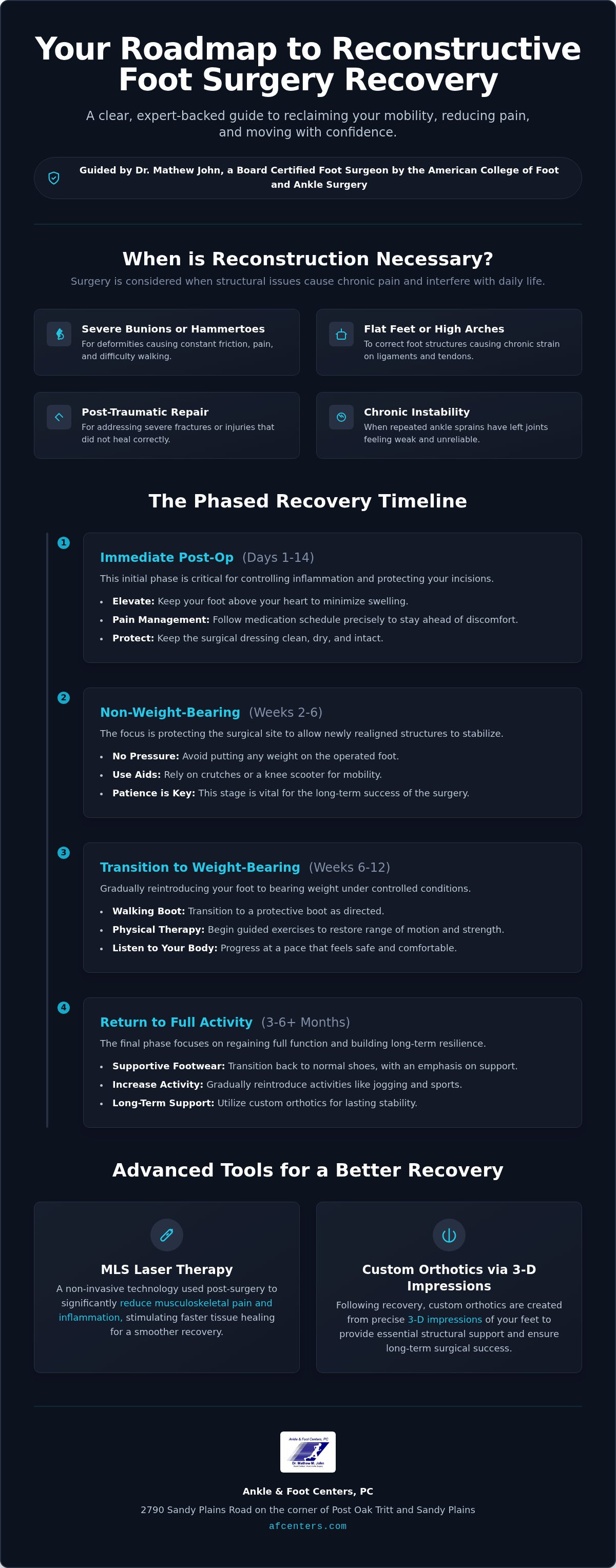
- Map out your reconstructive foot surgery recovery with a phased timeline that prioritizes early pain management and safe mobility milestones.
- Discover how MLS Laser Therapy acts as a non-invasive tool to significantly reduce inflammation and stimulate faster tissue healing after your procedure.
- Learn why custom orthotics created from 3-D impressions are essential for providing the precise structural support your feet need for long-term success.
- Understand the clinical benefits of choosing Dr. Mathew John, a Board Certified Foot Surgeon by the American College of Foot and Ankle Surgery, for your journey.
- Gain professional guidance on transitioning from non-weight-bearing stages back to the activities you love with a focus on progress over perfection.
Understanding Reconstructive Foot Surgery and the Path to Mobility
Reconstructive foot surgery is a specialized field focused on restoring the complex architecture of your foot. While many minor issues respond well to conservative care, certain structural deformities or traumatic injuries require a more definitive approach to regain function. This process involves realigning bones, repairing tendons, or fusing joints to create a stable foundation for your body. Your reconstructive foot surgery recovery isn't just a period of forced rest; it's an active partnership between you and your surgical team. Success relies on surgical precision and your dedication to the healing plan we create together.
When is Reconstruction Necessary?
Choosing surgery is a significant decision, usually reached after non-invasive options no longer provide the relief you need. Foot and ankle surgery becomes necessary when structural issues interfere with your gait or daily quality of life. You can explore our services to see the full range of conditions we address, but reconstruction is most common for:
- Severe bunions or hammertoes: When these deformities cause constant friction and make walking a chore.
- Flat feet or high arches: If your foot structure causes chronic strain on your ligaments and tendons.
- Post-traumatic repair: Following a severe break or injury that didn't heal correctly.
- Chronic instability: When repeated ankle sprains have left your joints feeling weak and unreliable.
In many cases, these conditions lead to a "domino effect." Pain in the foot causes you to change how you walk, which can eventually lead to knee, hip, or back problems. Addressing the root cause through reconstruction stops this cycle and protects your overall musculoskeletal health.
The Goals of Your Reconstructive Procedure
The primary driver for any patient at our clinic is pain reduction. We want you to move without the constant reminder of a nagging ache. Beyond comfort, we focus on restoring the natural alignment and arch of your foot. This ensures that your weight is distributed evenly, protecting your joints for years to come. By choosing a specialist like Dr. Mathew John, a Board Certified Foot Surgeon by the American College of Foot and Ankle Surgery, you're opting for a level of expertise that prioritizes long-term mobility. Whether you want to return to your morning jogs or simply walk through your favorite Marietta neighborhoods, our goal is to get you back to an active lifestyle with confidence. Your reconstructive foot surgery recovery is the bridge to that future. You can find our specialized team at 2790 Sandy Plains Road on the corner of Post Oak Tritt and Sandy Plains, ready to guide you every step of the way.
The Recovery Timeline: From Day One to Full Activity
Your reconstructive foot surgery recovery follows a carefully planned sequence designed to protect the delicate work performed in the operating room. While every patient heals at a different rate, understanding these milestones helps reduce anxiety and keeps you focused on your progress. It's a journey of patience, but each phase brings you closer to the mobility you've been missing. Think of this timeline as a roadmap to your future vitality.
Immediate Post-Operative Care (Days 1–14)
The first 48 hours are critical for controlling inflammation. You must prioritize elevation, keeping your foot above the level of your heart to minimize swelling and protect your incisions. During this time, you'll wear a hard cast or surgical splint provided by Dr. Mathew John, a Board Certified Foot Surgeon by the American College of Foot and Ankle Surgery. It's vital to stay ahead of the pain by following your medication schedule exactly as prescribed. Don't wait for discomfort to become severe before taking your next dose. Keeping the surgical dressing dry and intact is your primary job during these initial two weeks to ensure the skin heals perfectly.
The Transition to Weight-Bearing
As you move into weeks 2 through 6, you'll enter the non-weight-bearing stage. This period is all about surgical site protection. For those recovering from procedures related to Adult Acquired Flatfoot, this phase ensures that the newly realigned structures have time to stabilize before they face the stress of your body weight. You'll likely use a knee scooter or crutches to move around your home safely.
Around the six-week mark, we'll use X-rays to determine if your bone is ready for pressure. If the images show sufficient healing, you'll transition into a protected walking boot. This is an exciting milestone where we introduce gentle range-of-motion exercises. Physical therapy often begins here, focusing on waking up the muscles that have been dormant during your time in a cast. You'll learn how to walk with a natural gait again while the boot provides the necessary structural support.
The final phase of your reconstructive foot surgery recovery spans from month 3 to month 12. This is when bone consolidation reaches its peak. You'll gradually move from the boot back into supportive athletic shoes. By the six-month mark, many patients return to impact activities like jogging or hiking, provided their strength and balance have returned. If you're feeling unsure about your current progress, explore our specialized care options to ensure you're on the right track. Our team at 2790 Sandy Plains Road on the corner of Post Oak Tritt and Sandy Plains is here to support your journey back to full activity.
Accelerating Healing with MLS Laser Therapy
At Ankle & Foot Centers, PC, we go beyond standard protocols to offer advanced recovery tools that prioritize your comfort. One of the most effective methods we use to support your reconstructive foot surgery recovery is MLS Laser Therapy. This non-invasive technology uses specific wavelengths of light to penetrate deep into the tissues, stimulating repair at a foundational level. While standard recovery timelines for foot surgery provide a general guide, integrating laser therapy can help you reach your milestones with greater ease and efficiency.
Unlike traditional lasers, the Multi-Wave Locked System (MLS) delivers synchronized wavelengths that simultaneously address pain and swelling. This is particularly beneficial for difficult-to-heal open wounds or persistent post-surgical swelling that can sometimes stall your progress. By incorporating these sessions into your Marietta recovery plan at our office at 2790 Sandy Plains Road on the corner of Post Oak Tritt and Sandy Plains, you're giving your body a sophisticated edge in the healing process. Under the guidance of Dr. Mathew John, a Board Certified Foot Surgeon by the American College of Foot and Ankle Surgery, your treatment is always tailored to your specific surgical needs.
The science behind the treatment is fascinating. The laser delivers microwave-level light energy that reaches the mitochondria of your cells. This boost of energy accelerates the production of ATP, which is the fuel your cells need to repair themselves. This isn't just about feeling better; it's about physically rebuilding your tissues faster than your body could on its own.
Reducing Inflammation and Post-Surgical Edema
Edema, or swelling, is the body's natural response to surgery, but excessive fluid can put pressure on incisions and slow down tissue repair. MLS Laser Therapy works by flushing out inflammatory markers and improving lymphatic drainage. Reducing this swelling early in your reconstructive foot surgery recovery often leads to a faster return to normal footwear. It's a safe application that we use directly over surgical sites once the initial dressings are removed, providing a gentle yet powerful stimulus for repair without adding any heat or discomfort.
Pain Management Without Heavy Reliance on Medication
Many patients feel anxious about relying on heavy pain medications for extended periods. We offer MLS Laser as a drug-free alternative for managing musculoskeletal pain. By improving blood circulation to the surgical site, the laser brings oxygen and nutrients necessary for tissue repair while calming irritated nerves. Typical benefits include:
- Significant reduction in localized pain after just a few sessions.
- Improved mobility in the small joints of the foot during physical therapy.
- Accelerated closure of surgical incisions and reduced scar tissue.
Most patients see optimal results with a series of sessions spaced throughout the first few weeks of recovery. To learn more about how we integrate this into our comprehensive care, feel free to explore our services. This proactive approach ensures you're never navigating your path to mobility alone.
Maximizing Long-Term Results with 3-D Impressions
Reaching the final stages of your reconstructive foot surgery recovery is a significant milestone. However, the work doesn't stop once your incisions have healed and you've transitioned out of a walking boot. To protect the structural changes made during your procedure, you need a foundation that respects your new alignment. Custom orthotics act as a silent mentor for your feet. They guide your gait and ensure that the pressure of every step is distributed exactly where it should be. Without this specialized support, your feet might attempt to return to old, harmful patterns that led to the need for surgery in the first place.
At our Marietta office, we don't believe in one-size-fits-all solutions. Generic over-the-counter inserts often lack the rigidity and specific contouring required to support a reconstructed arch or realigned joint. Instead, Dr. Mathew John, a Board Certified Foot Surgeon by the American College of Foot and Ankle Surgery, utilizes highly accurate 3-D impressions. This process captures the unique nuances of your foot's anatomy, providing a level of precision that simply isn't possible with mass-produced alternatives. By choosing this advanced approach, you're investing in the long-term success of your surgical outcome.
Why We Prioritize Precision with 3-D Impressions
Achieving a perfect anatomical match is the only way to ensure your foot stays in its corrected position. Our 3-D impressions allow us to create a mold that accounts for the specific height of your arch and the width of your midfoot. This level of detail is vital for correcting any residual gait abnormalities that might have developed over years of living with a deformity. When you finally step back into your favorite athletic or professional shoes, these custom devices provide the comfort and stability you need to move without hesitation. It's about more than just padding; it's about biomechanical harmony.
The Role of Custom Orthotics in Preventing Recurrence
Surgical reconstruction is a powerful tool, but your feet still face the daily stress of gravity and movement. Custom orthotics reinforce the new alignment created during your procedure, acting as a safeguard against future issues. They prevent the development of new stress points that could lead to secondary deformities or chronic pain. For our neighbors in Sandy Springs and across Atlanta, this means maintaining the vitality you've worked so hard to regain during your reconstructive foot surgery recovery. We want your results to last a lifetime, not just a few seasons.
Ready to secure your surgical results with the gold standard of foot support? Schedule your custom 3-D impression fitting at our Marietta clinic today and take the final step toward permanent mobility. You can find us at 2790 Sandy Plains Road on the corner of Post Oak Tritt and Sandy Plains.
Choosing Your Reconstructive Surgeon in Marietta
Selecting the right specialist is the most important decision you'll make for your reconstructive foot surgery recovery. You aren't just looking for a technician; you're looking for a partner who understands the intricate mechanics of your feet and the personal goals you want to achieve. At Ankle & Foot Centers, PC, we provide that expert mentorship. Our clinic serves as a high-tech hub for the Marietta community, offering sophisticated resources in a welcoming, non-judgmental environment. We believe that your journey to mobility should be supported by the highest level of professional guidance.
Board Certification: Why It Matters for Your Feet
When a surgeon is Board Certified by the American College of Foot and Ankle Surgery, it means they've met the most rigorous standards in the profession. Dr. Mathew John has earned this distinction, demonstrating a deep expertise in complex reconstruction. This certification gives you peace of mind that your care is based on the latest surgical advancements and a proven track record of success. Choosing a specialist with these credentials ensures that your unique anatomical needs are met with precision. You won't feel like you're navigating this path alone; you'll have a reliable mentor guiding every step toward your personal health goals.
Comprehensive Care at Ankle & Foot Centers, PC
Our commitment to your vitality extends well beyond the operating room. We provide a full spectrum of podiatric care at 2790 Sandy Plains Road on the corner of Post Oak Tritt and Sandy Plains. This local accessibility means you don't have to travel far for high-end medical support. Whether you're in the middle of your reconstructive foot surgery recovery or looking for solutions to other stubborn foot health challenges, we're here to help.
For instance, we address stubborn or recalcitrant warts using the advanced Swift Treatment. This technology utilizes microwave ablation to target the root of the problem without the need for invasive cutting or chemicals. The process is efficient and typically involves four sessions spaced exactly one month apart. One of the greatest benefits for our active Marietta neighbors is that there's no downtime following the procedure. You can walk out of our office and continue your day immediately, making it a perfect fit for a busy, wellness-oriented lifestyle.
We believe that your foot health is a holistic choice that affects your entire quality of life. From utilizing 3-D impressions for custom orthotics to offering MLS Laser Therapy for post-surgical inflammation, every service we offer is designed to get you back to the activities you love. Explore our services to see how we can support your path to a pain-free life. We're proud to be your expert partner in this journey, ensuring you have the steady hand you need to reach your mobility goals.
Take the First Step Toward Lasting Mobility
Your journey through reconstructive foot surgery recovery is a path toward reclaiming the active lifestyle you deserve. By following a structured timeline and utilizing advanced recovery tools like MLS Laser Therapy, you can navigate the healing process with confidence and clarity. The goal isn't just to walk again; it's to move with a level of comfort and stability that lasts for years. Whether we're using 3-D impressions to create custom support or addressing recalcitrant warts with Swift Treatment, our focus remains on your long-term vitality and comfort.
At Ankle & Foot Centers, PC, you'll receive professional guidance from Dr. Mathew John, a Board Certified Foot Surgeon by the American College of Foot and Ankle Surgery. Our Marietta clinic, located at 2790 Sandy Plains Road on the corner of Post Oak Tritt and Sandy Plains, is your localized hub for sophisticated podiatric care. Schedule your consultation with Dr. Mathew John today and let's begin your personal journey toward a pain-free future. You have the strength to heal, and we have the expertise to guide you every step of the way.
Frequently Asked Questions
How long is the typical recovery for reconstructive foot surgery?
The timeline for reconstructive foot surgery recovery varies depending on the specific tissues repaired, but most patients follow a twelve-month arc to reach full mobility. Soft tissues typically stabilize within three weeks, while bone consolidation takes approximately three months. You can generally expect to return to high-impact activities between six and twelve months after your procedure. We provide a customized roadmap during your visits to ensure you're hitting every milestone safely and effectively.
Can MLS Laser Therapy help me recover from surgery faster?
Yes, MLS Laser Therapy is an excellent tool for accelerating the healing process. It uses specific wavelengths of light to reduce post-surgical inflammation and stimulate repair at the cellular level. By flushing out inflammatory markers and improving local circulation, this non-invasive treatment helps manage musculoskeletal pain and reduces swelling. Many patients find that incorporating these sessions into their plan allows for a more comfortable transition back to daily activities and footwear.
When can I start driving after reconstructive surgery on my right foot?
Driving typically requires you to be completely off narcotic pain medications and have enough strength to perform an emergency brake maneuver. For surgery on the right foot, this milestone often occurs between six and eight weeks post-operatively once you've transitioned into a walking boot. Dr. Mathew John will evaluate your reaction time and foot strength during your follow-up visits in Marietta to ensure it is safe for you and others on the road.
Why are 3-D impressions better than standard orthotics after surgery?
Standard over-the-counter inserts provide generic cushioning, but 3-D impressions capture the exact anatomical nuances of your reconstructed foot. This precision is vital for maintaining the new alignment created during your surgery and preventing the recurrence of deformities. By using these detailed molds, we create custom orthotics that distribute pressure evenly and support your unique gait. This level of personalized care ensures your surgical investment is protected for years of active use and long-term health.
What is Swift Treatment and can it be done during my recovery?
Swift Treatment is an advanced microwave ablation technology used to treat stubborn or recalcitrant warts. It typically involves four sessions spaced exactly one month apart and features the major benefit of having no downtime for patients. While we can often perform this during your reconstructive foot surgery recovery, it depends on the location of the wart relative to your surgical site. We'll assess your healing progress to determine the safest time to begin this specialized treatment.
Will I need physical therapy after my reconstructive procedure?
Most patients benefit significantly from physical therapy once they reach the weight-bearing stage of recovery. After weeks of limited movement, your muscles and joints need guided exercises to regain strength and flexibility. Therapy helps you transition from a walking boot back into standard shoes while correcting any temporary changes in your gait. This professional guidance ensures that you don't overexert yourself too early, promoting a steady and successful return to your favorite fitness routines.
Is Dr. Mathew John board certified in foot surgery?
Yes, Dr. Mathew John is a Board Certified Foot Surgeon by the American College of Foot and Ankle Surgery. This credential represents the highest level of training and expertise in the field of reconstructive foot and ankle procedures. Choosing a board-certified specialist ensures that your care is managed by an expert who stays current with the latest surgical advancements and safety protocols. You can find his specialized practice at 2790 Sandy Plains Road on the corner of Post Oak Tritt and Sandy Plains.
What should I bring to my first post-operative appointment in Marietta?
Please bring your post-operative instructions, a list of any medications you're currently taking, and your walking aids, such as crutches or a knee scooter. It's also helpful to have a list of any questions about your reconstructive foot surgery recovery or pain management levels. We'll perform a thorough check of your surgical site and may take X-rays to monitor bone healing. Our team is dedicated to providing a supportive environment at our office located on the corner of Post Oak Tritt and Sandy Plains.


