

You swing your legs out of bed expecting a fresh start, but the moment your feet hit the floor, a sharp, stabbing sensation shoots through your heel. It's a frustrating way to begin the day, especially when that persistent ache keeps you from your favorite morning walk or weekend hike. You likely want to avoid invasive surgery and long recovery times, yet you're tired of temporary fixes that don't solve the underlying problem. It's common to feel stuck between chronic pain and the fear of a scalpel.
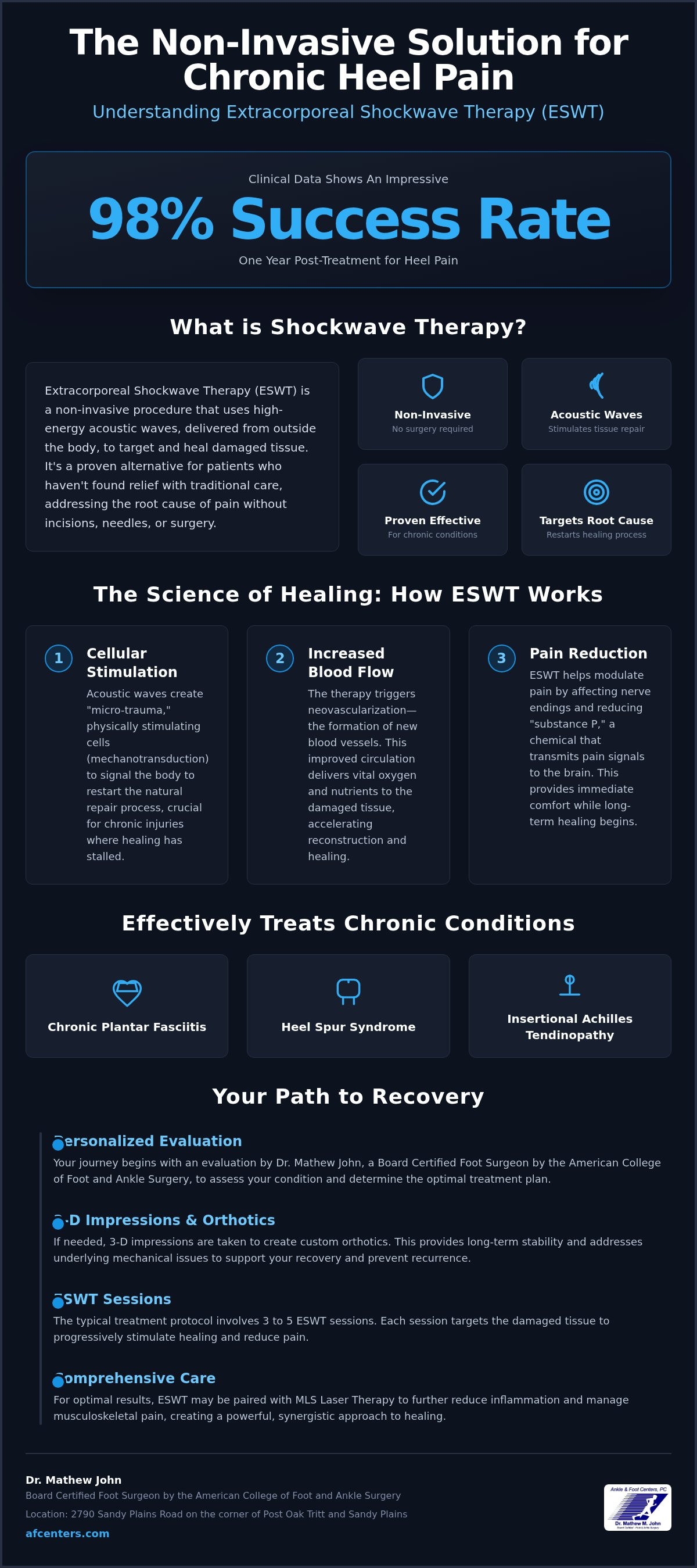
The good news is that the success rate of shockwave therapy for heel pain has reached impressive new heights. Clinical data from 2026 shows that radial shockwave therapy can achieve a 98% success rate one year post-treatment. At our office at 2790 Sandy Plains Road on the corner of Post Oak Tritt and Sandy Plains, Dr. Mathew John, a Board Certified Foot Surgeon by the American College of Foot and Ankle Surgery, uses this advanced technology to help patients reclaim their mobility. This guide will show you how ESWT works as a non-invasive bridge to recovery. You'll discover the treatment timeline and how you can return to an active lifestyle without relying on steroid injections or surgery.
Key Takeaways
- Discover how non-invasive acoustic waves trigger your body's natural healing process to resolve chronic plantar fasciitis and Achilles tendinopathy without surgery.
- Review current clinical data showing that the success rate of shockwave therapy for heel pain can reach 98% for long-term recovery and functional improvement.
- Learn how Dr. Mathew John, a Board Certified Foot Surgeon by the American College of Foot and Ankle Surgery, integrates 3-D impressions for custom orthotics to support your treatment results.
- Explore the benefits of a comprehensive approach that pairs ESWT with MLS Laser Therapy to effectively target inflammation and musculoskeletal pain.
- Understand the typical journey of 3 to 5 sessions at our Marietta clinic located at 2790 Sandy Plains Road on the corner of Post Oak Tritt and Sandy Plains.
What is Extracorporeal Shockwave Therapy (ESWT) for Heel Pain?
Living with chronic heel pain often feels like a cycle of temporary relief followed by frustrating setbacks. You might've tried stretches, ice, or over-the-counter inserts without finding lasting comfort. Extracorporeal Shockwave Therapy (ESWT) offers a different path. It's a non-invasive procedure that uses high-energy acoustic waves to target damaged tissue. The term "extracorporeal" simply means the treatment happens outside your body. No incisions, no needles, and no hospital stays are required.
This technology is a significant game-changer for people who haven't found success with traditional conservative care like physical therapy or stretching. Instead of just masking symptoms, ESWT addresses the root cause of the pain by restarting the healing process in stalled, chronic injuries. It's particularly effective for chronic plantar fasciitis and Achilles tendinopathy. Knowing that the success rate of shockwave therapy for heel pain is backed by clinical data helps many patients feel confident choosing this non-invasive route over more aggressive surgical options.
The Evolution of Shockwave Technology
While it feels like a modern miracle, this technology has deep roots in medical history. It originally gained fame as lithotripsy, a method used to break up kidney stones without surgery. Doctors eventually realized that lower energy levels could stimulate healing in tendons and ligaments. Today, we use two main types: radial waves for broader areas and focused waves for deeper, specific points. ESWT is a regenerative tool that triggers the body’s natural healing response.
Common Conditions Treated in Marietta
At our clinic, we focus on resolving the specific issues that keep you off your feet. Plantar fasciitis and heel spur syndrome are the most frequent conditions we treat with this therapy. We also see excellent results for patients struggling with insertional Achilles tendonitis, where the tendon meets the heel bone. These conditions often share a common trait: they involve damaged tissue that has stopped healing on its own.
Dr. Mathew John, a Board Certified Foot Surgeon by the American College of Foot and Ankle Surgery, personally evaluates every patient at our office at 2790 Sandy Plains Road on the corner of Post Oak Tritt and Sandy Plains. He examines your foot structure and may utilize 3-D impressions to determine if custom orthotics are needed to provide long-term stability. By reviewing the comprehensive range of services we offer, you can see how we build a personalized recovery plan. The success rate of shockwave therapy for heel pain is often maximized when we address both the immediate injury and the mechanical issues that caused it.
The Science of Healing: How Shockwave Therapy Works
Understanding the biology behind this treatment helps you see why the success rate of shockwave therapy for heel pain is so high for chronic cases. It isn't just a simple vibration or massage. Instead, ESWT relies on a process called mechanotransduction. This scientific term describes how acoustic waves physically stimulate your cells to trigger a healing response. When these waves penetrate the damaged fascia, they send signals to your body that it's time to repair the area. This is vital for chronic conditions where your body has essentially stopped trying to heal itself.
The therapy also modulates pain by affecting nerve endings and reducing the presence of substance P, a chemical that transmits pain signals to your brain. By interrupting these signals, you often experience a decrease in sensitivity shortly after the session. This provides a window of comfort while the deeper biological repair begins. If you're ready to explore these advanced treatments, you can learn more about our specialized foot care and how we tailor these solutions to your needs.
Neovascularization and Tissue Repair
One of the most important effects of ESWT is neovascularization, which is the formation of new blood vessels. Chronic heel pain often persists because tendons and ligaments have a naturally poor blood supply. The "micro-trauma" created by the shockwaves encourages your body to grow new capillaries in the area. These new vessels deliver oxygen and essential nutrients directly to the damaged tissue, allowing it to rebuild. This biological reboot is why Dr. Mathew John, a Board Certified Foot Surgeon by the American College of Foot and Ankle Surgery, recommends this therapy for patients who have hit a plateau with other treatments.
Immediate vs. Long-Term Biological Responses
You might notice a short-term analgesic effect immediately after your visit to our office at 2790 Sandy Plains Road on the corner of Post Oak Tritt and Sandy Plains. While this initial relief is encouraging, the real structural changes happen over a 12-week window. During this time, your body increases collagen production, which is the building block of healthy tendons. Unlike steroid injections, which can sometimes weaken the tissue or cause the fat pad to thin, ESWT actually strengthens the heel. It works with your body's natural rhythms to produce lasting results rather than a temporary mask for your symptoms.
Analyzing the Success Rate of Shockwave Therapy for Heel Pain
When you consider a new medical treatment, the first question you likely ask is whether it actually works. Success isn't just a abstract number; it's a measure of how quickly you can return to your daily life. The success rate of shockwave therapy for heel pain is exceptionally high, especially for those who've struggled with chronic symptoms for six months or longer. Clinical studies generally show that between 70% and 80% of patients experience significant relief after a standard course of treatment. However, "success" in our Marietta office means more than just a lower number on a pain scale. We define it as your ability to walk the dog, run errands, or return to your favorite sport without that familiar stabbing sensation in your heel.
When compared to traditional surgical intervention, ESWT offers a compelling advantage. Surgery often involves a long recovery period, potential scar tissue, and time away from work. In contrast, recent data from 2026 indicates that patients receiving radial shockwave therapy reported a 98% success rate one year after their initial treatment. This long-term durability is a key reason why Dr. Mathew John, a Board Certified Foot Surgeon by the American College of Foot and Ankle Surgery, prioritizes this non-invasive approach. It allows for functional improvement and tissue regeneration without the inherent risks of an operating room.
What Clinical Studies Reveal
Research indicates that high-energy ESWT often yields a better success rate than lower-energy applications for chronic plantar fasciitis. This is particularly true for recalcitrant cases where other conservative treatments have failed to provide relief. Clinical data consistently shows ESWT as a superior alternative to repetitive cortisone shots. While cortisone might provide a quick fix for inflammation, it doesn't address the underlying structural damage of the fascia or promote long-term tissue repair like shockwave therapy does.
Factors That Influence Your Personal Success Rate
Your individual journey toward a pain-free life depends on several specific factors. The duration of your condition matters; chronic cases often need the biological "reboot" that acoustic waves provide. Patient compliance is also vital. Following post-treatment activity modifications ensures the newly forming tissue has the time it needs to strengthen and mature. Finally, your underlying foot structure and biomechanics play a major role in your recovery. At our office at 2790 Sandy Plains Road on the corner of Post Oak Tritt and Sandy Plains, we use 3-D impressions to identify structural issues. Combining ESWT with custom orthotics helps maintain your results and prevents the original pain from returning.
What to Expect: The ESWT Treatment Journey in Marietta
Starting your recovery journey begins with a clear plan. When you visit our office at 2790 Sandy Plains Road on the corner of Post Oak Tritt and Sandy Plains, your experience is guided by clinical expertise. Dr. Mathew John, a Board Certified Foot Surgeon by the American College of Foot and Ankle Surgery, starts with a comprehensive diagnostic evaluation. This includes taking 3-D impressions of your feet to understand the mechanical stressors contributing to your condition. Understanding your foot's unique structure is a key factor in maximizing the success rate of shockwave therapy for heel pain. Most patients follow a protocol of 3 to 5 sessions, typically spaced one week apart to allow the biological healing response to build momentum between visits.
Your First Session at Sandy Plains Road
The actual procedure is straightforward and efficient. You'll be positioned comfortably while a coupling gel is applied to the treatment area. This gel ensures the acoustic waves travel effectively into the tissue. As the probe moves over your heel, you'll feel a rhythmic "tapping" sensation. While some patients find this slightly uncomfortable, we adjust the intensity to your tolerance level. No anesthesia is required, and the entire process usually takes only 15 to 20 minutes. You can walk out of the office immediately after and resume most light daily activities.
Recovery and Complementary Care
To get the most out of your sessions, we ask you to follow a specific post-treatment protocol. One of the most important rules is to avoid anti-inflammatory medications like ibuprofen or naproxen. Because ESWT works by re-initiating a natural inflammatory healing cycle, these drugs can actually dampen the treatment's effectiveness. Instead, we focus on structural support. Using 3-D impressions, we create custom orthotics that stabilize your gait and protect the healing fascia. Stabilizing your foot mechanics ensures the high success rate of shockwave therapy for heel pain translates into a permanent solution for your lifestyle.
This holistic approach is part of why we are a trusted source for Heel Pain Relief in Marietta. If you're ready to take the first step toward a pain-free life, you can schedule your evaluation with our team today. We'll work together to build a path that gets you back to the activities you love without the need for invasive surgery.
Why Choose Ankle & Foot Centers, PC for Your Heel Pain
Choosing the right partner for your health journey makes all the difference when you're dealing with chronic pain. You aren't just looking for a procedure; you're looking for a specialist who understands the complex mechanics of the human foot. At our practice, we provide a sophisticated environment where advanced technology meets personal, community-focused care. We see ourselves as your expert partner, guiding you through every step of the recovery process with a steady and reliable hand.
Meet Dr. Mathew John, DPM, FACFAS
Dr. Mathew John is a Board Certified Foot Surgeon by the American College of Foot and Ankle Surgery. His philosophy centers on finding the most effective, least invasive solution for your specific needs. While he possesses the high-level expertise required for complex reconstructive surgery, he prioritizes conservative care to help you avoid the operating room whenever possible. His primary goal is returning you to a pain-free, active lifestyle where you can enjoy your daily walks or gym sessions without hesitation. You'll find that his approach emphasizes long-term health and steady progress over quick, temporary fixes.
Advanced Technology Under One Roof
We believe that sophisticated resources should be accessible within your community. Our Marietta office serves the Atlanta Metro area with a suite of modern tools designed to work in harmony. For example, we often pair ESWT with MLS Laser Therapy. While the shockwaves "reboot" the biological healing process, the MLS Laser Therapy specifically targets musculoskeletal pain and deep-seated inflammation. This multi-modal approach is a significant reason why the success rate of shockwave therapy for heel pain is so consistently high for our patients. We also offer specialized solutions for other conditions, such as Swift Treatment for stubborn warts. This microwave ablation technology typically involves four sessions spaced one month apart and requires absolutely no downtime.
Our facility is designed to be a localized hub for total foot health. Whether we are using 3-D impressions to craft custom orthotics or applying regenerative therapies, we ensure you never feel like you're navigating your path alone. If you're ready to leave heel pain behind, we invite you to visit us at 2790 Sandy Plains Road on the corner of Post Oak Tritt and Sandy Plains. You can explore our full range of services and schedule your evaluation to see how our professional guidance can transform your mobility.
Step Into a Pain-Free Future
You don't have to accept chronic heel pain as a permanent part of your daily life. By choosing a non-invasive path like ESWT, you're opting for a biological reboot that addresses the root cause of your discomfort rather than just masking the symptoms. The impressive success rate of shockwave therapy for heel pain proves that even long-standing conditions can resolve with the right technology and expert guidance. At our Marietta location at 2790 Sandy Plains Road on the corner of Post Oak Tritt and Sandy Plains, we combine this powerful therapy with 3-D impressions and MLS Laser technology to ensure your recovery is comprehensive.
Dr. Mathew John, a Board Certified Foot Surgeon by the American College of Foot and Ankle Surgery, is ready to help you navigate your personal journey back to health. Whether you want to return to morning runs or simply walk through the grocery store without a stabbing sensation, a professional evaluation is the first step. Schedule your heel pain evaluation with Dr. Mathew John today and discover how advanced care can restore your mobility. We look forward to supporting your progress toward a more active, vibrant lifestyle.
Frequently Asked Questions
Is shockwave therapy for heel pain painful?
Shockwave therapy is generally described as a series of rhythmic tapping sensations rather than intense pain. Most patients find it manageable without any local anesthesia. During your session at our Marietta clinic, we adjust the energy levels to match your comfort while ensuring the treatment remains effective. While you might feel some mild discomfort during the 15 to 20 minute procedure, the sensation typically subsides immediately after the probe is removed from your heel.
How many sessions of ESWT will I need for my heel pain?
Most patients require a series of 3 to 5 sessions to achieve the best results. These visits are typically spaced one week apart to allow your body to respond to the acoustic waves. This protocol is designed to build a cumulative healing effect in the damaged fascia. Dr. Mathew John monitors your progress throughout these sessions to ensure you're on the right track toward the high success rate of shockwave therapy for heel pain.
When will I start to feel the results of shockwave therapy?
You might experience a temporary decrease in pain immediately after your first visit due to the analgesic effect on local nerves. However, the true biological repair takes time. The peak period for tissue regeneration and collagen production occurs within a 12-week window following your final session. You should remain patient as your body builds new blood vessels and strengthens the heel structure during this critical recovery phase.
Are there any side effects or risks associated with ESWT?
ESWT is a very safe, non-invasive procedure with minimal side effects. Some patients experience mild redness, swelling, or temporary bruising at the treatment site. These minor reactions usually resolve within a few days. Because the therapy happens outside the body, you don't face the risks of infection or scarring associated with surgery. It's an excellent alternative for those who want to avoid the tissue-weakening potential of repeated steroid injections.
Can I walk or exercise immediately after a shockwave treatment?
You can walk and perform normal daily activities immediately after your treatment at 2790 Sandy Plains Road on the corner of Post Oak Tritt and Sandy Plains. There's no downtime required, which makes it a convenient option for busy individuals. We do recommend avoiding high-impact sports or long-distance running for about 48 hours after each session. This brief period of rest helps protect the area while your body's initial healing response begins.
Is shockwave therapy covered by insurance in Marietta, GA?
Insurance coverage for shockwave therapy in Marietta varies significantly depending on your specific health plan. Some insurers provide coverage for chronic plantar fasciitis if you've documented six months of failed conservative treatments. Other plans may still classify it as investigational. We recommend contacting your provider directly to verify your benefits. You can also use funds from a Health Savings Account (HSA) or Flexible Spending Account (FSA) for these services.
What is the difference between ESWT and MLS Laser therapy?
The technology used to stimulate healing is the main difference. ESWT utilizes high-energy acoustic waves to create micro-trauma and restart the healing cycle in chronic injuries. MLS Laser Therapy uses specific wavelengths of light to reduce inflammation and manage musculoskeletal pain. At our practice, we often combine these tools to maximize the success rate of shockwave therapy for heel pain by addressing both the structural injury and the surrounding inflammation.
What happens if shockwave therapy does not work for my heel pain?
If ESWT doesn't provide the desired relief, Dr. Mathew John, a Board Certified Foot Surgeon by the American College of Foot and Ankle Surgery, will re-evaluate your condition. We may look closer at your biomechanics using 3-D impressions for custom orthotics to provide better structural support. In some recalcitrant cases, surgical options might be discussed. Because ESWT is non-invasive, it doesn't prevent you from pursuing other treatments or surgery later if it's eventually required.


