
The ice pack you typically reach for after an injury might actually be your recovery's worst enemy following a session of Extracorporeal Shockwave Therapy (ESWT). It feels counterintuitive, but because this treatment intentionally triggers a healing inflammatory response, cooling it down can stall your progress. If you're feeling a bit lost regarding what to do after shockwave therapy session, you aren't alone. Many patients come to us at Ankle & Foot Centers, PC, feeling overwhelmed by contradictory advice or the fear of accidentally undoing their progress.
We believe your recovery should be a journey of confidence, not guesswork. Dr. Mathew John, a Board Certified Foot Surgeon by the American College of Foot and Ankle Surgery, emphasizes that your actions in the days following treatment are vital. This guide provides a clear, expert-backed roadmap to help you protect your investment in your health. We'll outline a precise recovery timeline, list safe medications, and explain how to support your body's natural healing. You deserve a pain-free return to the activities you love, and we're here to guide you at our office at 2790 Sandy Plains Road on the corner of Post Oak Tritt and Sandy Plains.
Key Takeaways
- Understand how Extracorporeal Shockwave Therapy (ESWT) acts as a regenerative catalyst by using controlled inflammation to signal your body's natural repair systems.
- Discover exactly what to do after shockwave therapy session to safeguard your progress, starting with the critical rule to skip ice and NSAIDs for the first 48 hours.
- Identify the essential nutrients and hydration habits that support new blood vessel formation and collagen synthesis during your intensive healing phase.
- Learn how to balance activity with "relative rest" and why custom orthotics created from 3-D impressions are a vital partner for long-term structural support.
- Gain peace of mind with expert oversight from Dr. Mathew John, a Board Certified Foot Surgeon by the American College of Foot and Ankle Surgery, at our clinic on Sandy Plains Road.
Understanding the Biological Healing Response After ESWT
Extracorporeal shockwave therapy (ESWT) isn't just a simple procedure; it's a powerful regenerative catalyst for your body. At Ankle & Foot Centers, PC, Dr. Mathew John, a Board Certified Foot Surgeon by the American College of Foot and Ankle Surgery, utilizes this technology to jumpstart healing in tissues that have stalled in their recovery. By delivering high-energy acoustic pulses to the site of your pain, we're essentially waking up your body's natural repair mechanisms.
Many patients feel concerned when they hear the word inflammation, but ESWT relies on "controlled inflammation." This is a deliberate, localized micro-trauma that serves as a repair signal. It alerts your immune system to send specialized healing cells to the area, which is vital for treating chronic conditions like plantar fasciitis or Achilles tendonitis. This process effectively transitions an injury from a stagnant, chronic state back into an active, acute healing phase.
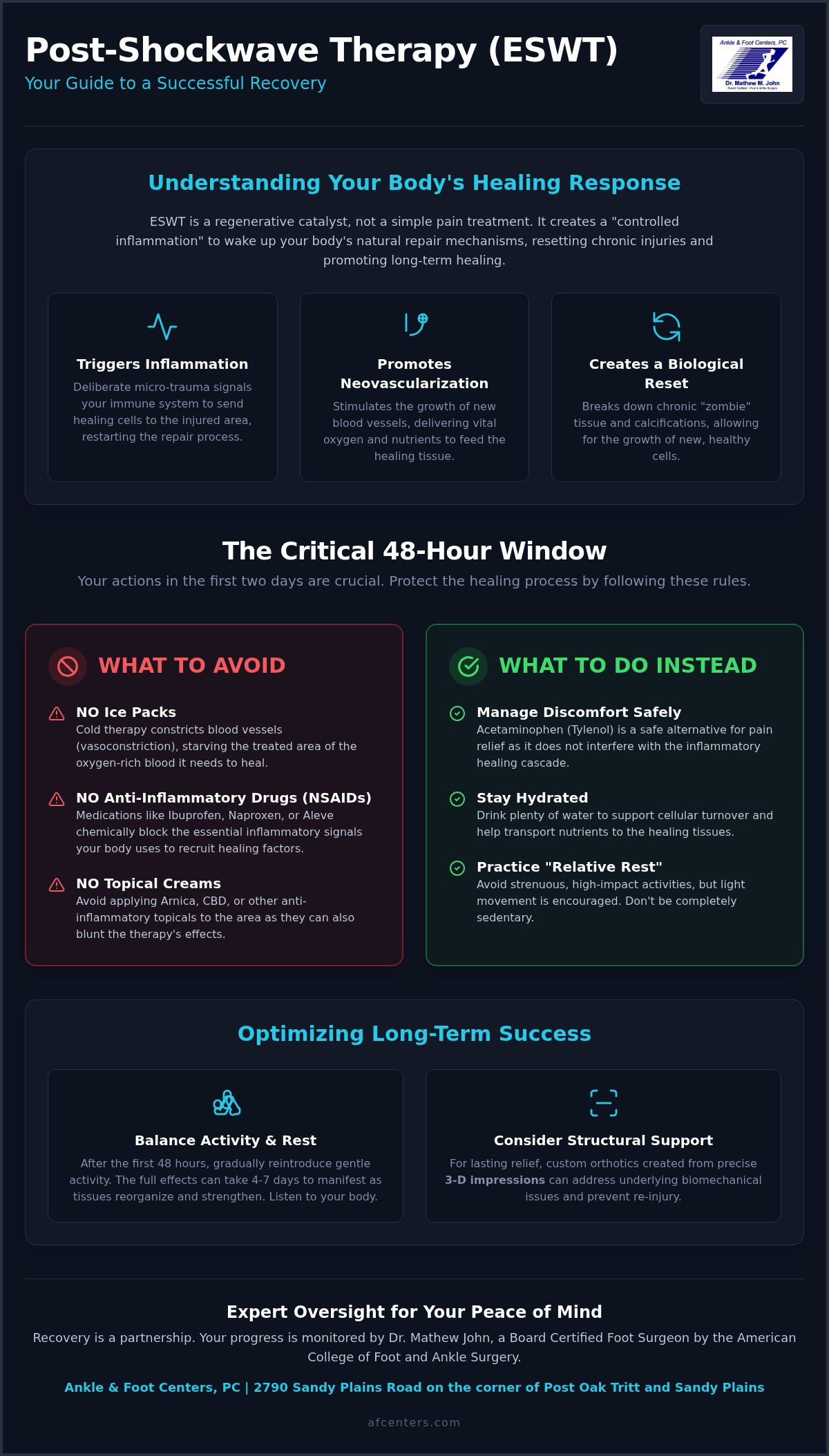
A major benefit of this therapy is neovascularization, which is the creation of new blood vessels. These microscopic channels are essential because they "feed" the injured area with oxygen and nutrient-rich blood. The first 48 hours represent a critical window where your body begins this intensive cellular turnover. Knowing exactly what to do after shockwave therapy session during this timeframe is the difference between a successful recovery and a stalled one. Every choice you make in these first two days helps protect the new biological framework your body is building.
How Shockwaves 'Reset' Chronic Injuries
Chronic injuries often involve "zombie" tissue or painful calcifications that your body has stopped trying to fix. High-energy acoustic waves physically break down these internal barriers without the need for invasive surgery. Unlike traditional treatments that might merely mask symptoms, ESWT releases specific growth factors that stimulate the production of fresh, vibrant cell tissue. You can view it as a biological reset button for your feet and ankles. It's a sophisticated alternative for those looking to avoid reconstructive foot and ankle surgery while still achieving long-term relief.
What to Expect: Immediate Post-Session Sensations
It's common to experience mild soreness, stiffness, or even a "shooting" sensation the night after your visit to our office at 2790 Sandy Plains Road on the corner of Post Oak Tritt and Sandy Plains. This temporary discomfort is a clear signal that the healing process has been triggered. You aren't being re-injured; you're being repaired. While some patients notice a change quickly, the full effect of a single session often takes 4 to 7 days to fully manifest as your tissues begin to reorganize and strengthen.
The Essential 'Don't' List: Protecting Your Results
Protecting your results requires a temporary shift in how you handle recovery. While your instinct might be to reach for an ice pack or a bottle of Advil after feeling post-treatment soreness, these common remedies can actually sabotage the healing process we started at Ankle & Foot Centers, PC. Dr. Mathew John, a Board Certified Foot Surgeon by the American College of Foot and Ankle Surgery, advises all patients to strictly avoid anti-inflammatory measures for at least the first 48 hours. If you are wondering what to do after shockwave therapy session to ensure success, the answer often starts with what you should avoid.
Why NSAIDs and Ice are Counterproductive
Shockwave therapy relies on a specific biological "pro-inflammatory" window to work. When you take NSAIDs like Ibuprofen, Naproxen, or Aleve, you're chemically blocking the very signals your body uses to recruit growth factors and repair damaged tissue. It’s essentially like turning off the alarm while the fire department is trying to find the fire. You want that inflammation to persist briefly because it's the engine of your recovery.
The "No Ice" rule follows the same logic. Cold therapy causes vasoconstriction, which narrows blood vessels and reduces the circulation we worked so hard to stimulate during your session. We want the treated area warm and filled with nutrient-rich blood to support cellular turnover. For pain management, Acetaminophen (Tylenol) is typically a safe alternative because it manages discomfort without interfering with the inflammatory healing response. You should also skip topical creams like Arnica or CBD during this initial window, as they can also blunt the therapy's effectiveness.
Managing Discomfort Safely
Instead of reaching for the freezer, focus on supporting your body from the inside out. Drink plenty of water to help your lymphatic system flush out metabolic waste and keep your tissues elastic. If the treated area feels particularly stiff or achy, a warm (not hot) Epsom salt soak can provide relief without the negative effects of ice. Magnesium creams can also be helpful for muscle relaxation as long as they don't contain anti-inflammatory agents.
Gentle range-of-motion exercises are encouraged to prevent stiffness. You don't need to stay in bed, but you must avoid high-impact activities like running, jumping, or heavy lifting for at least 48 hours. This period of "relative rest" allows the tissue to begin its structural reorganization without the risk of re-injury. If you have questions about specific activity levels or other podiatric services we offer, our team at 2790 Sandy Plains Road on the corner of Post Oak Tritt and Sandy Plains is always ready to provide personalized guidance.
Optimizing Recovery Through Lifestyle and Nutrition
While the shockwaves do the heavy lifting of breaking down damaged tissue, your daily habits provide the raw materials for rebuilding it. Think of your body as a construction site; Dr. Mathew John has provided the blueprint and the initial spark, but your nutrition determines the quality of the new foundation. Knowing what to do after shockwave therapy session involves more than just avoiding certain medications; it requires actively nourishing your cells to support the work we do at Ankle & Foot Centers, PC.
Dr. Mathew John, a Board Certified Foot Surgeon by the American College of Foot and Ankle Surgery, emphasizes that systemic health directly impacts localized healing. When your body is well-rested and properly fueled, it can dedicate more resources to the "controlled inflammation" site in your foot or ankle. This holistic approach ensures that the regenerative signals sent by the ESWT equipment result in strong, flexible new tissue rather than a stalled recovery.
Fueling Tissue Regeneration
Protein is the non-negotiable building block for repairing the plantar fascia and various tendons. Since these structures are primarily composed of collagen, increasing your intake of lean meats, beans, or Greek yogurt helps provide the amino acids necessary for structural repair. You should pair these proteins with Vitamin C-rich foods like citrus or bell peppers, and Zinc sources like pumpkin seeds, to accelerate collagen synthesis. We recommend focusing your "recovery plate" on whole, nutrient-dense foods for the first 72 hours to maximize the regenerative window. Antioxidant-rich foods, such as blueberries and leafy greens, also support vascular health, ensuring that the new blood vessels formed during neovascularization remain healthy and efficient.
Hydration and Metabolic Waste
Water is the primary transport system for the healing proteins and growth factors moving toward your treatment site. Staying well-hydrated also maintains tissue elasticity, which significantly reduces the post-treatment stiffness many patients experience. When you're dehydrated, your blood is more viscous, making it harder for those essential nutrients to reach the microscopic repair zones in your feet. Aim for a consistent intake of water, ideally 8 to 10 glasses a day, during the 48 hours following your visit to our office at 2790 Sandy Plains Road on the corner of Post Oak Tritt and Sandy Plains.
Quality sleep is when the real magic happens. During 7 to 9 hours of deep rest, your body releases systemic growth hormones that are essential for tissue repair. To keep your internal environment optimal, try to limit pro-inflammatory triggers like processed sugars and excessive alcohol. These substances can create systemic stress that competes with your foot's healing signals. By prioritizing rest and clean fuel, you're giving your body the best possible chance to return to a pain-free life.
Activity Guidelines and Long-Term Structural Support
Shockwave therapy is a powerful tool for biological repair, but it doesn't change the underlying mechanics of how you walk or run. If your injury was born from structural issues like flat feet or high arches, the regenerative benefits of ESWT need a stable foundation to "stick." Determining exactly what to do after shockwave therapy session involves balancing smart movement with long-term protection. At Ankle & Foot Centers, PC, we view ESWT as the "fix" and custom orthotics as the "insurance policy" that prevents your pain from returning.
Dr. Mathew John, a Board Certified Foot Surgeon by the American College of Foot and Ankle Surgery, often recommends a period of "relative rest" following your procedure. This doesn't mean staying in bed; rather, it means staying active without overstressing the specific limb we treated. By managing your physical load, you allow the newly triggered growth factors to organize into healthy, resilient tissue.
The Role of 3-D Impressions in Preventing Re-Injury
To ensure your recovery is permanent, we use advanced 3-D impressions to create precise corrective devices. Unlike generic store-bought inserts that offer a "one size fits most" approach, 3-D impressions capture the unique, complex architecture of your foot. These custom orthotics are designed to offload pressure from the plantar fascia or Achilles tendon, giving those tissues the space they need to heal after ESWT. By correcting your foot's alignment, these devices address the root cause of your injury rather than just the symptoms. If you're ready to secure your long-term health, explore our custom orthotics and podiatric services today.
Returning to Your Active Marietta Lifestyle
Getting back to the walking trails around Sandy Plains Road is a top priority for our patients. We recommend a conservative timeline for returning to activity. For the first 24 hours, stick to light, essential walking around your home. Between 48 and 72 hours, you can typically transition to moderate activity, such as a gentle stroll at a local park. If you're a runner or athlete in the Atlanta area, we'll work with you on a gradual return-to-play protocol that monitors your progress session by session.
Listen closely to your body for "red flag" pains. Sharp, stabbing sensations or an increase in swelling are signs that you're pushing too hard too soon. If you experience these, scale back your activity and give your tissues more time to respond to the therapy. Our goal at 2790 Sandy Plains Road on the corner of Post Oak Tritt and Sandy Plains is to ensure you feel supported through every step of this transition. Understanding what to do after shockwave therapy session regarding your movement levels is the best way to turn temporary relief into a lifetime of mobility.
Professional Follow-Up at Ankle & Foot Centers, PC
Your journey toward a pain-free life doesn't end when the shockwave machine is turned off. While the initial biological reset happens in our office, the long-term success of the treatment depends on professional oversight and a structured plan. At Ankle & Foot Centers, PC, we pride ourselves on being more than just a clinic; we're your partners in health. Dr. Mathew John, a Board Certified Foot Surgeon by the American College of Foot and Ankle Surgery, provides the high-level expertise needed to ensure your recovery stays on track. Understanding what to do after shockwave therapy session involves staying connected with your care team to monitor how your tissues are responding to the regenerative signals.
Comprehensive Foot and Ankle Care
There's a significant advantage to receiving ESWT from a specialist who understands the internal mechanics of your feet. While general physical therapy is valuable for overall movement, a podiatric surgeon brings a deeper understanding of the complex bone and ligament structures involved in chronic pain. Dr. Mathew John takes a mentorship approach, guiding you through each phase of healing with a focus on progress over perfection. For many of our neighbors in Marietta, ESWT is just one piece of a holistic recovery strategy. We often integrate this treatment with other advanced options, such as MLS Laser Therapy, to manage musculoskeletal pain and inflammation more effectively. By visiting our office, you gain access to a full suite of podiatric services designed to support your personal goals and long-term vitality.
When to Contact Your Marietta Podiatrist
Recovery is rarely a perfectly straight line, and it's normal to have questions as your body begins to rebuild. While mild soreness is expected, you should know which symptoms warrant an earlier-than-planned follow-up. We encourage you to reach out to our office at 2790 Sandy Plains Road on the corner of Post Oak Tritt and Sandy Plains if you experience any of the following:
- Pain that intensifies significantly after the initial 48-hour window.
- New or unusual numbness or tingling in the treated foot.
- Severe swelling or redness that doesn't respond to elevation.
- Uncertainty about what to do after shockwave therapy session regarding your specific activity levels.
We're located at 2790 Sandy Plains Road on the corner of Post Oak Tritt and Sandy Plains, providing a sophisticated and welcoming environment for your follow-up care. Remember, you aren't navigating this path alone. Whether we're adjusting your custom orthotics made from 3-D impressions or simply checking your progress, our team is dedicated to your long-term health. Recovery is a rewarding journey, and we're honored to be the expert partners guiding you back to the activities you love.
Take the Next Step Toward Lasting Relief
You've taken a significant step toward reclaiming your active lifestyle by choosing Extracorporeal Shockwave Therapy. Success now depends on supporting that biological reset through mindful recovery. By respecting the inflammatory window, fueling your body with the right nutrients, and utilizing custom orthotics made from 3-D impressions, you ensure your healing is both deep and durable. Knowing what to do after shockwave therapy session transforms a medical procedure into a lifelong wellness victory.
At Ankle & Foot Centers, PC, we're dedicated to your progress. Dr. Mathew John, a Board Certified Foot Surgeon by the American College of Foot and Ankle Surgery, combines specialized ESWT technology with a personalized touch to help you achieve your goals. Visit our convenient Marietta location at 2790 Sandy Plains Road on the corner of Post Oak Tritt and Sandy Plains to finalize your recovery plan. Schedule your consultation with Dr. Mathew John at Ankle & Foot Centers, PC to secure the professional guidance you deserve. Your path to a pain-free future is clearer than ever, and we're honored to walk it with you.
Frequently Asked Questions
Can I drive myself home after a shockwave therapy session?
Yes, you can drive yourself home immediately after your session. Because Extracorporeal Shockwave Therapy (ESWT) is a non-invasive procedure that doesn't require local anesthesia or sedation, your reflexes and alertness remain unaffected. Most of our patients at our Marietta office find they can comfortably navigate the traffic on Sandy Plains Road right after their appointment. We simply recommend wearing supportive footwear to ensure your treated foot feels stable during the drive.
Is it normal to have bruising or swelling after ESWT?
It is perfectly normal to experience mild bruising, swelling, or redness at the treatment site. These symptoms are positive indicators that the "controlled inflammation" healing response has been triggered. This localized reaction usually subsides within 24 to 48 hours as your body begins the cellular turnover process. If you notice these signs, simply follow our guidelines on what to do after shockwave therapy session, which include avoiding ice and resting the limb.
When can I return to running or high-impact sports?
You should generally wait at least 48 to 72 hours before returning to moderate activity, while high-impact sports like running may require a longer break. Dr. Mathew John, a Board Certified Foot Surgeon by the American College of Foot and Ankle Surgery, typically recommends a gradual return-to-play protocol. This ensures that the newly stimulated tissues have time to reorganize and strengthen without the risk of re-injury. We'll provide a specific timeline based on your condition's severity.
What should I do if the pain feels worse the night after treatment?
If your pain intensifies the night after treatment, focus on rest and elevation. This "treatment soreness" is a common byproduct of the acoustic waves breaking down damaged tissue and is not a sign of injury. Avoid using ice packs, as they counteract the therapy. Instead, keep the area warm and stay hydrated to help flush out metabolic waste. If you're uncertain about what to do after shockwave therapy session regarding discomfort, contact our Sandy Plains Road office.
Can I take Tylenol if the soreness is too much?
Yes, you can safely take Tylenol (acetaminophen) for post-treatment soreness. Unlike NSAIDs such as Ibuprofen or Aleve, Tylenol does not block the specific inflammatory pathways your body needs to repair itself after ESWT. It provides effective pain relief without stalling the regenerative process. Always follow the dosage instructions on the bottle. If you're unsure about other medications, Dr. Mathew John can provide a list of allowed and prohibited options during your consultation.
How many shockwave sessions will I need for plantar fasciitis?
Most patients require a series of 3 to 6 sessions to achieve optimal results for chronic plantar fasciitis. International clinical guidelines as of 2026 suggest a frequency of 3 to 5 treatments, typically spaced one to two weeks apart. Each session delivers at least 2,000 shock-wave pulses to the affected area. This cumulative approach ensures that the regenerative signals remain strong enough to fully remodel the stubborn, damaged tissue in your heel and arch.
Is shockwave therapy covered by insurance in Marietta?
As of 2026, most major insurance carriers, including Medicare and Medicaid, classify ESWT as investigational and do not provide reimbursement for the treatment. However, you can use Health Savings Account (HSA) or Flexible Spending Account (FSA) funds to cover the costs at our Marietta clinic. These funds are eligible for legitimate medical expenses like shockwave therapy. We recommend checking with your specific provider regarding your "out-of-network" benefits or specialized coverage determinations.
Can I combine shockwave therapy with MLS Laser Therapy?
Combining ESWT with MLS Laser Therapy is an excellent strategy for managing complex musculoskeletal pain. While shockwave therapy focuses on structural repair and breaking down calcifications, MLS Laser Therapy targets inflammation and provides rapid pain relief. This synergy can accelerate the healing timeline for difficult-to-heal injuries. Dr. Mathew John often uses this combination to provide a comprehensive, non-surgical solution for patients at our office located on the corner of Post Oak Tritt and Sandy Plains.


