
Imagine stepping onto the floor for your morning workout and feeling a sharp, localized sting that stops you in your tracks. For many of our neighbors in Marietta, a stubborn wart on foot feels like a constant, unwelcome pebble in their shoe. You've likely tried every drugstore patch and freezing kit available, only to see the growth return a few weeks later. It's frustrating to feel like your journey toward wellness is being stalled by something so small. We agree that you shouldn't have to hide your feet or endure daily discomfort just to stay active.
Research from the American Academy of Dermatology indicates that untreated warts can persist for 24 months or longer, often spreading to other areas during that time. This article will show you how to identify these viral growths and why professional removal at 2790 Sandy Plains Road on the corner of Post Oak Tritt and Sandy Plains is the most reliable way to achieve permanent results. You'll learn about the expert treatments that clear your skin and restore your confidence. Let us help you move through your day with the comfort and vitality you deserve.
Key Takeaways
- Identify the specific signs of a wart on foot, including rough textures and tiny black pinpoints, to distinguish them from other common skin conditions.
- Learn how to protect your wellness journey by identifying high-risk transmission sites like local gym locker rooms and public swimming pools.
- Discover why professional removal at 2790 Sandy Plains Road on the corner of Post Oak Tritt and Sandy Plains offers a more reliable path to recovery than drugstore kits.
- Explore advanced medical solutions like liquid nitrogen cryotherapy that target the virus directly to restore pain-free movement and clear skin.
- Master a simple daily prevention checklist and shoe rotation strategy to maintain your foot health and keep your fitness goals on track.
Understanding Warts on the Foot: Symptoms and Identification in Marietta
A Plantar wart is a small, rough growth that usually appears on the heels or balls of your feet. These specific areas take the most pressure when you're standing, walking, or hitting the gym. Because of this constant weight, the growth often gets pushed inward under a thick layer of skin. In the humid environment of Marietta, where average relative humidity can reach 70% during the summer, your skin often stays softer and more susceptible to these viral invaders. We want to help you understand exactly what you're looking at so you can take the next step toward clear skin.
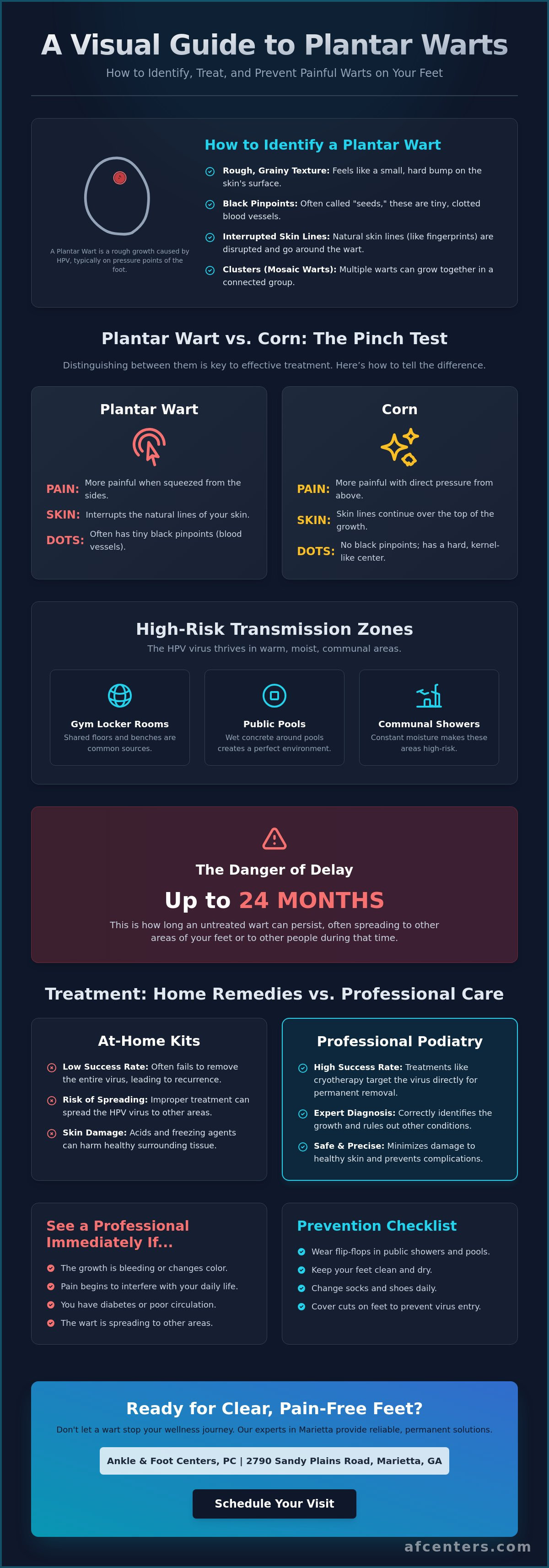
You might notice tiny, black pinpoints on the surface of the growth. While many people call these "seeds," they're actually small, clotted blood vessels. A wart on foot often mimics a callus because of the way skin builds up over the lesion to protect it. If you see a cluster of several warts growing together, you're looking at what podiatrists call mosaic warts. Identifying a wart on foot early is the first step toward reclaiming your active lifestyle and moving without hesitation.
To better understand how these growths develop and what they look like, watch this helpful video:
At Ankle & Foot Centers, PC, we view your foot health as a vital part of your total wellness journey. We're here to empower you with the right information so you don't have to guess about your care. Our team provides the expert guidance you need to transform your foot health and get back to the activities you love.
Plantar Wart vs. Corn: How to Tell the Difference
Distinguishing between a common corn and a viral growth is essential for proper treatment. If you look closely at your foot, you'll see natural skin lines similar to fingerprints. A wart will break these lines, while a corn allows the lines to wrap around the growth. You can also try the pinch test. Warts tend to be more painful when you squeeze them from the sides. Corns usually hurt more when you press them directly. For a definitive diagnosis, visit our team at 2790 Sandy Plains Road on the corner of Post Oak Tritt and Sandy Plains.
When Your Foot Pain Requires a Professional Evaluation
Don't ignore changes in your foot's appearance. If the growth starts bleeding, changes color, or causes pain that makes your Atlanta morning commute a struggle, it's time for professional help. Patients with diabetes or poor circulation in Georgia must be especially careful, as minor foot issues can quickly escalate into serious complications. A plantar wart is a benign but contagious epithelial tumor caused by the human papillomavirus. You can explore our full range of professional care on our services page to see how we help our community stay mobile and pain-free.
How You Contracted a Plantar Wart in the Atlanta Metro Area
Contracting a wart on foot often feels like a mystery, but the cause is quite specific. The Human Papillomavirus (HPV) is the driver behind these growths. This virus targets the outer layer of your skin, causing cells to grow rapidly and harden into a bump. In the Atlanta metro area, our warm and humid climate provides a perfect breeding ground for this virus to survive on surfaces for extended periods. If you frequent communal areas like public pools in Roswell or gym locker rooms in Marietta, you're likely crossing paths with HPV more often than you realize. The virus loves the moisture found in these high-traffic community hubs.
The symptoms and causes of plantar warts are tied directly to how the virus interacts with your unique immune system. Not everyone who comes into contact with the virus will develop a growth. Your age and skin integrity play significant roles. Children and teenagers are often more susceptible because their immune systems haven't yet built up a strong defense against various HPV strains. Similarly, if your skin is dry or cracked, the virus finds an easier path into your body. We see many patients who are surprised to find a wart on foot despite maintaining a rigorous fitness routine.
The Pathway of Infection
Microscopic abrasions or tiny cuts on the sole of your foot act as welcoming gates for the virus. These entry points can be so small that you don't even know they're there. Even something as simple as walking barefoot across a high-traffic Marietta pool deck can lead to infection. Once the virus enters, it doesn't always show up immediately. The incubation period can range from two to six months. This long delay often makes it hard to pinpoint exactly where you first encountered the virus during your local travels.
Myths About Wart Transmission
Let's clear up some common misconceptions. You didn't get this from a toad; that's an old myth that has no basis in medical science. While the virus is contagious, it isn't so aggressive that you'll catch it every single time you touch a contaminated surface. Most infections happen through indirect contact, like sharing a towel or walking where an infected person just stepped. For active Marietta families, a great hygiene tip is to always wear shower shoes in public spaces and dry your feet thoroughly after every workout. Keeping your skin's barrier healthy is a great way to empower your body against infection. If you suspect you've picked up a wart on foot, you can request a professional consultation at our office located at 2790 Sandy Plains Road on the corner of Post Oak Tritt and Sandy Plains.
Home Remedies vs. Professional Treatment: Why Marietta Patients Choose Podiatry
Many residents in Marietta try to handle a wart on foot independently before seeking expert help. We understand the appeal of a quick drugstore trip. However, over-the-counter freezing kits and acid patches often lead to more frustration than relief. These products use a "shotgun" approach that lacks the precision needed for deep-rooted plantar warts. Instead of a clear path to recovery, you might find yourself stuck in a cycle of temporary improvement followed by a painful return of the lesion. Choosing professional care early in your journey ensures that you don't waste months on ineffective treatments.
We strongly advise against "bathroom surgery." Attempting to cut or scrape away a growth with non-sterile household tools significantly increases your risk of a secondary infection. According to clinical data from various podiatric studies, nearly 20% of home-treated skin lesions can lead to complications like cellulitis or scarring that require even more extensive medical intervention. Your health journey deserves a safer, more reliable foundation. Expert intervention at 2790 Sandy Plains Road on the corner of Post Oak Tritt and Sandy Plains offers the security you need to move forward with confidence.
Podiatric tools allow for a level of detail that home kits simply cannot match. While a drugstore patch might cover a broad area, a podiatrist uses specialized instruments to isolate the viral tissue. This precision is vital because it prevents the virus from shedding and infecting other parts of your foot. For the busy professionals commuting through Marietta and Woodstock, a single effective treatment is a much better investment of time than months of failed DIY attempts. We are here to provide the steady hand you need to regain your mobility.
The Dangers of OTC Acid Treatments
OTC acid treatments often contain concentrations of salicylic acid ranging from 17% to 40%. While this can peel away the top layers of skin, misapplication can cause chemical burns on the healthy tissue surrounding the wart. This damage creates new entry points for the virus to spread. Choosing professional care at Ankle & Foot Centers, PC ensures that only the infected tissue is targeted. Our approach removes the guesswork and protects your skin's integrity. We focus on long-term results rather than short-term fixes, helping you avoid the frustration of a recurring wart on foot.
Why Professional Removal is More Effective
Professional removal is more effective because it starts with a precise debridement. We carefully remove the overlying callus so that our treatments reach the actual viral root. Professional-strength cryotherapy, which uses liquid nitrogen at temperatures around minus 320 degrees Fahrenheit, is far more potent than the cooling agents found in drugstore kits. This level of expertise transforms a frustrating problem into a manageable recovery. We believe in empowering our patients with the best tools available for their long-term health. Expert guidance beats DIY guesswork every time, allowing you to focus on your personal wellness goals without the distraction of persistent foot pain.
Advanced Medical Solutions for Persistent Foot Warts at Ankle & Foot Centers, PC
When a persistent wart on foot refuses to budge after home care, our team provides the clinical expertise needed to resolve the issue for good. Dr. Mathew M. John utilizes professional-grade cryotherapy to treat these stubborn lesions. Unlike drugstore options, this procedure involves the precise application of liquid nitrogen to trigger a specific immune response that targets the virus at its source. We also offer prescription-strength topicals that are far more concentrated than anything found on a retail shelf. These advanced modalities empower you to move past the frustration of recurring growths and toward a future of pain-free movement.
For the most difficult cases, we introduce immune-modulating treatments. These therapies work by "teaching" your own immune system to identify and eliminate the HPV virus that causes the wart on foot. It's a holistic approach that focuses on long-term wellness rather than just a temporary cosmetic fix. While we utilize cutting-edge technology like MLS Laser Therapy in our office, we specify its use for treating musculoskeletal pain, inflammation, and difficult-to-heal open wounds. For other conditions like fungal toenails, we provide fungal laser therapy using the Cutera Genesis Plus NDYag Laser, ensuring you receive the most appropriate tool for your specific journey.
Surgical and Procedural Excellence
Sometimes a deep-rooted plantar wart requires a more direct approach. We perform minor in-office procedures to remove the lesion entirely. You don't need to worry about discomfort; we use local anesthesia to ensure your experience is completely relaxed and comfortable. Our goal is to provide a neighborhood hub where world-class equipment meets a friendly, human touch. You can schedule your professional evaluation at our facility located at 2790 Sandy Plains Road on the corner of Post Oak Tritt and Sandy Plains.
Custom Support and Recovery
Recovery is just as important as the procedure itself. We provide detailed post-care instructions to promote fast healing and prevent scarring. If your wart has caused you to change how you walk, you might experience secondary pain in your arches or ankles. In these cases, we use 3-D impressions to create custom orthotics at Ankle & Foot Centers, PC that realign your gait. 3-D impressions provide a precise map of the foot without the inaccuracies of older casting methods. This ensures your support is perfectly tailored to your unique anatomy, helping you stay active and energized as you return to your favorite fitness activities.
Preventing Future Foot Warts and Scheduling Your Visit in Marietta
Once you've successfully removed a wart on foot, the focus shifts toward maintaining your results and protecting your long-term wellness. We believe that staying active should be a rewarding experience, not one clouded by the worry of a recurring infection. By incorporating a few simple habits into your daily routine, you can empower your body to stay healthy and resilient. Prevention isn't just about avoiding a virus; it's about choosing a lifestyle that prioritizes your foot health as much as your cardiovascular fitness.
To keep your skin clear and your movement pain-free, follow this simple prevention checklist:
- Wear shower shoes: Never walk barefoot in high-traffic areas like gym locker rooms, public pools, or communal showers.
- Perform daily inspections: Spend 30 seconds each day checking the soles of your feet for any new bumps or texture changes.
- Prioritize dryness: Change your socks immediately after a workout and use moisture-wicking materials to keep the virus from thriving in damp environments.
- Avoid sharing: Don't share towels, pumice stones, or nail clippers with others, even within your own household.
For our Marietta athletes, we recommend a strict shoe rotation strategy. Don't wear the same pair of sneakers two days in a row. Giving your shoes a full 24 hours to dry out helps eliminate the moisture that HPV needs to survive. If you notice a new growth, don't wait for it to become painful. An immediate consultation can stop the spread early, saving you time and discomfort in the future. We invite you to join our community at Ankle & Foot Centers, PC, where we treat every member like a partner in their own health journey.
Your Local Marietta Podiatry Hub
Our office is more than just a medical facility; it's a neighborhood hub designed to provide world-class care in a welcoming, non-judgmental atmosphere. You can find us at 2790 Sandy Plains Road on the corner of Post Oak Tritt and Sandy Plains. We take great pride in serving our local community and the surrounding areas of Roswell, Woodstock, and Kennesaw. Whether you're a seasoned athlete or someone just starting their fitness journey, our professional guidance ensures you never have to navigate your path alone.
Take the First Step Toward Pain-Free Walking
You deserve to stand, walk, and run without the sting of a wart on foot holding you back. We're here to provide the steady hand and expert expertise you need to transform your health and regain your confidence. Scheduling your diagnostic evaluation is the first step toward a permanent solution. Our team is ready to help you move through your day with vitality and ease. Schedule your professional wart evaluation at Ankle & Foot Centers, PC today.
Reclaim Your Active Lifestyle Without Discomfort
You now have the knowledge to distinguish between a simple callus and a viral growth; you also understand why professional precision is vital for deep-seated lesions. We've discussed how to stop the cycle of failed home treatments and how to prevent the spread of the virus in our local Marietta community. Your journey toward clear skin and pain-free movement is a vital part of your overall wellness. By choosing expert care, you're investing in a faster, more reliable recovery that keeps your fitness goals on track.
Led by Dr. Mathew M. John, DPM, FACFAS, our team provides a supportive environment equipped with advanced diagnostic tools and 3-D impressions for custom support. We're conveniently located at 2790 Sandy Plains Road on the corner of Post Oak Tritt and Sandy Plains. Don't let a persistent wart on foot distract you from the activities you love. Take the final step in your healing journey today. Book Your Foot Wart Consultation at our Marietta Office and move forward with confidence.
Frequently Asked Questions
How can I tell if the bump on my foot is a wart or a corn?
You can distinguish a wart from a corn by looking at the skin's ridges. A wart on foot interrupts the natural fingerprint-like patterns, while a corn keeps them intact. Warts also contain tiny black pinpoints of clotted blood. If you squeeze the growth from the sides and feel sharp pain, it's likely viral. Corns typically hurt more when you press them directly from the top.
Are plantar warts contagious to other members of my family?
Plantar warts are highly contagious because they are caused by the Human Papillomavirus (HPV). You can spread the virus to family members through shared towels, bath mats, or by walking barefoot on the same flooring. We recommend that everyone in your household wears flip-flops in shared showers until the infection is fully resolved. This simple step protects your family's wellness journey and prevents the virus from spreading through your home.
Why do my foot warts keep coming back after using drugstore treatments?
Drugstore treatments often fail because they only address the top layer of dead skin. The virus lives deeper in the dermis, where over-the-counter acids and freezing sprays cannot reach. This leads to high recurrence rates with home kits. Professional care at our office at 2790 Sandy Plains Road on the corner of Post Oak Tritt and Sandy Plains targets the root directly. We ensure the entire lesion is addressed so you don't have to deal with repeated outbreaks.
Does professional foot wart removal hurt?
We prioritize your comfort during every procedure. For minor surgical removals, we apply a local anesthetic to numb the area completely. You might feel a brief cold sensation during cryotherapy, but the discomfort is typically minimal and short-lived. Our team acts as a steady hand to guide you through the process. We want you to feel empowered and relaxed as you take this step toward healthier feet.
Can I walk normally immediately after a wart removal procedure?
Most patients can walk immediately after their appointment. We use specialized padding to protect the site and ensure you stay mobile for your daily activities. If a large growth has altered your gait, we might recommend 3-D impressions to create custom orthotics. These help realign your stride and prevent secondary pain in your knees or back. 3-D impressions ensure your support is perfectly tailored to your unique foot structure.
How long does it typically take for a plantar wart to disappear with professional care?
Professional treatments typically resolve a wart on foot within 3 to 5 sessions, depending on the size and age of the lesion. This is significantly faster than the 12 to 24 months a wart might last without expert intervention. We monitor your progress at every visit to ensure the skin is healing cleanly. Our goal is to provide a rhythmic and logical path toward clear skin and full mobility.
Does insurance usually cover professional wart removal at a podiatrist?
Most major insurance providers in Georgia cover wart removal when performed by a podiatrist. Since warts are viral infections that cause pain and can spread, they are considered a medical necessity rather than a cosmetic issue. We recommend calling your provider to confirm your specific co-pay or deductible before your visit. Our staff is also happy to help you navigate these details to make your care accessible.
What is the best way to prevent getting warts at the gym?
The best way to stay protected at the gym is to never let your bare feet touch the floor. Wear shower shoes in the locker room and keep your feet dry using moisture-wicking socks. Since the virus thrives in damp environments, drying between your toes after a workout reduces your risk of infection significantly. These small habits are rewarding opportunities to maintain your long-term health and keep your fitness journey on track.


