

You are walking across a flat sidewalk when, without warning, your foot rolls and your heart leaps into your throat. That unsettling feeling of ankle giving way is more than just a momentary stumble; it's a clear signal that your joint's natural support system is struggling to keep up. Whether you are avoiding your favorite hiking trails or constantly worrying about the next tweak, living with chronic instability can make the world feel like a series of obstacles rather than opportunities for movement.
We understand how frustrating it is to lose trust in your own body, but you don't have to navigate this journey alone. This guide will help you understand the structural and neurological causes behind your symptoms and introduce you to modern, non-surgical ways to strengthen your foundation. We'll explore how professional podiatric care, including precision 3-D impressions for custom orthotics, can restore your confidence with every step. Under the guidance of Dr. Mathew John, a Board Certified Foot Surgeon by the American College of Foot and Ankle Surgery, you'll learn exactly when to seek specialized help at our clinic located at 2790 Sandy Plains Road on the corner of Post Oak Tritt and Sandy Plains.
Key Takeaways
- Understand why that persistent feeling of ankle giving way is often the result of Chronic Ankle Instability (CAI) and past injuries that haven't fully healed.
- Learn how Dr. Mathew John, a Board Certified Foot Surgeon by the American College of Foot and Ankle Surgery, uses 3-D impressions to design custom orthotics for better joint alignment.
- Discover how non-surgical options like MLS Laser Therapy and targeted physical therapy can reduce inflammation and restore your natural balance.
- Identify when it's time to consider reconstructive surgery to repair stretched ligaments and regain the stability you need for an active lifestyle.
- Find out how professional care at 2790 Sandy Plains Road on the corner of Post Oak Tritt and Sandy Plains can help you walk with confidence again.
What Does the Feeling of Your Ankle Giving Way Actually Mean?
If you often experience the feeling of ankle giving way while stepping off a curb or even just standing in line, your body is sending you a clear message. This sensation is the hallmark of Chronic Ankle Instability (CAI). It typically involves the outer side of the ankle failing to support your weight, causing the joint to roll outward. While it's easy to feel embarrassed after a stumble, this isn't about being uncoordinated. It's a structural and neurological failure that requires professional attention to prevent long-term joint wear.
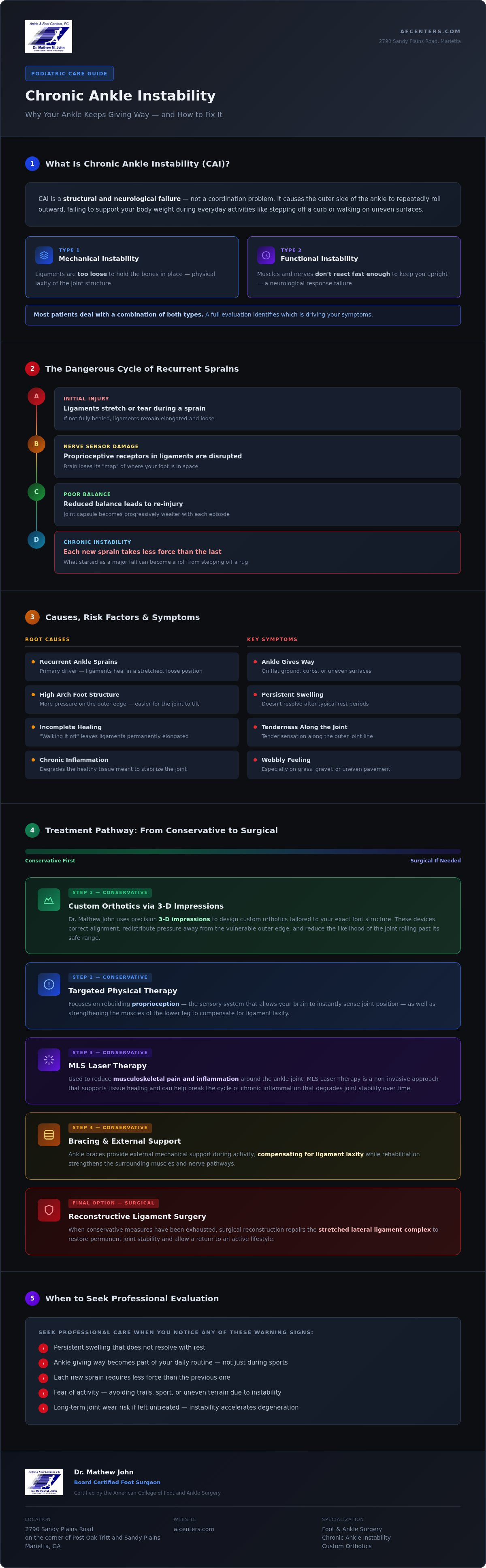
Clinicians categorize this instability into two distinct types. Mechanical instability refers to physical laxity where the ligaments are too loose to hold the bones in place. Functional instability occurs when your muscles and nerves don't react quickly enough to keep you upright. Most patients we see deal with a combination of both. At our office located at 2790 Sandy Plains Road on the corner of Post Oak Tritt and Sandy Plains, Dr. Mathew John evaluates these failures. As a Board Certified Foot Surgeon by the American College of Foot and Ankle Surgery, he helps patients identify the root cause of their instability. You can explore our specialized foot and ankle services to see how we address these complex joint issues.
The Difference Between a Weak Ankle and Instability
Many people assume they just have weak ankles and try to power through with basic exercises. However, there's a vital distinction. True weakness usually involves muscle atrophy in the lower leg. Instability is a problem with the lateral ligament complex, the set of structural bands that keep your joint centered. When you choose to walk it off after an injury, these ligaments often heal in a stretched position. This creates a permanent gap in your joint's defenses, which explains why that persistent feeling of ankle giving way continues long after the initial swelling disappears.
Why Your Brain Stops Trusting Your Ankle
Your ligaments do more than just hold bones together; they are packed with tiny nerve receptors. These receptors tell your brain about every micro-adjustment needed for balance. Repeated injuries damage these sensors, breaking the vital communication link between your foot and your head. This creates a dangerous feedback loop where an initial injury leads to poor balance, which inevitably leads to more sprains. Proprioception is the sensory system that prevents the ankle from rolling by allowing your brain to sense the joint's position instantly. Without it, your brain loses its map of where your foot is, leading to a terrifying loss of control during simple activities.
Common Causes and Symptoms of Chronic Ankle Instability
The primary reason for a persistent feeling of ankle giving way is a history of recurrent ankle sprains. When you roll your ankle, the ligaments on the outside of the joint stretch or tear. If these structural anchors don't heal properly, they remain elongated and loose. This creates a state of permanent laxity. Beyond the instability itself, you might notice secondary symptoms like chronic swelling, a tender sensation along the joint line, or a general wobbly feeling when walking on grass or uneven pavement.
Your foot's natural shape also plays a significant role in your joint health. Individuals with high arches, for example, are often more predisposed to rolling their ankles. This structural alignment puts more pressure on the outer edge of the foot, making it easier for the joint to tilt past the point of no return. Unlike some general health resources that only focus on the injury itself, we look at your entire foot structure to understand why these rolls keep happening. Identifying these structural risks is a key part of an expert evaluation.
The Cycle of Recurrent Sprains
Many patients find that each subsequent sprain requires less force to occur than the one before it. What started as a major fall might eventually turn into a roll caused by simply stepping off a rug. This happens because the joint capsule becomes progressively weaker with every injury. Chronic inflammation sets in, which can degrade the healthy tissue meant to keep your ankle stable. Your activity levels also dictate the frequency of these episodes; the more you try to stay active on an unstable joint, the more likely you are to trigger another instability event.
When to Seek Professional Evaluation in Marietta
It's time to seek help when the warning signs become part of your daily life. Persistent swelling that doesn't resolve with rest or pain that lingers after minor activity are indicators that the damage is more than just a simple strain. If you're tired of the constant feeling of ankle giving way, ignoring these signals increases the risk of developing early-onset arthritis as the bones in the joint grind against each other without proper ligamentous support.
At Ankle & Foot Centers, PC, we focus on breaking this cycle before permanent joint damage occurs. Dr. Mathew John, a Board Certified Foot Surgeon by the American College of Foot and Ankle Surgery, provides expert diagnostics to determine the extent of your ligament damage. You can learn more about our comprehensive podiatric services and how we tailor treatments to your specific needs. Visit us at 2790 Sandy Plains Road on the corner of Post Oak Tritt and Sandy Plains to start your recovery journey with a team that values your long-term mobility.
Professional Diagnosis and the Role of 3-D Impressions
When you visit Ankle & Foot Centers, PC at 2790 Sandy Plains Road on the corner of Post Oak Tritt and Sandy Plains, our goal is to move beyond surface-level symptoms. A general urgent care visit might result in a "sprain" diagnosis and a basic elastic wrap, but a specialist exam dives deeper. We focus on why you have that persistent feeling of ankle giving way by performing specific physical stress tests. These tests allow us to manually check the integrity of your ligaments, ensuring we don't miss a complete tear that might be masked by swelling.
Gait analysis is another cornerstone of our diagnostic approach. By observing how your ankle behaves under a load, we can see the exact moment the joint begins to tilt or "give." This dynamic assessment helps us understand the relationship between your foot structure and your stability. It's not just about finding the injury; it's about identifying the biomechanical patterns that led to it in the first place. This level of detail is what sets professional podiatric care apart from general medical advice.
The Precision of 3-D Impressions for Orthotics
Generic, over-the-counter inserts often fail because they don't account for your unique anatomy. We use 3-D impressions to capture the exact contours of your foot while it sits in a neutral, corrected position. This process creates a perfect physical mold of your foot's structure. By avoiding a simple "scan" and focusing on a true three-dimensional representation, we can craft custom orthotics that provide superior stability. These devices are designed to stabilize the heel and prevent the lateral roll of the ankle, effectively silencing that feeling of ankle giving way during your daily walks.
Imaging: X-rays and MRI
While physical exams provide a wealth of information, imaging is sometimes necessary to rule out hidden complications. X-rays help us identify bone chips or fractures that may have occurred during a previous roll. If conservative treatments aren't providing relief, Dr. Mathew John may order an MRI to visualize soft tissue damage. Imaging helps visualize ligament damage that a physical exam might miss, such as small tears in the peroneal tendons. As a Board Certified Foot Surgeon by the American College of Foot and Ankle Surgery, Dr. John uses these detailed images to determine if surgical intervention is the best path forward for your long-term mobility.
Non-Surgical Solutions: PT, Bracing, and MLS Laser Therapy
Recovering from a persistent feeling of ankle giving way doesn't always require a trip to the operating room. Many patients find significant relief through a structured, non-surgical approach that focuses on rebuilding the joint's natural defenses. Physical therapy serves as the foundation of this process, specifically targeting the peroneal muscles on the outside of the leg. These muscles act as the primary dynamic stabilizers of your ankle; strengthening them helps your body react faster when you encounter uneven ground. Balance training also retrains the nerve receptors we discussed earlier, helping you find relief for chronic heel and ankle pain while restoring your confidence.
How MLS Laser Therapy Speeds Recovery
For those dealing with the musculoskeletal pain and inflammation that often accompany chronic instability, we offer MLS Laser Therapy. This advanced technology uses specific wavelengths of light to stimulate cellular repair and move fluid away from the joint. It's a non-invasive way to manage swelling without relying on long-term medication. Because the procedure is entirely painless and performed right in our office at 2790 Sandy Plains Road on the corner of Post Oak Tritt and Sandy Plains, there's absolutely no downtime for patients. You can receive a treatment and return to your daily routine immediately, making it an ideal option for active individuals in Marietta.
Custom Bracing vs. Over-the-Counter Sleeves
While a simple compression sleeve might offer a sense of security, it's often insufficient for a joint that is structurally unstable. A sleeve provides sensory feedback but lacks the mechanical strength to stop a roll. Custom-fitted braces, however, are designed to provide rigid or semi-rigid support during high-risk activities like tennis or hiking. These devices act as external ligaments, physically preventing the feeling of ankle giving way when your internal structures fail. By combining custom bracing with activity modifications, such as choosing supportive footwear over flexible shoes, you create a safer environment for your joint to function.
If you're ready to stop guessing which brace or exercise is right for you, our team is here to help. Dr. Mathew John, a Board Certified Foot Surgeon by the American College of Foot and Ankle Surgery, can develop a personalized plan that incorporates these advanced therapies. Schedule your consultation at Ankle & Foot Centers, PC to begin a treatment program designed around your specific lifestyle goals.
Reconstructive Surgery in Marietta: When Is It Time?
While we always prioritize non-invasive treatments like custom orthotics and physical therapy, surgery becomes a necessary step when the structural damage is too extensive for conservative care alone. If you've spent six months or more trying various therapies without success, and that persistent feeling of ankle giving way still dictates your daily life, reconstructive surgery offers a reliable path back to stability. The most common solution is Lateral Ligament Reconstruction, also known as the Brostrom procedure. This specialized surgery focuses on tightening and reinforcing the ligaments on the outside of your ankle to ensure they can once again support your weight during lateral movements. It's about more than just repair; it's about giving you back the freedom to walk on any surface without hesitation.
Expert Care with Dr. Mathew John
Choosing a surgeon is a personal decision that requires trust in both their technical skill and their understanding of your long-term health goals. At Ankle & Foot Centers, PC, you are in the hands of a specialist who understands the unique needs of our Marietta community. Dr. Mathew John is a Board Certified Foot Surgeon by the American College of Foot and Ankle Surgery. His approach to reconstructive surgery is rooted in restoring the natural tension and biomechanics of your joint. By carefully tightening the lateral ligaments, he helps eliminate the mechanical laxity that causes frequent rolls and chronic soreness. You can visit our clinic at 2790 Sandy Plains Road on the corner of Post Oak Tritt and Sandy Plains to discuss your surgical options in a professional and welcoming environment.
What to Expect After Reconstructive Surgery
Many patients worry that surgery means a permanent end to their active lifestyle, but modern techniques are designed to get you back on your feet stronger than before. Reconstructive surgery has a high success rate for returning individuals to high-impact sports and daily activities without fear of re-injury. Your recovery will begin with a non-weight-bearing period to allow the repaired tissues to knit together firmly. Following this initial phase, you'll transition into a structured rehabilitation program where we focus on restoring your range of motion and functional strength. The ultimate goal is to move you from a place of constant caution to a place of absolute confidence in your body's ability. Schedule your consultation with Dr. Mathew John today and take the first step toward a future where you don't have to watch every single step you take.
Reclaim Your Confidence with Every Step
Living with the persistent feeling of ankle giving way can make even the simplest walk feel like a gamble. We've explored how chronic instability stems from a combination of stretched ligaments and a breakdown in your body's natural balance sensors. Whether your path to recovery involves precision-crafted orthotics made from 3-D impressions or advanced MLS Laser Therapy to calm inflammation, the right support system is available right here in Marietta. You have the power to break the cycle of re-injury and return to the activities you love.
You don't have to navigate this journey toward health alone. Dr. Mathew John, a Board Certified Foot Surgeon by the American College of Foot and Ankle Surgery, is ready to help you build a stronger foundation. Visit us at 2790 Sandy Plains Road on the corner of Post Oak Tritt and Sandy Plains to receive the expert care you deserve. Book an Appointment with Dr. Mathew John in Marietta today and start moving toward a more stable, active future. We're here to help you progress with confidence and restore your vitality.
Frequently Asked Questions
Is it normal for my ankle to give way without any pain?
Yes, it's quite common to have the feeling of ankle giving way without experiencing sharp pain. This often points to functional instability, where your brain and nerves aren't communicating correctly with your muscles. Even if it doesn't hurt, this instability can lead to future injuries and joint wear. It's a sign that your proprioception, or your body's ability to sense its position, needs professional attention to prevent a serious fall.
Can I fix ankle instability with just exercises at home?
While home exercises are a great start, they often miss the underlying structural issues. Strengthening your peroneal muscles is vital, but if your ligaments are physically stretched out, exercises alone can't tighten them. A professional evaluation helps determine if you need custom orthotics or targeted physical therapy. We focus on a holistic approach that combines strength training with structural support to ensure your long-term stability and joint health.
How many sessions of MLS Laser Therapy are usually needed for ankle pain?
Most patients see the best results with a series of MLS Laser Therapy sessions, typically ranging from six to ten treatments. Because this laser targets musculoskeletal pain and deep-seated inflammation, the cumulative effect helps your body repair itself more efficiently. We'll monitor your progress during each visit to Marietta to ensure the treatment is effectively reducing your swelling. Each session is quick and fits easily into your busy schedule.
What is the difference between 3-D impressions and standard foot molds?
We use 3-D impressions to create a highly accurate model of your foot's unique structure in a neutral position. Unlike standard plaster molds that can be messy and imprecise, our process captures every contour with incredible detail. We don't use scanning; instead, we rely on these precision impressions to craft custom orthotics that provide superior control. This ensures your corrective devices fit perfectly and offer the exact support needed to stabilize your joint.
Will I need surgery if my ankle gives way frequently?
Surgery is usually the last step in our treatment plan. We typically recommend exploring non-surgical options like bracing, physical therapy, and custom orthotics for at least six months first. If you still experience a frequent feeling of ankle giving way after conservative efforts, then reconstructive surgery might be the right choice. Our goal is always to find the least invasive way to return you to your favorite activities and a pain-free lifestyle.
How does Dr. Mathew John determine if I have a ligament tear?
Dr. Mathew John uses a combination of physical stress tests and advanced imaging to diagnose the severity of your injury. As a Board Certified Foot Surgeon by the American College of Foot and Ankle Surgery, he has the expertise to feel for ligament laxity that general doctors might miss. He may also order an MRI to visualize the exact location and extent of any tears. This precise diagnosis ensures your treatment plan is built on accurate information.
Is there any downtime after non-surgical treatments like MLS Laser?
There is absolutely no downtime after non-surgical treatments like MLS Laser Therapy. This procedure is completely painless and non-invasive, allowing you to walk right out of our office and continue your day. You won't need to worry about recovery periods or activity restrictions following your session. It's a convenient option for residents across the Atlanta metro area who want to manage inflammation without the complications of drugs or invasive procedures.
Where is Ankle & Foot Centers, PC located in Marietta?
Our practice, Ankle & Foot Centers, PC, is conveniently located in the heart of the community. You can find us at 2790 Sandy Plains Road on the corner of Post Oak Tritt and Sandy Plains. This local Marietta office is fully equipped to handle everything from initial diagnostic evaluations to advanced reconstructive surgery. We take pride in being a local hub for sophisticated resources, helping our neighbors regain their mobility and confidence.


