

What if repeated ankle turning points to more than a lingering sprain, but still doesn’t mean surgery is your only option? If you’re exploring ankle ligament repair surgery Kennesaw patients can begin with an evaluation of what’s causing the instability, how it affects daily activities, and whether nonsurgical care may help. A feeling that your ankle might give way can be unsettling, especially when you’re unsure whether the problem will persist.
Understanding your options can make the next step feel more manageable. This article explains how ankle instability is assessed, when a surgeon may discuss repair, and what to ask about recovery and everyday routines. You’ll also learn what to bring up with a foot and ankle surgeon, including your symptoms, activity goals, and prior treatment. Ankle & Foot Centers, PC provides foot and ankle care for patients in Kennesaw through its Marietta practice. Dr. Mathew John is a Board Certified Foot Surgeon by the American Board of Foot and Ankle Surgery, offering guidance as you consider an individualized plan.
Key Takeaways
- Recurring ankle giving-way can have different causes. Note when it happens and how it affects everyday activities.
- An evaluation may include your injury history, a physical examination, and imaging when clinically appropriate.
- Ankle ligament repair surgery Kennesaw discussions should start with your instability findings and the care you’ve already tried.
- Nonsurgical care may be considered based on your evaluation. Surgery is one possible option, not an automatic next step after a sprain.
- Before deciding on surgery, discuss how the plan may affect mobility, work, daily responsibilities, and follow-up care.
Ankle Ligament Repair Surgery in Kennesaw: When Instability Needs Attention
Hearing “ligament repair” can make it sound as though an operation is the expected next step after an ankle sprain. It isn’t. A sprain is an injury to one or more ligaments, the strong bands of tissue that help support the ankle joint. Repair surgery is intended to address ligaments that remain loose or damaged and contribute to ongoing instability. Whether surgery is relevant depends on your symptoms and a clinician’s assessment, not simply on the fact that you’ve sprained an ankle.
Ankle instability is a persistent feeling or experience that the ankle may shift, buckle, or give way during standing or movement. One sprain can cause pain and swelling while it heals. Repeated giving-way episodes or continued difficulty trusting the ankle may point to a longer-lasting problem that deserves evaluation. This distinction can help you explain what you’re experiencing and understand why one injury doesn’t automatically mean surgery is needed.
What does ankle ligament damage feel like?
A ligament injury may cause pain, swelling, and tenderness around the ankle. You might also feel unsteady, particularly when walking on uneven ground, changing direction, or returning to an activity that puts more demand on the joint. Symptoms vary, and these sensations alone can’t identify which ligament is involved or whether it has healed.
Pay attention to the pattern: when discomfort occurs, whether swelling persists, and whether the ankle has actually given way. Seek medical evaluation for severe, persistent, or worsening pain, visible deformity, or an inability to bear weight. These signs warrant prompt attention rather than waiting to see if the ankle settles on its own.
How can repeated ankle sprains affect stability?
After a sprain, injured ligaments need time and appropriate care to recover. Repeated injuries, or healing that doesn’t restore enough support, may leave the ankle feeling unreliable. For example, you might recover from the initial soreness but continue to experience buckling during routine walking or on uneven surfaces. That recurring pattern differs from temporary tenderness after one recent sprain.
Similar symptoms can have different explanations, so a sensation of looseness doesn’t confirm ligament damage by itself. An evaluation can help distinguish a recent injury from ongoing instability and guide next steps. Ankle & Foot Centers, PC treats ankle sprains and ankle instability as part of its foot and ankle care, with attention to your symptoms and how they affect daily movement.
If you’re considering ankle ligament repair surgery Kennesaw care, start by describing the full history: previous sprains, episodes when the joint gave way, and activities you’ve changed or avoided. Those details help put the current concern in context. The goal is to understand what may be affecting stability and which options fit your situation, without assuming an operation is necessary.
How a Foot and Ankle Surgeon Evaluates Ligament Instability
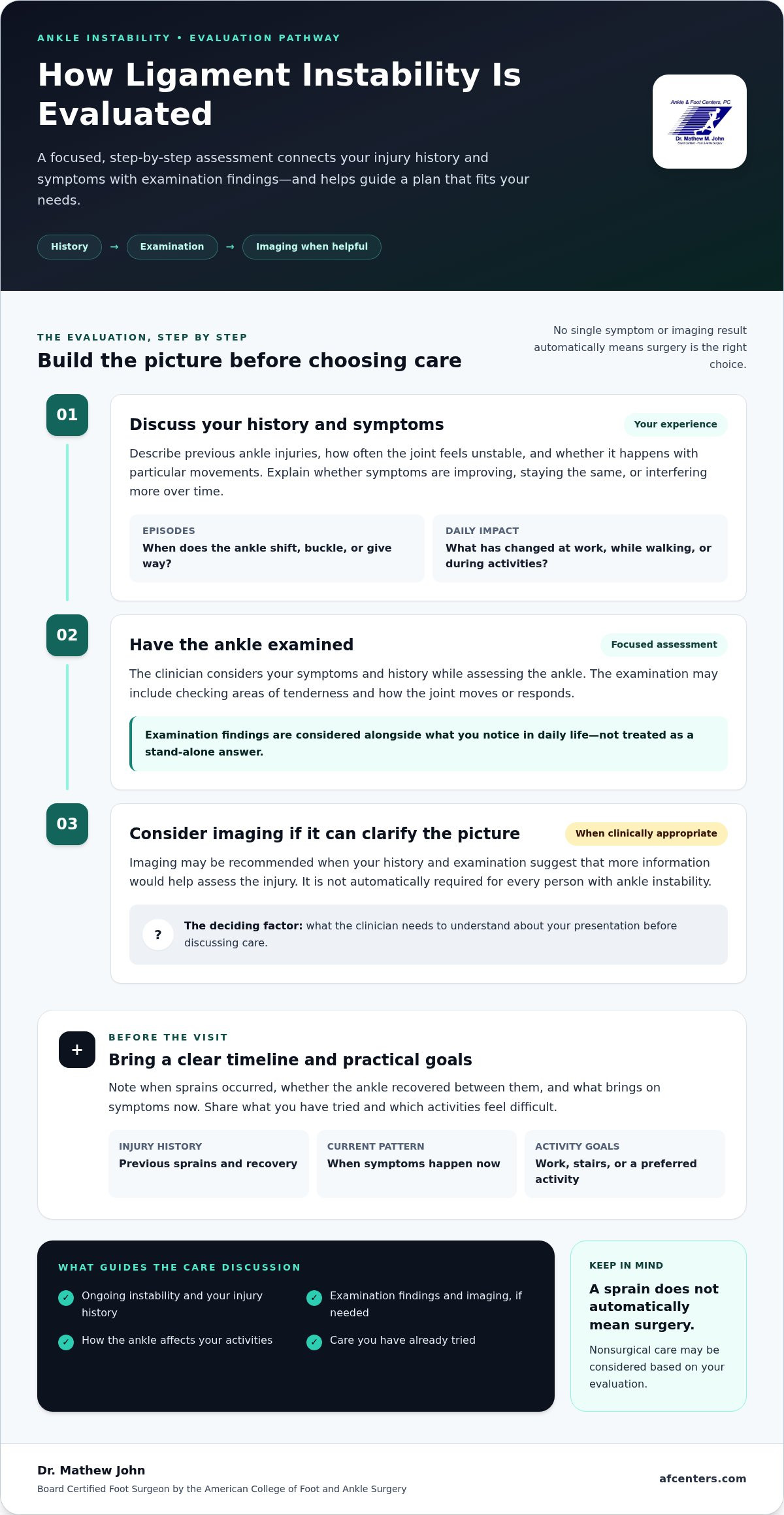
An evaluation is more than a quick check of where your ankle hurts. The surgeon asks how the problem began, which movements bring on instability, and what you need your ankle to do. This step-by-step approach helps distinguish ongoing ligament concerns from other explanations for your symptoms and keeps treatment decisions tied to your circumstances.
- Discuss your history and symptoms. Be ready to describe previous ankle injuries, how often the joint has felt unstable, and whether episodes happen during particular movements. Mention changes to walking, work, exercise, or other routines. Explain whether symptoms are improving, staying the same, or interfering more over time.
- Have the ankle examined. The clinician assesses the joint in light of your history and reported symptoms. They may check areas of tenderness and how the ankle moves or responds to examination. Your experience matters: examination findings are considered alongside what you notice in daily life, rather than treated as a stand-alone answer.
- Consider imaging if it can clarify the picture. Imaging may be recommended when your history and examination indicate that additional information would help assess the injury. It isn’t automatically required for every person with ankle instability. The decision depends on your clinical presentation and what the clinician needs to understand before discussing care.
What happens during an ankle instability evaluation?
Think of the visit as a conversation followed by a focused assessment. Explain what you’ve tried, which activities feel difficult, and whether the ankle has actually given way or mainly feels unreliable. The clinician examines the ankle in relation to those concerns. If questions remain about the injury, imaging may be considered to help guide the assessment.
Preparing a short timeline can make the conversation easier. Note when your sprains occurred, whether the ankle recovered between them, and what brings on symptoms now. You can also describe practical goals, such as walking comfortably at work, managing stairs, or returning to a preferred activity. These details connect examination findings to the demands you place on your ankle.
What findings can influence a surgical recommendation?
A surgical discussion may take into account ongoing instability, the examination, your injury history, and how the ankle affects your activities. No single symptom or imaging result automatically means surgery is the right choice. The clinician considers how these factors fit together and explains whether further nonsurgical care or a surgical option is appropriate to discuss.
Examination findings help guide an individualized treatment plan by showing how your ankle’s condition relates to your symptoms and activity needs. Ask how the findings support the proposed next step, which alternatives are relevant, and how your goals factor into planning. Clear answers can help you weigh options without feeling rushed.
Ankle & Foot Centers, PC provides ankle instability care through its Marietta practice for patients in Kennesaw and nearby communities. The practice also serves patients from Marietta, Roswell, Woodstock, Atlanta, and Sandy Springs. Review the practice’s foot and ankle services as you prepare questions about your evaluation.
Surgery or Nonsurgical Care: Comparing Ankle Ligament Treatment Options
An ankle sprain or ligament injury doesn’t automatically mean surgery. The right approach depends on how your ankle is functioning, what the evaluation shows, and whether symptoms continue despite appropriate nonsurgical care. For some people, clinician-directed nonsurgical treatment remains part of the plan. If instability persists, a surgeon may discuss whether a procedure is worth considering, including its possible benefits, risks, and alternatives.
This comparison can help you organize the conversation. It isn’t a personal treatment recommendation, since the choice depends on your clinical circumstances.
| Option | Purpose | When it may be discussed | Clinician guidance |
|---|---|---|---|
| Nonsurgical care | Support recovery and address symptoms or ankle function without an operation. | When the evaluation suggests it may be appropriate, including after an injury or as part of ongoing care. | The clinician tailors options such as bracing, limited weight-bearing, or physical therapy to your symptoms and findings. |
| Surgical care | Address ligament-related instability when a procedure is considered appropriate. | When instability continues despite nonsurgical treatment and the overall assessment supports discussing surgery. | The surgeon considers your ligament condition, goals, and individual circumstances when discussing repair or reconstruction. |
When may nonsurgical treatment remain part of the plan?
Nonsurgical care may be considered when it fits your symptoms and examination findings. Depending on the situation, a clinician may discuss external support such as a brace, a period of limited weight-bearing, or physical therapy. These are options to review with your care team, not a one-size-fits-all checklist. The most suitable plan depends on the injury, your current ankle function, and how symptoms affect daily life.
What is the goal of discussing ligament surgery?
Surgery may be discussed as a way to address instability related to injured or weakened ligaments, not as a guarantee of a particular result. Repair and reconstruction are different approaches; the choice depends on clinical considerations, including the condition of the ligament tissue. Ask the surgeon to explain why a particular option may fit your situation, what benefits and risks matter in your case, and what alternatives remain.
If ankle ligament repair surgery Kennesaw is part of your care discussion, bring questions about what the findings mean and how each option relates to your activity needs. Ankle & Foot Centers, PC provides ankle instability care through its Marietta practice. Review foot and ankle services as you prepare for a conversation about next steps.
Preparing for Ankle Ligament Surgery and Discussing Recovery
Considering surgery involves more than deciding whether a procedure might address instability. You’ll also want to understand what the proposed plan means for mobility, work, home responsibilities, and follow-up. Preparation and recovery instructions depend on the procedure being considered and your personal circumstances, so a general timeline or set of instructions may not apply to you.
What should you discuss before deciding on surgery?
Use your appointment to clarify the diagnosis and the purpose of the proposed procedure. Ask how the findings relate to your symptoms, which alternatives are appropriate, and what benefits and risks apply to your situation. These questions can help you understand the reasoning behind a recommendation and make a considered decision.
- Which findings suggest surgery may be appropriate in my case?
- What nonsurgical alternatives are relevant, and what might each involve?
- How could the plan affect walking, work, caregiving, or other daily responsibilities?
- What follow-up should I expect, and how will I receive instructions for my individual care?
Be specific about your routine. For example, explain if your work involves standing, if you regularly manage stairs, or if you have responsibilities at home that affect your ability to rest or get around. If ankle ligament repair surgery Kennesaw is under consideration, sharing these details can help shape a practical discussion of the treatment plan.
Why can recovery expectations differ?
Recovery planning is influenced by the procedure selected and the patient’s circumstances. Your surgeon will provide instructions suited to your individual plan, including guidance relevant to mobility and follow-up. Avoid relying on another person’s experience as a timetable for your own recovery. Different needs and treatment plans can lead to different instructions.
Recovery expectations should be discussed in the context of your individual treatment plan. Before making a decision, ask what support you may need at home, how the plan could affect work and daily tasks, and how follow-up will fit into your care. If returning to a particular activity matters to you, bring it up early. Your surgeon can explain how that goal relates to the plan without promising a specific return date or outcome.
Preparation also means knowing whom to contact with questions about your instructions and what changes should prompt follow-up. Ask for details in clear, practical language, and make sure you understand any guidance before proceeding. Ankle & Foot Centers, PC provides foot and ankle care for patients in Kennesaw through its Marietta practice. Review the practice’s ankle and foot care information as you prepare to discuss your options.
Ankle Ligament Care Near Kennesaw: Your Evaluation and Next Steps
If ankle symptoms continue to limit your comfort or confidence, an evaluation can help turn uncertainty into a clearer plan. You don’t need to know whether surgery is appropriate before making an appointment. The purpose is to discuss what you’re experiencing and understand which next steps fit your situation.
What can you expect from a local evaluation?
Come ready to describe what changes your symptoms, how they affect your routine, and what you’d like to do more comfortably. It may help to note repeated episodes of the ankle giving way and the activities you’ve adjusted as a result. Your clinician can use that context, along with the assessment, to discuss relevant options. Recommendations are based on your individual evaluation, and surgery isn’t a foregone conclusion.
Use the visit to clarify what you’re unsure about. You might ask what the assessment suggests, whether more information is needed, and how the proposed next step relates to your goals. If a treatment plan is discussed, ask how instructions and follow-up will be handled so you know what to expect before moving ahead.
When should you seek prompt foot and ankle care?
Seek prompt medical evaluation for severe, persistent, or worsening ankle pain. Visible deformity, an open wound, numbness, or inability to bear weight are also signs that warrant timely attention. These symptoms don’t establish a diagnosis on their own, but they shouldn’t be dismissed or left unassessed.
If symptoms are less severe but keep returning, arrange an evaluation to better understand what may be causing them. For sudden or severe changes, seek appropriate urgent medical care. A clinician can help determine what assessment or care is suitable for your circumstances.
For patients in Kennesaw, Ankle & Foot Centers, PC’s Marietta practice provides care for ankle instability and related concerns. The practice serves the surrounding Atlanta Metro communities, including Marietta, Roswell, Woodstock, Atlanta, and Sandy Springs. Learn more about ankle instability and related foot and ankle services.
Take the Next Step With Confidence
You don’t need to arrive with a decision already made. A helpful next step is to identify what you most want to understand: what may be causing the ankle to feel unstable, which options fit your circumstances, or how a proposed plan could affect everyday life. For ankle ligament repair surgery Kennesaw decisions, a focused conversation can help turn uncertainty into practical questions and a clearer path forward.
Before an appointment, jot down the activities you hope to return to and any concerns you have about treatment. Bring those notes along, and take the time you need to understand the recommendations. Your care should reflect your individual needs, with space to discuss the choices ahead.
Read about Ankle & Foot Centers, PC and the foot and ankle care available through its Marietta practice as you consider your next steps.
Frequently Asked Questions
Can an ankle ligament heal without surgery?
Yes. Some ankle ligament injuries can be managed without an operation, depending on the injury and your symptoms. Lingering soreness after one sprain, for example, is different from repeated buckling during routine activities. A foot and ankle clinician can assess your situation and discuss suitable care. If instability keeps interfering with daily life, ask about your options. Don’t assume every sprain requires surgery or that home care will resolve the problem.
Can you walk on a torn ankle ligament?
Possibly, but walking doesn’t show whether a ligament is torn or rule out another injury. The ability to take a few steps may not reflect how the ankle responds to continued use. Seek an evaluation if you have notable pain, swelling, a sense of instability, or difficulty bearing weight. Describe which movements are manageable and which make symptoms worse, so the clinician can assess your ankle and decide whether imaging or another step is appropriate.
Does an ankle ligament injury always need an MRI?
No. An MRI isn’t automatically needed for every ankle injury. A clinician considers your symptoms, injury history, and examination findings to decide whether imaging could add useful information. An MRI may be discussed if more assessment is needed, but the choice depends on your clinical picture. If you’re researching ankle ligament repair surgery Kennesaw, remember that imaging is one part of an evaluation, not a substitute for discussing symptoms and findings with a clinician.
Is ankle ligament repair the same as ankle stabilization surgery?
These terms may arise in conversations about surgery for ankle instability, but they don’t always identify the same specific procedure. Repair and reconstruction can describe different approaches, selected according to the condition being treated. Ask the surgeon to name the proposed procedure and explain its purpose in plain language. You can also ask how alternatives compare and what recovery instructions would apply to your particular plan.
What happens if ankle instability is left untreated?
Ongoing instability may continue to affect your confidence using the ankle, walking, or taking part in activities you value. Repeated episodes of giving way are a reason to seek an assessment, especially if you’re changing your routine to avoid them. Symptoms can have different causes, so they shouldn’t be ignored or self-diagnosed. A foot and ankle clinician can assess the concern and discuss appropriate options; instability doesn’t automatically mean surgery is needed.
When should ankle pain or instability be evaluated promptly?
Seek prompt medical evaluation for severe, persistent, or worsening pain, visible deformity, an open wound, redness or warmth, numbness, or inability to bear weight. These signs don’t identify a specific diagnosis by themselves, but they warrant professional attention. If symptoms are milder yet keep returning, arrange an evaluation to understand what may be causing them. If you’re concerned about a sudden or severe change, seek appropriate urgent medical care.
Will ankle ligament surgery guarantee that my ankle will not sprain again?
No. An operation can’t be presented as a guarantee against future sprains. The purpose of discussing surgery is to address the diagnosed problem, and the expected benefits and limitations depend on your individual case. Before deciding, ask how the proposed procedure relates to your symptoms and activity goals, what alternatives are reasonable, and what recovery guidance would involve. To discuss ankle instability and possible next steps, schedule an evaluation with Ankle & Foot Centers, PC in Marietta.


