

If you live with diabetes, a change in your foot may be hard to notice or explain. A diabetic foot check gives you an opportunity to discuss what you’ve noticed and get a clearer picture of your foot health. Finding peace of mind with diabetic foot checks Marietta can start with a conversation about your concerns and what you’d like help understanding.
An appointment also gives you a chance to ask questions and hear guidance based on your circumstances. You don’t need a diagnosis or the perfect words to describe a concern. This article explains what a podiatrist may assess, how to prepare, and how to discuss changes so you can understand your next steps.
At Ankle & Foot Centers, PC, Dr. Mathew M. John provides diabetic foot care in Marietta. He is a Board Certified Foot Surgeon by the American College of Foot and Ankle Surgery. Learn what to expect from a local podiatric visit and how to make the most of the conversation.
Key Takeaways
- A diabetic foot check is an opportunity to discuss concerns and understand more about your foot health, even if a change is difficult to describe.
- A podiatrist may assess your skin, circulation, sensation, and foot structure, depending on your history and concerns.
- Feeling comfortable and noticing no visible changes are useful details to share, but they do not replace a professional assessment.
- Prepare by noting changes, gathering relevant health information, and writing down questions.
- Knowing what to expect can make it easier to discuss your concerns and understand next steps with a local podiatrist in Marietta.
Why a diabetic foot check can bring peace of mind in Marietta
A small change can leave you wondering whether it matters. Perhaps a spot looks different, an area feels unfamiliar, or you’re unsure how to describe what you’ve noticed. Bring it up even if it seems minor or comes and goes. Your podiatrist can consider it alongside your health history and other concerns.
A diabetic foot check is a professional assessment and a chance to talk through questions with a podiatrist. It can help you understand what was assessed and what next steps may be appropriate. It provides information, but cannot guarantee that a problem won’t develop or that complications will be prevented. The aim is a clearer understanding of your foot health, not a promise of a particular outcome.
What peace of mind means during a foot check
Reassurance doesn’t have to mean hearing that everything is perfect. It can mean knowing what the clinician considered, explaining what feels different, and leaving with guidance you understand. Mention discomfort, changes in appearance, or questions you’ve been holding back. You don’t have to decide whether something is serious before bringing it up.
Feeling comfortable and seeing no obvious change are useful details, but they don’t replace a professional assessment. Diabetes can affect foot health, and people may experience changes differently. For background on one possible foot complication, the Diabetic Foot Ulcer overview discusses contributing factors and diagnosis. Your clinician’s advice should guide decisions about your individual health.
Why local podiatric support matters
A podiatric visit in Marietta gives you a place to discuss foot concerns with a professional focused on foot and ankle health. The conversation can connect what you’ve noticed with an assessment and help clarify what to do next. If you’re unsure whether a concern is worth mentioning, share it. That context helps the clinician understand what matters to you.
Ankle & Foot Centers, PC provides diabetic foot care in Marietta. Explore the practice’s foot and ankle services and bring your questions to your visit. This article offers general information to help you prepare; it complements, rather than replaces, advice from a clinician who can consider your health history and circumstances. A personal, informed conversation is one meaningful part of finding peace of mind with diabetic foot checks Marietta.
What happens during a diabetic foot check with a Marietta podiatrist?
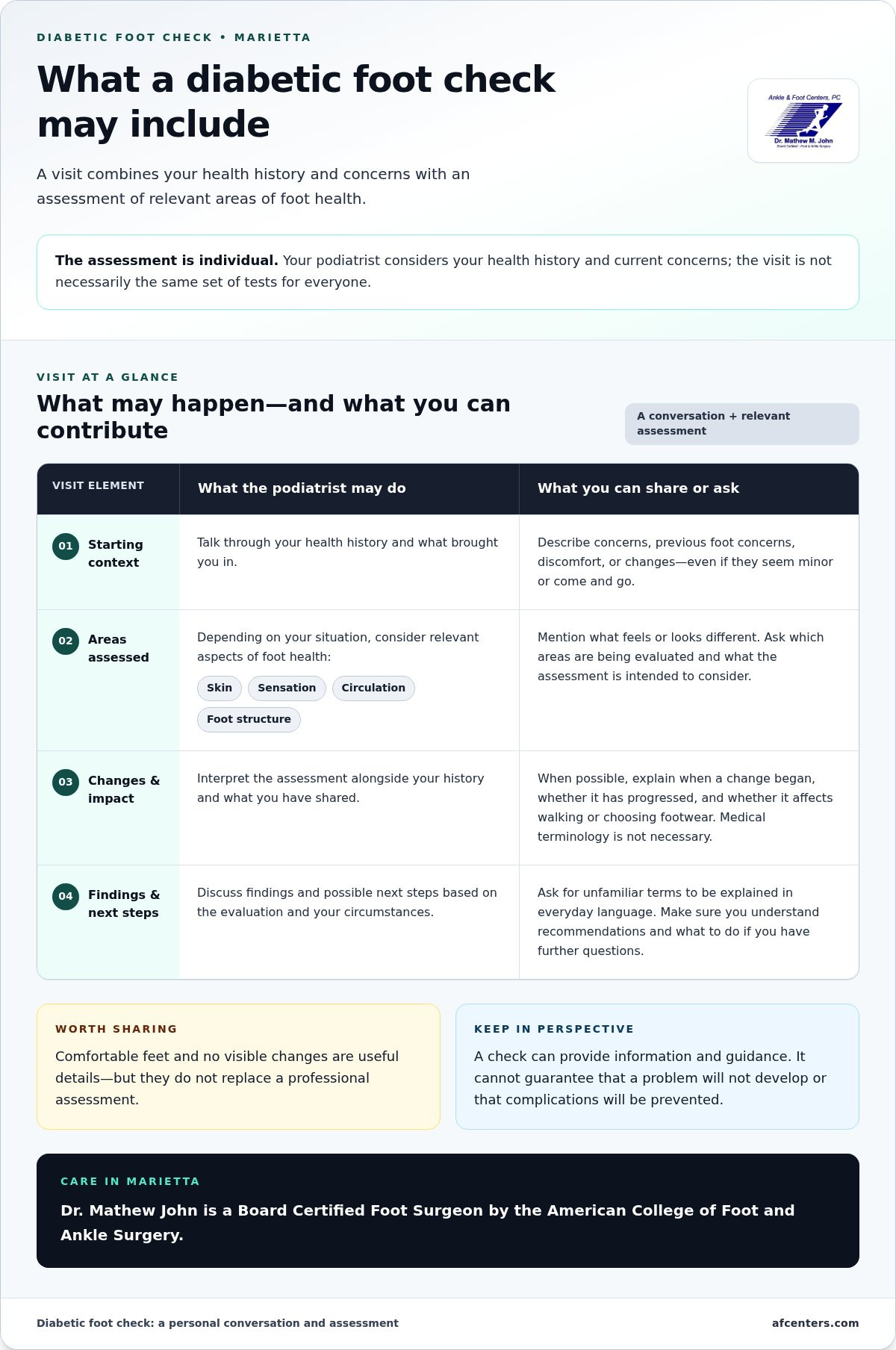
A foot check is not necessarily the same set of tests for everyone. Your podiatrist starts by learning about your health and what brought you in, then considers which aspects of your foot health are relevant to your history and concerns. The Diabetic Foot Exam guide from MedlinePlus, part of the National Library of Medicine, also describes common elements of this type of evaluation.
A visit may include:
- A conversation about your health history and foot concerns
- An assessment of relevant areas, which may include skin, sensation, circulation, and foot structure
- A discussion of the findings and possible next steps
This is a general overview, not a fixed protocol. The evaluation depends on your health history, current concerns, and the clinician’s judgment. Ask what the clinician is assessing and why, so you understand the purpose of each part of the visit.
Questions your podiatrist may ask
Be ready to talk about changes, discomfort, previous foot concerns, and relevant health history. If possible, describe when a change began, whether it has progressed, and how it affects activities such as walking or choosing footwear. Medical terminology isn’t necessary. If an explanation is unfamiliar, ask the clinician to put it in everyday language.
Areas a podiatrist may assess
Depending on your situation, the clinician may consider skin condition, sensation, circulation, and foot structure. These areas provide different information, which is interpreted alongside your history and what you’ve shared. The assessment may vary from person to person, so ask which areas are being evaluated and what the findings mean for you.
The discussion at the end matters, too. Make sure you understand any recommendations and what to do if you have further questions. Clear explanations turn an assessment into a useful next step and support peace of mind with diabetic foot checks Marietta without suggesting that one visit guarantees a particular outcome. Explore the services available at Ankle & Foot Centers to learn more about the practice’s foot and ankle care.
No pain or visible change? Why a check can still be worth discussing
If your feet feel comfortable and look the same as usual, that may feel reassuring. Share it with your clinician, but remember that it isn’t the same as a professional assessment. Diabetes can affect foot health, including sensation, so changes may not always feel obvious. This doesn’t mean everyone with diabetes has a foot problem. It means that symptoms, or a lack of symptoms, are only part of the picture.
What if my feet feel normal?
A foot check gives you an opportunity to discuss your health history and whether an evaluation is appropriate for you. Rather than relying on a schedule that may not fit everyone, ask your clinician how often checks make sense based on your individual circumstances. The conversation can help you understand what to watch for and when to follow up.
A professional check is part of an informed approach, not a reason to assume something is wrong. Your clinician can consider your circumstances and explain the reasoning behind any recommendations. For people seeking peace of mind with diabetic foot checks Marietta, a clear, personal conversation can be more useful than judging foot health by comfort alone.
When to raise a change promptly
Don’t wait for a routine check to mention a new, worsening, or concerning change. Tell a clinician what you’ve noticed, when it began, and whether it is changing or affecting your usual activities. You don’t have to identify the cause or decide how serious it is before asking for guidance.
A routine check and attention to a new concern serve different purposes. A scheduled assessment allows time to discuss your foot health; a change that worries you may call for more timely advice. If a concern feels urgent or severe, seek appropriate medical care rather than waiting for a routine visit or trying to manage it on your own. Your clinician can help clarify the next step without assuming that every change points to a complication.
Bring up what feels different, even if the change seems small or you’re unsure how to describe it. Clear communication helps your clinician understand your perspective and provide guidance suited to your situation.
How to prepare for a diabetic foot check in Marietta
A little preparation can make it easier to explain what you’ve noticed and get answers to your questions. You don’t need to arrive with a diagnosis or a perfect account of every change. Your notes can simply give the conversation a useful starting point.
A short checklist before your appointment
Before your visit, take a few minutes to organize what you want to discuss. Consider noting:
- Changes in your feet, when you first noticed them, and whether they’ve changed since
- Discomfort or other concerns, including how they affect walking or daily activities
- Relevant health history and information about your current care, if available
- Questions you don’t want to forget, including any difficulty checking or caring for your feet at home
Small details can help your clinician understand a concern. For example, you might note that an area feels different in certain shoes or is hard to see without help. If you’re unsure whether something matters, include it in your notes and let the clinician assess its relevance. Preparation supports clear communication, but it can’t determine a diagnosis in advance.
Questions to ask during the visit
Use the appointment to understand the assessment and what comes next. You might ask:
- What did the assessment find, and what do those findings mean for me?
- Are there changes I should bring to your attention promptly?
- Who should I contact if I have a concern after the visit?
- How often should I have future checks based on my individual circumstances?
If an explanation uses unfamiliar terms, ask for everyday language. You can also repeat back what you understood or ask the clinician to clarify a recommendation. A clear conversation helps you leave with a better sense of your personal next steps instead of relying on general advice that may not fit your situation.
Preparation can support peace of mind with diabetic foot checks Marietta by helping you share relevant details and take part in the discussion. If you’re ready to talk about your foot health, schedule a diabetic foot care visit with Ankle & Foot Centers.
Find reassurance with diabetic foot care at Ankle & Foot Centers in Marietta
Understanding what a foot check may involve is a helpful start. The next step is having a place to discuss your concerns and understand guidance that fits your circumstances. Ankle & Foot Centers, PC provides diabetic foot care in Marietta, where your questions and observations can shape the conversation.
What to expect from a supportive local visit
Dr. Mathew M. John is a Board Certified Foot Surgeon by the American College of Foot and Ankle Surgery. During a visit, share changes you’ve noticed, questions about your foot health, or difficulties checking or caring for your feet. A professional evaluation gives you a chance to discuss those concerns and understand the clinician’s recommendations. Findings and next steps depend on your individual situation, so no particular result should be assumed in advance.
Clear explanations matter. Ask what the clinician assessed, what the findings mean for you, and what to do next. Explore the practice’s diabetic foot care and podiatry services to learn more about care at Ankle & Foot Centers.
The practice is located at 2790 Sandy Plains Road on the corner of Post Oak Tritt and Sandy Plains. Patients from Marietta and nearby Atlanta Metro communities, including Roswell, Woodstock, Kennesaw, Atlanta, and Sandy Springs, can bring their foot-health questions to a local podiatric practice.
Take the next step toward clearer foot-health guidance
If you’re ready to discuss your foot health, schedule a professional diabetic foot evaluation with Ankle & Foot Centers in Marietta. Bring your questions and share any changes or concerns, even if you’re unsure how to describe them. The aim is to help you understand an appropriate next step, not to promise a specific outcome.
Seeking peace of mind with diabetic foot checks Marietta can begin with a straightforward conversation. Schedule a visit to discuss your concerns with a podiatric professional.
Take a confident next step for your foot health
A diabetic foot check gives you a chance to discuss changes or concerns, understand what was assessed, and hear guidance tailored to your circumstances. Feeling no pain or noticing no visible change doesn’t replace a professional evaluation. Preparing questions can help you make the most of the conversation.
Ankle & Foot Centers, PC provides diabetic foot care in Marietta. Dr. Mathew M. John is a Board Certified Foot Surgeon by the American College of Foot and Ankle Surgery. If you’re ready to seek peace of mind with diabetic foot checks Marietta, a professional conversation can help you understand a clear next step for your foot health.
Schedule a diabetic foot check in Marietta and bring your questions, observations, and care goals. The visit is an opportunity to feel more informed and supported as you look after your feet.
Frequently Asked Questions
What happens during a diabetic foot check?
A diabetic foot check generally includes a conversation about your health history and foot concerns, an assessment guided by your situation, and a discussion of findings and possible next steps. A podiatrist may consider skin condition, sensation, circulation, or foot structure, but the exact evaluation can vary. Share any changes you’ve noticed and ask for unfamiliar terms to be explained so you understand what the assessment means for you.
Can I need a diabetic foot check if my feet do not hurt?
Yes. A lack of pain doesn’t replace a professional assessment. Diabetes can affect foot health, and people may experience changes differently. Mentioning that your feet feel normal is still useful information for your clinician. Discuss your individual circumstances with a podiatrist to understand what kind of evaluation and follow-up may make sense for you.
How often should someone with diabetes have a foot check?
There isn’t one schedule that’s right for everyone. Ask your clinician how often checks are appropriate based on your health history, foot-health findings, and current concerns. If you notice a new or worsening change between planned visits, don’t wait for the next routine check to bring it up. Your clinician can advise whether it needs attention sooner and explain an appropriate follow-up plan.
What should I bring to a diabetic foot check in Marietta?
Bring notes about any changes, when they began, and how they affect daily activities, along with relevant health-history information and details about your current care, if available. Write down questions so they’re easy to remember. Mention if checking or caring for your feet at home is difficult. You don’t need to diagnose a concern in advance; your notes help start a clear conversation with the podiatrist.
Can a podiatrist tell whether I have a diabetic foot problem during a check?
A podiatrist can assess your feet, consider your health history, and explain findings that may need attention. The evaluation may help clarify whether further assessment or a particular next step is appropriate, but no check can guarantee that every concern will be identified or predict future problems. Ask what the findings mean for you and what changes should prompt follow-up. Your clinician can provide guidance based on your individual situation.
Where can I get a diabetic foot check in Marietta, GA?
Ankle & Foot Centers, PC provides diabetic foot care in Marietta, Georgia. Dr. Mathew M. John leads the practice, which serves the greater Atlanta Metro area, including Roswell, Woodstock, Kennesaw, Atlanta, and Sandy Springs. A visit offers an opportunity to discuss your concerns and understand a personal next step.
What should I do if I notice a new foot change before my appointment?
Tell a clinician about a new, worsening, or concerning change rather than waiting for a routine appointment. Describe what you noticed, when it started, and whether it has changed or affects your usual activities. You don’t need to determine what caused it. If the concern feels urgent or severe, seek appropriate medical care instead of trying to manage it alone or waiting for a scheduled check.


