

The right specialist for ankle pain isn’t determined by a title alone. If you’re weighing a podiatrist vs orthopedist for ankle pain, it’s understandable to worry that choosing the wrong first appointment could delay a useful assessment. Both specialists may treat ankle problems, but their training and areas of focus differ.
Start with the symptoms you want assessed and the clinician’s experience with foot and ankle conditions. A podiatrist focuses on foot and ankle health, while an orthopedist treats a broader range of musculoskeletal problems and may specialize further in the foot and ankle. Neither title is automatically the right fit for every injury.
This guide explains where the specialties differ and overlap, which ankle concerns may suit each, and what to expect during an evaluation, including an examination, possible imaging, and a discussion of treatment options. You’ll also learn which symptoms call for prompt medical attention and what details to bring. At Ankle & Foot Centers, PC in Marietta, Dr. Mathew John is a Board Certified Foot Surgeon by the American Board of Foot and Ankle Surgery. The practice evaluates ankle sprains, instability, fractures, tendonitis, and arthritic conditions for patients in Marietta, Roswell, Woodstock, Kennesaw, Atlanta, and Sandy Springs.
Key Takeaways
- For podiatrist vs orthopedist for ankle pain, focus on the problem’s scope and the clinician’s foot and ankle experience, not the title alone.
- Both specialists may evaluate ankle concerns. Their training differs, and individual specialization can help guide your choice.
- Sudden injuries, recurring instability, persistent pain, and suspected fractures each call for an assessment based on your symptoms and findings.
- Prepare to describe when the pain began, what affects it, and any relevant medical history. Imaging may be considered after the examination.
- Ankle & Foot Centers, PC evaluates a range of ankle conditions in Marietta, with care led by Dr. Mathew John, a Board Certified Foot Surgeon by the American Board of Foot and Ankle Surgery.
Podiatrist vs. Orthopedist for Ankle Pain: What Is the Difference?
Ankle pain can make it hard to know where to start, especially when both podiatrists and orthopedists may evaluate ankle problems. In the podiatrist vs orthopedist for ankle pain decision, the key distinction is each specialist’s overall focus, not a rule that one is always the better choice.
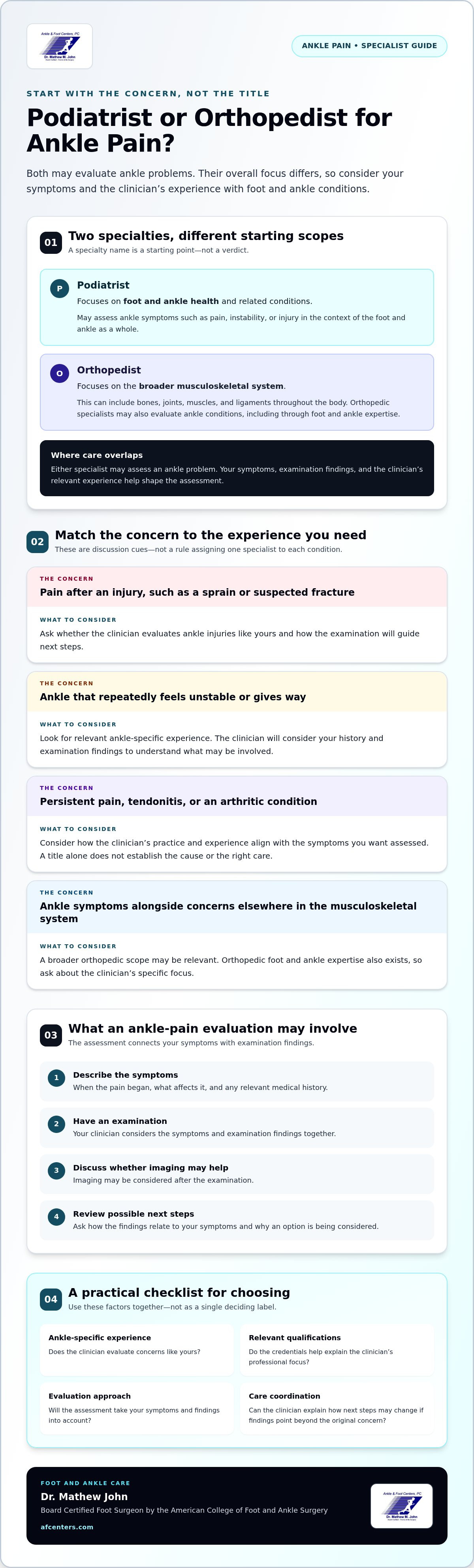
A podiatrist specializes in foot and ankle health and related conditions. An orthopedist focuses on the broader musculoskeletal system, including bones, joints, muscles, and ligaments throughout the body. There is overlap: either may assess an ankle condition, and the right fit depends on your symptoms, examination findings, and the clinician’s relevant experience. The Podiatry overview provides additional background on the specialty.
| Comparison | Podiatrist | Orthopedist |
|---|---|---|
| Primary focus | Foot and ankle health and related conditions | The musculoskeletal system, including bones and joints throughout the body |
| Typical evaluation scope | Foot and ankle symptoms, such as pain, instability, or injury | Ankle concerns and other musculoskeletal symptoms, considered within a broader scope |
| Where care may overlap | Both may evaluate ankle problems. The clinician’s focus and your individual findings help shape the assessment. | |
What does a podiatrist treat when ankle pain is involved?
A podiatrist can assess ankle symptoms in the context of the foot and ankle as a whole. An evaluation may address a sprain, a feeling that the ankle gives way, a fracture, tendonitis, or an arthritic condition. Where the pain occurs, how the ankle moves, and what the examination shows all help guide next steps. A specialty title alone doesn’t determine which care is appropriate for you.
How does an orthopedist’s scope compare?
An orthopedist’s broader musculoskeletal focus includes bones and joints throughout the body, and orthopedic specialists may also evaluate ankle conditions. This can be relevant when ankle symptoms occur alongside concerns elsewhere in the musculoskeletal system. Orthopedic foot and ankle expertise also exists, so the specialty name alone doesn’t tell you a clinician’s specific focus. Your symptoms and examination findings remain central to the assessment.
Think of the distinction as a starting point, not a verdict. An ankle problem may need careful evaluation to understand which structures are involved. A broader orthopedic scope also doesn’t mean an orthopedist lacks ankle expertise. Consider what you’re experiencing and whether the clinician’s practice and experience align with that concern. Ankle & Foot Centers, PC evaluates foot and ankle conditions, including ankle injuries and pain.
How Training and Ankle Specialization Shape Your Care
A specialty name is a useful starting point, but it doesn’t tell you everything about a clinician’s experience with your specific ankle concern. Training pathways differ, and clinicians within each specialty may develop focused experience in particular conditions. As you decide where to begin, consider how a clinician’s qualifications and evaluation approach relate to the symptoms you want assessed.
For the podiatrist vs orthopedist for ankle pain decision, look for a fit between your concern and the clinician’s background. Ankle-specific experience may be useful whether your symptoms followed an injury, keep returning, or affect your movement over time. It can’t establish the cause of your symptoms in advance. That takes an individual assessment.
Which credentials matter when choosing an ankle specialist?
Credentials can help you understand a clinician’s qualifications and areas of focus. Board certification is one factor to consider, alongside relevant experience and the way the clinician approaches your evaluation. A credential reflects professional qualifications, but it can’t predict a particular outcome. Consider it as one part of the picture, along with whether the assessment and possible next steps are clearly explained.
This checklist can help you compare what matters for your concern:
- Ankle-specific experience: Does the clinician evaluate concerns like yours, such as symptoms after an injury or repeated instability?
- Relevant qualifications: Do the clinician’s credentials help you understand their professional focus?
- Evaluation approach: Will the assessment take your symptoms and examination findings into account?
- Care coordination: Can the clinician explain how next steps may change if the findings point beyond the original concern?
Why ankle-focused experience can be relevant
Ankle-focused experience is relevant when assessing sprains, instability, fractures, and tendon problems. These concerns can share symptoms, so familiarity with a condition doesn’t establish what is causing your pain. The clinician considers your history and examination findings to understand what may be involved and discuss appropriate next steps.
Pay attention to whether the explanation connects the findings to your symptoms and clarifies why a particular next step is being considered. You can ask what the clinician is assessing and how the suggested options relate to your concern.
Ankle & Foot Centers, PC provides foot and ankle services in Marietta, with evaluations for ankle conditions including sprains, instability, fractures, tendonitis, and arthritic conditions. Dr. Mathew John is a Board Certified Foot Surgeon by the American Board of Foot and Ankle Surgery. Considering relevant experience alongside your symptoms can help you approach an appointment with greater confidence.
Which Specialist May Fit Different Types of Ankle Pain?
The pattern of your symptoms can help you decide where to begin, but it can’t identify the cause on its own. The table below offers a starting point for the podiatrist vs orthopedist for ankle pain decision. Both specialists may be relevant, depending on what the evaluation finds and the clinician’s focus.
| What you’re experiencing | Why a podiatrist may fit | Why an orthopedist may fit |
|---|---|---|
| Sudden injury | A foot-and-ankle-focused assessment may help evaluate a sprain or sports injury. | An orthopedist may assess the ankle injury, particularly if other musculoskeletal concerns are involved. |
| Recurring instability | Repeated giving way can be assessed as an ankle-specific concern. | An orthopedist with relevant ankle experience may also evaluate the joint and related structures. |
| Persistent pain | A podiatrist may assess ankle symptoms, including possible tendon or arthritic concerns. | An orthopedist may be relevant if the pain connects with broader musculoskeletal symptoms. |
| Suspected fracture | A podiatrist may evaluate the foot and ankle injury and determine appropriate next steps. | An orthopedist may also assess a suspected fracture, depending on the injury and clinician focus. |
This comparison is for navigation, not self-diagnosis. Severe pain, marked swelling or bruising, or inability to bear weight calls for prompt medical evaluation. Don’t rely on the table to rule out an injury or decide whether imaging is needed. An examination helps determine what further assessment or care may be appropriate.
When ankle pain follows a sprain or sports injury
After a twist, fall, or sports injury, notice whether swelling, bruising, severe pain, instability, or difficulty bearing weight develops. These symptoms are reasons to seek evaluation, especially if you can’t comfortably stand or walk. A clinician can examine the ankle and decide whether imaging or further care is appropriate. Ankle sprains and sports injuries are among the conditions evaluated at Ankle & Foot Centers, PC.
When pain is persistent, recurrent, or linked to a chronic condition
Arrange an assessment if ankle pain keeps returning, the joint repeatedly gives way, or discomfort persists around a tendon or arthritic joint. These symptoms can have different causes, so avoid assuming a diagnosis without an examination. If pain extends into your heel, its source may need separate consideration as part of the evaluation.
Bring a clear description of what you notice: where the pain is, when it began, what movements aggravate it, and whether the ankle has buckled or swelling has changed. These details help the clinician connect your experience with the examination findings. Ankle & Foot Centers, PC evaluates ankle sprains, instability, fractures, tendonitis, and arthritic foot and ankle conditions in Marietta, serving patients from Roswell, Woodstock, Kennesaw, Atlanta, and Sandy Springs. Its foot and ankle services include care for ankle injuries.
What to Expect at an Ankle-Pain Evaluation
An ankle-pain visit is a chance to explain what you’re experiencing and work toward a clearer understanding of what may be contributing to it. Whether you’re seeing a podiatrist or orthopedist, the assessment typically moves from a conversation about symptoms and medical history to an examination, possible imaging, and a discussion of care options. This sequence helps the clinician tailor the evaluation to your situation.
What details help explain your ankle symptoms?
Before your appointment, think through when the pain began, where you feel it, and what makes it better or worse. Mention whether it started after a specific injury or developed gradually. Describe any swelling, weakness, numbness, or feeling that the ankle gives way. Share whether standing or walking has become difficult and whether your ability to bear weight has changed.
Bring a list of medications, relevant medical history, records or images from previous ankle evaluations, and details about any injury. Include prior ankle problems, even if they seemed to resolve. These details give the clinician useful context and help keep the conversation focused on what matters to you.
What happens during the evaluation?
The clinician will discuss your symptoms and medical history, then examine the ankle in light of what you’ve described. Be ready to explain which movements or activities affect your discomfort. The examination helps assess your ankle and determine whether more information is needed. Imaging may be considered if your symptoms and examination findings indicate it could help, but it isn’t automatic.
You don’t need to know the exact medical terms for your symptoms. Clear descriptions are useful: “It hurts on the outside after I turn my foot,” or “It feels unsteady on stairs.” If you have prior images or records, bring them so the clinician can consider them as part of the assessment.
What happens after the examination?
After reviewing your symptoms and examination findings, the clinician can explain what they’ve observed and discuss appropriate treatment options with you. Recommendations depend on the individual evaluation and may include nonsurgical care. If imaging could help clarify the situation, the clinician can discuss that possibility. The visit is also a good time to ask what each proposed next step is intended to address.
The podiatrist vs orthopedist for ankle pain choice can feel less uncertain when you know what a first visit involves: sharing your story, having the ankle assessed, and discussing possible next steps. Ankle & Foot Centers, PC offers foot and ankle evaluations that may include an examination, possible imaging, and a discussion of treatment options. Explore the practice’s foot and ankle services to arrange an evaluation.
Choosing Ankle-Pain Care in the Atlanta Metro Area
To choose where to start, consider the concern you want assessed and the clinician’s relevant experience and qualifications. A specialty title can help orient you, but it doesn’t determine the right fit for every ankle problem. Focus on care that aligns with your needs and gives you a clear opportunity to discuss your symptoms.
Ankle & Foot Centers, PC provides specialized foot and ankle care in Marietta for patients across the Atlanta Metro area, including Roswell, Woodstock, Kennesaw, Atlanta, and Sandy Springs. The practice evaluates ankle sprains, instability, fractures, tendonitis, and arthritic foot and ankle conditions. Sharing how your symptoms affect daily activities helps make the evaluation relevant to your experience.
How Ankle & Foot Centers, PC evaluates ankle concerns
An evaluation includes discussion of your symptoms and medical history, followed by an examination. Imaging may be considered based on your situation, and the clinician can discuss appropriate options in light of the findings. Recommendations are individualized; an appointment doesn’t mean you’ll need imaging, surgery, or a particular intervention.
Think about what you want help understanding, such as discomfort that limits your routine or uncertainty about what may be contributing to your symptoms. Sharing those concerns helps focus the conversation and makes space for questions about the assessment and possible next steps.
A clear next step for ankle pain in Marietta
Consider seeking an evaluation if ankle pain persists or you notice swelling, weakness, numbness, or a change in your foot’s appearance. These signs don’t identify a cause by themselves, but they’re worth describing to a clinician. Bring relevant medical history and any prior imaging or records that may provide context.
If you’re ready to take a considered next step, Ankle & Foot Centers, PC provides foot and ankle care in Marietta for patients from Roswell, Woodstock, Kennesaw, Atlanta, and Sandy Springs. Explore foot and ankle care options and arrange an evaluation to discuss your concerns.
Take the Next Step Toward Comfortable Movement
An ankle problem doesn’t need a perfect label before you seek guidance. If discomfort is changing how you walk, work, exercise, or manage everyday routines, let that impact prompt a conversation with a specialist. You don’t have to resolve the podiatrist vs orthopedist for ankle pain question on your own before arranging an evaluation.
Seeking care is a step toward understanding your options, not a commitment to a particular treatment. Think about what you’d like to do more comfortably, and bring that goal into the conversation. Your priorities can help make the discussion practical and personal, whether you’re hoping to move with greater confidence or better understand persistent symptoms.
Ankle & Foot Centers, PC offers foot and ankle care in Marietta for patients across the Atlanta Metro area, including Roswell, Woodstock, Kennesaw, Atlanta, and Sandy Springs. Take a considered next step and explore foot and ankle care in Marietta by arranging an evaluation for your ankle concerns.
Frequently Asked Questions
Is a podiatrist qualified to treat ankle pain?
Yes. Podiatrists focus on foot and ankle health, so ankle pain is within the area they evaluate. Orthopedists may also assess ankle problems as part of their broader musculoskeletal practice. For the podiatrist vs orthopedist for ankle pain decision, consider your symptoms and the individual clinician’s qualifications and ankle experience. Recurring ankle pain after an old sprain, for example, is worth describing even if you’re unsure what’s causing it.
Can an orthopedist treat ankle sprains and fractures?
Yes. An orthopedic specialist may evaluate ankle sprains and fractures as musculoskeletal injuries. The appropriate clinician depends on the details of the injury and the specialist’s focus. A sprain with persistent instability calls for an assessment of the ankle and its function, while a suspected fracture needs prompt evaluation. The examination helps determine what further assessment or care may be appropriate.
Should I see a podiatrist or orthopedist for a suspected ankle fracture?
Seek prompt medical evaluation for a suspected ankle fracture rather than trying to decide from symptoms alone. A podiatrist or an orthopedist may be relevant, depending on the injury and the clinician’s ankle expertise. An examination can help assess the concern, and imaging may be considered if it would help. Pain, bruising, or swelling can’t confirm a fracture remotely, so don’t use an online description to rule one out.
When should ankle pain be evaluated by a doctor?
Seek medical evaluation for severe, worsening, or persistent ankle pain, especially with swelling, deformity, an open wound, redness, warmth, numbness, or inability to bear weight. These signs don’t identify a specific cause, but they can indicate that an assessment is important. If the ankle’s appearance changes or walking becomes difficult, explain when the change began and whether it followed an injury. Don’t wait for a self-diagnosis before seeking guidance.
Do I need a referral to see a podiatrist?
Referral requirements depend on your insurance plan. Many plans allow direct access to a podiatrist, while some HMOs require a referral from a primary-care provider. Review your plan’s referral rules before scheduling so you understand any steps it requires. If you have questions about your plan, use the contact details on your insurance card. Referral requirements are separate from deciding which specialist’s experience best fits your ankle concern.
What happens during a first appointment for ankle pain?
A first appointment usually starts with a conversation about your symptoms and medical history, followed by an examination of the ankle. The clinician may consider imaging based on what you describe and what the examination shows. Then you can discuss the findings and possible treatment options. To make the conversation useful, note what activities affect the pain and what you hope to return to, such as walking comfortably or playing a sport.
Is a podiatrist the same as a foot and ankle surgeon?
No. Podiatrist describes a specialty focused on foot and ankle health; foot and ankle surgeon refers to a clinician with additional surgical training and relevant board certification. The titles aren’t interchangeable, and a podiatrist’s title alone doesn’t establish surgical credentials. Dr. Certification is a professional credential, not a promise of a particular result.
What should I bring to an ankle-pain appointment?
Bring photo ID, insurance information, a current medication list, relevant medical history, and prior ankle imaging or reports if you have them. Shoes or orthotics you use may also provide context, particularly if symptoms change during walking or activity. Whether you’re coming from Marietta, Roswell, Woodstock, Kennesaw, Atlanta, or Sandy Springs, prepare the same way: gather the items beforehand and note when symptoms began and how they’ve changed.


