

For a second opinion for foot surgery in Marietta, bring your imaging, written reports, treatment recommendation, and a summary of your medical history and current medications. Include the MRI or X-ray images when available, not just the written report, so the surgeon can review the findings alongside your records. Write down your questions before the appointment.
It’s understandable to want a clearer picture before deciding on surgery. A focused review can help you understand how the diagnosis relates to your symptoms and which surgical or nonsurgical options may suit your situation. This article explains which records to gather, how imaging and reports support the discussion, and what to ask as you consider your next steps.
Key Takeaways
- Gather your medical history, current medications, prior treatment recommendations, and relevant written records before your appointment.
- Bring MRI and X-ray images as well as their reports so the surgeon can review both the pictures and the written findings.
- Prepare questions about your diagnosis, the reasoning behind the proposed procedure, and possible nonsurgical approaches.
- Organize your documents by date and note how your foot or ankle symptoms affect your daily activities.
- A second opinion can help you understand the options and make a more informed decision about your care.
Ankle & Foot Centers, PC: Reconstructive Foot and Ankle Surgery
Ankle & Foot Centers, PC offers reconstructive foot and ankle surgery for people considering an operation for a foot or ankle condition. If you’re weighing a surgical recommendation, bring your records and imaging to discuss the diagnosis, proposed procedure, and relevant options. The practice also treats bunions and hammertoes, which may lead people to explore surgery. A conversation can connect the recommendation with your condition and goals. Contact Ankle & Foot Centers, PC to discuss an appointment.
Preparation and records to bring to the appointment
A clear appointment starts with an organized record set. Before seeing a doctor, write down your diagnosis, symptoms, medical history, current medications, and previous treatment recommendations. Include dates you remember, such as when pain began or when a sports injury occurred. This timeline helps the physician understand how your condition has changed.
Prepare Your Records and Questions
Gather paperwork related to your foot or ankle concern, including notes from the clinician who recommended surgery, previous evaluations, relevant test reports, and a medication list. If another practice treated the problem, add its visit summaries. Keep the original documents together and arrange copies by date so the doctor can follow the sequence of care.
- Write a brief symptom timeline, including what activities worsen or ease discomfort.
- List medications and treatments you have tried, such as bracing or activity changes.
- Note medical conditions that may affect planning, including allergies you know about.
- Prepare questions about the diagnosis, proposed procedure, alternatives, and recovery needs.
Bring questions in writing rather than relying on memory. Ask what the operation aims to change and how the recommendation relates to your symptoms. You can also ask which records the doctor reviewed and whether more information would clarify the plan. Focus your list on the decisions you need to make.
Appointment Timing and Availability
Appointment availability can affect how quickly you receive another review. Compare scheduling options alongside the surgeon’s relevant focus, rather than choosing only the earliest opening. If your planned procedure concerns an ankle tendon, prioritize a practice that evaluates foot and ankle conditions. Keep the appointment confirmation and note any records the practice asks you to bring.
Save the practice’s phone number, appointment time, and location with your booking details. If your records are stored electronically, make sure you can access the files before the visit. Imaging reports and referral notes may be held by separate offices, so identify each source and request the documents early. Keep a copy of every request for your reference.
Referral Paperwork and Contact Details
Referral requirements depend on your insurance plan and appointment pathway. If a clinician referred you, bring the referral paperwork and the clinician’s contact details. Include the referring doctor’s name, the reason for referral, and any written recommendation. These details help the reviewing physician understand how the second opinion fits into your care.
Tell the appointment team that you’re seeking an independent review of a surgical recommendation. This helps them direct your visit appropriately. If the concern involves a sports injury, bring notes about the activity that triggered symptoms and any changes since then. Before leaving, gather your records, questions, and appointment information in one place.
Review of MRI, X-rays, reports, and medical records
A useful review connects your images, written findings, medical history, and proposed treatment plan. Bring the actual imaging when available, along with the reports describing it.
Medical Records and Imaging Review
MRI and X-rays show different details, while their reports summarize a radiologist’s interpretation. The reviewing physician can consider both the images and written findings alongside your symptoms and examination. For example, a report may describe a structural change, but the treatment plan also needs to address how that finding relates to your foot or ankle problem.
Organize imaging by date and body part. If you have repeat X-rays or MRI studies, bring each set so the surgeon can consider changes over time. Keep each written report with its matching images. Don’t rely on the report alone if you can access the original files, since the images provide additional context for discussion.
Records to Provide
Share written information about your condition, medical history, current medications, and previous treatment recommendations. Include visit summaries, relevant test reports, and notes describing treatments already tried. If records come from more than one Georgia clinic, group them by date and source. For instance, you can place documents from appointments near Windy Hill or Austell in separate labeled sections.
- Bring MRI and X-ray images with their corresponding reports.
- Include the written surgical recommendation and related visit notes.
- List current medications and relevant medical conditions.
- Record previous treatments and how your symptoms responded.
An organized record set helps the doctor follow your care history without relying only on memory. Keep a personal copy, too, so you can refer to the same findings during the discussion.
Pre-Operative Clearances and Testing
If preoperative medical clearance or testing has already taken place, bring the results and any related instructions. These records can add context to a proposed operation and show what has been completed. If testing is still being arranged, note which evaluations are pending and who is coordinating them. Keep clearance paperwork separate from imaging reports so each document is easy to find.
Include questions about testing in your appointment discussion. Ask which results relate to the proposed procedure, how they inform the treatment plan, and whether they change the next steps. The answers can help you understand how medical information fits into surgical planning.
Use Medical Education During the Review
A second opinion should make the medical reasoning understandable. Ask the physician to explain unfamiliar terms in an MRI report, identify the finding linked to your symptoms, and describe how it affects the recommendation. You can also ask how the treatment plan would change if an image or report showed a different finding.
Write down key explanations and the names of any structures discussed. Before leaving, summarize what you understood about the diagnosis, the role of imaging, and the next decision. This helps you carry what you learned at the appointment into a clear, informed conversation about care.
Surgical and nonsurgical care options
A second review should explain why a proposed operation fits your diagnosis and goals. In Marietta, ask the surgeon to compare the recommendation with nonsurgical care and clarify how each option addresses the affected foot or ankle structure.
Start with the diagnosis. Ask which examination and imaging findings support surgery and what the procedure aims to change. Then discuss the alternative plan: what it involves, how progress would be assessed, and what might prompt reconsideration. A useful conversation connects the recommendation to your symptoms, daily activities, and priorities, rather than treating an image finding in isolation.
For a sports injury, describe the activity that triggers symptoms and the movements you hope to resume. An East Cobb runner and an Atlanta worker who stands throughout the day may have different functional goals, even with a similar diagnosis. Share your priorities so the physician can explain how each approach relates to your routine.
Use these questions to compare the options:
- What diagnosis is the treatment plan addressing?
- What specific goal does the surgical option target?
- What nonsurgical approach is available, and how is progress judged?
- What factors would lead the surgeon to revise the plan?
Training history can provide context, but it isn’t a substitute for a clear explanation of your case. Mark Light completed a two-year podiatric medicine and surgery residency at Kern Hospital in Warren, Michigan. His background also includes adjunct clinical faculty roles at Barry University, Temple University, and California College of Podiatric Medicine from 1998 to 1999.
A surgeon’s training and professional background can help you understand their qualifications, but they don’t determine whether a particular operation suits your condition. Ask how the surgeon’s experience relates to your diagnosis, the proposed procedure, and the alternatives under discussion. The answer should connect directly to your records and goals.
Medical education also shapes how a surgeon communicates. Mark Light earned a Doctor of Podiatric Medicine degree at Dr. William M. Scholl College of Podiatric Medicine from 1985 to 1989. When reviewing credentials, consider the education and surgical training alongside the reasoning offered for your treatment plan. A well-explained comparison gives you practical points to consider before making a decision.
Take notes during the appointment, especially about the differences between options. If a term is unfamiliar, ask the surgeon to explain it in plain language. Before concluding, summarize what you understand about the diagnosis, recommended surgical approach, and nonsurgical alternative. This recap can reveal unanswered questions while there’s still time to discuss them.
What medical records and imaging should I bring to a foot surgery second-opinion appointment?
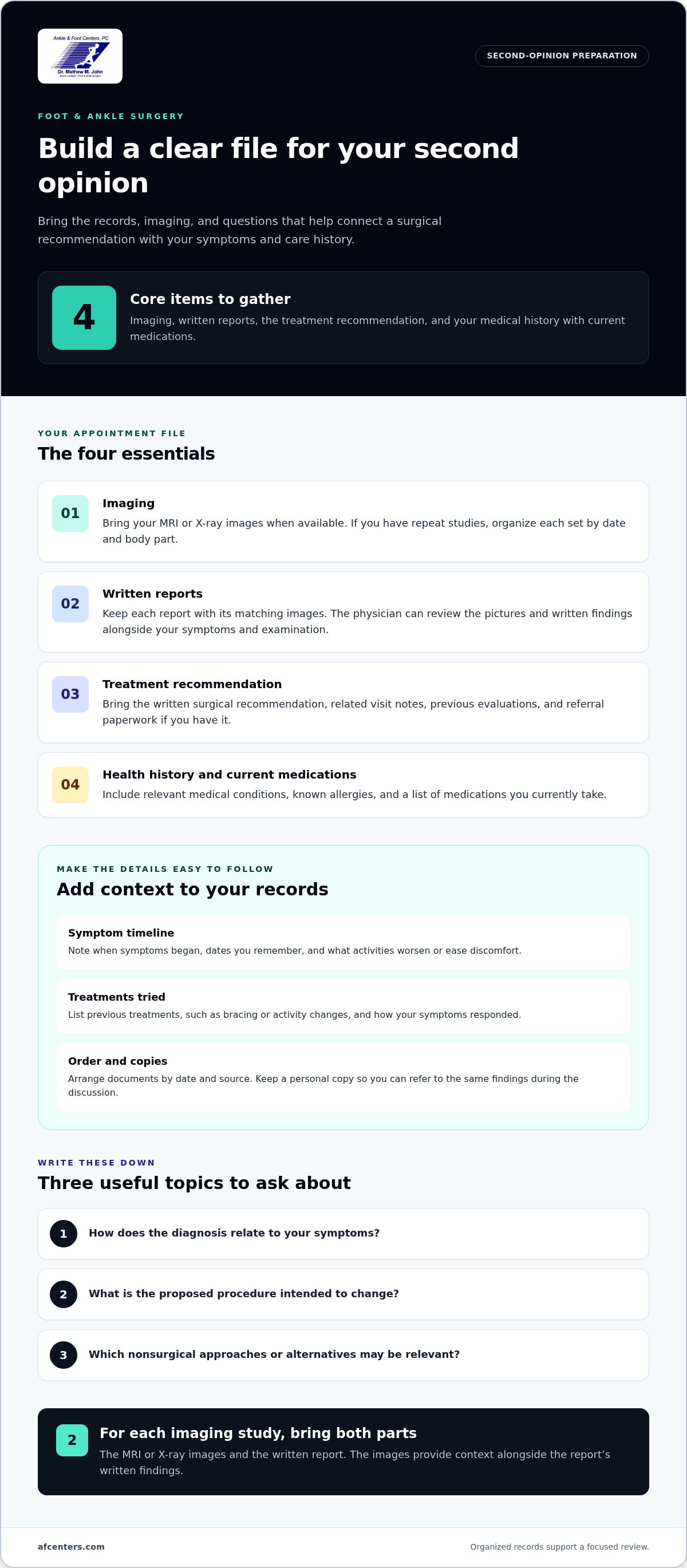
Bring the records that show how your foot or ankle concern has been assessed and treated. Include written information about your condition, medical history, current medications, and the recommendation for surgery. Add MRI or X-ray images and reports, if available. Together, these materials help the reviewing surgeon connect the proposed procedure with your diagnosis and care history.
Gather the Core Documents
Start with the records most directly related to the operation under discussion. A referral note or consultation summary can explain why surgery was recommended. Previous visit notes may show how symptoms and treatment decisions developed. Include relevant test results, too. If your records come from different clinics, keep each document with its source and date.
- MRI and X-ray images, plus the matching written reports
- Notes describing your condition and medical history
- Your current medication list and relevant treatment recommendations
- Visit summaries and test results related to the affected area
- A written list of questions about the diagnosis and proposed procedure
Keep the original files in their available format, such as a disc or digital image access. A report describes findings in writing, while the image lets the surgeon review the study. Bring both when possible. For repeat imaging, label each study by date so the sequence is easy to follow at the appointment.
Make the Record Set Easy to Review
Arrange papers in a simple timeline, with the earliest evaluation first, followed by later reports and recommendations. Place the written report beside its matching MRI or X-ray information. This makes it easier to distinguish an earlier assessment from a more recent treatment plan. A short cover page can list document dates and identify the clinic or physician associated with each record.
Prepare a concise symptom summary to accompany the documents. Note where discomfort occurs, which activities affect it, and what treatments you have tried. For example, describe whether walking or standing changes your symptoms. Keep observations factual and specific rather than interpreting what an image means. The surgeon can compare your description with the records and explain the medical reasoning.
Before the visit, review your question list and mark the decisions you need help understanding. Ask what the proposed surgery is intended to address, how the imaging supports the recommendation, and which nonsurgical options were considered. Bring a pen or device for notes, then record unfamiliar terms and explanations. This gives you a clear account to revisit after the appointment.
If your review concerns a possible reconstructive procedure, you can discuss reconstructive foot and ankle surgery as part of exploring your care options.
Ankle & Foot Centers, PC: Reconstructive Foot and Ankle Surgery
Ankle & Foot Centers, PC offers reconstructive foot and ankle surgery for people considering an operation for a foot or ankle condition. Dr. Mathew M. John is board certified by the American Board of Foot and Ankle Surgery. If you’re weighing a surgical recommendation, bring your imaging and records to discuss the diagnosis, proposed procedure, and relevant options. This conversation can help you understand how the recommendation connects with your condition and goals. The practice also treats bunions and hammertoes, which may lead patients to explore surgery. Contact Ankle & Foot Centers, PC to discuss an appointment.
Move Forward With a Clearer Plan
A second opinion for foot surgery in Marietta can help you feel more prepared to choose your next step. Use the discussion to connect your care plan with daily life, whether your priority is comfortable walking, returning to sports, or managing work activities. You deserve to understand the purpose of a proposed procedure and how it fits your goals.
Ankle & Foot Centers, PC provides reconstructive foot and ankle surgery and treats bunions and hammertoes. If you’re considering surgery for one of these concerns, a conversation with a foot surgeon can help you explore care options in context. Bring any unresolved questions and share what you hope to regain or maintain.
Contact Ankle & Foot Centers, PC to take the next step in your foot and ankle care. You can move forward at your own pace, with a clearer understanding of the choices ahead.
Ankle & Foot Centers, PC for a Second Opinion
Ankle & Foot Centers, PC provides reconstructive foot and ankle surgery and care for conditions such as bunions, hammertoes, flat feet, and sports injuries. If you’re considering foot surgery in Marietta and want another perspective on your options, the practice can discuss your concerns.
The team also treats heel pain, plantar fasciitis, neuromas, and other foot concerns, and offers custom orthotics and MLS Laser Therapy. Contact Ankle & Foot Centers, PC to discuss your needs and how its services may fit your situation.
Frequently Asked Questions
What Should You Bring?
Bring the documents that clarify the recommendation and help the surgeon understand your care so far. Include your medication list, relevant medical history, imaging reports, and any notes explaining why surgery was proposed. If you’ve had treatment for the same issue before, note what helped and what didn’t. A brief written timeline can keep the appointment focused on the decisions you’re considering.
Where can I get a second opinion for foot surgery in Marietta, Georgia?
Ankle & Foot Centers, PC provides foot and ankle care in Marietta, including reconstructive surgery. The practice serves people in Marietta and nearby communities, including Roswell, Woodstock, Kennesaw, Atlanta, and Sandy Springs. If you’re considering a surgical recommendation, discuss your diagnosis and goals with a foot surgeon. Bringing your records can help make the conversation relevant to your particular concern.
Which Marietta podiatrists or orthopedic foot and ankle surgeons offer second opinions?
Foot and ankle specialists named in this guide who practice in Marietta include Dr. Mathew M. John, Ryan Alexander Goldfine, Shaynah H. Goldfine, Ketan Bakul Patel, Ashish Nikunjkumar Shah, and Sequioa R. DuCasse. Roshmi Bhattacharya is an orthopedic foot and ankle surgeon in the area. Consider which clinician’s focus best matches your diagnosis, such as a tendon condition, fracture, or structural deformity.
How do I find a board-certified foot and ankle surgeon for a second opinion near Marietta?
Look for a surgeon whose board certification and clinical focus fit the procedure under consideration. Dr. Mathew M. John at Ankle & Foot Centers, PC is a board-certified foot and ankle surgeon in Marietta. As you review a surgeon’s background, note the certifying organization and whether the training relates to your affected area. Bring the proposed procedure name so you can discuss its connection to your diagnosis.
Can I get a second opinion through my insurance plan before foot surgery?
Many insurance plans allow direct access to a podiatrist, while some HMO plans require a primary-care referral. Your plan’s rules determine the steps for your situation. For example, an HMO member may need referral paperwork before seeing a specialist. Review your plan documents or member resources for referral and specialist-visit requirements, and have your insurance information available when arranging the appointment.
How long does it take to schedule a foot surgery second opinion in Marietta?
Scheduling depends on appointment availability and the practice’s booking process. It may also depend on how quickly you can gather records held by another clinic or imaging center. Contact the practice to arrange a visit, explain that you’re seeking review of a surgical recommendation, and begin collecting your documents. Having relevant records ready can make the appointment more useful.
What questions should I ask a surgeon during a second opinion about foot surgery?
Ask which diagnosis the proposed operation addresses and how the surgeon connects it to your symptoms. You can also ask what the procedure is intended to change, which alternatives are relevant, and what factors shape the recommended plan. If your goal is to return to a sport or manage work comfortably, explain that priority. This makes the discussion specific to your daily needs.
How do doctors compare nonsurgical treatment with foot surgery for common conditions?
Doctors consider the condition, its effect on daily activities, and the response to conservative care. For a bunion, ongoing pain, difficulty wearing shoes, and limits on activity may inform a surgical discussion. Depending on the problem, nonsurgical approaches can include footwear changes, medication, physical therapy, or custom orthotics. Certain fractures or tendon injuries may call for a different treatment discussion.


