

What if burning or tingling in your foot isn’t simply soreness from a long day? Numbness or discomfort while walking can make everyday routines harder and leave you unsure where to turn. If you’re searching for a tarsal tunnel syndrome specialist Woodstock patients can reach, focused foot and ankle care is a practical first step.
An evaluation should consider your symptoms and possible causes rather than assume every case is the same. At Ankle & Foot Centers, PC, Dr. Mathew M. John is board certified by the American Board of Foot and Ankle Surgery. The practice is in Marietta and serves patients from Woodstock and across the Atlanta Metro area.
This guide covers symptoms that may warrant professional attention, what a foot and ankle assessment may involve, and how to choose care that feels clear and approachable. It also explains how nerve-related symptoms may differ from heel pain associated with conditions such as plantar fasciitis, so you can feel prepared to discuss your next step.
Key Takeaways
- Burning, tingling, numbness, or foot discomfort that affects walking or daily routines may be a reason to seek a professional evaluation.
- A foot and ankle assessment considers your symptom history and examination findings together, rather than relying on one sensation alone.
- When choosing a tarsal tunnel syndrome specialist Woodstock patients can access, look for foot and ankle expertise, a relevant evaluation, and clear communication.
- Prepare for an appointment by noting when symptoms began, what affects them, relevant medical history, and any prior imaging or treatments.
- Ankle & Foot Centers, PC serves Woodstock patients from its Marietta practice, where Dr. Mathew M. John provides foot and ankle evaluations.
Tarsal Tunnel Syndrome Symptoms: When Woodstock Patients Should Seek an Evaluation
Unexplained foot sensations can affect how you move through the day. Burning or numbness may make a walk, workout, or time on your feet less comfortable. It can be hard to tell whether the cause involves a nerve, a joint, or something else. Symptoms offer useful clues, but they don’t tell the whole story.
Tarsal tunnel syndrome is a possible nerve-related condition in which the tibial nerve, as it passes through a narrow space near the inner ankle, is irritated or compressed, potentially causing symptoms in the ankle or foot. People commonly describe tingling, numbness, burning, or pain that may extend into the sole. The location and pattern can vary. The Tarsal Tunnel Syndrome overview offers more background on the anatomy and symptoms.
What symptoms can be associated with tarsal tunnel syndrome?
Some people notice sensations around the inner ankle or along the bottom of the foot. Others describe discomfort that travels into the arch or toes. Symptoms may become more noticeable during or after standing and walking, but experiences vary. These descriptions are general information, not a way to diagnose yourself. Similar sensations can have different causes, and location alone can’t confirm tarsal tunnel syndrome.
Make a note of the pattern: where you feel the sensation, when it starts, what seems to bring it on, and whether it eases with rest. Record whether it happens occasionally or repeatedly and whether it has changed over time. These details can help a clinician understand your concern, but they don’t replace an individual assessment.
When should Woodstock-area patients seek foot and ankle care?
Consider arranging a professional evaluation if pain, tingling, numbness, or swelling persists, keeps returning, or interferes with everyday activities. Worsening symptoms, new weakness, a change in the appearance of your foot, or difficulty bearing weight also warrant timely attention. These signs don’t identify a specific diagnosis by themselves, but they are useful reasons to discuss what’s happening with a foot and ankle clinician.
For Woodstock-area residents, searching for a tarsal tunnel syndrome specialist Woodstock can be a starting point for finding focused care. Ankle & Foot Centers, PC provides foot and ankle evaluations in Marietta and serves Woodstock patients. A clinician can consider your symptom pattern alongside an examination and discuss appropriate next steps, rather than assuming that a particular sensation has only one explanation.
If symptoms affect how you walk, exercise, or manage daily routines, don’t guess at the cause. Note what you’re experiencing and seek an assessment, especially if the issue persists or changes. An evaluation can help you understand your foot and ankle concerns and discuss a plan based on your individual needs.
How a Tarsal Tunnel Specialist Evaluates Possible Nerve Symptoms
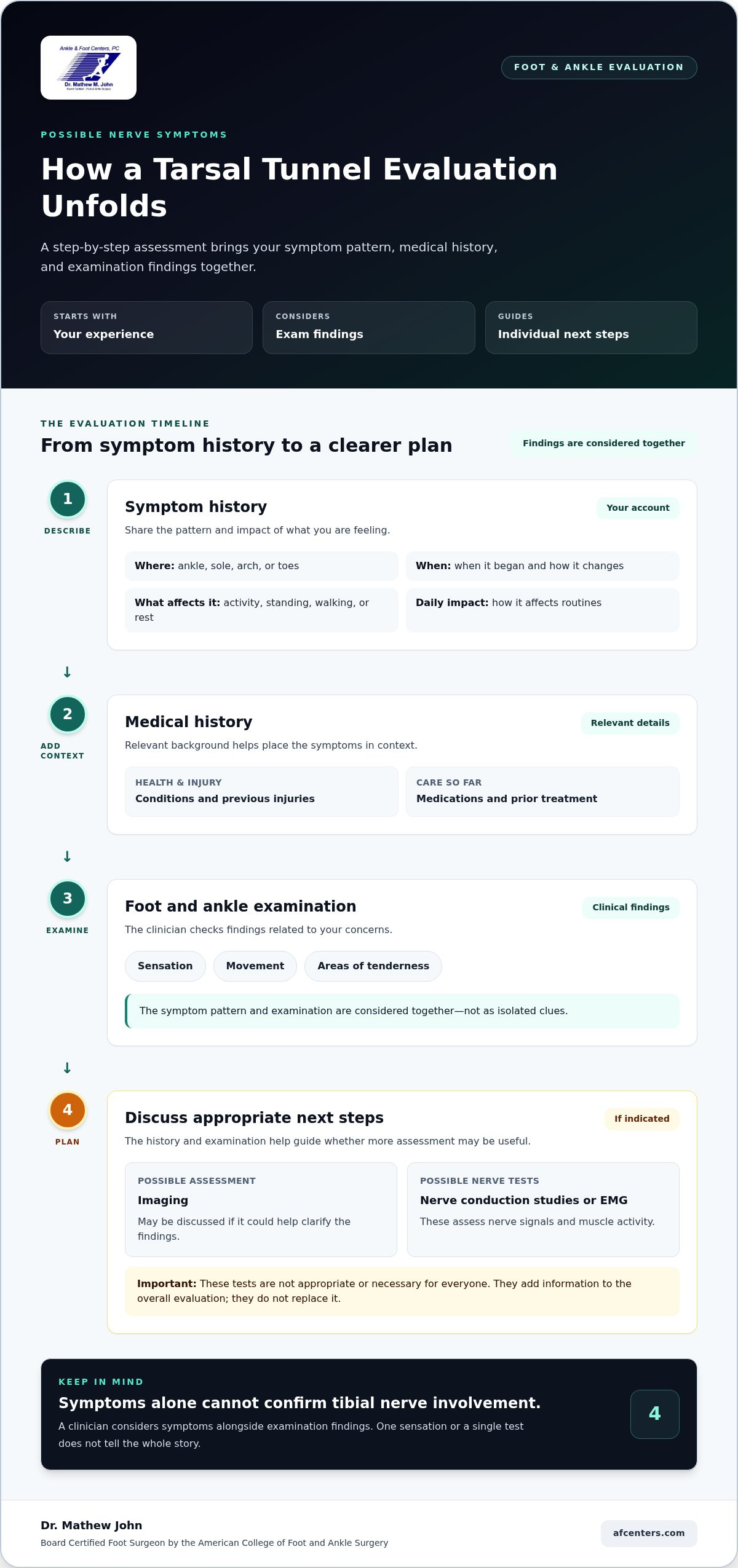
An evaluation is a step-by-step process, not a decision based on one sensation or a single test. Your clinician considers your symptoms, medical history, and findings from a foot and ankle examination. Together, these details guide a discussion about whether further assessment may be useful and which next steps fit your situation.
The tarsal tunnel is a narrow passage near the inner ankle through which the tibial nerve travels before branching into the foot. Irritation or compression in this area may be considered when assessing certain nerve-like symptoms. MedlinePlus’ overview of Tarsal Tunnel Syndrome also describes diagnosis and related symptoms. Symptoms alone can’t establish whether the tibial nerve is involved; they must be considered alongside examination findings.
What should you expect during the first appointment?
Your clinician will ask when symptoms began, where you feel them, how they change with activity, and how they affect daily life. They may discuss your medical history, previous injuries, relevant conditions, and care you’ve already tried. A physical examination focuses on your foot and ankle concerns and may include checking sensation, movement, and areas of tenderness. Imaging may be discussed if it could help clarify the findings, but it isn’t automatically needed for every patient.
How can clinicians assess possible tibial nerve involvement?
A clinician considers the symptom pattern and examination together, rather than treating one finding as definitive. Depending on your history and exam, further assessment might include imaging or nerve tests such as nerve conduction studies or electromyography (EMG). These tests evaluate nerve signals and muscle activity, but they aren’t appropriate or necessary for everyone. Their role is to add information to the overall evaluation, not replace it.
In practical terms, the discussion may move through these steps:
- Symptom history: Describe where sensations occur, when they started, and what affects them.
- Medical history: Share relevant conditions, injuries, medications, and prior care.
- Foot and ankle examination: The clinician checks findings related to your concerns.
- Next-step planning: Discuss whether more assessment is appropriate and what the findings may mean.
For Woodstock residents searching for a tarsal tunnel syndrome specialist Woodstock, a foot and ankle evaluation can help organize these details into a clearer plan. At its Marietta practice, Ankle & Foot Centers, PC evaluates foot and ankle disorders and develops individualized treatment plans for patients from Woodstock and the wider Atlanta Metro area. Explore the practice’s foot and ankle care services to learn about its care for conditions including heel pain and plantar fasciitis.
Choosing a Tarsal Tunnel Syndrome Specialist Near Woodstock
Choosing a clinician for possible nerve-related foot symptoms means looking beyond a title or search result. Consider foot and ankle training, an evaluation that addresses your concerns, and communication that helps you understand the reasoning behind next steps. These factors can help you take part in decisions about your care, without assuming a credential guarantees a particular diagnosis or result.
Which qualifications matter for foot and ankle evaluation?
Foot and ankle training is relevant because symptoms in this area can have different explanations, and assessment involves attention to the structures involved. Dr. Mathew M. John is board certified by the American Board of Foot and Ankle Surgery. Board certification is one part of a clinician’s background, not a promise of an individual outcome. Dr. John completed a three-year residency in the Baltimore/Washington, DC area, served at the National Naval Medical Center, and was Chief Resident.
What should you consider when comparing Woodstock-area care?
As you compare care, consider whether the practice focuses on foot and ankle conditions, explains how your symptoms inform the evaluation, and makes room for questions. A useful conversation should help you understand what the clinician is assessing and why a suggested next step may be relevant to your situation.
This framework can help organize your search:
| What to consider | What to look for | A question to ask |
|---|---|---|
| Qualifications | Foot and ankle specialty training and relevant certification | How does your training relate to foot and ankle concerns? |
| Appointment approach | A discussion of your concerns and an individualized evaluation | How will you assess my symptoms and explain possible next steps? |
| Communication | Clear explanations that leave space for your questions | Can you explain what the findings may mean in everyday language? |
| Location | A practical option serving Woodstock-area patients | Where is the practice located? |
Ankle & Foot Centers, PC is located in Marietta and serves patients from Woodstock and across the Atlanta Metro area. Dr. John’s surgical training and board certification are relevant background for a foot and ankle evaluation. The practice evaluates foot and ankle disorders and develops individualized treatment plans. Explore its foot and ankle services to learn more about the conditions it treats.
If you’re looking for a tarsal tunnel syndrome specialist Woodstock patients can reach in the surrounding area, use these points to guide your choice. Look for a clinician who takes your concerns seriously, explains the assessment clearly, and helps you understand a practical next step.
Preparing for a Tarsal Tunnel Specialist Appointment in Woodstock
A little preparation can help you make good use of your appointment. You don’t need to arrive with a diagnosis or know which test you might need. Clear notes about your symptoms, relevant records, and questions can help your clinician understand your concerns and explain the evaluation.
What information should you bring to the visit?
Gather details that help fill in your foot and ankle health history. A short symptom log can be useful if sensations come and go or change with activity. Note when symptoms occur, where you feel them, how they affect walking or exercise, and whether anything seems to ease or aggravate them. These notes record your experience, but they aren’t a way to diagnose yourself.
- Visit and health details: Bring photo identification, insurance information, a list of medications, and relevant medical history, including prior foot or ankle injuries and care.
- Records: Bring prior imaging reports or other records related to your foot concern, if available.
- Footwear and supports: Bring shoes or orthotics if you think they relate to your symptoms or walking comfort.
- Symptom notes: Write down when sensations began, how often they occur, and what activities or positions seem to affect them.
If you have heel discomfort as well as nerve-like sensations, describe both instead of assuming they share a cause. Heel symptoms can have different explanations, and your clinician can consider the full pattern. Ankle & Foot Centers, PC treats heel pain and plantar fasciitis as part of its broader foot and ankle services.
What questions can help you understand the care plan?
It’s reasonable to ask for clear explanations at each step. Questions can help you understand how the clinician interprets the exam and what proposed next steps are intended to clarify. Consider asking:
- Which findings support your assessment, and what remains uncertain?
- Could another foot or ankle issue explain some of these symptoms?
- What options fit my examination findings and the activities I want to return to?
- Would any additional evaluation be useful, and what would it help determine?
- What should I watch for, and when should we review how things are going?
Bring your questions in writing if that makes them easier to remember. A helpful discussion connects the findings to your concerns and goals, while making space for you to ask for clarification.
If you’re preparing to see a tarsal tunnel syndrome specialist Woodstock patients can reach in the area, use your notes and questions to start an informed conversation. Explore foot and ankle care at Ankle & Foot Centers as you plan your next step.
Tarsal Tunnel Care in Woodstock at Ankle & Foot Centers
If foot sensations affect how you walk or manage daily activities, a focused evaluation can help you understand what may be contributing to them. Ankle & Foot Centers, PC is a foot and ankle practice in Marietta that serves patients from Woodstock and across the Atlanta Metro area. For Woodstock residents seeking professional foot and ankle care, the Marietta practice offers a local option for an evaluation.
Local foot and ankle care serving Woodstock
Dr. Mathew M. He completed a three-year residency in the Baltimore/Washington, DC area, served at the National Naval Medical Center, and was Chief Resident. His specialty training is relevant background for foot and ankle concerns, while your symptoms and clinical findings guide the discussion about care.
Board certification reflects specialty qualifications, but it doesn’t predict a particular diagnosis or result. A careful evaluation begins with listening to what you’ve noticed and considering the full picture, rather than assuming tingling, burning, or discomfort has one cause. That distinction matters when symptoms overlap with other foot and ankle concerns.
Take the next step toward a clearer diagnosis
An initial visit is an opportunity to explain what you’re experiencing, share relevant medical history, and discuss how symptoms affect your routine. The clinician examines your foot and ankle in light of those concerns, then reviews the findings and possible next steps with you. Further assessment may be considered when appropriate. Recommendations depend on your individual history and clinical findings, not a one-size-fits-all approach.
You can make the conversation more useful by describing where sensations occur, when they tend to appear, and what activities affect them. Bring relevant records or a list of questions if you have them. Ask the clinician to explain an unfamiliar term or why a particular option may fit the findings. Understanding the reasoning can help you take part in decisions about your care.
If you’re searching for a tarsal tunnel syndrome specialist Woodstock patients can reach in the surrounding area, Ankle & Foot Centers, PC provides foot and ankle evaluations and individualized treatment planning. Recommendations are shaped by the assessment, so no particular diagnosis or treatment outcome should be assumed beforehand.
For a practical next step, contact Ankle & Foot Centers, PC to arrange an evaluation. Share what you’ve been experiencing and begin a conversation focused on your foot and ankle health.
Take a Thoughtful Next Step for Your Foot Health
Unexplained foot sensations can leave you second-guessing each step. You don’t have to work out the cause on your own. A professional conversation gives you a chance to describe what you’ve noticed, understand what an evaluation may involve, and discuss next steps based on your needs.
If you’re looking for a tarsal tunnel syndrome specialist Woodstock patients can reach nearby, Ankle & Foot Centers, PC offers foot and ankle evaluations in Marietta. Dr. Mathew M. John’s board certification and residency training, including his role as Chief Resident, inform his work in foot and ankle care. An evaluation can guide an individualized discussion without assuming a diagnosis or outcome in advance.
Ankle & Foot Centers, PC serves patients in Woodstock, Marietta, Roswell, Kennesaw, Atlanta, and Sandy Springs. Contact Ankle & Foot Centers to discuss a foot and ankle evaluation and take a clear next step for your foot health.
Frequently Asked Questions
Can tarsal tunnel syndrome affect both feet?
Yes, it can affect both feet, though symptoms may be present on only one side. If you notice similar tingling or burning in each foot, mention that pattern during an evaluation rather than assuming both sides have the same cause. Note whether symptoms start together, follow different activities, or feel more intense on one side. A clinician can assess each foot and consider your overall health history.
Can tarsal tunnel syndrome be confused with plantar fasciitis?
Yes. Both conditions can involve discomfort around the sole or heel, so the location of pain alone may not distinguish them. Burning, tingling, or numbness can suggest nerve involvement, while plantar fasciitis is associated with heel pain, but symptoms can vary and overlap. Describe the quality of the sensation, where it travels, and when it occurs. A foot and ankle evaluation can help assess possible explanations.
Does an X-ray show tarsal tunnel syndrome?
No. An X-ray doesn’t directly show irritation or compression of the tibial nerve. It may help a clinician assess bones or identify structural findings that could be relevant to your symptoms. Whether an X-ray or another kind of imaging is useful depends on your history and examination. Ask what a suggested test is intended to clarify and how its findings would fit with the rest of the evaluation.
Can tarsal tunnel symptoms come and go?
Yes, symptoms may fluctuate. You might notice sensations during a particular activity or after spending time on your feet, then feel less discomfort later. A symptom-free stretch doesn’t establish the cause or rule out a foot or ankle concern. Note when symptoms appear, what you were doing, and how long they last. This pattern can give your clinician helpful context, especially if the sensations are difficult to describe during an appointment.
Is surgery always needed for tarsal tunnel syndrome?
No, surgery isn’t automatically needed. The appropriate approach depends on the evaluation, what may be contributing to symptoms, and how the issue affects you. A clinician can discuss options in light of your findings and goals. If surgery is raised, ask what it is intended to address, what alternatives may suit your situation, and how the decision would be made. A diagnosis alone doesn’t determine that surgery is necessary.
Should you keep exercising with possible tarsal tunnel symptoms?
Don’t push through activity that clearly worsens pain, numbness, or tingling. Consider easing or modifying the activity that brings symptoms on while you arrange an assessment, and note which movements or footwear seem to affect your comfort. You don’t need to make a long-term exercise decision on your own. A clinician can discuss activity choices in relation to your symptoms and examination findings.
When should foot numbness or tingling be evaluated?
Arrange an evaluation if numbness or tingling persists, returns repeatedly, worsens, or interferes with walking or daily activities. Seek timely foot and ankle assessment if it occurs with weakness, swelling, difficulty bearing weight, or a change in foot appearance. These symptoms can have different causes, so they can’t identify tarsal tunnel syndrome by themselves. Woodstock-area patients searching for a tarsal tunnel syndrome specialist Woodstock can use a focused evaluation to discuss their concerns.


