

What if pain on the top of your foot isn’t simply a shoe problem or something to walk off? If discomfort is making it harder to work, exercise, or manage daily activities, a top of foot pain specialist Roswell residents can see can help assess what’s behind it. The cause may involve a tendon, bone, joint, or nerve, and similar symptoms can call for different care.
You deserve clear guidance when the cause is uncertain or the pain is getting worse. This article explains possible causes of top-of-foot pain, signs that it’s time for a professional evaluation, and what a foot and ankle specialist may ask about and examine. Persistent pain, swelling, difficulty bearing weight, or concern about a fracture are reasons to seek assessment rather than guess at the cause.
Ankle & Foot Centers, PC provides foot and ankle care from its Marietta practice for patients in Roswell and across the Atlanta Metro area. Dr. Mathew M. John, DPM, is board certified by the American Board of Foot and Ankle Surgery. An evaluation can help connect your symptoms and examination findings to appropriate next steps.
Key Takeaways
- Pain on the top of your foot can have several possible causes. The location alone can’t identify which one applies to you.
- Notice whether pain worsens with activity, stays in one focused spot, or comes with swelling or stiffness. These details can help guide a specialist’s evaluation.
- Persistent pain, swelling, or difficulty bearing weight are reasons to seek professional assessment rather than guess at the cause.
- A top of foot pain specialist Roswell patients can see may review your symptoms and medical history, examine your foot, and discuss next steps based on individual findings.
- Treatment depends on the cause and may include footwear changes, custom orthotics, or other options selected after evaluation.
Top-of-Foot Pain Near Roswell: When Should You See a Specialist?
Pain across the top of your foot can make a walk, workout, work shift, or ordinary trip across the room uncomfortable. A brief ache after unusual activity may settle, but pain that lingers, returns, or interferes with your routine deserves attention. If you’re looking for a top of foot pain specialist Roswell residents can turn to, start by noticing how the symptoms affect you and whether they’re changing.
The location is useful information, but it can’t identify the cause on its own. Tendons, bones, joints, and nerves sit close together, and different problems can feel similar. An evaluation helps put your symptoms in context rather than relying on a guess.
Which symptoms make an evaluation more important?
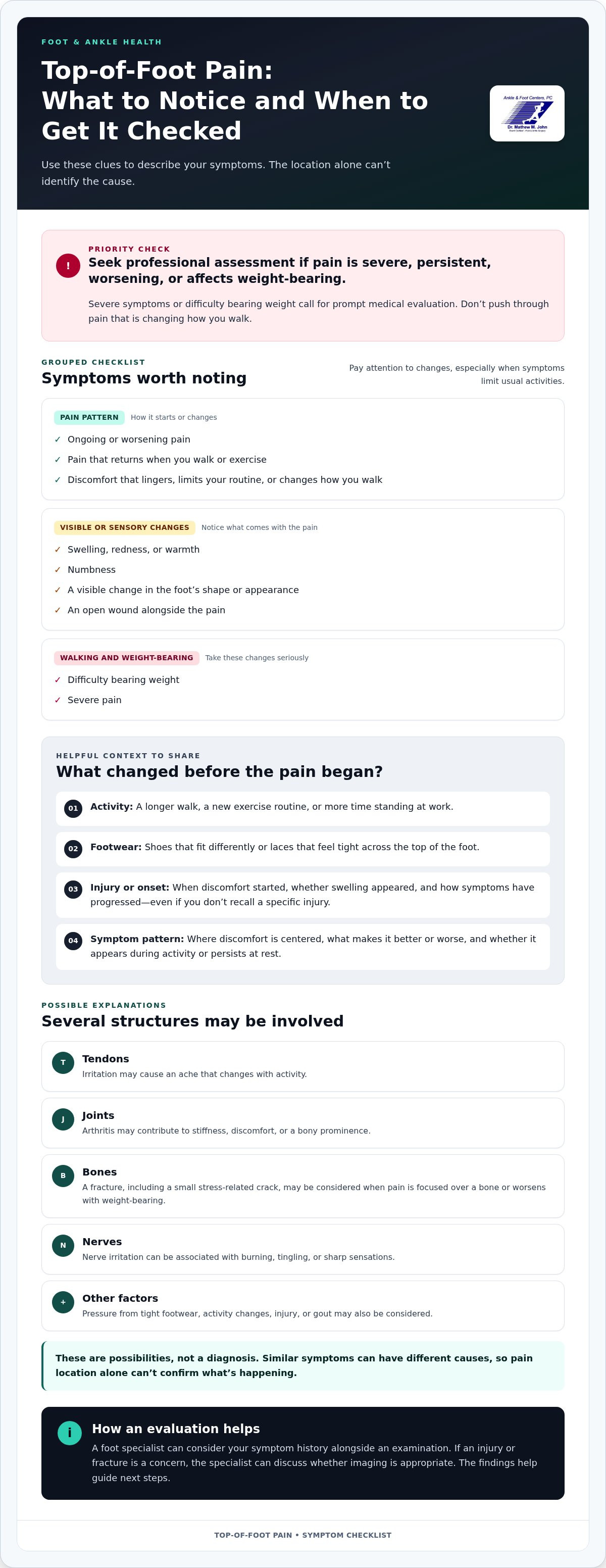
Mild discomfort that improves quickly may not call for the same response as pain that persists or steadily worsens. Pay attention to changes, especially if symptoms limit walking or other usual activities. Arrange a professional evaluation if you notice:
- Ongoing or worsening pain, or pain that returns when you walk or exercise
- Swelling, redness, warmth, or numbness
- A visible change in the foot’s shape or appearance
- An open wound alongside the pain
- Difficulty bearing weight or severe pain
Severe symptoms or an inability to bear weight call for prompt medical evaluation. Don’t push through pain that is changing how you walk. It can make it harder to judge what’s happening and may place extra strain on the foot.
Seek professional assessment when top-of-foot pain is severe, persistent, worsening, or affecting your ability to bear weight.
Why pain location is a useful starting point, not a diagnosis
The foot contains many connected structures. A basic overview of the anatomy of the foot helps show why a sore area can have more than one possible source. Pressure from tight footwear, overuse, an injury, tendon irritation, arthritis, or a fracture may be considered, but symptoms can overlap. An online description can offer general context, not determine which explanation fits your symptoms.
Notice where discomfort is centered and what changes it: whether it appears during activity, persists at rest, or comes with swelling or altered sensation. Share these observations with a foot specialist rather than treating them as proof of a particular condition. Pain centered at the heel is a different concern, and heel-pain advice shouldn’t substitute for evaluating pain on the top of your foot.
What Can Cause Pain on the Top of Your Foot?
Several structures share the top of the foot, so discomfort in this area can have more than one possible explanation. Tight laces or footwear may press on sensitive tissue. A change in walking or exercise, an injury, tendon irritation, joint arthritis, or a fracture may also be considered. These are possibilities, not a diagnosis. Overlapping symptoms make it difficult to identify the cause from location alone.
How activity, footwear, and injury may contribute
Think about what changed before the pain began. A longer walk, a new exercise routine, more time standing at work, or shoes that fit differently can add pressure or load to the foot. Laces that feel tight across the top may also be relevant. These details help a specialist understand the context, but pain during movement by itself doesn’t prove that overuse or a particular injury is responsible.
Not every injury has an obvious moment. You may not recall twisting your foot or striking it, yet symptoms can still follow a change in activity or develop gradually. Note when the discomfort started, what makes it better or worse, whether swelling appeared, and how symptoms have progressed. Share any concern about an injury during an evaluation, even if you’re unsure how it happened.
When tendon, joint, or bone problems may be considered
Tendons that help move the foot and toes can become irritated, sometimes causing an ache that changes with activity. Arthritis affects joints and may contribute to stiffness, discomfort, or a bony prominence. A fracture, including a small stress-related crack, may be considered when pain is focused over a bone or worsens with weight-bearing. These patterns can offer useful clues, but they can’t confirm a condition on their own.
Other causes may also enter the discussion. Nerve irritation can be associated with burning, tingling, or sharp sensations. Gout may cause foot pain as well; the Arthritis Foundation provides background on gout and foot pain. Neither a symptom description nor an online comparison can establish whether these explanations fit your situation.
Because different conditions can cause similar top-of-foot pain, a focused examination matters before deciding what care may be appropriate. A foot specialist can consider your history and symptoms alongside an examination. If an injury or fracture is a concern, the specialist can discuss whether imaging is appropriate. A top of foot pain specialist Roswell patients visit can use these details to guide next steps based on individual findings.
If pain persists or limits your usual activities, consider a professional foot and ankle evaluation. Explore foot and ankle care services to learn more about evaluation and treatment options.
How a Foot Specialist Evaluates Top-of-Foot Pain
A focused evaluation connects what you’re feeling with what an examination reveals. A top of foot pain specialist Roswell patients visit will generally review your symptoms and health history, examine your foot and ankle, and discuss possible next steps. The goal is to understand your individual findings, not assume one cause or treatment based on pain location alone.
- Symptom history: You’ll describe when the pain began, where it’s centered, how it feels, and whether it’s changing. Mention activities that aggravate it, such as walking, exercise, or standing at work.
- Health history: The specialist may ask about relevant health conditions, medications, previous foot or ankle problems, and treatments you’ve tried.
- Physical examination: The foot and ankle may be checked for tenderness, swelling, movement, function, and your ability to bear weight.
- Next steps: The specialist discusses what your history and examination suggest, whether further assessment may be useful, and care options suited to your findings.
What to share about your symptoms and health history
Clear details make the conversation more useful. Explain whether symptoms started suddenly or gradually, whether they’re getting better or worse, and what you were doing around the time they began. Share any injury, even if it seemed minor or you’re unsure it caused the pain. Prior imaging or shoes you suspect may be contributing can also be useful to bring.
You don’t need to arrive with a diagnosis. Focus on what you’ve noticed and what has changed. A note about when discomfort appears, how it affects your usual activities, and what you’ve tried can help you describe the pattern clearly.
What the examination and possible imaging can clarify
During a focused foot and ankle examination, the specialist may look for swelling or changes in appearance, check areas of tenderness, and assess movement and function. Depending on your symptoms, you may be asked about or assessed for your ability to stand or bear weight. These observations provide context alongside your history.
Imaging isn’t automatic. If your history or examination raises concern about an injury or structural issue, the specialist may discuss whether imaging is appropriate. The findings help guide a discussion of next steps; they don’t guarantee a particular treatment or outcome.
Come ready to ask questions and share what matters to your routine, whether that’s walking comfortably, staying active, or managing work demands. Ankle & Foot Centers, PC evaluates and treats foot and ankle concerns, with care decisions guided by your symptoms and individual findings. Explore the practice’s foot and ankle services to learn more.
Treatment for Top-of-Foot Pain Depends on the Cause
There isn’t one treatment plan for every sore spot across the top of the foot. A foot specialist considers examination findings, your health history, the nature of your symptoms, and the activities you need to manage. For example, a plan for irritation linked to shoe pressure may differ from care discussed for a suspected injury or joint problem. The aim is to match options to the findings, not treat the symptom location in isolation.
Non-surgical care may be part of an individualized plan
Depending on the assessment, non-surgical options may be discussed. The comparison below outlines approaches a specialist may consider and the concerns they may address. It isn’t a personal treatment recommendation; the appropriate choices depend on your evaluation.
| Approach | When it may be discussed | What it aims to address |
|---|---|---|
| Footwear adjustments | When shoe fit, pressure, or lacing may be contributing | Reducing pressure across the top of the foot |
| Medication | When symptom relief is considered appropriate in light of your health history | Pain or inflammation, depending on the medication and cause |
| Immobilization | When limiting foot movement or protecting an area is part of the care discussion | Reducing movement or load on an affected area |
| Physical therapy | When guided movement or exercise is considered suitable | Supporting mobility, strength, or function |
| Custom orthotics | When an evaluation suggests supportive inserts may suit the condition | Providing customized support within the shoe |
| Injections | When a specialist considers them appropriate for the identified problem | Addressing symptoms in a specific area |
These options aren’t interchangeable. Medication choices can depend on your health history and other medicines, while immobilization or physical therapy may be considered for different reasons. Custom orthotics may be discussed for certain conditions after evaluation. Severe or worsening symptoms shouldn’t be managed with footwear changes or home measures alone; seek professional assessment to clarify what’s going on.
When procedures or surgery may be discussed
If an assessment identifies a condition that may call for a procedure, the specialist can explain why it’s being considered and how it relates to other care options. Reconstructive foot and ankle surgery may be discussed when clinically appropriate. Whether a procedure is suitable depends on the diagnosis, examination findings, health history, and response to other care. An evaluation can guide that conversation, but it can’t promise a particular treatment or result.
A top of foot pain specialist Roswell patients see can help connect the evaluation to a care plan that reflects their individual findings and daily needs. Ankle & Foot Centers, PC provides foot and ankle evaluation and treatment, including custom orthotics and reconstructive foot and ankle surgery when appropriate.
Finding Top-of-Foot Pain Care Near Roswell
Choosing a clear next step doesn’t require you to know what’s causing the discomfort. Begin with a simple account of how it affects your day: perhaps you’re changing how you walk, cutting back on exercise, or finding work tasks uncomfortable. A focused conversation with a foot and ankle specialist can help you discuss your concerns and consider what assessment may be useful.
What to expect when seeking care from Roswell
Bring questions that matter to your daily life. You might ask what the examination findings could mean, whether further assessment is appropriate, and how any recommended care relates to the activities you want to resume. Sharing what you’ve already tried and what you hope to make easier can keep the discussion focused on your needs.
Ankle & Foot Centers, PC provides foot and ankle care tailored to individual symptoms and findings. A visit gives you the opportunity to understand the reasoning behind the next steps and discuss concerns before making decisions about care.
Choose a clear next step for persistent or worsening pain
If pain continues, gets worse, or interferes with your usual activities, consider arranging an evaluation rather than managing the uncertainty alone. Beforehand, note any changes you’ve made to walking, exercise, or work because of the discomfort. A short list of questions can also help you make the most of the conversation.
You don’t need to arrive with a diagnosis or a perfect account of every symptom. Start with what you’ve noticed and what you want help understanding. The specialist can use your concerns and individual findings to guide a discussion of appropriate next steps.
Ankle & Foot Centers, PC serves patients in Roswell and nearby Marietta, Woodstock, Kennesaw, Atlanta, and Sandy Springs.
Take the Next Step Toward Comfortable Movement
Foot pain can make it tempting to change your routine around the discomfort and hope it settles. A more useful next step is to make a plan based on what your foot is telling you. If pain continues to interfere with walking, work, or exercise, an evaluation can help you discuss your concerns and consider care that fits your individual findings.
Choosing a top of foot pain specialist Roswell patients can access gives you a place to start that conversation with a foot and ankle professional. You don’t need to know the cause before seeking guidance. Bring your questions, describe the changes you’ve noticed, and take the process one step at a time.
When you’re ready, schedule an evaluation with Ankle & Foot Centers, PC.
Frequently Asked Questions
Can pain on the top of my foot be a sign of a fracture?
Yes, a fracture is one possible cause, including a small stress-related crack that can develop with repeated force. Pain focused over a bone, swelling, or discomfort when bearing weight may be useful details to share, but symptoms alone can’t confirm a fracture. A foot specialist can examine the area and discuss whether imaging is appropriate. If you can’t bear weight or have severe pain, seek prompt medical evaluation.
When should I see a foot specialist for pain on top of my foot?
Arrange an evaluation if the pain persists, worsens, keeps returning, or makes walking and daily activities difficult. Swelling, redness, warmth, numbness, an open wound, or a visible change in your foot are also reasons to seek care. Severe symptoms or inability to bear weight call for prompt medical evaluation. If you’re looking for a top of foot pain specialist Roswell patients can access, describe how the pain affects your routine.
What happens during a top-of-foot pain evaluation?
A specialist will ask how the pain began and how it affects your activities, review relevant health information, and examine your foot and ankle. Mention whether discomfort changes when you climb stairs, walk in certain shoes, or stand for work. The specialist may check tender areas and assess movement and function. After reviewing the findings, you can discuss possible next steps together.
Can tight shoes cause pain on the top of the foot?
Yes, footwear that presses across the top of your foot or laces pulled too tightly may contribute to discomfort. Notice whether symptoms change with a particular pair of shoes or after adjusting the lacing, and share that observation during an evaluation. Shoe pressure is only one possible factor. Pain that continues after changing footwear, worsens, or comes with swelling or numbness deserves professional assessment rather than an assumption about the cause.
Does top-of-foot pain always need imaging?
No. Imaging isn’t automatically needed for every case of pain on the top of the foot. A specialist considers your symptoms and examination findings, then may discuss imaging if there’s a reason to assess a suspected injury or structural concern. You can ask what the imaging is intended to clarify and how the result would inform next steps. The decision is based on your individual assessment, not simply the location of pain.
What should I bring to my first foot specialist appointment?
Bring photo identification, insurance information, a list of medications, and notes about relevant medical history. If you have prior imaging, bring the available records or images. Shoes or orthotics you wear often may also help explain where pressure or discomfort occurs. You don’t need to know what’s causing the pain; a clear account of when it started, what affects it, and what you’ve already tried is a useful place to begin.
Can I see a podiatrist near Roswell without a referral?
Referral requirements can depend on your insurance plan. Many plans allow direct access to a podiatrist, while some HMO plans require a referral from a primary care provider. Ankle & Foot Centers, PC is based in Marietta and serves patients from Roswell and the Atlanta Metro area. The practice evaluates foot and ankle concerns, including top-of-foot pain.


